
 sea anemones
Anthopleura spp.
more information
As a kid, whenever we'd go to the beach, my mother would repeatedly warn me to never step on sea anemones, because she believed they would sting. Now, I don't step on them for fear I could crush these seemingly delicate animals. I learned through the links included in this post that both ideas, stings to humans and being delicate, are incorrect.
I should note not all sea anemones are in the Anthopleura genus. The two species I have identified below just happen to be in the same genus.
I should note not all sea anemones are in the Anthopleura genus. The two species I have identified below just happen to be in the same genus.

 aggregating anemone
Anthopleura elegantissimamore pictures
The aggregating anemone is known to clone itself, hence why they're often found in dense clusters. The Walla Walla site linked in the scientific name above shows some incredible pictures of the dividing process. Some anemones also have green algae (zoochlorellae) or dinoflagellates (zooxanthellae) living symbiotically in their gut lining (but maybe not these ones?). The Monterey Bay Aquarium site has fun information on the aggregating anemone, but it states "Anthropleura" with an extra 'r', which is incorrect. Anthropleura was an ancient giant centipede.

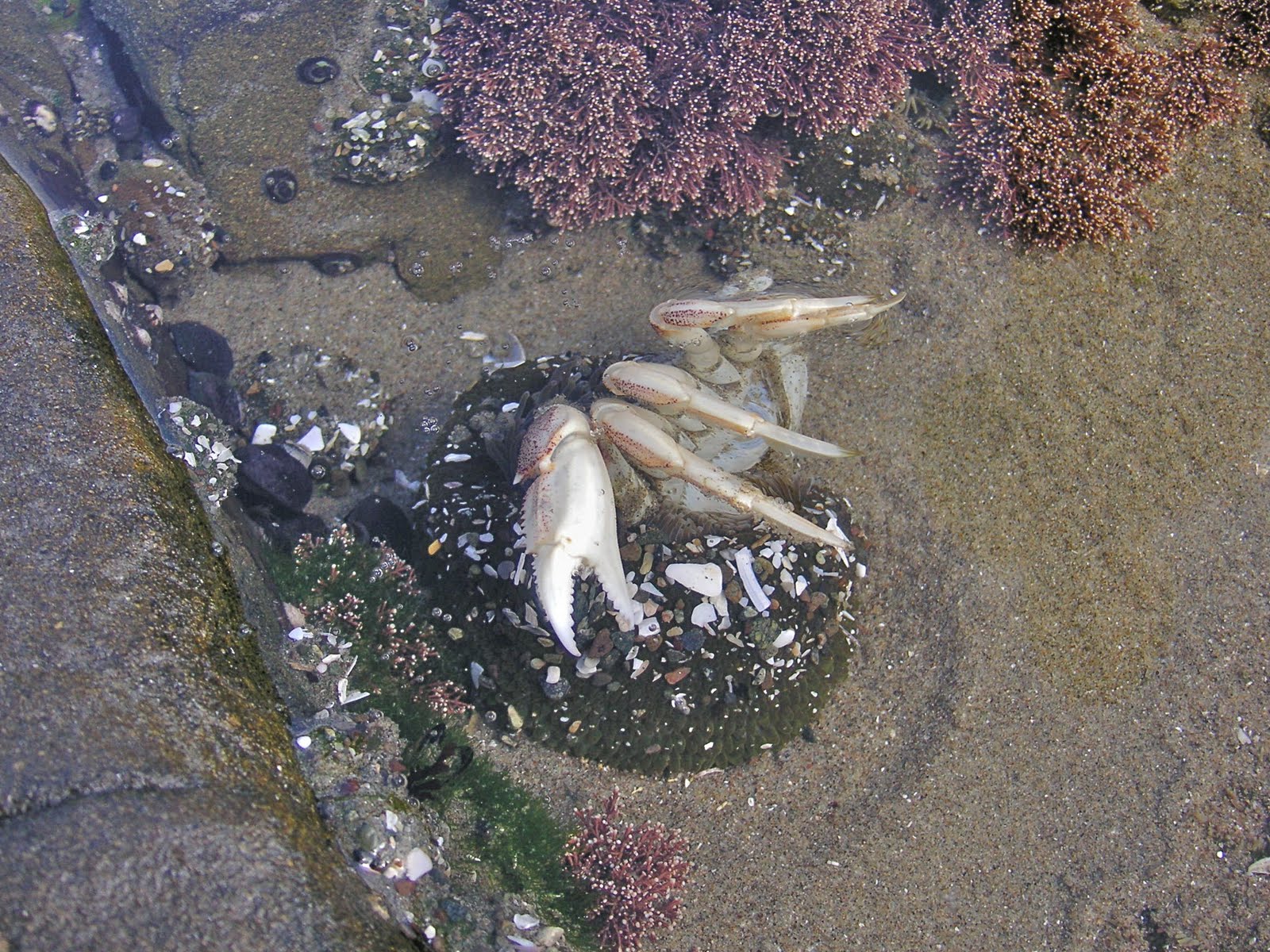 sunburst anemone / solitary green anemone / starburst anemone (scroll down for pics)
Anthopleura sola
more information
I was lucky enough to get a decent picture of this anemone slightly open to see the lines on the oral disk for a positive ID.
Two additional similar looking species found in our area are the moonglow anemone, aka burrowing anemone (Anthopleura artemisia), and the giant green anemone, aka solitary green anemone (Anthopleura xanthogrammica) - which I believe is shown in the first photograph above, but there is no way for me to know for sure.
For much better photographs of anemones and other tide pool life, check out John Wall's Natural California. It's extremely difficult to get decent pictures through moving water. Most of my attempted shots ended up being lovely reflections of the clouds above.
Two additional similar looking species found in our area are the moonglow anemone, aka burrowing anemone (Anthopleura artemisia), and the giant green anemone, aka solitary green anemone (Anthopleura xanthogrammica) - which I believe is shown in the first photograph above, but there is no way for me to know for sure.
For much better photographs of anemones and other tide pool life, check out John Wall's Natural California. It's extremely difficult to get decent pictures through moving water. Most of my attempted shots ended up being lovely reflections of the clouds above.
