Showing posts with label * expert ID. Show all posts

Friday, July 25, 2014

ox-eyed satyr ~ 07/25/14 ~ Sierra Valley

female ox-eyed satyr nectaring on Canada thistle
Asteraceae

Like so many of Art's Sierra Nevada butterflies, I would have never gotten this ID without his patient help.  This ox-eyed satyr is one of at least 25 subspecies of the common wood-nymph!  Here I am just trying to figure out the difference between the common and the Great Basin wood-nymph (Cercyonis sthenele).  Gah!  Additional posts to come...

Thursday, July 17, 2014

acmon blue on seacliff buckwheat ~ 07/17/14 ~ Podere di Farfalla

mating acmon (male left, browner female right) on seacliff buckwheat
mating Icaricia acmon (aka Plebejus acmon) on Eriogonum parvifolium (var. parvifolium)
Polygonaceae

Having both acmon blue sexes in the same photograph is very helpful, because I've had some difficulty distinguishing between them on their own, since lighting and wing angle can be so variable and deceptive.  Ya, I know, I've been told repeatedly, "Get a photograph of the topside (dorsal), then it's easy to tell them apart."  Ha!  As if it were that easy!  I'm thrilled whenever I can get any photograph at all that's not a total fuzzy blob.  Seriously.  And, after seeing numerous butterflies in a day, I never can remember if the topside of butterfly #34 was blue or brown while it flew away.  Maybe other people have an easier time of it?  This is only my second photo of mating butterflies that I've managed to get all year.  The first were Edith's checkerspots back in May at Pinnacles.  As with the Melissa blues, the female acmon blues have a browner ground color on the underside (ventral).

I'm noting the plant they're perched on while they do their thing, but that may not mean much.  While I do have other photographs of worn female acmons nectaring on seacliff buckwheat, I don't have any photographs of egg-laying on this plant.  It cannot be assumed seacliff buckwheat is the larval host plant of these acmons.  I didn't notice any other buckwheats or lotuses in bloom in the area, which also may not mean much.  In any case, I thought this would be a good time to showcase this lovely local buckwheat...

tight pom-pom shaped multi-colored mature pink blooms

narrow arrow-shaped leaves, cobweb top and felty bottom

seacliff buckwheat from a distance
(it apparently likes "cliffs" with a marine influence)

another pair of mating acmon blues on a drier seacliff buckwheat flower head
(browner female left, male right)

ps 11/21/14 - Jim Reveal confirmed this ID, and if he recognized varieties, he'd call this var. parvifolium.

Wednesday, July 2, 2014

crab spider ~ 07/02/14 ~ Donner Pass


posted 09/28/14 - If I were to hazard a guess as to the type of crab spider, I'd say it's a flower crab spider (Misumena), more specifically the goldenrod crab spider (Misumena vatia).  Another possibility could be the whitebanded crab spider (Misumenoides formosipes).  However, I'm guessing it's near impossible to tell from my photo, even if I knew what diagnostics to look for.  Eh, I'm not too fussed about the spider ID.  I'm guessing there are more spiders on flowers than I ever notice, because good nectar sources are essentially ready-made butterfly buffets, bee buffets, you name it, for hungry spiders.  Seriously, crab spiders are extraordinarily good at camouflage.  Art thought the Montana here is most likely a female.  Ya.  Hey, I'll take whatever photos I can get.  This is one of my better ones.

ps  - I found Ed Nieuwenhuys' Australian crab spider page to be fantastic.

Tuesday, June 10, 2014

mountain mahogany hairstreak ~ 06/10/14 ~ Pinnacles


I asked Paul J. his ID of this individual, because I've never knowingly seen a mountain mahogany hairstreak before.  Although, I did note in the Pinnacles Count about seeing a hairstreak with a blue tail end (just like this one!) and was hoping my count partner from the Sequoias had gotten a picture.  Tiny, dark, zippy shadows.  The iridescent sheen looks so much like the hedgerow hairstreak I photographed only 2 days before that I can easily see getting them mixed up on the wing from a distance.  Up-close and depending on the lighting, it's darker than the hedgerow, without the bright copper color, and has an overall blue cast to the underside wings.  Other people note the white flecks in the wings and the pointier forewing tip compared to the hedgerow.  I have a hard time seeing other people's descriptions of shapes, so that doesn't work very well for me.  With the relative lack of tails, this is apparently a boy

ps 08/05/14 - Art also pointed out many male hairstreaks have a stigma on the forewing that shows through as a relief.  It's absent in females.

Thursday, May 29, 2014

grunion greeting, 2014 #3

prejuvenile spotted cusk-eel

While we were out on the nighttime beach looking for grunion, it quickly became all about the cusk-eel for J and me.  Armed with a flashlight under the complete darkness of the clear skies and new moon, we eventually found 4 or 5 after waves washed out (we had different counts, and we didn't even need a 2nd hand to count - ha!).  They seemed a bit lethargic, kind of like the grunion I observed on May 15 (Something weird is going on, because even in SoCal the grunion are inexplicably beaching themselves and not in a good way.)  One cusk-eel we found wiggled its entire body down, tail first, not too dissimilar to what a grunion does when she lays eggs, except the cusk-eel completely disappeared into the sand.  We also noticed numerous mini-craters that noisily bubbled water as the waves receded.  J kept saying, "It totally sounds like a spa!"  Ya, the waves were relatively calm this night for us to hear the bubbling.  We're wondering if all the cratered holes were created by the freshly dug cusk-eels?  There were also a handful of cancer crabs and sand crabs digging down in the sand, but nothing thin enough to make a drill-like hole.

It's thanks to Dr. Guacamole (that's not his real name, btw) for alerting me to the fact my crappy photo "eel" from July 9, 2013 was a cusk-eel, but all I could recall to tell J this night was that it wasn't a real eel and was actually a fish.  Dr. Martin also chimed in and eventually I was able to get "retired" CDFW Bob Lea's expert ID down to species.  He cowrote the technical report Checklist of Fishes Known to Occur in Monterey Bay National Marine Sanctuary with Erica Burton last year.  And thankfully, considering I'm bugging some very busy people with my ID questions, they were glad to get my observations and photos.  I'm guessing not a lot of people report cusk-eel sightings.  This is only the second time I've ever seen them in all my grunion nights.  I've seen grunion more times than cusk-eels, and that might be saying something. 

I found the burrowing tail first to be fascinating, especially in the exact same spot we've seen the grunion lay eggs.  What makes this beach so great for these sand-loving fish?  The extremely calm waters and fine sand?  With Bob's permission, this is what he said about my photo above, "The cusk-eel is a prejuvenile Spotted Cusk-eel, Chilara taylori.  At this size the spots have not yet developed; I am guessing the fish in photo is ca. 5 to 6 inches in length.  Cusk-eels enter the substrate tail first and their caudal structure is modified, fusion of bony elements, enabling them to do this.  There have been several papers discussing tail-standing and burrowing in cusk-eels and I can send you the references if you are interested.  Chilara taylori was originally described from the beach at Monterey in 1858.  We encountered prejuvenile fish last year (July or August) solving a puzzle that I did not know the answer to until then.  Also, the prejuvenile stage is nektonic and the fish you saw are in the transition process of changing from a pelagic to benthic existence.  Good to get your observation."  Man, it's been forever since I've seen someone use "ca." - no offense to Bob.  Fortunately, after having watched Bob measure grunion last year, I thought to throw down my lined-note pad next to the cusk-eel for a photo and then later the lined-note pad with a ruler to get an accurate read of size (I don't take my favorite ruler out for fear of losing it in the waves).  So, I sent a second set of photos.  The one shown above is only ~3 3/4" long, which turns out to be in the typical 70 to 100mm range.  Bob collected 20 specimens last year, and they're now housed at CalAcademy (CAS 236552).  I wonder how long they live?  Holes and infrequent sightings make me think of periodical cicadas which develop en masse every 13 or 17 years.

I should mention that I had a very difficult time finding an ID match online a couple weeks back when I was updating my July 9, 2013 post, but that's not surprising for marine life.  Little did I know the cusk-eels I've seen aren't the fully spotted adults yet.  Ha!  There are several SCUBA divers' community groups that share wonderful photos of marine animals.  Makes me wonder if any of them have ever seen grunion, because so little is known about their behavior off the sand and in the water.


I'm always entertained by Charlie.  Over the course of half an hour 3 Charlies showed up and were unusually friendly with us as we stood at the water line with them.  I think they snatched up a couple tiny cusk-eels.

(CDFW)

Eh, we only saw 2 waves of 6 grunion each (whippee) not too far from the cement structure down the beach.  I reported it as a W-1, because Dr. Martin instructed me that any sighting at all is significant for the Monterey Bay.  It was a mellow night, good to be out with J, and always fun to find new things.  Oh!  We also quickly stopped at San Carlos Beach on our way home.  No grunion there.

05/28/14 full moon 11:43am
05/29/14 high tide 11:18pm 5.52 ft
beaches: Municipal, San Carlos
Charlies: 3 + 3 western gulls
others: J, Steve the Fisherman (yes, he was there - I should recruit him!)
my observation time: 10:27pm - 12:10pm
W-1, 2 sets of 6 (same individuals?) near cement structure down beach 11:33-11:38pm.

Tuesday, May 27, 2014

variable checkerspot ~ 05/27/14 ~ Pinnacles

variable checkerspot / chalcedon checkerspot
(Shapiro and Tenney)

I'm determined to learn the local butterflies like the back of my hand, but distinguishing look-alike spp. can sometimes trip me up.  Identifying photos is very different than identifying them on the wing, and I want to improve my skills for both methods.  Several have argued with me that it is impossible to tell sp. based only on a photo.  Hogwash.  I'll admit, I want to disprove the detractors, but I could end up being completely wrong.  It certainly helps as I do this exercise that I have the added benefit of having watched the live butterfly and am focusing primarily on one location through the season.

I'm of the belief that it simply takes a differently trained eye to ID photos compared to the traditional examination of a series of pinned and spread specimens.  Emphasis on trained.  I've noticed the classic lepidopterists will most likely describe the topside view of the butterfly as they're most predominantly pinned and spread, compared to what's actually seen out in the wild.  I tend to capture pictures of the underside with the wings held up above the body.  So, guess which side needs to get the description for diagnostics as we transition from specimen identification to photo identification?  

From what I can tell from my photos, both variable above and Edith's look like the underside forewing's 3rd-4th row from the margin have 2 distinct patterns.  I would have thought the two above might be sexually dimorphic with the female facing left, but it can't be.  You know why?  The going assumption is that only male butterflies mud-puddle.  Seriously.  FYI, the only females in our area that are known to mud-puddle are CA sister.  So, we presumably have two males above.  Check.

I have to say, I really want the 2nd photo facing left and the redder of the two to be Edith's.  Red flash = red underside FW.  Nope.  Glassberg says in his west binoc book that Edith's "always lack white, off-center abdominal spots that variable checkerspots sometimes have."  Indeed, there are obvious off-center abdominal spots evident in both pictures.  Just to make sure the local ssp. of Edith's might not break that rule, I double-checked with Art and Paul J.  They both confirm that they believe the two individuals shown above are E. chalcedona, not E. editha, primarily by overall gut feeling.  Paul says, "Around here, variable always* has those spots, and Edith's always has orange rings.  *Always = unless the individual is very worn and the spots/rings are gone.  Remember, these comments apply to the top half of the abdomen."  Art also uses the all-orange antennal bulbs as indicators of variable like I do.  I've noticed shading is often present, and sometimes it's a judgment call if they're considered black like in Edith's.  Also, note the white stripes on orange antennal stems, not white stripes on black antennal stems like in Edith's.

Really, out in the field, there's a third way to describe what's seen as the butterfly is in flight.  Flashes of color will often present themselves that are not obvious from a still photo of either the top or bottom sides.  Variable at Pinnacles flash black and lemon yellow to me.  Edith's flash reddish-orange checks.  Sigh, I know this seems like a lot, but I want to make sure I have my basics down pat.

Friday, May 23, 2014

coast horned lizard ~ 05/23/14 ~ Pinnacles


Apparently, this cool lizard is now supposed to be called Blainville's horned lizard?  Sigh.  I can't keep up with all the name changes, scientific or common.  Eh, that's not the point of this post, anyways, even though I have seen a few impressively large horned lizards during my many recent activities.

Paul has suggested I try iNaturalist as a way to document and share what I find during my weekly Pinnacles visits.  I haven't decided yet, because I have questions about macro photo quality and GPS capability in a smart phone where there's no cell service.  Click here to see Paul's photo of this same horned lizard using his iPhone 5 (don't know which letter c or s), and then click on my photo above to enlarge.  What do you think about the photo quality comparisons?  I think Paul's appears very tan colored and a little flat, even though my depth of field is shallow.  I'll mainly be taking photos of little butterflies about the size of the lizard's head anyways, but coloring is important.  And, I'm still unsure how to resolve the pseudo-GPS in phones issue.  I heard there are GPS units that bluetooth to the phone, but what a pain and more crap to carry.  Does anyone have any suggestions to obtain accurate GPS linked to a phone-generated photo?  Are there actual GPS phones, not the fake ones reliant on cell service?

Oh, have I mentioned I don't currently have a smart phone?  I've had my flip phone since 2006, which I think is the responsible thing to be aware of in this day and age of disposable everything, including electronics.  I had my last computer for 10 years before I upgraded to iMac.  I really don't need the latest and greatest toy, but it may be time to update.  Plus, we've been needing to switch carriers for some time since many of my calls get dropped at home on the Peninsula where ocean meets spotty cell coverage.  We never had a land line.  There was a bit of a city hall brouhaha over additional cell towers being installed.  On one side were the monarch butterfly lovers who didn't want the overwintering butterflies or themselves to be radiated (is that the term?), and on the other side was the city needing to offer basic public services, like cell phone coverage for emergencies.  The towers went in, cleverly disguised as chimneys.  Are we all being microwaved now?

ps 05/30/14 -  One of the take-aways I got from the Citizen Science Session of the Ocean Science Trust Conference last month was that citizen science could and should be able to provide data rigorous enough for scientific review (Thanks, Lisa Emanuelson!).  So, when a few days later CalAcademy announced their acquisition of iNat, I paid attention.

Ken-ichi Ueda, co-founder of iNaturalist, has been kind enough to reply to my numerous criticisms (hopefully, constructive!) and questions as I figure out the best recording method(s) for my project, which in an unexpected way could also help shape its initial purpose.  With Ken-ichi's permission, here's what he said, "Ok, let's talk tech. For iNat, my recommendation is to get the latest iPhone. Our iOS app is quite a bit better than our Android app, and the iPhone's GPS and camera are great. Here's are some particulars:

IMAGE QUALITY
As you pointed out in your post, the iPhone isn't quite as good as a conventional camera, but it's still pretty good. It doesn't give you much DoF control, but it can be quite sharp, particularly for stable subjects that are close.

GPS
Any device with a real GPS chip should get coordinates *anywhere* it has a clear view of the sky, since it works by communicating with satellites, not ground-based towers. Reception may vary depending on weather, topography, or the particular configuration of satellites in line-of-sight from your position. Devices like the iPhone can improve both the speed of coordinate acquisition and the accuracy of those coordinates by using cell tower and wifi signals, but they aren't required. Almost every cell phone has a real GPS chip on board, including every iPhone and most Android phones. Note that the majority of tablets do NOT have onboard GPS. This includes the iPad.

In my experience the iPhone's GPS functionality is very accurate. If you get a chance to look over someone's shoulder, you'll see that the iNat works by continually acquiring coordinates until it gets the precision below 5m."

To keep this from becoming free advertising for phones and plans, I'm skipping some of what Ken-ichi recommends.  Then, he goes on to say, "Regarding iNat recording devices, keep in mind you don't need a phone to use iNat! You can upload images directly. My usual practice is to use my phone for most observations, but to also carry around my SLR and a handheld GPS in my pack. The GPS is always recording a track, which I use to add geotags to my SLR photos later (I use http://www.earlyinnovations.com/photolinker/ for this, but there are many other such applications, including Lightroom). The SLR is much faster and sharper, so for things like butterflies, that's usually what I'm going to use. Getting identifiable lep shots with a phone takes more time and patience than you can probably spend if you're doing a research project. Most high-end point-and-shoots would probably be as good or even better (in terms of flexibility) than my SLR setup."

Then, I asked questions about iNat itself.

I haven't found where it explains the different color map markers (red, blue, green?).
"Colors relate to the "iconic taxon" of the thing observed: blue for most animals, orange for insects / spiders / molluscs, green for plants, purple for slime molds, brown for chromists, pink for fungi. It isn't really explained anywhere. There are a lot of things on the site we just assume people will figure out for themselves."

I also don't understand how the "Redo search in map area" works, because it comes up with new and different points depending on the zoom level on the map.
"It redoes the search using the bounding box of the current map. It loads different observations because some of the observations in your previous search will be outside the bounding box."

Then, how do you select the marker that sits just below another one when on max zoom?
"I guess you don't, but you can see them all in the list on the right. You can also zoom in much farther with the satellite tiles."

Is it possible to select by week number to see everything found at a particular location in that week of any year?
"You can't look up observation by week, but you can do it by month. If you go to http://www.inaturalist.org/observations and click the "Search" button you'll see a bunch of filters, one of which is a month filter. If you set that and leave year and day blank, you'll see all the observations added in that month, regardless of year."

... He did say he privatizes his locations, does not carry a GPS unit, guesses based on a google app, so maybe that was the result of being "obscured" as well.  It doesn't seem like that should qualify for "research grade".
"... his observations for that day is due to the fact that he obscures the coordinates, which means each observation is displayed at a randomly chosen location somewhere within 10km of the true coordinates. iNat's "research" quality grade doesn't consider how precise the coordinates are, just that you've added them. The name "research" was probably a poor choice since it seems to get people's ire up, but it just means observations of that grade are probably more accurate / complete than others. Then again, the definition of "research" is pretty flexible. For some studies, precision of 50k might be adequate."

Finally, in the spirit of encouragement to become better, I had the audacity to question Ken-ichi's algorithms.  It's a bit meta, and I've noticed not everyone appreciates the different perspective.  In fact, he seemed very receptive to it.  I agreed with him that the freedom to make errors is educational, which is why this hobby blog has been so liberating for me over the past 5 years.  By being okay to make mistakes, being honest in the not knowing, asking those questions, and accepting of others' help, I have learned so much.  Here's Ken-ichi's reply to my algorithms charge:
"I would argue that our crowdsourcing approach generates data that is close to the accuracy of professionally collected data, with the added benefit that it usually comes with media evidence for independent verification. It is generally not as comprehensive as professionally collected data (most casual naturalists aren't going to identify every carabid under a log in the way that a working coleopterist would), but if you look at the inaccuracies present in supposedly professional collections at museums or in GBIF, you will find most of the same geographic biases (no collections far from roads or trails), identification mistakes, and taxonomic confusion... except it's really hard to see this errors because either there's no associated media evidence or you have look at a specimen. An actually quantitative comparison between professional and crowdsourced data collections like this would be a pretty cool outcome of being at CAS. We shall see."

This is all very helpful information for me.  Thanks, Ken-ichi!

The future of natural history documentation is at our feet, a path extending into the digital age through the eyes and hands of millions of curious participants.  I know that sounds corny, but it's true.  This is exciting stuff!  It's too bad it currently selects for the well-to-do with expensive phone requirements, GPS devices, and fancy cameras.  The reality of the situation is nature is available to pretty much everyone... and it's free, if we just put down our electronic devices.

Edith's checkerspots ~ 05/23/14 ~ Pinnacles


I call this butterfly p0rn.  It's a bit perverted, I know, but the term tickles my funny bone, so it stays.  Sigh.  It was initially challenging for me to distinguish between the look-alike Edith's and variable checkerspots, mainly because the variable are indeed quite variable from place to place.  Paul was helpful in pointing out how much redder the Edith's look on the wing, compared to the very dark version of variable found at Pinnacles.  Also, in nice close-up photos (click pic to enlarge), notice the black-striped antennal stems with clubs dipped in curry colors, compared to the completely solid pumpkin-orange of the variable checkerspot (this may also be variable, unfortunately).  I'm making the guess that the female is on the left and the male is on the right, based on whose belly is hanging down, looking a little pregnant (i.e., filled with fat and eggs).  They're getting their groove on perched on blooming woolly yerba santa (the butterfly version of the neighborhood pick up joint).

ps 05/31/14 - Considering it is so hard to differentiate variable from Edith's, I asked Dr. Shaprio's opinion on these.  He said, "But the mating pair may be editha. Can't see the abdomens, but the antennae match editha, and the male has a vaguely 'cold' yellow color that is editha-ish, as well as a rather rounded FW apex."  Based on the photo samples he sent me, the female is on the left like I guessed, and the rounder FW apex male (it's hard for me to "see" this) is on the right.  To me the female FW is wider and less pointy than the male's.  Paul mentioned that at Pinnacles, Editha's tend to have orange rings on the top side of the abdomen.  There are rings shown here, but both sp. can have them on the underside of the abdomen, so that's not conclusive.  Does this make sense?  Overall vote, Edith's checkerspot.

Sunday, May 18, 2014

coast buckwheat ~ 05/18/14 ~ San Bruno Mt.

Polygonaceae
(fuzzy and not fuzzy)

 coast buckwheat leaves
(fuzzy and not fuzzy)

coast buckwheat in bloom
(fuzzy and not fuzzy)

Polygonaceae
(fuzzy and not fuzzy)

I'm on a mission to learn the regional buckwheats as they bloom this year, because it's much easier to locate them when they're in full blooming glory.  Calflora currently lists 256 spp./var. of Eriogonum.  That's a lot of buckwheat, and it's all quite confusing.  Fortunately, I'm focusing on the dozen or so found regionally from the central CA coastal area, inland to Pinnacles.  So when the opportunity came up to visit San Bruno Mountain with Santa Clara Valley CNPS guru Ken Himes, I was ready to get my buckwheat IDs sorted.  Turns out, the mountain in all its uniqueness has only one sp. of buckwheat, E. latifolium, locally known as coast buckwheat, and elsewhere described as seaside buckwheat.  I found plenty of variation, from pink to white blooms, perfectly round to flatted pom-poms, fuzzy to green leaves, short stalk stature to reaching for my knees.  I kept asking Ken, "Are you sure this is still coast buckwheat?"  He laughed at first, but then I think he tired of my repeated questions.  I still suspect there's some naked buckwheat (E. nudum) in the above with the flattened flower heads and greener, fuzzless top, larger leaves.  In any case, I'm now familiar with coast buckwheat, and I hope I can recognize it even when it's not blooming.  I found the low-growing, wavy-edged leaf shape with fuzzy underside to be recognizable, but not entirely distinguishable.  It's a perennial herb.  So, does that mean it dies after 2 years?  Yes, I'm seriously asking.

Saturday, May 17, 2014

diffuse spineflower ~ 05/17/14 ~ Fort Ord

Polygonaceae

These short and spreading white flowers tickled my fancy.  I wish I had better pics a couple steps back, but with a large tour group that kept moving at quick clip (thanks to speedy Jane Styer) I only had time for a couple quick pics.  Too bad it was also blustery windy (read: blurry photos).  I'd like to note that spineflowers belong to the buckwheat family, an extremely popular food source for several local butterflies.  I double-checked this ID with David Styer who gave me his 2014 updated Fort Ord plant list, which is different than the online 2012 CNPS list.  I hear from his wife Jane that he's recently described a new spineflower sp.  Very cool.  Out of the 51 Chorizanthe spp./var. listed on Calflora and in addition to the diffuse spineflower shown above, here are the other spineflowers of record for Fort Ord (with my common name updates taken from Jepson eFlora):

(CalPhotos) --- (Calflora) --- (Jepson) --- (CNPS status)
narrow-leaf spineflower --- C. angustifolia --- uncommon, sand --- may be new sp.*
Douglas' spineflower --- C. douglasii --- sand or gravel --- 4.3
Monterey spineflower --- C. pungens var. pungens --- sand --- 1B.2
robust spineflower --- C. robusta var. robusta --- sand or gravel --- 1B.1 --- not on David's list**

* With David's permission, this is what he said, "Also, what we had called C. angustifolia, turns out not to be that, but a species new to science that will probably be called C. minutiflora. It has smaller flowers than any other Chorizanthe."  He goes on to say, "You can mention it, but you should note that the new name is not yet official."

** Also, David said, "I would, however, remove C. robusta from the list. Randy Morgan says he added some years ago (perhaps when he was working for Jones & Stokes), but learned later, when he saw the real robusta, that what he had seen at Ft Ord was not robusta. That is how it got on the Ft Ord list, and why I removed it from the list."

I also made a spineflower list o' links for Pinnacles National Park with Douglas' being the only spineflower found at both locations.

Tuesday, May 13, 2014

lupine blue ~ 05/13/14 ~ Pinnacles


I told Art Shapiro about this day's visit, "Blues are numerous at Pinnacles with swirly flights of flirting and cooling fluttering clouds under shady rocks.  I love it.  I only wish I could tell them all apart.  Ha!"  This beautiful little blue butterfly has caused me so much headache you wouldn't believe.  No one seems to agree.  There are many variations of lupine blues depending on region, and there's also the look-alike acmon blue (Plebejus acmon) with a blue-colored early spring form female.  Who knew, all this time I've had a hard time figuring them out, and the experts also have a hard time figuring them out.

I didn't know I caught one laying eggs in a series of several photos until I got home and looked at my pictures.  I was so concerned with quickly sticking the little camera over there to hopefully, maybe, catch a decent picture that I wasn't actually watching what the butterfly was doing.  And, I'm paying attention to the difference between the two var. of CA buckwheat found at Pinnacles.  The one shown above could potentially be polifolium, the fuzzier one.

With Paul Johnson's encouragement, this is the butterfly that has changed my mind about collecting for research.  I wanted to make sure any collecting I do would not be merely self-indulgent.  I am not a hobbyist butterfly collector.  However, I believe collecting in this case is worth the contribution to our understanding of these fascinating little blue butterflies.  I will be applying for a collecting permit, and the specimens and associated plant data are tentatively earmarked for the Pinnacles National Park collection.

Thursday, April 17, 2014

duskywings ~ 04/17/14 ~ Chews Ridge


I find many skippers (Hesperiidae), including the dark duskywings (Erynnis spp.), extremely difficult to tell apart.  I'm conferring with Chris Tenney before I finish placing embedded IDs on these pictures.  More to come...

ps 04/21/14 - Chris confirmed my IDs.  He said we also saw pacuvius duskywing (Erynnis pacuvius callidus, Shapiro, Tenney), but I probably mistook them for the similarly dark sleepy duskywing since ours in CA don't have the white fringe.  These are all hilltoppers for the most part, and we found them either right at the top at the base of the lookout or in a fairly limited radius around the summit.  I don't have any helpful ID notes to offer, because Chris basically pointed them all out to me.

Tuesday, April 15, 2014

red-winged wave ~ 04/15/14 ~ Pinnacles


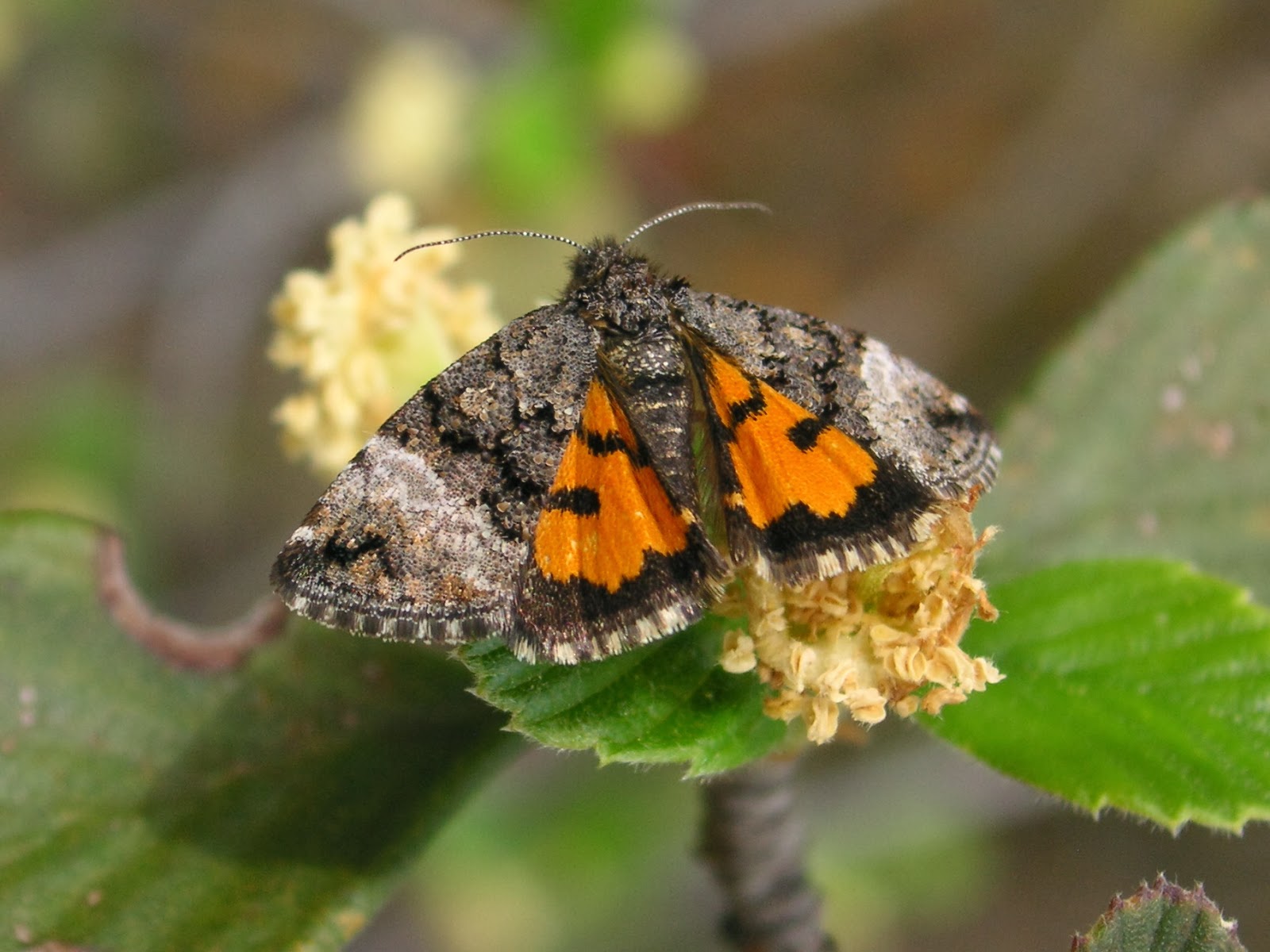
Paul had just finished telling me about another day-flying moth that looks like an x-large Annaphila, when one kindly obliged and landed in front of us.  It was roughly the size between crescents and coppers, which also look superficially similar.  The Annaphila I've seen recently are at least half the size of this.

Tuesday, April 8, 2014

tufted poppy ~ 04/08/14 ~ Pinnacles

Papaveraceae

Now, these are not the famous California poppy (E. californica - I always have a hard time spelling Eschscholzia correctly).  The way I know is to look under the flower for a red ring.  If present, then CA poppy; if not, then good luck!  I already guessed these were tufted poppy, because that's just what they look like to me.  I'm not familiar with the miriad of other native poppies to know any differently. Maybe the folks in the Sierras are the ones that call this foothill poppy, but I've never heard that name actually used.  The tufted poppy is the one that gets everyone going gaga at Hite Cove near Yosemite.

As with the woodland star, I asked the CNPS folks 2 days later to confirm.  What I thought was an easy casual question ended up pulling out loupes and keys with a debate over whether it lacked hair.  Honestly, I couldn't follow the conversation, but I think they were trying to decide between tufted poppy and San Benito poppy (E. hypecoides), which is also on the latest Pinnacles plant list.  It's tufted.

Ed Ross advised me once that if given the choice between two flower photographs, always pick the one that has an insect on it.  He said it made it more interesting.  So, there's a bonus unidentified little beetle in the first photo above.  However, I'll admit I often pick pretty over practical.  I do like poppies of all sorts, including the fancy garden ones.  They're so cheery.  I forgive our natives for being yellow.

woodland star ~ 04/08/14 ~ Pinnacles

Saxifragaceae

posted 04/15/14 - I double-checked with the CNPS folks 2 days later whether they considered the calyx here as being V-shaped (obconic), not square (bell-shaped) as with the hill star (L. heterophyllum).  Yes, V-shaped, obconic, woodland star, L. affine.  Note the green stem.  It can also be red.

Wednesday, March 19, 2014

Annaphila decia ~ 03/19/14 ~ Pinnacles


More dead animals.  Hey, don't laugh at my photos, okay?  I should have asked for better lighting; the busy office was incredibly dark.  Getting decent pics is a crapshoot for me, as is evidenced by my crappy photos label.  I have zero interest in photography itself.  However, looking at my photo set compared to the standard is making me feel a bit embarrassed that I didn't take the time to line them up perfectly, properly sized, lighted, etc.  Eh, as it was, it took me a good 2-hour visit to take photos of a few trays' worth of Paul Johnson's Annaphila specimens, some from the Pinnacles National Park collection and some from his personal collection.  Thank you for your time and attention, Paul!

While I prefer alive and natural, over dead and spread, collections do have their uses.  My photos of a live Annaphila from March 9, 2014 match Paul's 4 A. decia specimens, especially compared to the series (scroll down for Annaphila spp.).  There's a distinctive, cartoony sideview of a boy's face on the hindwing, too.  The collection dates were 03/12/02, 03/18/07, and 2x 04/13/06 (yes, yes, I use mm/dd/yy).  That's good enough for me, even though I still don't think they're well represented online and barely match old hand-drawn plates (Hampson Species Index, figs. 7 & 8).  I did find it interesting that a couple more photos were uploaded to BugGuide in the days since my live post.  It's natural, since they're on the wing now.  And, I also located this gorgeous live shot, despite its misspelling (a challenge of online searching).

Alright, I'll admit I was jumping the gun the other day, fantasizing about how I may have accidentally found a previously undescribed species.  It's funny; I'm not ashamed.  Regardless, it reminded me of an item on my bucket list.  I'm not ready to go down that path now, anyways. Someday, right?  

Annaphila decia head on view

I should mention, it's really difficult to spread tiny moths this well.  Spreading takes good dexterity, talent, patience, and desire.  I have none of those qualities.  It's cool how those upright scales (that looked like jumping spider eyes) are still preserved in the spread body.  Now, all I need to do is find me some jumping spiders...

ps 03/27/14 - I am still researching this and may end up personally comparing with U.C. Berkeley's Essig Museum of Entomology original paratypes, which are accurately identified.  There is a potential that my photos, Paul's specimens, BugGuide, and Flickr are all the same, just not A. decia. Crazy, huh?  Go museums!

Monday, March 10, 2014

black rat ~ 03/10/14 ~ Midpen Preserve

Rattus rattus alexandrinus

posted 03/19/14 - Here's another dead animal to add to my virtual collection.  I'll take it.  I just noticed most of my dead animal finds have been mammals and snakes.  Hey, it's the only time I seem to get any pictures of them.  I'm not very good with their IDs and often have to ask for help.  I try to spread my queries around so as not to pester any one person too much, because everyone's busy and my blog is not that important.  In my zeal to double-check my facts as I always do, I ended up being a bit ratty myself.  Eventually, it was passed among a couple big-wig Mammalogists, so I am confident of this expert ID.  I'd quote the e-mails, but I didn't ask for permission, so I won't.  Sorry, all.

There were two other possible IDs:  the native dusky-footed woodrat (Neotoma fuscipes) and the introduced brown rat / Norway rat (Rattus norvegicus).  Without looking at teeth and skulls, they're not as easy to distinguish as I would have guessed.  My personal, completely uninformed, vote was woodrat, because of its obvious white belly, even though the tail wasn't as hairy as I would expect. Nope.  It's a black rat that isn't actually black.  Go figure.  I should note, the 2nd picture was my attempt to return the body back to its original stuffed-in-the-hole position, so that the black burying beetle I spied could get back to business.  I wouldn't even begin to guess how the rat died and got stuffed.

Sunday, March 9, 2014

Annaphila decia ~ 03/09/14 ~ Pinnacles

Annaphila day-flying moth nectaring on birch-leaf mountain mahogany
Annaphila decia nectaring on Cercocarpus betuloides
Rosaceae

I think I've fallen in love.  This Annaphila is small, maybe 2/3 the size of its larger A. depicta sibling.  In fact, that's how I was introduced to the genus 3 years ago by Chris Grinter.  Its lines are gorgeous.  Look how they line up exactly on both the top and bottom wings, in its natural pose.  Even from the underside, there's full-on orange.  Be still my heart.

Unfortunately, I'm uncertain of its ID.  I queried Paul Johnson from Pinnacles, and we agreed it isn't well represented online.  Come on, look at this horrid picture.  He thinks it's A. decia. Both Moth Photographers Group and Pacific Northwest Moths have spread photos that don't quite match in my eyes.  I used to be quite familiar with Hodges, and I believe it's possible this is a yet undescribed Annaphila species (Hodges 9850-9872), the same as Hartmut Wisch's photos on BugGuide.  I'm asking Jerry Powell and Paul Opler for their opinions, hence why I'm including extra photos in this post.  Then, for Jeffrey Caldwell, yes, I do have additional pictorial evidence of proboscis use on the Cercocarpus betuloides flowers.

Holy cow, btw!  This bush was literally buzzing, which is so strange, because nothing else around it had that kind of activity, not even neighboring mountain mahoganies.  The leaf chews were kind of cute.  Leafcutter bees?

Annaphila decia looking very much like a jumping spider

And finally, you read it here first on Nature ID.  Paul Johnson suggested I could get an Annaphila paper out of the uncanny resemblance to jumping spiders that I noticed in this photo, right down to their striped legs.  The black scales on its shoulders and scruff of the neck look a lot like eyes, don't they?  Of course, I'd need to look at Paul's PNP specimens, observe more, take a lot more photos including local jumping spiders.  Apparently, our crappy 10-year-old point-and-shoot isn't so crappy, since it gets images when Paul's fancier DSLRs scare away the subjects.  Mmm, maybe, I should take on this pet project?  That is, if I don't lose interest first; I am prone to infatuations, after all (don't get me started on salamanders).  At the very least, I should figure out a way to get gas and food supplemented for these kinds of efforts.  For astonishingly hilarious jumping spider videos from down under, check out Jürgen Otto's peacock spiders.  Ha!  LiveScience has an excellent interview with Jürgen of how he came to do this.

ps 03/16/14 - I'm worried I might be a little crazy to believe I may have found a "new to science" moth.  In my defense, I've seen it happen twice for plants at Fort Ord within the last 2 years.  For some wacky reason, land life has not been as well-documented for the greater Monterey area compared to just north by 2 hours.  I think everyone is focused on the ocean life here, instead.

Then the thought process continues to something on my bucket list.  I want to be the person to name and describe a new species.  Crazy, huh?  I already know I would name it after Chris Grinter @ The Skeptical Moth, because of all the help he's provided me with moth IDs since I started my blog 5 years ago.

I've heard back from everyone I've queried.  I feel like I've found my fold with their various personalities.  There was a suggestion that this was A. divinula, which has only a single online reference on the Moth Photographers Group.  Nope.  Yes, yes, I already have in mind to personally check out 5 collections that would most likely have comparable specimens.  And so, my journey continues...

ps 03/21/14 - I've made a firm ID above (until I find out otherwise) and provided an update with comparison to Pinnacles specimens.