Showing posts with label y: San Luis Obispo County. Show all posts

Saturday, January 17, 2015

cloudless sulphur ~ 01/17/15 ~ Los Osos/Baywood Park

female cloudless sulphur (BAMONA)

If I didn't know I took this picture on Saturday in the middle of January, 105 miles down the coast as the crow flies in Los Osos/Baywood Park, I would have guessed this was taken sometime in late September or October, based on the yellow and green coloring of the sweetgum (in the garden behind the Back Bay Inn).  Up here in Monterey, November is usually when sweetgum leaves have already finished turning bright red, before dropping completely off the tree.  Apparent seasons on the coast continually surprise me, even after living here for 12 years.  I can't tell you much about the timing of the butterfly, either.  I don't think January is typical for cloudless sulphur sightings in CA considering there's only one report this year down in Orange Co. and only one other (ever!!!) single report way back in 1977 down in Riverside Co. (according to BAMONA and an additional quick internet search). Both Art and Chris make little mention of the cloudless sulphur, because it's a more southerly butterfly.  So, is this a migrant?  Did it recently emerge from its crysalis nearby?  Who knows?

Sunday, January 19, 2014

habitat ~ 01/19/14 ~ Morro Bay State Park - Black Hill

Morro Bay State Park - Black Hill
January 19, 2014

This was purely a social visit, so we barely got out on a short section to Black Hill before the football games started.  The road access is located above the Morro Bay Golf Course, a San Luis Obispo County Parks on CA State Parks land.  Confused?  Yeah, me, too.  It looks like they've been cutting back on watering the greens, because there was quite a bit of yellow.  Good.  I think golf is a gross misuse of precious water for an exclusive recreation.

I love the 360° views from on top this volcanic peak and am sorry my uncle didn't join us.  Every visit I worry may be the last time I see him or my aunt, so I try to make the most of our time together.  Even though he still hikes like a mountain goat for short periods of time, he wasn't really aware of the trails here.  I'm not surprised, because for all the years I've been going to Morro Bay, too, it took Andy's wandering trail running ways to discover this little gem a few years back.  

It wasn't until I started Nature ID that I wanted to learn more about Morro Bay, which I discovered is actually part of the larger Estero Bay.  I appreciate the estuary more than ever now, but finding information online has been challenging, especially 5 years ago when I started this blog.  I don't know if google has customized my search properties and/or if the sites have just gotten better.  Two that I like are Morro Bay National Estuary Program and grad student Eric Mohler's Morro Bay Watershed site.

January 17-20, 2014

Oh, while we were there, this was going on.  Everywhere we went there were folks with good sun hats, binoculars, and cameras so big that I'm surprised they didn't walk all hunched over from the weight around their necks.  The festival was completely not on my radar, so I was not prepared.  Still, I'm not sure I would have participated anyways.  Every time I stopped an obvious birder to ask them what something was, they weren't very helpful or accurate.  Avid birders are a strange bunch.  Talk about another exclusive recreation, which reminds me of the topic of lack of minorities in birding. While I can't say I feel uncomfortable among affluent, retirement-aged, Caucasian nature folks, after all my uncle and aunt fit quite neatly in that category, I am aware I am "other" or the designated minority friend in most groups.  Hmm, maybe that's why I tend not to join things?  My favorite bird blogger is Steve of Bourbon, Bastards, and Birds.  He crushes birder stereotypes.

ps 02/13/20 - I removed several embedded links thanks to Ryan Blundell at Tideschart.  Here's his tidechart for Morro Bay: https://www.tideschart.com/United-States/California/San-Luis-Obispo-County/Morro-Beach.

hairy woodpecker ~ 01/19/14 ~ Black Hill


Ta-da!  This has got to be one of the crappiest pics posted to Nature ID.  I digitally enhanced it as much as possible, too, which is something I rarely do.  Oh well, I think it's good enough to make a positive ID.  It's another new-to-me sp.

The first thing that caught our attention was the tree seemed to be dropping bits and pieces.  What the hey?  Turns out this woodpecker was pulling bits of bark off the tree trunk in between brief bouts of drilling.  Well, that's different.  Hey, where's the red head?  Usually, whenever I notice woodpeckers (rarely), they almost always have a red head, which I assume (probably inaccurately) are the clown-like acorn woodpeckers.  The last thing I noticed was that long white stripe.  Visually it didn't make sense to me that it was located in the middle of the back, because I kept wanting to believe it was on the edge of the wing, like with the sapsuckers.  It really confused me until I looked at my pictures and read up on an ID.  Turns out there's a smaller, cuter look-alike called the downy woodpecker (P. pubescens).  I liked the description on Cornell's site that said the larger hairy woodpecker has a "somewhat soldierly look".  True, true.  Oh, and that pulling bits of bark is to find tasty insects.  They're apparently pretty decent at pest management.  Btw, males do have a small patch of red on the back of the head.

Cool.  Slowly expanding my bird awareness...

spotted towhee ~ 01/19/14 ~ Black Hill


Considering I still have my bird books out, I might as well continue with the crappy bird photos... hop, hop, hop, nah, nah, nah, you can't get a good shot.  This is a new sp. to Nature ID.  Except for its shape, it looks nothing like the related California towhee.  I like this striking bird, which reminds me more of a bolder and more colorful dark-eyed "Oregon" junco.  What would be the evolutionary advantage of the dark executioner's hood that many birds seem to have?

Saturday, January 18, 2014

Cooper's hawk ~ 01/18/14 ~ Tidelands Park


I'd really like to be able to ID all the local hawks, but until I'm willing to carry around binoculars and/or a better, larger camera, my learning is slow going.  So, after much comparing of photos and finding this great Project FeederWatch page, I've concluded what I have here is a Cooper's hawk, not a sharp-shinned hawk (Accipiter striatus).  I focused on its capped (vs. hooded) head and tubular body shape.

Thursday, July 18, 2013

habitat ~ 07/18/13 ~ Morro Bay State Park

July 18, 2013

Wanting a shower, we headed over to the main Morro Bay State Park camping area to use their facilities (this access is included with a stay at the Strand).  While Andy went for a pre-shower run, I strolled around to see what was new.  It's weird to think of my life in decades, but I've been coming to this spot for close to 4 decades.  The very first time, I remember coming home from Morro Bay and not understanding why we were returning to our old house after vacation.  I thought we had moved!

Despite all the financial difficulties the CA State Parks have faced in the last many years, I've been impressed with the improvements they've managed to implement here.  The housing for employees is very nice, with one growing native plants in the backyard for what I assume will be park landscaping.  I sometimes fantasize working at a state or national park with housing provided in the actual park would be awesome, but then you've got to be careful what you ask for.  Like health insurance for many out there, if you lose your job, you end up loosing way more than a paycheck. Maybe when we retire, we'll try the whole camp host thing.  The groomed trails around Black Hill didn't exist when I was a kid; there used to be only an exercise loop with stations and a painted pole-style frisbee golf course. There's also a new boardwalk along the estuary. It's artistically laid out, zigzagging through the muddy parts, but it'll mean no more looking for native horn snails for me.  I have mixed feelings about that.  On one hand I know things need to be protected, fenced, signed, etc., but it comes at the cost of us humans not allowed to get in touch with nature.  In the act of saving, it's also distancing from raw human experience, which is ironic.  Hey, lady, put that shell down and step away!

And, finally, I included the eucalyptus tree above, because I wanted to ask my nature-loving blog readers... have any of you ever heard of hummingbirds clustering in 1 or 2 trees?  I could not believe the loud chatter coming from this tree, and I figured there had to be several dozen hummingbirds, if not a hundred.  It was really wild.

Wednesday, July 17, 2013

habitat ~ 07/17/13 ~ Morro Strand State Beach

July  17, 2013

Per our usual of not making reservations, we were out of luck securing a camping spot at the main Morro Bay State Park.  So we settled for the parking lot at Morro Strand State Beach.  Truth be told I wouldn't exactly recommend either campground at $35/night, but the locations work well for what we like to do down there.  Perhaps it's mostly nostalgia for why I keep going back.  I was a little surprised to find out Morro Strand SB is still open for business considering it has been on the chopping block twice since 2009.  How did this get resolved?  Did Save Our State Parks actually save it?  Does anyone know how this played out?  Darn news these days rarely offer follow-up reports.

The nicest thing about staying at the strand is, well, the beach... even though it can get extremely windy in the afternoons.  I know, I know, I live along Monterey Bay with plenty of perfectly fine beaches here in town, but there's something about this beach adjacent to Morro Bay that hits home for me.  It's my favorite central CA coast beach for beachcombing.  It's long and flat and rarely stinky. There are always plenty of birds, like the Heermann's gulls, western gulls, and marbled godwit shown here.  There are also many more sand dollars, crabs, and clams than I can find at home.  It's a lovely spot to watch the sun set.

Tuesday, July 16, 2013

tarantula hawk ~ 07/16/13 ~ Cayucos


posted 07/24/13 - This sucker was HUGE!  Capturing a real sense of size seems so tricky in photography.  Using my finger as a makeshift measuring guide, I estimate this tarantula hawk at 30mm from head to abdomen tip.  Interestingly, according to Powell and Hogue, this is not the largest spider wasp found in CA;  that title goes to the closely related Pepsis thisbe coming in at a whopping 32-44mm.  Secondary to its size, I noticed it was rotating around in a clockwise fashion and continued even after I poked it a couple times.  Very odd behavior.  It's beautiful and magnificent in a bold way.

Later I found out that a dear friend unexpectedly died this day.  I'm dedicating this blog post to Steve Gally.  He was truly one-of-a-kind with a booming voice, a heart of gold, and endless stories.  A mason by craft, and an artist by heart.  He loved insects and would have found this tarantula hawk absolutely amazing.  He helped shaped my life today in ways few people ever do.  I am incredibly thankful and honored to have been included in his fold of many friends.  To quote Bob Dylan, "But to live outside the law, you must be honest."  Goodnight, sweet man.

ps 08/17/13 - Additional links for Steve:  Legacy.com, BigSurKate, Bread on the Water, SeaRock.

Thursday, November 3, 2011

habitat ~ 11/03/11 ~ Morro Strand State Beach


When I first started Nature ID back in May 2009, Andy I were visiting San Luis Obispo County a little more frequently than we do now, and my blog subtitle was "from the Central Coast of California." Thanks to school and changes in our lifestyle, we stay closer to home in Monterey County these days, so I've re-subtitled Nature ID to reflect the change of location focus.
However, it's only been 3 weeks since I last visited this beach on October 12, 2011 in Morro Bay, about 150 miles southeast of Monterey Bay. The weather couldn't have been more different with a high of 67.5°F compared to the 92.8°F previously.

My friend Jennifer, who is also a regular commenter on
Nature ID, loved my sand dollar shots. Since she had never really been to Morro Bay, I thought it'd be a good idea to play hookey from our responsibilities and do a girls' trip. And, yes, she found many, many sand dollars, not to mention added new bird sightings to her brother's Birdpost [no longer available] site.

Heavy sigh... Morro Strand State Beach is on the list for closure in the coming year along with 69 other CA State Parks. Unlike back in 2009 when Mr. Terminator proposed closing 80% of CA's 278 State Parks, this year's threat of closure feels realistic and more serious. While I can see them closing and fencing off the campground, I just can't imagine any agency being able to keep people off this awesome 3-mile beach. With no restrooms, no refuse containers, or other maintenance and management, I predict the quality of this beach will quickly go downhill. Public-private partnerships have been organized to attempt to fill the gaps throughout the state, but it takes a cadre of folks willing to volunteer their money, time, sweat, and expertise. Randy at Way Points has been vocal with his posts about Trail Closure at Garrapata and Henry Coe gets a Reprieve. I'm surprised other CA nature bloggers I follow haven't said much on this very important and relevant topic. Save Our State Parks seems to me to be the best organization out there spreading the word.
ps 05/31/12 - The Central Coast Natural History Association Executive Director contacted me and asked if they could use my last picture of the SOS sign alongside the standard brown State Parks sign on the cover of their "Nature Notes" newsletter. They're a non-profit that raises money for their local SLO County State Parks and have been fighting to keep these special parks open for over 4 years. Of course, they have my permission! I sent to her a few higher resolution image files from which to choose.

terns ~ 11/03/11 ~ Morro Strand Beach


edited 11/11/11 - These were the funniest looking birds I've seen in a long time, like gulls with clown outfits on. It's too bad we lost sight of the Morro Bay Winter Bird Festival leader who pointed out the surfbirds for us.

I originally posted these as all being elegant terns, but I was unsure and considered royal terns as an option. I asked if anyone could help me tell the difference between the two species, because I was pulling my hair out thinking they all had to be either elegant terns or all royal terns. I tried to convince myself the variations I spotted were due to some being younger birds. As I've blogged before, I'm aware I often make the incorrect assumption that similar looking things near each other must be the same. Thanks to commenters Neil and Jennifer, I agree there are actually two species of birds hanging out together. Neil provided an excellent link to the San Diego Natural History Museum Focus On Royal and Elegant Terns. Thanks to you both!


royal terns with 1 elegant tern 2nd from right
S. maxima with 1 Sterna elegans 2nd from right

The royal terns have white tops of the heads, like a man balding on top, and thicker, pumpkin-colored bills. They look stockier than elegant when standing side by side.

elegant terns with 1 royal tern 2nd from left
S. elegans with 1 S. maxima 2nd from left

The elegant terns have heads with black hoods that touch their eyes, thinner, sharper bill, and slightly smaller overall size. Note the yellow legs of the juvenile elegant tern.


mixture of elegant and royal terns

Now, can you spot the differences above? With all the variations in plumage within a species, depending on time of year, age of the bird, and sometimes sexual dimorphism (other birds), I hope my confusion can be easily understood. Now that I know what to look for, the differences seem obvious. It'd be more of a challenge distinguishing these terns in their breeding plumage. I'm just glad a caspian tern (Sterna caspia) was not in the mix, too.

Somehow it's comforting to know other people have a hard time IDing these terns, e.g., Ben's Blog - In Search of Nature, Birds, Butties & Bugs, and John Wall's Natural California (does he have a mix of both species, too?).

barnacles ~ 11/03/11 ~ Morro Strand Beach


I'm trying to get outside of my comfort zone and ID things I know very little about. Many people would recognize a barnacle, but I think few would know particular species. Indeed, as I was researching, there seems to be conflicting information about the identity of some very common barnacles. I may change the embedded links as I look into this some more.

sea anemones ~ 11/03/11 ~ Morro Strand Beach

sea anemones
Anthopleura spp.
more information

As a kid, whenever we'd go to the beach, my mother would repeatedly warn me to never step on sea anemones, because she believed they would sting. Now, I don't step on them for fear I could crush these seemingly delicate animals. I learned through the links included in this post that both ideas, stings to humans and being delicate, are incorrect.

I should note not all sea anemones are in the Anthopleura genus. The two species I have identified below just happen to be in the same genus.


aggregating anemone
Anthopleura elegantissimamore pictures


The aggregating anemone is known to clone itself, hence why they're often found in dense clusters. The Walla Walla site linked in the scientific name above shows some incredible pictures of the dividing process. Some anemones also have green algae (zoochlorellae) or dinoflagellates (zooxanthellae) living symbiotically in their gut lining (but maybe not these ones?). The Monterey Bay Aquarium site has fun information on the aggregating anemone, but it states "Anthropleura" with an extra 'r', which is incorrect. Anthropleura was an ancient giant centipede.


I was lucky enough to get a decent picture of this anemone slightly open to see the lines on the oral disk for a positive ID.

Two additional similar looking species found in our area are the moonglow anemone, aka burrowing anemone (Anthopleura artemisia), and the giant green anemone, aka solitary green anemone (Anthopleura xanthogrammica) - which I believe is shown in the first photograph above, but there is no way for me to know for sure.

For much better photographs of anemones and other tide pool life, check out John Wall's Natural California. It's extremely difficult to get decent pictures through moving water. Most of my attempted shots ended up being lovely reflections of the clouds above.

surfbird ~ 11/03/11 ~ Morro Strand Beach


Surfbird, huh? So, where's the surfboard or the, um, computer with internet connection? I would've never been able to identify these birds, let alone even spot them, if it weren't for the help of a total stranger.

My friend was asking me about marbled godwits that we saw, which for the life of me I could not remember their name even though I had been on this beach only 3 weeks before and blogged about it. So, I took to asking random strangers, especially ones carrying massive cameras and binoculars, if they knew the birds. The first couple I asked replied in a thick accent, "Ve ar' not vrom around hair." The second couple I asked ended up being leaders of the Morro Bay Winter Bird Festival. Bingo! As I was absorbed taking pictures of anemones in the rocks they called us over to look at the surfbirds. Really, since they are actual birds, their name should be "surf bird" as two words.

From a distance, I'm sure I'd get them confused with a lot of other shorebirds, including black turnstone (which were also picking at the mussel-covered rocks for food), least sandpiper (Calidris minutilla), western sandpiper (Calidris mauri), red knot (Calidris canutus), and pectoral sandpiper (Calidris melanotos). As a note about the pectoral sandpiper, even though several reputable books and Cornell's All About Birds site show they are not ever here in CA, both the Morro Bay Winter Bird Festival site and Don Roberson's Monterey Birds book show they are recorded migrants in our area.

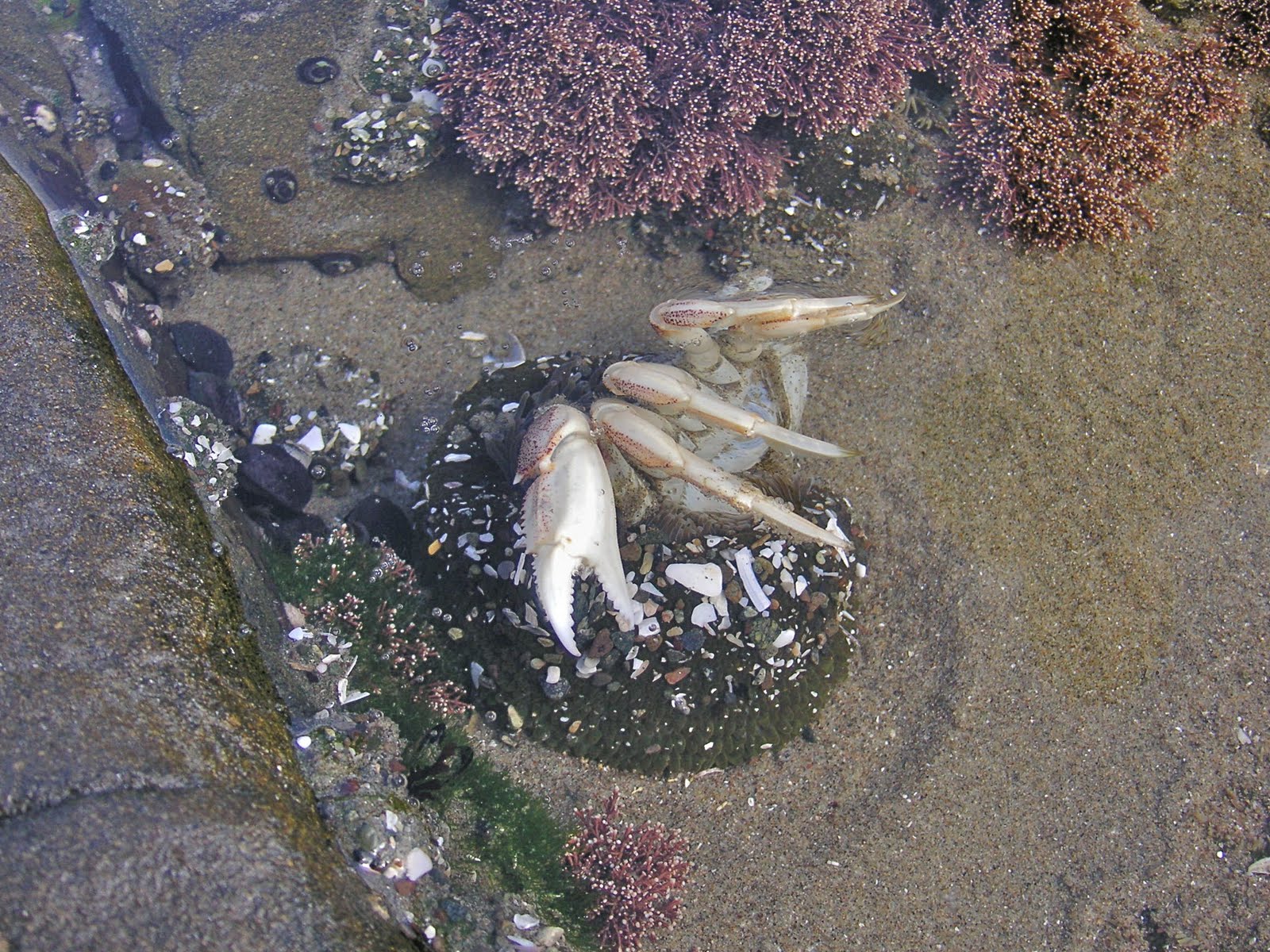
cancer crabs ~ 11/03/11 ~ Morro Strand Beach

rock crab carapaces
Cancer
spp.

The interior of Cancer carapaces are amazingly colorful. These almost look like they've been filled with Easter egg dye and sand.

This post was very challenging to research, hence it's link-laden. According to the California Department of Fish and Game, we have 9 species of Cancer crabs. I used an old edition of Light's Manual: Intertidal Invertebrates of the Central California Coast sent to me by Steve at Blue Jay Barrens (Thanks again, Steve!), which listed only 8 species and keyed 6 of those.

I'm attempting to ID based solely on the carapaces, which is the most common body part I saw washed up on the beach. Everything I found were 1-3" in width. Since crabs molt, size is not a significant indicator of a species. I spent quite a bit of time zooming in on each of the photos and counting the carapace spines/teeth. There is very little information online for some of the smaller species. If you're curious to learn more, make sure to click on the embedded links under each photo.


best guess hairy rock crab
best guess Cancer jordani (aka Romaleon jordani)

ps - For a little bit of gutter humor, as I was researching the IDs above using the old Light's Manual and with selective choice of spp. and words... I discovered pee crabs, er, pea crabs (Pinnixa spp. and others) live in penis fish (Urechis spp.) burrows. Haha, who knew!?!

Thursday, October 13, 2011

CA sea-lavender ~ 10/13/11 ~ Morro Bay


posted 11/04/11 - Too bad these flowers are past their prime. I've been wanting to get pictures of our native sea-lavender ever since our last visit to Morro Bay on October 31, 2010 when I spotted the purple flowers but failed to photograph them. Interesting to note, even though we visited a couple weeks earlier compared to last year, the purple flowers had already dried up. I like seeing how plants bloom at slightly different times every year.

This is the only native Limonium found in CA, and one of only 3 species native to North America, with the other two being L. carolinianum and L. limbatum. Thanks to the Morro Bay National Estuary Program site, I learned that the non-native Algerian sea-lavender (L. ramosissimum) has recently been found in Morro Bay. Most folks around the world likely know Limonium spp. as statice.

ps - Lavender is spelled with an -er, not -ar, of which the above named plants are not actually related.

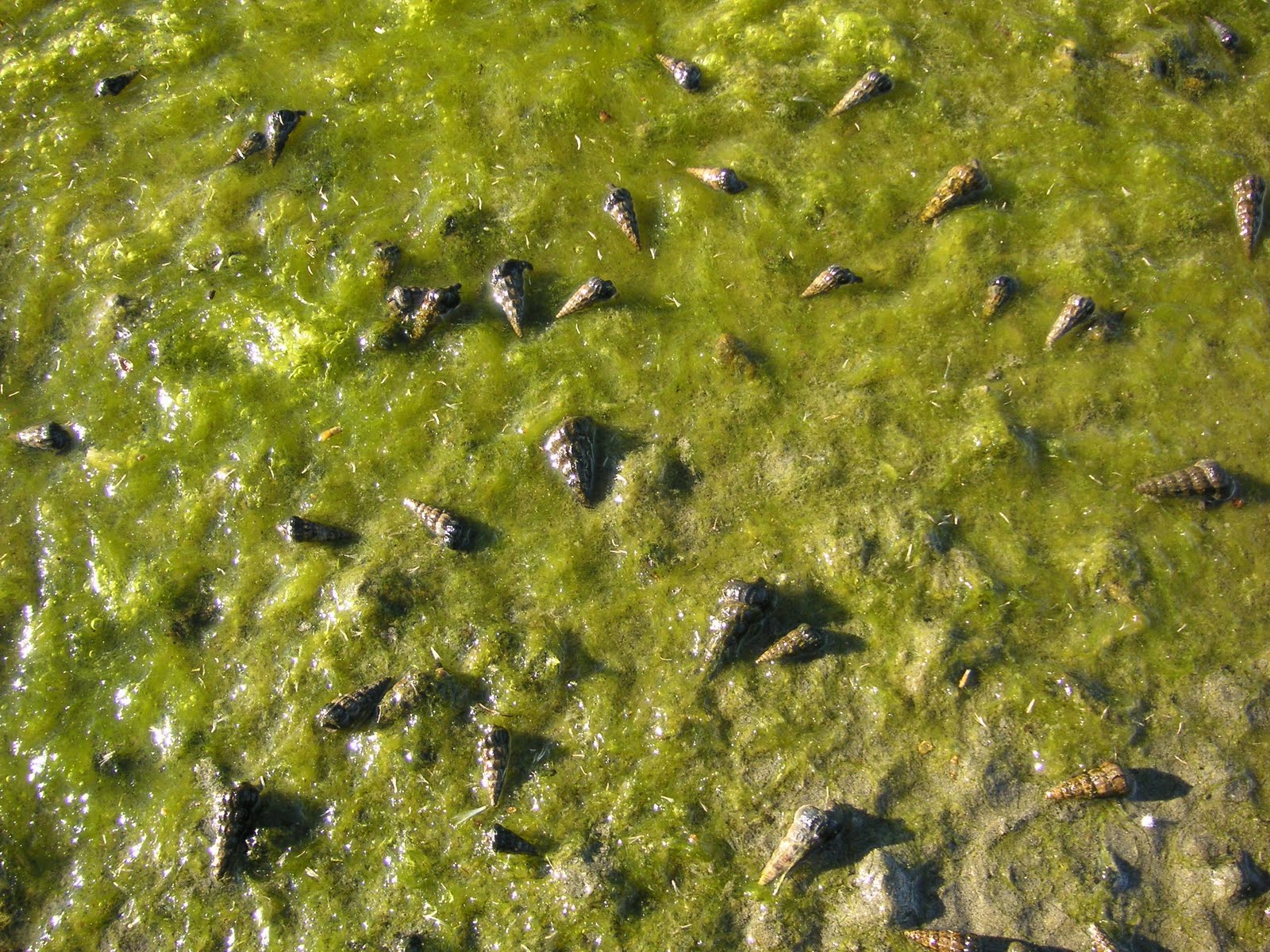
CA horn snail ~ 10/13/11 ~ Morro Bay


posted 11/03/11 - I wanted to revisit this ID with fresh pictures and conduct another online ID search. What I noticed this visit was that all the snails on the path were dead with their openings facing down in the mud. I thought this was peculiar and probably not random. For the second picture above, I turned one over and cleaned the opening to show the shape of aperture. I reached into the green gunk to take a closer look at an actual live snail. The one I'm holding is about medium sized compared to the larger empty shells.

Walla Walla University still has the best somewhat-local ID comparative description I've found under Batillaria attramentaria (one of two Japanese false cerith snails, with the other being Batillaria zonalis, if indeed it is a distinct species). Plus, this time around I noticed Conchology, Inc. has at least two errors on their Potamididae family page; Batillaria spp. belong to the Batillariidae family page. So, this got me thinking about looking at other similar looking marine snails. WoRMS is great for listing the names of other Cerithioidea families. I looked through the Natural History Museum Rotterdam's site and came up with the following families that have similar looking shells: Batillariidae, Cerithiidae, Dialidae, Potamididae, Scaliolidae, Thiaridae, and Turritellidae. I checked the EOL for the locations of some of the snails, but none are recorded anywhere near central California's coast, except C. californica and B. attramentaria. Nature's variations amaze me.

I don't often post so many pictures for a single ID, but this was a personal quest after my minor hubbub around a permissions request and withdrawal from my first post of CA horn snails. It caused me to go into major blogging existential contemplation, which I wrote about in am I doing the right thing with this blog?

Wednesday, October 12, 2011

habitat ~ 10/12/11 ~ Morro Strand State Beach


posted 10/28/11 - It was so hot and windy when we arrived in Morro Bay. It hit 92.8°F! After setting up camp, I suggested we go to the beach to cool off a bit. Morro Strand SB is a flat 3-mile beach with gentle waves. It's great for bird watching, beach combing, and tide pooling (when the tide is low). It was also once known as Atascadero State Beach, the name I remember as a child when my dad would surf fish here.

Andy and I first "discovered" this lovely beach when we camped back in June of 2009. Usually we prefer to camp at Morro Bay State Park where we ended up on this trip. Hey, I like being able to scope out individual campsites and check out any potential neighbors... so I never make reservations. This can be risky finding a spot during peak summer season, hence why 2 years ago, we had the fortune to find the less-developed Morro Strand SB, which is right on the beach. It's essentially a big parking lot with fire pits and restrooms with no showers. However, you can have access to showers at Morro Bay SP. I believe Morro Strand SB is $25/night and Morro Bay SP is $35/night. If you don't make online reservations like us, the State Parks only accept cash. Morro Strand State Beach is one of many State Parks slated for closure by next summer. I'm not sure how they would keep people off this incredible beach if it were closed.