Showing posts with label x: Elkhorn Slough - NERR. Show all posts

Wednesday, October 9, 2013

habitat ~ 10/09/13 ~ Elkhorn Slough - NERR

Elkhorn Slough - National Estuarine Research Reserve entrance

We weren't sure if Elkhorn would be open considering the federal government shutdown.  Unlike many people, the only impact that we've noticed for us has been closed parks.  We had hoped to camp at Pinnacles National Park during fall break, but we scrapped those plans with the shutdown.  My backup plan was to go to nearby Kirby Park if the NERR was closed, but it wasn't.  What surprised me was to see folks in CA Dept of Fish and Wildlife (formerly Game) uniforms.  I don't know how I missed that.  Elkhorn Slough confuses me as to which agency does/owns what.  Apparently, the National Oceanic and Atmospheric Administration (NOAA) is also involved.  After inquiring, come to find out the Nature Center is run by CADFG.  I did not know that. They do a nice job. 

The tide was very high during our visit.  One of the main walkways was almost covered in water.  I don't get too excited about the proliferation of invasive plants here, like poison hemlock, but for some reason I still want to go back to visit the Slough.  I've even come to like the soothing rattling sound of wind-blown dried harding grass.  It looked like they had recently done some extensive mowing.  They have an incredibly work-intensive management plan.  I think I'd feel defeated if I worked there.  It could be coincidental, but it seems like we've seen less and less wildlife (snakes and rabbits) in recent years since they've stepped up their attempts to get rid of invasive plants.

All surrounding the Slough, the farmers are just now covering their lands with a fresh round of plastic (seen in the middle picture above on the surrounding hills) for another planting of strawberries, one of Monterey County's most valuable crops.  This type of plasticulture really bothers me.  The waste generated must be incredible.  I've been wondering if anyone makes biodegradable plastic for strawberry farming.  If I did it, I'd make it so the farmer could till the plastic into the soil as a soil replenisher.  I bet the chemistry wouldn't be too difficult to figure out.  The biggest hurdle would be to invest in an efficient manufacturing process so that it would be cost effective for the farmers.

salt bush ~ 10/09/13 ~ Elkhorn Slough

 salt bush/fat-hen among pickleweed

When fellow bloggers post seasonal pictures from their neck of the woods, like the common milkweed, I'm reminded of how much I absolutely loved autumn in Ohio - the vibrant colors, the damp woodsy smell, the crisp chill in the air.  Sigh.  It's taken me a while to appreciate autumn here on the coast of CA.  I tend to seek out places, like Garzas Creek, that remind me of Ohio.  Amazingly, autumn colors occur in the slough, too, where salt water meets fresh water.


I try to take full advantage of nature center displays and will often take pictures before a hike as a take-along ID guide.  I love it when they have sample plants with identification tags... that is until what they show cannot be confirmed anywhere else.  Erg.  Assigning names for this post was a bit of a challenge since there have been recent changes among different classification systems.  Same or different species?  Who knows? Other names associated with this particular salt bush are:  A. triangularis ssp. hastata (as shown above), spearscale, A. patula ssp. hastata.  Even fat-hen refers to different kinds of plants.  Then, there's the question of is it native (as shown above) or naturalized?  Other names associated with local pickleweed are:  Pacific swampfire, S. virginica, glasswort, S. depressa.  And finally, Jepson, our CA plant bible, sticks with Chenopodiaceae as the family name.  Phew.

Mylitta crescent ~ 10/09/13 ~ Elkhorn Slough

for more information, click here and here

Eh, crescents and checkerspots are somewhat challenging to ID.  They're incredibly variable and can look like each other.  For me, I use the row of dots on the hindwing to know for sure it's a crescent; checkerspots never have the dots, which, unfortunately, makes it confusing to remember.  A funny thing about these butterflies, I find IDing them on the wing much easier to do than from photographs.  The crescents are smaller and a bit more erratic in their flight compared to checkerspots.

I have a question for you:  Does anyone know the function, if any, of the colorful antennal clubs often found on various insects?  This discussion came up on my black burying beetle post.

Sunday, October 21, 2012

colonial orb weaver ~ 10/21/12 ~ Elkhorn Slough


Whenever I consider shutting down Nature ID due to the tremendous time commitment it requires, I'm reminded of the value of the personal narrative that's recorded as I learn about my local natural world.  Last summer while driving home from the grocery store I happened to meet a fellow who is the country's lead researcher on these unusual social spiders, which also happened to answer a question I had from the year before.  To read that post, click here.

Now, this past winter was definitely not an El NiƱo year, so it was interesting to find hundreds of these colonial orb weavers on Hummingbird Island and nowhere else we visited at Elkhorn Slough, exactly where the CA oak moths were most abundant - a great example of prey availability. Apparently, Metepeira spinipes are not always colonial.

In the first picture, above the spider are her egg sacs.  In the second picture, there are at least 3 different females, one in the center and the other 2 towards the top at 12:01 and 12:05 positions.  The plant they've spun their chaotic orb webs on is CA sagebrush (Artemisia californica).  And, here's a repeat link, because I like it so much in how these colonial orb weavers remind me of "Spiders on Drugs".

CA oak moth ~ 10/21/12 ~ Elkhorn Slough


For all the evidence I've seen of oak moths recently, like the total defoliation of oak trees at Garzas Creek and the crunchy munching at Toro Park, this is the first I've found the classic prolific pupae and moths on the wing this autumn.  Getting pics of the cloud of moths is difficult since they look like fuzzy tan blobs.  Even these photographs do a poor job at illustrating how the pupae were on any and every available surface.  We had oak moths like this at home this past spring, but for some reason a 3rd generation never materialized.  Country Mouse of Town Mouse and Country Mouse has a nice post of oak moths up near Santa Cruz.  This local abundance of oak moths leads into my next post...

arum ~ 10/21/12 ~ Elkhorn Slough


I've wondered what these are for quite a while, ever since I first saw them in a corner of the Memory Garden behind the Pacific House in Monterey.  Lately I've seen them more and more in yards here in town.  I attribute their recent proliferation to Trader Joe's offering cheap, decorative potted plants. Unfortunately, while you shop for pseudo-organic, cleverly packaged food products, many of their potted plants only include generic care instructions for water and sunlight without any identifying label.  This is the first time I've seen these growing in the "wild" outside of a tended garden.  Given Elkhorn Slough's history as a farm and the proximity of this bunch under an oak tree next to one of the barns, I suspect this is a waif from the past.

Without seeing the leaves or flowers, I can't easily tell which of the 25 spp. of Arum this is.  Calflora and Jepson eFlora list only Italian lords and ladies (A. italicum) and black calla (A. palaestinum, A. palestinum seems to be a misspelling) as occurring in CA.  The ones in the Memory Garden have a striking deep purple spathe, like the black calla, aka Solomon's lily, but several Arum spp. are also black.  If I had ignored the bright orange color of the fruit, I may have been able to figure out this was related to the locally prolific calla lilies (which surprisingly I don't have as a featured ID yet).  Oddly enough Arum and calla lilies are in the same Araceae family as duckweed.  Weird.

ps 08/19/13 - For a fun post on the related cuckoo pint (A. maculatum), check out Cabinet of Curiosities.

broad-footed mole ~ 10/21/12 ~ Elkhorn Slough


Hey, it's a mole!  Cool!  A dead one.  Aw, too bad.  Considering I've probably only ever seen one other mole in my life (it was dead, too, in the middle of a trail), I started wondering how I knew this was a mole.  I suspect many people would be able to recognize a picture of a mole without ever having seen one in person.  Why is that?  Children's books?  Nature shows?  Sure, I'd be able to recognize a panda or an alligator if I ever saw one firsthand.  But, moles?  They're not exactly wildly popular animals.

Then, the question for Nature ID becomes, "What kind of mole is it?"  This was a little challenging to research.  Most online pictures of moles are dead, and interestingly they all look like they've been licked by a canine or something.  I don't know why they have a wet licked look about them.  And why do they seem to go above ground to die?  I was fortunate to have found the kind with unusually large front feet to distinguish it from the numerous shrews.  There are 7 spp. of moles in North America.  Of those 7, 4 are found in CA.  Townsend's mole (Scapanus townsendii) and coast mole (Scapanus orarius) are found along the northern CA coast.  S. latimanus has the widest range in CA, but part of Monterey County is the southern-most area for shrew-moles (Neurotrichus gibbsii), which has a longer tail.  As a side note, in these scientific names here I've linked to sibr.com, a database design site which for some reason contains the exact compilation of PDFs found on the California Wildlife Habitat Relationships website in association with the California Department of Fish and Game.  If you want to see larger range maps, select the common name on the CWHR site.  For an extensive sp. account published by the American Society of Mammalogists, check out Smith College>PDFs>No. 666 (it doesn't look like it links to anything, but it opens up a PDF to the publication).  While moles are reported to eat gastropods, beetles, and earthworms (see pub No. 666), it seems they have been targeted as an enemy of the gardener, like gophers.  Poor moles.

Saturday, November 12, 2011

habitat ~ 11/12/11 ~ Elkhorn Slough - NERR


First off, let me say that Andy and I had a lovely afternoon walk at Elkhorn on a very overcast day. This slough is one of my top 5 places to enjoy the outdoors in Monterey County. We had planned to go the day before for the holiday, but major rains kept us mostly indoors. I seem to have a rain curse anytime I plan on hiking or camping ahead of time, hence why I'm a bit superstitious and tend not to plan ahead for such things. They raised their entrance fee from $2.50/person to $4.00/person. It's still a small amount to pay for the pleasure.

What's that saying, "Ignorance is bliss"? It wasn't until I blogged about the prolific invasive plant species that I started getting grumpy about our visit. I looked into the history of Elkhorn Slough. In the past 140 years, the place has been built, ditched, diked, dairied, diverted, farmed, channeled, mounded, and is now being utilized as an outdoor laboratory. Then, I started reading about all the research that is going on there. Instead of being encouraged, I got depressed. Out of numerous not-so-fun to report items, DDE was circumstantially linked to a caspian tern colony crash in 1995. When was DDT banned here in the US? 1972! So, 23 years later the stuff is still killing non-target life? I wouldn't be surprised if Monsanto's Roundup ends up being this century's DDT. It's used everywhere, including as a management tool against invasive plants - to be fair, the agricultural runoff into watersheds overshadows any minimal use of herbicide at reserves. However, just because everyone uses it, doesn't mean it's good - think fossil fuels, plastics, cigarettes. Dang, we humans sure can eff things up! How will Elkhorn Slough be in another 140 years?

Oh, I should mention that pretty pink plant is the native red-flowering currant (Ribes sanguineum). I believe it's introduced and tended like a garden plant.

ps 11/23/11 - This post really got me thinking about what exactly are my views on conservation, restoration, gardens, and research in the 21st century, so I've been keeping an eye out for more information. I found Biodiverse Gardens' book review of Rambunctious Gardens interesting.

belted kingfisher and western gull ~ 11/12/11 ~ Elkhorn Slough

belted kingfisher (below) and western gull (above)
Ceryle alcyon and Larus occidentalis

Phew! I'm done posting about non-native invasive plants for this hike. I realized I had neglected covering the most obvious weeds at Elkhorn Slough and needed to rectify the situation. In a similar vein, considering this estuary has so many birds, I always try to post at least one bird photo from an outing, even if it's crappy - I'm talking about the photos, not any particular bird... but now that I think about it... Unfortunately, many of the birds are far enough away that my little point-and-shoot can only cough up fuzzy, zoomed-to-the-max shots.

We came across two hikers with large binoculars, loudly ooing and awing over the various birds across the water. It was quite entertaining to hear their excitement. I overheard they were looking for a belted kingfisher that they thought had left the area. I casually looked down and pointed out, "Is that the kingfisher you're looking for?" As Andy and I walked away, we chuckled how sometimes people are so focused looking through their binoculars that they're unable to spot the bird nearest to them. And, in the relative quiet away from the hikers, we thoroughly enjoyed the amazing afternoon bird chorus that carried across the water. I wish I could have recorded it for this blog. For an incredible blog that does have various animal recordings, check out The Music of Nature.

ps - I'm considering organizing Nature ID birds a little better than I have. At this point, I'm undecided if I should do Order or Family, like is featured at BirdWeb, or more loose groupings based on shape, like is featured at Bird Friends of San Diego County and whatBird.com. For you birder followers out there, I'd appreciate hearing your opinion. Thanks!

wild radish ~ 11/12/11 ~ Elkhorn Slough

Well, knock my socks off! Hello? I had no idea the wild radish I frequently see around here is the same species as the radish I buy at farmers' markets and the grocery store. Did you know that? I even grew one this summer in my mini-greenhouse after a stocky sprout came up from my too-soon-to-use compost. I'm laughing, because the whole time I was perplexed thinking, "Hey, this looks exactly like what I see growing out in the wild." I should note, there is another species of radish that grows wild at Elkhorn and is aka wild radish / jointed charlock (Raphanus raphanistrum).

The second photo above is the exact area where last year I noticed a heavy dose of herbicide to knock down the poison hemlock. I'm sorry to say that at the time I was very critical of the reserve's generous use of herbicides. I had quickly edited the post, which now doesn't reflect what I was reading at the time. I'll admit to being ignorant of lots of things. Through following blogs, my opinions about land management practices have been changing. Bree at the now defunct Land Steward had two really good posts, what restoration means to me and weeds. I still think the marketing departments at major pesticide manufacturers do too good of a job at pulling the wool over people's eyes, ears, and mouths. However, given the choice between invasives versus reintroduced natives... well, I do like seeing native flowers... but at what costs?

poison hemlock ~ 11/12/11 ~ Elkhorn Slough


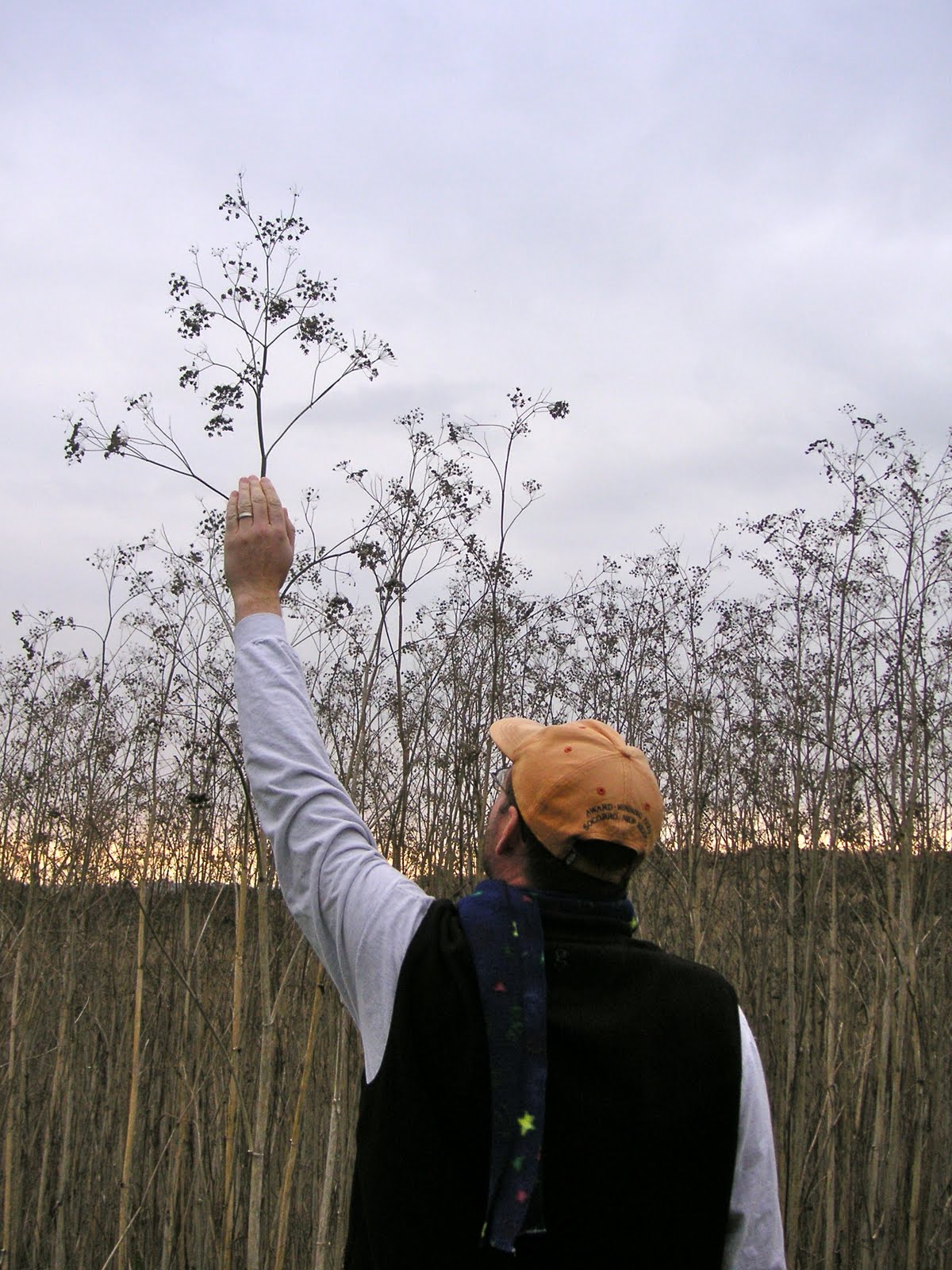
While poison hemlock gets very little mention on the recently revised official Elkhorn Slough site, in my humble opinion, it is the single most dominating weedy species on their coastal, publicly-accessed grasslands. There are massive stands of it, not only in the expansive area it encompasses but also in height. Andy was kind enough to provide a size comparison for me to show it readily grows to 8 feet tall at Elkhorn.

Per my m.o. for Nature ID, all these photos were taken on November 12, 2011. This means the typical blurb repeated everywhere from books to online that C. maculatum flowers from April to July is not entirely correct. It's obviously flowering here in November, so it's no wonder it's such a productive plant. The flowers and leaves remind me very much of Queen Anne's lace and garden carrots.

I was sorry to see Land Steward ceased blogging about Elkhorn Slough. In fact, I discovered several blogs that featured Elkhorn Slough have stopped abruptly in the past two years, which makes me wonder if all the staff and volunteers were asked to stop blogging about their experiences. I now receive weekly, glossy, sugar-coated e-mail updates on what is going on there. It's too bad; I preferred the nitty-gritty and personal perspective of the reality of land management.

Did you notice the other unwanted resident in the first photo, a cucumber beetle?

Oop, I guess I should also note that there are other hemlocks out there besides the ones in the Apiaceae, aka carrot family, such as those in the pine family like Tsuga spp.

harding grass ~ 11/12/11 ~ Elkhorn Slough


Sigh... off the beach and back to drier land. My brain has to switch some serious gears for Nature ID. I occasionally overlook the fact that Elkhorn Slough used to be a farm. I'm often so preoccupied simply being in awe of the estuary, or looking for birds close enough to photograph, or seeking out native plants, which, pardon the expression, is like looking for a needle in a haystack. The official Elkhorn Slough site has a nice write-up on this common grazing grass.

Friday, July 22, 2011

dodder and pickleweed ~ 07/22/11 ~ Elkhorn Slough

salt marsh dodder on pickleweed

The orange stringy stuff is dodder, and the cactus-looking plant is pickleweed. When I first saw dodder at Elkhorn Slough, I thought someone's brightly-colored, tangled, plastic fishing line had washed in from the last high tide. It took seeing dodder at Pinnacles, too far away from any fishing, for me to figure out it is a plant, parasitic and alive.


blooming salt marsh dodder
Cuscuta salina 
Convolvulaceae (formerly Cuscutaceae)

So, imagine my further surprise to find dodder blooming... not just tiny little blooms, but relatively good-sized white blooms, way bigger than the thin orange stems supporting them. As of 1998, it has been moved to the morning glory family. Wild.


blooming pickleweed
Salicornia virginica (aka Salicornia depressa, Sarcocornia pacifica)
Amaranthaceae (formerly Chenopodiaceae)

When I first saw the dodder blooms, I thought it was the pickleweed blooming. Nope. Pickleweed has barely noticeable white blooms as shown above, which apparently has allergenic pollen. It, too, has been moved to a new family.

ps 10/07/11 - I wished I had linked to the reference of where I read the pollen was allergenic. I do remember a volunteer-looking fellow had stopped as I was taking these pictures to point out the tiny flowers on the pickleweed. We had a brief quip about how that was unexpected considering the more showy dodder blooms. In any case, the main reason for this postscript is that Wanderin' Weeta states the white stuff on the pickleweed are actually salt crystals, not flowers. I haven't been able to find any information about this. Do you know?

bull and milk thistle ~ 07/22/11 ~ Elkhorn Slough

bull thistle (left) and milk thistle (right)
Cirsium vulgare (left) and Silybum marianum (right)
Asteraceae

posted 09/28/11 - The above are easily identifiable and distinct. However, I recently realized that I often falsely assume look-alike plants do not grow right next to each other. Once I think I've made an ID, I walk by similarly looking plants believing they're all the same. I may have hastily overlooked differences in patches of Clarkia, Delphinium, early leaves of soap plant and death camas, and false Solomon's seal. In upcoming posts, I'll have additional examples of this.


cliff swallow ~ 07/22/11 ~ Elkhorn Slough

juvenile cliff swallow
Petrochelidon pyrrhonota (formerly Hirundo pyrrhonota)

posted 09/26/11 - This poor little thing had fallen out of its nest. The dutiful parents were still swooping down to feed it even though people were only feet away from the entrance to the nature center building. Judging by the amount of piled poop, I wonder if it was close to being fledged. By the time we returned from our hike the juvenile cliff swallow was gone. Surely it didn't fly away on its own? We went inside to inquire what had happened. One of the volunteers is a wildlife rehabilitator and took the bird. Apparently, there were many things wrong with it, including open sores and a misshaped wing. I know bird lice are common, but that wouldn't necessarily explain the open sores. And, how would one rehab a bird with a misshaped wing? My question was shrewdly evaded by the volunteer.

I've posted pictures of cliff swallows at Elkhorn on 05/13/10 with their distinctive gourd-shaped nests. The volunteers told us that the odd wooden structures in the meadows were built specifically to lure the cliff swallows to nest there, instead of on the nature center and research buildings. It didn't work. That may explain why for a couple years I noticed strips of reflective ribbon exactly where this bird's next was.

ps - I often don't think things through before commenting on others' blog posts. I couldn't figure out why Tree in the Door's Fauna and Flora has pictures of cliff swallows in cup-shaped nests, like what barn swallows have. Duh! I should have noticed the birds were adult and that they were just starting the process of building their nests.

chicory ~ 07/22/11 ~ Elkhorn Slough


posted 09/16/11 - I'm very fond of this weed. Not only is the light lilac color my favorite, I have cherished memories of when I first saw it in Ohio. During the college years, we lived in a rather poor neighborhood of Cleveland, and this plant, ever the cheerful survivor, would spring up through the cracks in the sidewalks and in abandoned lots. I ignored the rusty hypodermic needles, brown bag wrapped empty bottles, and McD's wrappers strewn about the streets, and I would focus on the thrill of seeing my favorite color. Sonja told me how the roots have been used like coffee. That was the first time it ever hit me that wild plants could be used as food, and this is coming from a girl who grew up on a family farm. My naivetƩ seems silly now, but I really didn't know much about the world around me. Maybe I still don't. I think I've seen chicory occasionally here in CA, but until now I wasn't sure since it's not often that I see the same plants that live in OH as in CA, even if they're weeds. For what it's worth, chicory supposedly is native to Europe.

curly dock ~ 07/22/11 ~ Elkhorn Slough


posted 09/12/11 - I usually only notice this non-native (and other Rumex spp.) sticking out by its reddish-brown, erect, mature form. I believe I've seen it frequently in the late summer vernal pools at Fort Ord (the second picture in my post from 08/04/10 shows a good example). I was surprised to discover this is classified as Polygonaceae, the buckwheat family; although, worldwide I think the family is better known as the knotweed family. To my untrained eye, docks seem very, very different from buckwheats. Wikipedia says this originated from Europe and western Asia. Cal-IPC and UC IPM classifies this non-native as a limited invasive weed.

Sigh, I'm still trying to examine my prejudices against non-natives and will probably post more non-natives here on Nature ID. Isn't that the American way? Non-natives making a new life for themselves, surviving and succeeding in a new environment against all odds? Apologies, the media proliferation of the 10-year anniversary of 09/11 is still running through my head, and I'm wondering what it means to me to be a naturalized citizen of the United States of America. If anything, the seed coverings are an interesting form.

field bindweed ~ 07/22/11 ~ Elkhorn Slough

field bindweed / orchard morning glory
Convolvulus arvensis
Convolvulaceae

Seriously, after this post, I think I'm going to stay away from even attempting to identify bindweeds/morning glories. Between Calystegia, Convolvulus, Ipomoea, and Polygonum/Fallopia convolvulus (black bindweed) there are at least 51 sp./ssp./var. in CA with multiple name changes. Of those there are only a handful distinctive enough for non-experts like me to ID on the spot. Based on Wikipedia, I'm guessing this is the narrow leaved Convolvulus arvensis var. linearifolius. As a comparison, see what I think is the broader leaved variety from Hopkins.

Saturday, October 16, 2010

dusky-footed woodrat house ~ 10/16/10 ~ Elkhorn Slough

dusky-footed woodrat house
Neotoma fuscipes

I have absolutely no idea what made this. I would estimate it's about 4 feet wide and about 5 feet up off the ground and within 20 feet from the slough water. There looks to be a clear hole leading from the main tree branch. We actually spotted 2 of these nest/den thingies within 50 ft of each other; they're kinda hard to miss since they're so big. I would have tried to get a closer look, except the poison oak was particularly dense around the trees. I'm guessing some kind of mammal made this. Does anyone know what it is?

ps 02/11/11 - I originally posted this as an unknown nest or den. Thanks to commenters both here on Nature ID and Flickr, I've learned it's the house of the dusky-footed woodrat.

Pacific aster ~ 10/16/10 ~ Elkhorn Slough

Symphyotrichum chilense (formerly Aster chilensis)
Asteraceae

posted 02/05/11 - I double-checked the Elkhorn Slough Plant List and this is the only aster on record. As a note, I'm going with Calflora's new genus name Symphyotrichum, rather than the more commonly known Aster chilensis (there's a spelling difference in the species name that complicates search queries). In my humble opinion, I'm wondering if this might not be Symphyotrichum lentum (Suisun Marsh aster), but considering there's no record of this in Monterey County, I'm going with the more common species on this ID.