Showing posts with label * permissions granted. Show all posts

Tuesday, February 25, 2014

Annaphila depicta ~ 02/25/14 ~ Pinnacles

Annaphila day-flying moth nectaring on California milkmaids
Annaphila depicta nectaring on Cardamine californica
Brassicaceae

This is the same sp. moth I photographed on March 4, 2011, but these new macro shots are much clearer.  Three years ago, I had alerted Paul Johnson, Wildlife Biologist for Pinnacles, that it was on the wing.  A couple days later he was able to net a specimen for the Park's collections.  It was a new sp. for him, and he has since confirmed its ID.  Now, he's asked my permission to store my top photo in their wildlife observation files for interpretive/educational use.  Cool.  Not bad for my 10-year-old point-and-shoot.  Paul says his DSLR makes too much noise (slap of a mirror?), which scares off this beautiful moth in a blur.  Fancy-schmancy doesn't always get the goods.  Hehe.

There's also a fabulous fly in the second photo, but I'm ID'd out.  Can you ID?

ps 03/13/14 - I noticed the first set of Hodges 9866 photos in the Moth Photographer's Group by John Davis are misidentified.  I think BugGuide got it right, and they're A. macfarlandi and should be moved to Hodges 9867.  I don't know what happened to MPG, but they don't seem to be curating their collection as well as they used to.  It happens.

Friday, February 21, 2014

western blacklegged tick ~ 02/21/14 ~ Hatton Canyon

female western blacklegged tick (lookalike in eastern US - deer tick)
Ixodes pacificus (lookalike in eastern US - Ixodes scapularis)

posted 02/27/14 - I remember hearing adult female blacklegged ticks are about the size of a sesame seed, so I thought I'd compare.  Yep.  It's 2 or 3 mm long, depending on if you include the relatively massive mouth parts.

She is my souvenir from Hatton Canyon.  Within 4 hours after strolling through the canyon, my left side began to feel really sore, as if I just had a vaccine shot that gives a strong punch.  I've been generally achy all over anyways due to lingering bike accident injuries, so I kind of brushed it off.  But it kept hurting more and more, so I took a look in the mirror.  Heey, I don't have a mole in that location.  What is that?  Ooof, a tick!  

My immediate reaction was to pull it off immediately.  I think you're supposed to be careful in how you do it, so as not to break off mouth parts or inadvertently squeeze any potential bacteria into the bite wound.  Eh, that's not my instinct.  Get it out, now!  I broke a couple of her legs in the process, as you can see in the picture.  It amazes me how they can get their mouth parts so far into the skin.

I've only ever been bitten by a tick twice before (that I know of), once on my eyelash line while camping on a friend's farm in southern Ohio (I thought the shadow in my view was a crusty chunk of sleep), and another in my butt crack from a day trip to Rocky Creek (it felt like a wedgie). Neither of those bites hurt at all.  So, I was really surprised at what a punch this one gave me for a little more than 24 hours after tick removal.  I kept saying, "I can't believe how much it hurts."  Thankfully, it doesn't hurt at all now.

I'm generally pretty diligent in doing tick checks, which can also be fun with a partner. Who knew "tick check, tick check" could be a bedroom call?  Eh-hem.  But this time, it didn't occur to me I had been on a "hike", so I didn't check, even though Hatton Canyon habitat matches tick territory to a T.  Doh!

bite site on torso 24 hours after removal of tick

No, that's not my boob.  Had to use a flashlight to get a clear shot of the bite site.  It's exactly the diameter of a pencil eraser.  I'm watching it for infection or a bull's-eye ring. Although, the hypochondriac in me is convinced I'm developing symptoms of anaplasmosis.  I have been feeling less than spectacular this week.

There are a surprising number of tick sites online, and who knows how reliable most of the chat community compiled information is anyways.  Lyme disease gets a lot of publicity, but it's not the only tickborne disease.  In addition to my standard links in the ID above, I want to call out a few reputable sites by name (click around, they did an excellent job!):

And lastly, for a parasite souvenir to beat them all, check out fellow blogger Camera Trapping Campus' bot flies from Belize.

ps 03/08/14 - TickEncounter contacted me fairly quickly confirming my ID and asking what type of seed was in the picture I submitted via their online form.  I replied with a link to here.  Whoa!  Whoever is writing me sure has a lot of character.  S/he is incredibly interested in Garrapata State Park, which means "tick" in Spanish.  I gave them local CNPS and FOG contact information, folks I figured would be most familiar with Garrapata's ticks.  They also asked me if they could adapt my blog post for TickEncounter.  Sure.

With their permission and edit (which I found curious), here's what they said, "Thanks Katie for the backstory. One of those other tick bites must have been a western blacklegged tick, too. That earlier bite "primed" you to react like you did.  Our studies suggest strongly that a certain protein or proteins in the tick saliva stimulate an IgE response. On re-exposure, the antigen-bound IgE also binds to basophils through their Fc receptors, activating the basophils to release their "payload" of histamine and other cytokines--resulting in the immediate type hypersensitivity rxn that your body so aptly displayed.  Itching from a tick bite might seem annoying but hey, if it helps alert you to the tick so you can promptly remove it then maybe its a good thing." 

Well, I have to say I wouldn't call the pain I felt with my bite as "itching".  In any case...  Doh!  A classic Jones-Mote levels of hypersensitivity!  That's why I didn't have a reaction from the first bites of 2 different species of tick, my body hadn't made antigens yet.  It's interesting that my initial lack of reactions look like they're specific to the type of tick (Ohio does not have I. pacificus).  I barely remember this from my Medical Entomology class (I think professionals use another reaction model now besides Jones-Mote), but the first time someone gets bitten by certain insects and related, they will not have a reaction.  None.  I'm serious.  Hence why I think so many diagnosed with Lyme disease never even knew they had been bitten by a tick.  Given enough time (~2 weeks?) for the body to create antigens, there will be an immediate reaction upon the 2nd bite.  More bites?  Then a delayed reaction after a day or more.  Eventually if bitten, like constantly, the body will go back to not having a reaction at all.  Crazy, huh?  (Disclaimer: I could totally be recalling this incorrectly, but I can't find anything online that isn't bogged down in immunoglobulin gobbledygook.)

Monday, February 10, 2014

convergent lady beetle ~ 02/10/14 ~ Stevens Creek


Holy cow!  Wow!  Just... wow.  When I first heard about this phenomena happening in the Sierra Nevada during my first entomology class 20 years ago, I mentally placed it on my bucket list of things I wanted to witness firsthand.  In my mind's eye, I had pictured maybe a gallon's worth of beetles at the base of a large tree.  Actually seeing this exceeded all my long-held expectations... by a long shot.  Wow.

During my museum stint in Cleveland, I fielded calls about aggregating ladybugs around Halloween, but instead of doing their thing out on the forest floor like shown above, the introduced multicolored Asian lady beetles (Harmonia axyridis) preferred the warmth in or on human structures.  I don't blame them, it's gets awfully cold in Ohio. Imagine having a horde of ladybugs on the wall of your living room?  Interesting, but not pleasant to live with.  They make such a mess and are not good house guests.  My advice to folks who called was to use a vacuum cleaner, as this Ohio State Extension Fact Sheet clearly explains.

There are lots of different kinds of lady beetles and many of them look very similar. According to Powell and Hogue, there are more than 125 spp. in CA alone.  I couldn't find any information on whether all lady beetles gather in some capacity for the winter or not, or even if they move their gathering spot around.  I believe the recent, decent rains helped create this massive and extensive aggregation.  By the next day, Randy @ Way Points discovered there were much fewer here, but his pictures are still impressive. I've heard the term hibernate thrown around when referencing lady beetles, but I don't think that's an accurate use of the word.  Does anyone have a better descriptor for what lady beetles do in the winter?  Diapause?

Sigh... now, this was one of several of our day's findings which prompted some discussion about, as Cindy put it, the "delicate process of protecting natural resources on public land."  I have to admit, that's one thing I do not miss about being affiliated with an institution, organization, or governmental body - that kind of public tiptoeing over my own sheer joy of nature.  For my own blog, I've laid out some basic, good-sense ground rules and generally don't worry about what other people will do with the limited information I choose to share.  However, this time I'm trying to be especially respectful of other people's concerns.  So, in the interest of sharing the wonder of nature, I've been given the green light to post about this very cool lady beetle phenomena... despite the fact there are people who could profit from such a find.  Indeed, most of those garden centers that sell ladybugs?  Well, where do you think they get them?  Eh-hem.  My advice?  As a rule of thumb, do not purchase lady beetles, even if it superficially appears to be the "green" thing to do for your garden.

ps 08/22/14 - Cat Ferguson from the Awl asked for permission to use my photos to illustrate ladybugs harvested in the Sierra Nevada.  I initially declined, "Thank you for your permissions request and compliments on my photos.  Unfortunately, I am denying your use of my photos to illustrate Sierra Nevada lady beetle congregations, because my photos were taken in the Santa Cruz Mountains - totally different habitat with different trees.  To the trained eye, it is not factually correct.  Isn't the Awl motto Be Less Stupid?  And, for the record, I am against wild-collecting ladybugs for sale as natural pest control.  Due to their documented seasonal pattern of winter congregation and then obligate flight dispersal before chowing down on aphids, they are not effective as directed pest control.  All collecting achieves is quick money for the sellers and a disruption of natural processes, which could potentially have a negative impact on our native beetle populations."  After assuring me her article would be about general Northern CA ladybug populations, not just Sierra Nevada, and about the ineffectiveness and problems with wild collection, I finally agreed for a fee.  Eh, my photos ended up not being used, and that's fine by me.  Cat's "The Flight of the Ladybugs" contains an interesting tidbit  from a 1919 California State Commission of Horticulture bulletin about dispersal of the ladybugs.  We've known for almost a hundred years that releasing ladybugs at a location doesn't work, and yet it remains a commercial enterprise?  Too bad.  I've got a bridge to sell you.

Saturday, December 7, 2013

coast live oak ~ 12/07/13 ~ Fort Ord

Fagaceae

As we were driving out to the Creekside entrance on Hwy 68, I noticed most of the oaks had dead tips.  Speeding past, it looked like a deep green mosaic with scattered bits of tan.  I don't think this is sudden oak death, which is caused by a fungus-like pathogen.  I'm guessing it's caused by true fungal diseases, some of which apparently show themselves more when the oaks are drought-stressed, like this year.  I'm not quite sure how that works since fungi generally like moisture.  Right?  This looks very different from the swaths of entirely dead trees I saw last year at Toro Park, which is located right across the street of Hwy 68.  The U.S. Forest Service Pacific Southwest Research Station has an excellent technical report "A Field Guide to Insects and Diseases of California Oaks".  Maybe it's Diplodia quercina branch canker (pp. 88-89) or Cryptocline cinerescens twig blight (pp. 76-79)?  I really don't know.  I'm no tree doctor.  Half the time I can't even distinguish coast live oak from other Quercus spp.  In any case, this widespread dieback is interesting to note.

ps 03/12/14 - An intern from a local paper The Californian contacted me regarding this post.  She wants to use my pictures and information in an article she's writing.  This is the first time I've ever been contacted by a newspaper for Nature ID, so it was an interesting experience... I think for the both of us.  She was sweet but sounded a little nervous.  I gave my photos free of charge, because I didn't want the hassle of creating an invoice and dinging for payment (so many places conveniently "forget" to actually pay).  I'll link to the article once it comes out.  Cool beans.

Thursday, April 18, 2013

lots o' lotuses ~ 04/18/13 ~ Huckleberry Hill

Bentham's deerweed / Bentham's lotus
Fabaceae

Fabaceae

Fabaceae

Fabaceae

Fabaceae

Oy!  The 2nd edition Jepsons Manual released last year with its classification overhaul has thrown everyone for a loop, from the reliable memories of old-time native plant folks to the extensive databases of Jepson eFlora, Calflora.org, and CalPhotos.  The embedded links I've included in the names above were a little challenging to track down.  Lotus had most plants split off into Acmispon (deerweeds) and Hosackia (lotuses).  I wouldn't have attempted this post if I hadn't had the expert guidance of an experienced local CNPS member pointing out all these plants to me.  Our local chapter president asked me to accompany this fellow and make a record of what and where he collected for our annual wildflower show.

Speaking of where, my new location label of Huckleberry Hill Natural Habitat Area, which is managed by the Del Monte Forest Conservancy in Pebble Beach, is not the same as my previously featured Huckleberry Hill Nature Preserve, which is managed by the City of Monterey. While these two locations are only across Hwy 68 from each other, I think I see slight differences in habitat resulting from different historical land uses.  For those who live around here, this location is what's better known as the "quarry entrance" off Holman Hwy.

Thursday, November 3, 2011

habitat ~ 11/03/11 ~ Morro Strand State Beach


When I first started Nature ID back in May 2009, Andy I were visiting San Luis Obispo County a little more frequently than we do now, and my blog subtitle was "from the Central Coast of California." Thanks to school and changes in our lifestyle, we stay closer to home in Monterey County these days, so I've re-subtitled Nature ID to reflect the change of location focus.
However, it's only been 3 weeks since I last visited this beach on October 12, 2011 in Morro Bay, about 150 miles southeast of Monterey Bay. The weather couldn't have been more different with a high of 67.5°F compared to the 92.8°F previously.

My friend Jennifer, who is also a regular commenter on
Nature ID, loved my sand dollar shots. Since she had never really been to Morro Bay, I thought it'd be a good idea to play hookey from our responsibilities and do a girls' trip. And, yes, she found many, many sand dollars, not to mention added new bird sightings to her brother's Birdpost [no longer available] site.

Heavy sigh... Morro Strand State Beach is on the list for closure in the coming year along with 69 other CA State Parks. Unlike back in 2009 when Mr. Terminator proposed closing 80% of CA's 278 State Parks, this year's threat of closure feels realistic and more serious. While I can see them closing and fencing off the campground, I just can't imagine any agency being able to keep people off this awesome 3-mile beach. With no restrooms, no refuse containers, or other maintenance and management, I predict the quality of this beach will quickly go downhill. Public-private partnerships have been organized to attempt to fill the gaps throughout the state, but it takes a cadre of folks willing to volunteer their money, time, sweat, and expertise. Randy at Way Points has been vocal with his posts about Trail Closure at Garrapata and Henry Coe gets a Reprieve. I'm surprised other CA nature bloggers I follow haven't said much on this very important and relevant topic. Save Our State Parks seems to me to be the best organization out there spreading the word.

ps 05/31/12 - The Central Coast Natural History Association Executive Director contacted me and asked if they could use my last picture of the SOS sign alongside the standard brown State Parks sign on the cover of their "Nature Notes" newsletter. They're a non-profit that raises money for their local SLO County State Parks and have been fighting to keep these special parks open for over 4 years. Of course, they have my permission! I sent to her a few higher resolution image files from which to choose.

Wednesday, August 24, 2011

Santa Barbara sedge ~ 08/24/11 ~ Fort Ord

Santa Barbara sedge
Carex barbarae
Cyperaceae

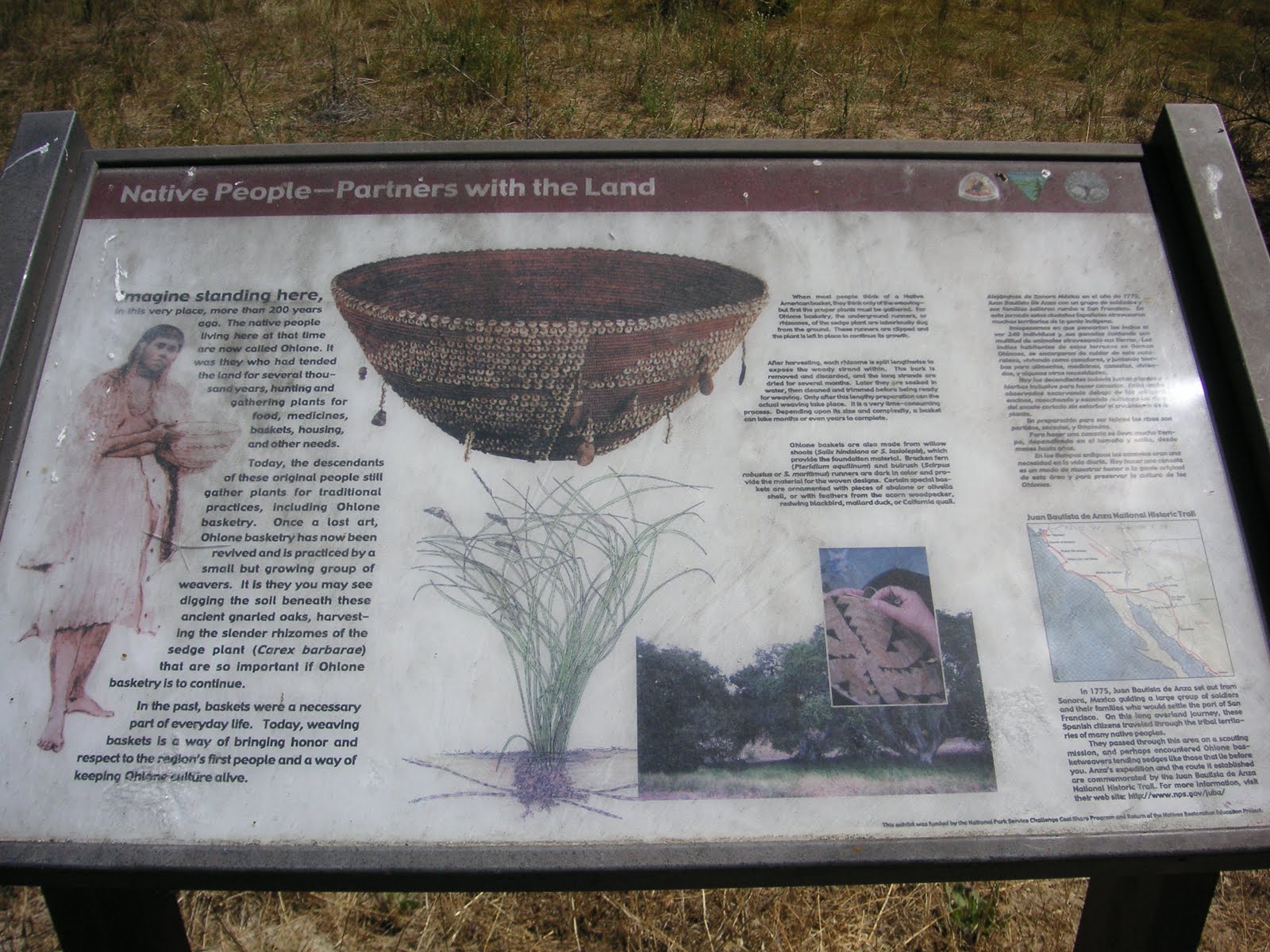
I normally stay away, far away, from sedge IDs. According to Calflora.org there are at least 292 members of the sedge family in CA alone, with 179 of those belonging to the genus Carex. Oh my! However, it helps to have a handy-dandy interpretive sign that identifies the Santa Barbara sedge I was seeing in the distance behind a fence. I was able to find more sedges to take close-up pictures without having to climb through fences or go off trail. Just to make sure, I checked the Monterey Bay Chapter CNPS Fort Ord plant list, which also names short-stemmed sedge (C. brevicaulis), round-fruited sedge (C. globosa), Monterey sedge (C. harfordii), sand dune sedge (C. pansa), clustered field sedge (C. praegracilis), and rusty sedge (C. subfusca). Luckily none of those look anything like Santa Barbara sedge, so I'm fairly sure of my C. barbarae ID. Since I have yet to figure out how to embed links to PDFs, here's an interesting google book view of California Riparian Systems with more information on indigenous sedge basketry. For additional references, check out a University of Michigan page I found. My main question from looking at sedges for the first time is: Are the brown things considered flowers or seeds?

Saturday, May 14, 2011

sand gilia and Monterey spineflower ~ 05/14/11 ~ Fort Ord


sand gilia and Monterey spineflower
Gilia tenuiflora ssp. arenaria and Chorizanthe pungens var. pungens
CNPS 8th Edition Inventory and CNPS 8th Edition Inventory
Polemoniaceae and Polygonaceae

This pretty little purple sand gilia, aka Monterey gilia, is listed as federally endangered and threatened in the state of CA. The dusty-pink clumps to the right in each picture is the Monterey spineflower.  I believe these pictures were taken in a 2003 burn area. The white flowers shown in the second picture are popcorn flowers (Plagiobothrys sp.) in Boraginaceae. Considering there are at least 7 species of popcorn flowers found at Fort Ord, I'm not going to attempt to identify it tonight from the fuzzy photo. 

Monday, May 2, 2011

silver-spotted tiger moth ~ 05/02/11 ~ at home

silver-spotted tiger moth caterpillar (or nameless arctiid moth) feeding on Monterey pine
Lophocampa argentata (or L. sobrina) feeding on Pinus radiata
Pinaceae

I laughed at how this caterpillar chomps the pine needle like it's eating a giant, long green bean. To see how beautiful this caterpillar is see my 03/15/11 post. As a recap, the pictures of the silver-spotted tiger moth caterpillars (Lophocampa argentata) on BugGuide were browner than what I found in the Carmel Highlands. Hmm? I consulted Chris Grinter of The Skeptical Moth who suggested, based on my location, this caterpillar is L. sobrina; he has since made a comment on BugGuide. Unfortunately, I have not found any other L. sobrina caterpillar images correctly identified on the internet to compare with mine. Actually, there is some question among the experts whether L. sobrina (sorry, there's no common name) is indeed a distinct species from the silver-spotted tiger moth. I also queried Jerry Powell and Paul Opler, co-authors of Moths of Western North America, a hefty book which was released last year. All three moth experts had differing opinions, but Paul had the best advice: raise the caterpillar to an adult to obtain a positive ID. Adult Lepidoptera are better documented and easier to identify. So, that's what I'm doing.

I collected my first caterpillar in the Carmel Highlands on 03/31/11. I found a second caterpillar on 04/20/11 at home and within feet of our local subspecies of the Douglas-fir, L. argentata's favored food. Then on Easter 04/24/11 in the Highlands, I gathered a much larger caterpillar on top of California hedge nettle (Stachys bullata). Finally, I found a fourth caterpillar climbing up the wall nearest the coast Douglas-fir at home. I'm guessing I collected it 04/30/11 while sitting outside to get fresh air, because I returned home from the hospital the previous night. As soon as I found it, I asked Andy to go cut more caterpillar food for me. Gotta love the man! After days of sitting by my hospital bed watching the Food Network (we don't get it at home) in between doctors and nurses visits, while tubes and wires connected to fancy machines beeped and hummed, he then obliged me by tromping through the park to get clippings from various trees. Well, you can guess where my priorities are... must feed my caterpillars first!
silver-spotted tiger moth caterpillar (or nameless arctiid moth) on coast Douglas-fir
Lophocampa argentata (or L. sobrina) on Pseudotsuga menziesii var. menziesii
Pinaceae

I want to show off the cute lemon yellow prolegs of this caterpillar. I have to say, that while these caterpillars did eat some coast live oak (Quercus agrifolia var. agrifolia), they seem to prefer the Monterey pine and coast Douglas-fir. I even tried to feed them various other plants, but they were totally not interested. They also like to feed during the day and get very still at night. Do caterpillars sleep like us humans?


Lophocampa argentata (or L. sobrina) cocoon

This was the largest caterpillar collected from the Highlands on Easter and it started making a cocoon the day before this picture on 05/01/11. Notice the loose hairs mixed in with its silk to make the cocoon? Unfortunately, I disturbed it to move the remaining caterpillars into their roomier home with fresher food.


Lophocampa argentata (or L. sobrina) cocoon lit from behind

I had to see how far along this caterpillar was to pupating, so I held the cocoon up to the light. It wasn't very far along. I've since looked at it again against the light and it looks like it's shed its larval exoskeleton and has the distinctive pupal shape that looks like a turd. I'll try to get a picture of that later.


Lophocampa argentata (or L. sobrina) cast exoskeleton
This may look like a dead caterpillar, but it's not. This is what is left behind when a caterpillar molts in order to grow into a larger caterpillar. I try not to repeat better information that can be found on the web, so if you really want to know, go look it up yourself.

Apologies for this atypically lengthy Nature ID entry. All these pictures were taken on the same day as this post's date of 05/02/11. I've missed doing my blog while I've been sick. I'm now 13 days behind with my posts and I want to catch up. Watch out for multiple posts in any given day...

ps 05/27/11 - Another caterpillar molted this morning and it's very white compared to my other remaining caterpillar of this sp. I was nervous, because it didn't move much for a couple days - I had one die last weekend. I took a close look at the dead one and it looks like some parasite had attacked it. There were numerous tiny cream-colored spots on the underside of its body. I never did get around to pulling out my dissecting scope to take a magnified look.

pss 10/16/11 - Greg Monson, Founder and Head of Production at Lost Nomad Media, requested permission to use the first photo above. With his permission, here's what he said, "I found your post on caterpillars while I surfing the internet. I'm currently editing a research documentary for a professor at the University of Arizona, and your first picture of the caterpillar eating the needle is perfect for a segment in the film where I mention how pine needles are a form of sustenance for insects." He goes on to say, "I'm wondering if I could have your permission to use the photo in my video. The film is a 12-minute short documentary on a research experiment being conducted in Colorado, where they are looking into the role that terpene molecules from pine forests play in generating clouds. It will be published on youtube, and the University of Arizona website, and I will be happy to give you credit for your photo. This is the first of a series of videos my company is producing to promote outreach from the scientific community to the public." I'll add a link to the video when it becomes available.

pss 01/11/12 - Here's the link to the video: http://cals.arizona.edu/research/monson/terpenes.

Sunday, March 20, 2011

habitat ~ 03/20/11 ~ Fort Ord - BLM InterGarrison

Fort Ord Public Lands - InterGarrison entrance
March 20, 2011

Considering it had been raining for a solid week before this hike, and indeed during our hike, all the vernal pools we passed were filled. They look like lakes, but most of them do dry up by the end of summer. Many rare plants can be found around the vernal pools, including Hickman's popcorn flower, which we found completely submerged by the recent rains.


This is quite possibly the largest vernal pool at Fort Ord. It extends to about twice as wide as shown in the picture. The InterGarrison parking area, consisting of a sand lot with no facilities, is located straight as the crow flies to the left of the water tower and a bit beyond.


I took this photo to show how this particular meadow looks before the sky lupine really gets going. There is only one lone lupine blooming now with some fiddlenecks. For a comparison photo taken from almost the exact same spot, see my May 8, 2010 lupine post.


This photo is looking southeast over towards the Creekside entrance where the trails are a bit more established and erm, less dangerous...


And the last photo is a reminder that the BLM lands were once an Army training site. I didn't get a great shot of the sign, because I was more interested in the brush clearing they were doing of a trail that had been previously open. The sign says, "Danger. Do not enter. This area is being investigated for ordinance and explosives." I got on my soapbox and mentioned this in my star tulip post from this hike.

While I don't particularly like hiking in the rain, Andy convinced me to get out there with hopes to see the bobcat he spotted the day before during a trail run. We only saw some bobcat poop in the usual places. I have to say, I think Fort Ord is becoming my favorite local place to hike, even more than Garland Ranch Regional Park.

ps 05/12/12 - At the end of April, I was contacted by a California Stare University, San Jose student who is working on a group project regarding California coastal wetlands. Apparently, Fort Ord vernal pools was his assignment for a presentation. Since his photos from a March 8 personal tour were of very dry vernal pool areas, he used and credited my first 2 pictures above to show vernal pools at Fort Ord with actual water in them. It pleases me that students and university professors are finding my blog for first-hand accounts, which are not simply repeated blurbs found on so many sites.

Friday, February 11, 2011

Monterey pine ~ 02/11/11 ~ Jacks Peak

male cones with pollen

old female cones

pine trunks in native habitat

Monterey pine
Pinus radiata
CNPS 8th Edition Inventory
for more information click here and here
Pinaceae

posted 02/19/11 - If you click on the first photo to enlarge it, you may be able to see the yellow pollen borne on the air to the right of the pic (no, that speckly stuff isn't due to my poor photography skills). During the last week of January, we noticed the thick annual pollen dusting on many parked cars - I wonder if there's some kind of electrostatic charge that particularly attracts pollen to the metal and glass of cars. There are many species of trees in the area, so I don't know if I can blame the Monterey pines for our non-stop runny noses. The recent rains do seem to help alleviate the allergies.

While the Monterey pine tree has been introduced around the world for lumber, apparently, the Monterey Peninsula is one of the few remaining places of native forests; it's actually considered a rare and endangered plant in California. I do find it interesting how the shape of the tree changes as it ages, from a traditional triangular Christmas tree shape when it's younger to a tall, rounded top shape once they mature.

Friday, February 4, 2011

habitat ~ 02/04/11 ~ Hatton Canyon State Property


Hatton Canyon State Park Property
February 4, 2011

There's been quite a bit of local controversy over Hatton Canyon from Caltrans to State Park ownership. Now, I hear there's more controversy over paving a trail through the canyon for bicycle access and concerns about a ban on being able to walk your dog on State Park property's unpaved trails. I have to say we spotted dog poo everywhere, which doesn't do the pro-dog folks any favors. Until I get my facts straight and instead of simply repeating what others have already written, here are 2 links that provide some basic information: Walking and Hiking on the Monterey Peninsula (scroll down 1/3 of the page) and Big Sur Land Trust. During this hike, we accessed the canyon through the newly constructed tunnel under Carmel Valley Road at Highway 1. Given the proliferation of invasive plant species here, it is definitely land that could use some management.

ps 02/26/14 - My original link to the Big Sur Land Trust no longer exists.  It was an informative page about how they're connecting trails.  I wonder what happened.  Instead, here's a nice map of the area under BSLT purview.  And here's a more recent Hatton Canyon habitat post.

Tuesday, December 21, 2010

many-headed slime ~ 12/21/10 ~ Mt. Madonna

many-headed slime
Physarum polycephalum

I have absolutely no idea what group this would even belong. Fungus? Lichen? The yellow venation pattern is visually reminiscent of fall ginko leaves. Does anyone have any clue as to what this is?

ps 01/05/11 and edited 08/18/11 - I originally had this posted as an unknown. It's a slime mold! Who knew this was in the kingdom of protista? Much of its taxonomy is debated beyond my comprehension, but one thing that most agree is that it is not a fungus. And apparently many slime molds move! Thanks to those who have commented, I believe I have a fairly accurate ID of this slime mold.

pss 01/13/11 - Very cool! I had a student from Liverpool John Moores University contact me to ask for permission to use my slime mold picture in her final year project presentation.

pss 08/18/11 - For other blogs posts of slime molds, check out Martin's Moths, Cabinet of Curiosities, and Curbstone Valley Farm. I'm fascinated those in the UK are just now seeing them in late-July to mid-August.

pss 10/09/11 - For an excellent explanation of slime molds with plenty of good links, check out The Biology Refugia.

pss 01/30/12 - Wow, this picture is popular on the internet. I received another permissions request from Mirian Tsuchiya Jerep, a TA for the Biodiversity course at George Mason University. With her OK, here's her request, "I am writing to know if you would allow me to use your slime mold picture in my class. Your picture is so pretty, and it shows where this type of organism is found on the real world, outside the lab. One of my main goals is to make the students connect what they see in the lab with their lives, and that picture is a great example. Of course, I would reference you and your blog as the source. Generally, I post my slides for the students, but if you prefer, I can remove your picture before doing that." Very cool, times two!

pss 11/22/13 - Apparently, this is a popular internet picture.  I received yet another request, this time from Dr. Peer Seipold from the Technical University of Hamburg-Harburg, Institute for Transport Planning and Logistics.  He's going to be presenting a talk about biomimicry and logisitcs (huh?  really? how?) at Magdeburg 2013: Green Innovations.  Amazing.

pss 05/10/16 - My photo above continues to be of interest, despite there being a virtual explosion of Physarum polycephalum photos in situ online compared to the paucity available back in 2010.  A couple days ago, I received yet another request for use of this photo from a blogger in France who is reporting on incredible recent research of the many-headed slime.  Please check out PK Read's Fast Learners.

Sunday, October 31, 2010

CA horn snail ~ 10/31/10 ~ Morro Bay


California horn snail
Cerithidea californica

These shells are kinda of pretty with the blue on the fat end. It's somewhat odd to me that I found these in a town that I visited for many, many years for holidays where we always went to The Shell Shop. They sold the prettiest, polished shells from around the world for pennies. My mother liked keeping an abalone shell filled with various other shells as decoration on our main bathroom counter. Maybe it was a sign of the times. I don't know. I do remember not being particularly keen on cleaning them when they got covered in household dust during my weekly bathroom chores. Now, I feel a little repulsed by any collection of animal parts on display as art or decoration, without any knowledge of what they are. "Pretty" just doesn't do it for me anymore.

With a quick search online, I didn't find a decent site describing C. californica, but I'm fairly sure of this ID. Several sites mention the CA horn snail is similar looking to the introduced Asian horn snail (Batillaria attramentaria), which I've posted about before. However, when considering the location, relative density of the horn snails, and looking at pictures of each without being completely covered in mud, the visual cues seem fairly obvious. Despite my hesitation to promote online commercial interests, I found Conchology, Inc. to have an excellent pictorial comparison of snails in the Potamididae family.

ps 10/01/11 - I was asked this week for permission to use my photos of CA horn snails by a journalist from Pour la Science (apparently the French version of Scientific American). I was pretty chuffed that someone from France found my pictures and wanted to use them in a respectable publication, online and in print. During our e-mail communications, I pointed out that I am not a malacologist and that my IDs are my amateur best guesses. Hey, I really do try to be honest and up front. I'm not sure how that translated into French, but she ended up declining use and thanked me for my time. I remember how long it took me to make this Cerithidea californica ID, and I'm 95% sure I got it correct. Before granting permission, I admit to holding concerns about knowing exactly what the article was supposed to be about and whether to charge $ for use (more for those bloggers who use their blogs as a way to advertise their own professional photography; personally, I don't have much interest in that kind of thing). I did not ask pay for use, but I did ask to quote her e-mail request. She didn't respond specifically, so I don't have it available here. I was a bit disappointed my photos are not being used, and my ego got bruised. In any case, her article is already out: http://www.pourlascience.fr/ewb_pages/a/actualite-escargots-volants-28027.php. I assume she received permission from Conchology, which I embedded in my original post above, but she also got the credits incorrect - I seriously doubt Haderman had access to e-photography back in 1840. I think it'd be a tough job being a journalist and writing about things you know very little about.

pss 11/03/11 - I visited this place again to get better pictures and to double-check my ID. Please see my new post on CA horn snails.

Saturday, October 16, 2010

dusky-footed woodrat house ~ 10/16/10 ~ Elkhorn Slough

dusky-footed woodrat house
Neotoma fuscipes

I have absolutely no idea what made this. I would estimate it's about 4 feet wide and about 5 feet up off the ground and within 20 feet from the slough water. There looks to be a clear hole leading from the main tree branch. We actually spotted 2 of these nest/den thingies within 50 ft of each other; they're kinda hard to miss since they're so big. I would have tried to get a closer look, except the poison oak was particularly dense around the trees. I'm guessing some kind of mammal made this. Does anyone know what it is?

ps 02/11/11 - I originally posted this as an unknown nest or den. Thanks to commenters both here on Nature ID and Flickr, I've learned it's the house of the dusky-footed woodrat.

Wednesday, August 4, 2010

poison oak ~ 08/04/10 ~ Fort Ord

Pacific poison-oak
Toxicodendron diversilobum
Anacardiaceae


posted 08/14/11 - Always trying for better photos. Am working on this day's hike from last year, because I just had a spider ID'd by an expert.

ps 07/10/14 - Caltrain asked permission to use the 3rd picture above in a video "Caltrain 150th Documentary - The San Francisco and San Jose Railroad".  Cool.