Sunday, February 20, 2011


California milkmaids
Cardamine californica
Brassicaceae

Um... oh boy, I got an eyeful as I tried to search for more information on this plant. Makes me wonder about the etymological relationship of the family name Brassicaceae with brassiere. I might add more information once I get the boobs out of my memory.

This plant is also known as bitter-cress or toothwort. There's a small section above the waterfall trail at Garland Ranch where I can always count on seeing this small white flower in February.

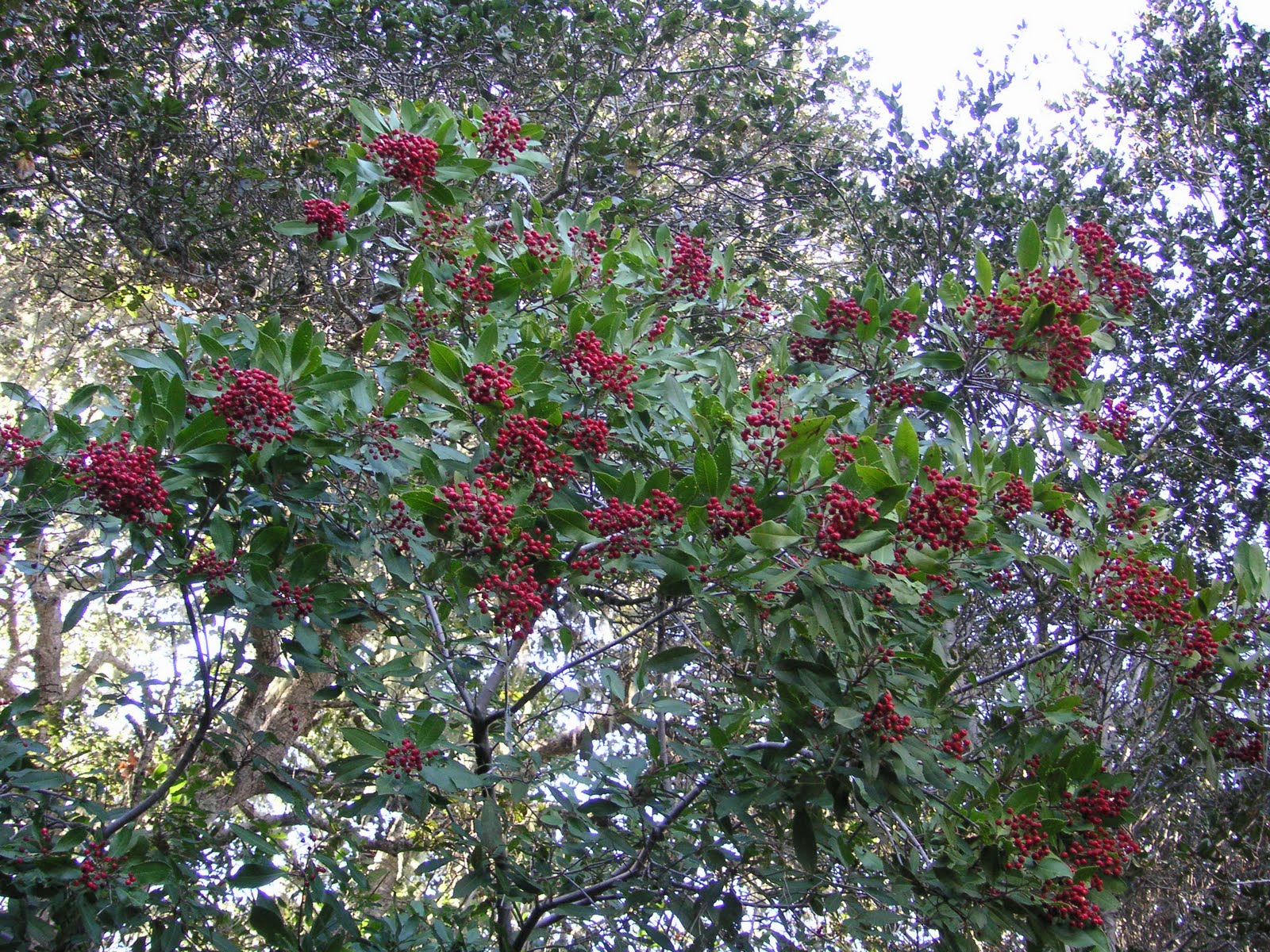
toyon ~ 02/20/11 ~ Garland Ranch


toyon / Christmas berry
Heteromeles arbutifolia
Rosaceae

Despite their bright red berries, I've usually ignored this plant during hikes. Quite honestly, I prefer to look for pretty spring flowers. It's thanks to fellow blogger GretchenJoanna at Gladsome Lights and her comment a couple weeks back mentioning toyon. The common name strikes me as a bit funny; I keep thinking back to those Toyota commercials with people jumping in the air, since I have a couple friends with old, beat-up, red Toyota trucks - funny how the brain works. So, when we checked out the Garland Ranch Visitor Center for a little pre-hike pit stop and to check out the current blooms (they cut flowers and place ID tags for people to see what's currently blooming), the name toyon jumped out at me. They had samples of the red berries but not the white blooms. I'll be on the look-out for the white flowers later this summer. Sure enough, the worn out red berries weren't difficult to find. To help me find toyon blooms later, I made a mental note of the finely serrated leaves and the height of the shrubs. For more information, check out Las Pilitas Nursery.

wedding tree ~ 02/20/11 ~ Garland Ranch


wedding tree
Fagaceae

posted 03/02/11 - No, it wasn't our anniversary when we visited this tree back on February 20, 2011. That was the first sunny day after a week of nonstop rain and we wanted to take full advantage of the nicer weather and get outside. I'll admit I'm a bit sad to see this magnificent tree decline. Other valley oaks (Quercus lobata) were already sprouting new leaves, so I suspect this tree may not have much to show anymore in terms of its own growth. Andy was kind enough to point out to me that the dead branches are now supporting a variety of life, including numerous fence lizards, an unknown nest (shown in the first pic), and numerous fungi, mosses, and lichen. It's the cycle of life. I'm sure we'll visit our tree again come April 8th.

Saturday, February 19, 2011

tree year project 2011, #4

double rainbow from home
February 19, 2011

Although we see double rainbows fairly frequently if and when it rains, this was the best photo I've managed to get so far. I like the colorful umbrellas down on the Rec Trail of people turned to watch this natural beauty. If you look closely, my favorite friendly scrub jay is perched on the top of the unidentified pine toward the center of the photo. And, yes, the coast Douglas-fir that I'm featuring in The Tree Year project barely shows itself in the bottom left.