Showing posts with label x: Garland Ranch Regional Park. Show all posts

Sunday, April 6, 2014

woodland star ~ 04/06/14 ~ Garland Ranch

Saxifragaceae

Thanks to Wildflowers of Garland Ranch by Michael Mitchell and Rod M. Yeager, I knew both hill star and woodland star occur here.  It's been a very handy go-to guide for local plants.  Three years ago I photographed the square-calyxed L. heterophyllum, and I've been on the search for this v-shaped L. affine ever since.  Note the pretty red stem.

ps 04/22/14 - I discovered there are other Lithophragma found in our area.  I just noticed the 3-lobed petals shown above have notches, whereas the green one I photographed at Pinnacles does not.  I don't know if that's a common variation of L. affine.  There is a possibility this is a smallflower woodland star (Lithophragma parviflorum var. parviflorum), but I don't know the difference. 

false turkey tail ~ 04/06/14 ~ Garland Ranch

Stereum hirsutum complex

Look how smooth it is on the underside!  No pores!  From the top, it looks very similar to turkey tail with both having strips of fuzz, but the false's sparser fuzz is longer, even hairy looking. However, I tend to notice the false turkey tail's orange tinge from a distance and thinner edge, like a potato chip.  Plus, during the rainy season, I often see witch's butter with false turkey tail. This batch was growing on a fallen oak, which is typical.

I normally don't go around pulling fungi off wood to take pictures of the underside, but this comparison endeavor was for Cindy @ Dipper Ranch.  I have no idea if these comparisons can be made beyond my local CA range.

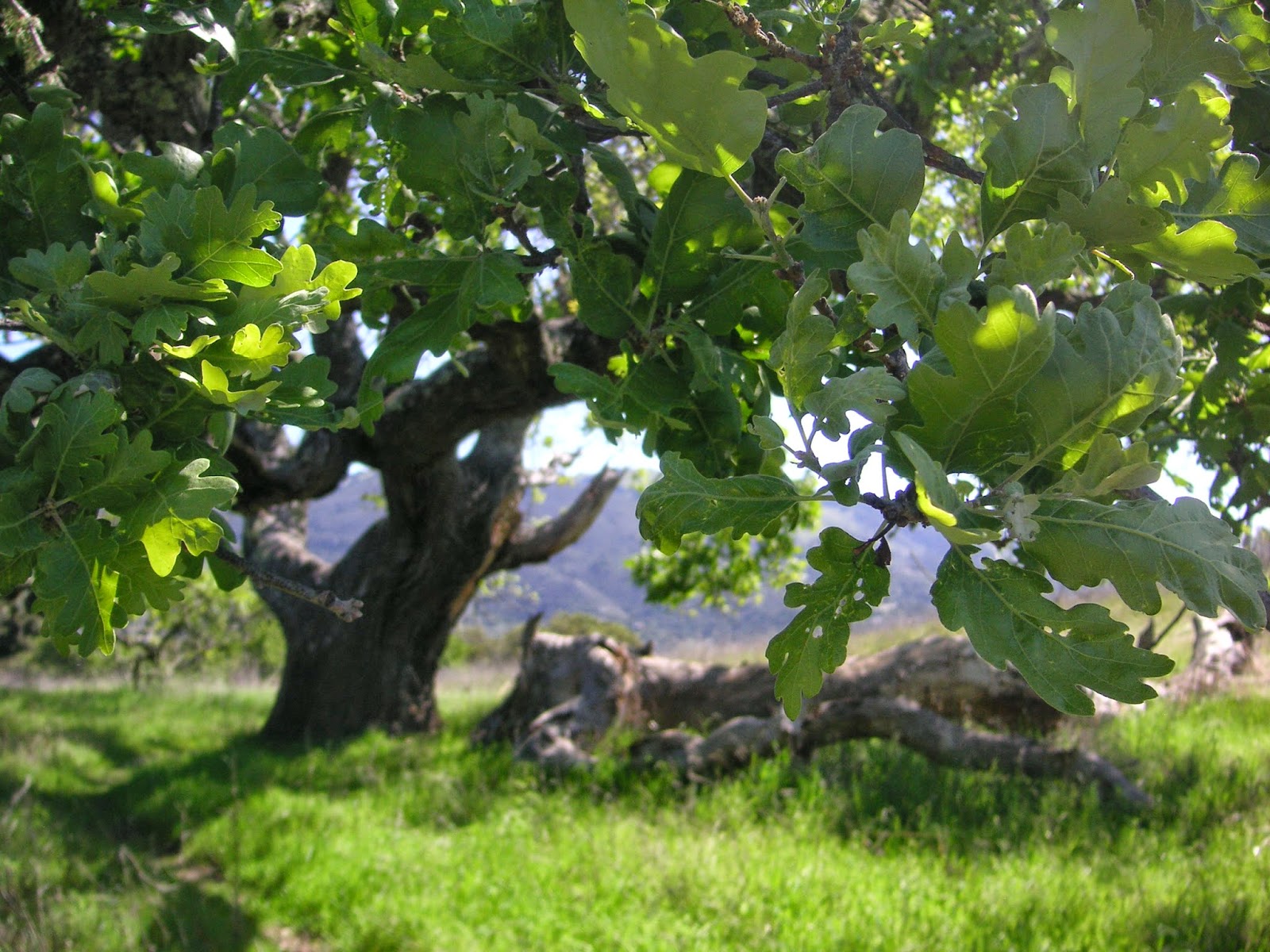
wedding tree ~ 04/06/14 ~ Garland Ranch


I think it's cool that Andy and I have made it a tradition to hike to our wedding tree on or around our anniversary.  It's not like we don't visit any other time of year, e.g., last November when it was dry, dry, dry or in February before the leaves come out.  It's been particularly interesting to look at my photos of this tree on an annual basis, showing variations in the timing of spring leaf-out and subtler, annual changes as the tree ages, not to mention the weather (it snowed on us in 2011!).  This year, the leaves were fairly progressed; some had already toughened up and were very shiny like typical summer leaves.  The last time it was anywhere near this leafy on our anniversary was back in 2010 when the catkins were still hanging on.  I don't know what's going on with the swath of no leaves in the last photo.  There's a patch of lace lichen there that hasn't spread much over the years, and supposedly it doesn't hurt the tree.  Also, notice how much greener the grass is in the shade of the tree versus out on the sunny hilltop?  What's that phenomena called?  It's as if mature oaks create their own personal water cache through their own shade.  Since we share this tree with other visitors to Garland, we also take note when other people leave their mark, in this case, a heart painted with... chocolate and vanilla pudding?  Cheers!

Sunday, November 17, 2013

habitat ~ 11/17/13 ~ Garland Ranch Regional Park


It's been a while since I've been out to a local park for a hike.  It's not that I haven't been getting outside, however.  I've been focusing on daily 5 mile walks from home along the Monterey Bay in an effort to gently heal from my bike accident.  Just look at what I've been missing!  The sparkling yellow cottonwood was glowing in the sunshine and filled the air with a soothing rustling sound.  We made sure to hit the hillside canyons littered with crunchy bigleaf maple leaves, which give off a distinctly dry aromatic scent when kicked around.  And, the bright red toyon berries seemed to be going gangbusters everywhere I looked.  There was enough color around that I could easily ignore all the dried straw and grey bits that dominate the landscape this time of year, compared to the lovely green of spring.  The seasonal foot bridge at the main parking is still up, but probably not for long.  It offers a lovely view of Carmel River.  Quite frankly, I'm amazed there's any water flowing this late in the season before the rains.  The nature center is still under renovation. We took a look, and I could hardly tell that they had changed anything.  All in all, I left feeling I need to get out more, because it's beautiful out there.

wedding tree ~ 11/17/13 ~ Garland Ranch


I love that we have a wedding tree.  And, yes, we do occasionally visit even if it's not our anniversary.  Analogies could be made comparing our marriage to the continuous changes in and around this tree.  With the relatively recent trail closure, I'm having to adjust to taking a different route to reach the tree.  I was resistant at first.  I noticed a new trail has popped up, and maybe next time we'll explore that path.  The leaves were still hanging on.  They were a bit crispy compared to the soft shoots of spring.  I'm not sure when they drop.  January?

ps 11/28/13 - I came across "That Tree: A Year in the Life of a Lonely Oak" on the Sierra Club site, and it reminded me a little of what I'm doing with our wedding tree.  So far, my less-than-artistic photos document 7 1/2 years of this oak tree, and I hope to continue chronicling at least once annually for the rest of our lives.

vinegar weed ~ 11/17/13 ~ Garland Ranch


Given how late in the year it is and how dry it's been, I really wasn't expecting to find any flowers blooming at Garland Ranch.  Quelle surprise!  I spotted two short vinegar weed plants in their lovely purple glory on a small sunny slope, a location which usually sprouts shootingstars and Johnny jump ups in the early spring.  These were softly fuzzy (i.e., non-irritating) and left a heavy scent on my fingers for hours.  I associate the smell to a mixture of turpentine and pitcher sage.  I kinda liked it.  It didn't remind me of vinegar at all.  The structure of the flowers fascinates me with its curve way back and then up and around.  I'd love to see how the mechanism works on pollinators.

Sunday, April 7, 2013

margined white ~ 04/07/13 ~ Garland Ranch

female  margined white / grey-veined white
female Pieris marginalis venosa (aka Pieris napi venosa)

edited 05/11/13 - Phew!  After a failed quick search of my go-to favorites for butterfly IDs, I cheated and asked Dr. Art Shapiro from UC Davis.  Once you know the spring generation has dark veins and the summer generation is almost all white, this is a fairly easy butterfly to distinguish.  Then, tracking down its currently correct name is a bugger. I'm using Butterflies of America in the first scientific name link above, because they seem the most anal about names. However, Art does not believe most of the CA populations are conspecific with P. marginalis and maintains the P. napi complex (mustard whites) remains uncertain.

Years ago, I was fortunate enough to have been a museum intern and later a research assistant for Dr. Sonja Teraguchi in the first establishment years of Ohio's Long-term Monitoring of Butterflies.  My fondest memories of Ohio are from butterfly outings and workshops with Sonja, various museum volunteers, and The Ohio Lepidopterists. That experience helped create and shape Nature ID. I was aware the program was partially based on the Illinois Butterfly Monitoring Network, but until I started this blog, I didn't know Art has been doing it since 1972. As an ulterior motive for contacting Dr. Shapiro, I've been wanting to go out with him during one of his butterfly walks for the past handful of years. I've dropped the ball, repeatedly... but not this year. Now, we're tentatively set to go to his Washington site in Nevada County next Tuesday.  I'm looking forward to meeting him and learning from a butterfly master.

checker lily ~ 04/07/13 ~ Garland Ranch

 Liliaceae

posted 05/05/12 - The only time I have ever found this lily before was during our wedding tree hike in 2009.  I'm posting these photos, because they're a vast improvement from my original entry.  The checker lily is generally not considered a rare plant, but it's rare to me.  Based on this sighting, I told the president of our local CNPS chapter that I predicted this year was going to be a great flower year for our annual wildflower show.  He was more concerned with how dry some areas of the county were.  Turns out we had an unofficial species count of 715 blooming flowers, the second highest count in the 50+ years our wildflower show has been held.  And, if my memory is correct, I believe 2009 was the highest count on record with over 735 spp.  To put this into perspective, we usually have maybe 625-675 spp. in the show, and many other regional wildflower shows may have 100-400 spp. at the most.

Skilton's skink ~ 04/07/13 ~ Garland Ranch


Swoon.  Bright blue is my favorite color. The juveniles and young adults have blue tails, and when they're ready for some lovin' they turn flushy orange. They're remarkably shiny. I've seen western skinks many times before, but this was the first time I could capture a couple on camera.  I was surprised to see one retreating to a hole.  I usually don't think of lizards as being burrowing animals.

wedding tree ~ 04/07/13 ~ Garland Ranch


Hey yo, long time, no?  Has it really been almost 4 months since I last posted to Nature ID?  It's interesting how time seems to become more condensed as I get older.  No offense to anyone but I have a theory as to why elderly folk drive so slow, if an hour feels like half an hour, then going 30 miles per hour feels more like 60 miles per hour.  Whoa.  Time and the unspoken commitments we all make to each other have been looming large in my brain space lately.  I had meant for Nature ID to chronicle nature.  Now I realize it's helped me chronicle the seasons of my life... and I miss the act of recording.  Anniversary.  We did our annual hike a day early with concerns over having enough daylight after school and the possibility that I might be traveling. Imagine our surprise when we found our wedding tree trail closed for rehabilitation.  Fortunately other trails to the tree remain open for now.

Sunday, April 8, 2012

wedding tree ~ 04/08/12 ~ Garland Ranch


How often will our wedding anniversary land on Easter? While extending our regrets for leaving the Highlands shin-dig early, a sentimental fellow best known as "Boo" suggested we take Easter egg offerings for our wedding tree. That's exactly what we did! Once the kids' egg and adults' beer hunts were finished, we found cracked eggs we liked and wrapped them up for our hike up to the mesa. It was great fun selecting our own hiding spots on our tree. Notice the ant on mine? Many ants came to check it out. Andy hid his high in a nook. The vernal greenery on this deciduous oak was notably varied this year with clusters of tight buds to soft unfurled leaves. Click to see this tree on April 8 in 2006, 2008, 2009, 2010, and 2011.

ps 04/12/12 - I looked for fairy fingers and could not find them.

Saturday, October 1, 2011

habitat ~ 10/01/11 ~ Garland Ranch Regional Park

Garland Ranch Regional Park
October 1, 2011

posted 10/08/11 - Like I said before, I was not out this day. Andy took all these pictures. He likes setting the timer on the camera and shooting himself running down a trail. It seems quirky to me, but I've seen many trail runners do this kind of thing. Park staff and/or volunteers set up several seasonal footbridges across Carmel River and Las Garzas Creek. The one shown is over the Carmel River by Carmel Valley Village, 12 miles inland from Hwy 1. There's not much water and it's not primarily due to the time of year. There's a huge ruckus between Cal-Am (local water co.) and steelhead conservationists. The mountain ranges in the fourth picture above are the Sierra de Salinas range on the left and the better known Santa Lucia Range on the right. The last picture is of Veeder Pond, which despite its name is actually a vernal pool.

As I was writing this post, I realized I haven't labeled many water features, except for vernal pools and waterfalls. I've added some more this morning:
bays (not Monterey)
creeks/rivers
dams/reservoirs
estuaries/sloughs
lakes
Monterey Bay
Pacific Ocean
ponds
snow
Mostly these are scenery shots.

I did a little research to figure out the differences between lakes, ponds, and reservoirs. I also tried to find exactly where the Monterey Bay extends (see District 17). Erga. I didn't like what I found, so I've made up my own definitions. Hey, it's my blog. I don't know the official difference between creeks and rivers and suspect many are misnomers, so I'm combining them for simplicity. Dams and reservoirs are obviously man-made. Lakes and ponds are (or were) natural for my own definition. For the demarcation of Monterey Bay, I've chosen Point Pinos Lighthouse near Crespi Pond as the southern boundary. Since I live here, it's really easy to see the difference in the way the water acts around that point. For the northern boundary of the Monterey Bay, I arbitrarily decided Lighthouse Field State Beach in Santa Cruz, which makes nearby Wilder Ranch State Park part of my Pacific Ocean designation. I really want to get a map up and running for this blog, but I'm still working on revamping my labels. Beside, if anyone were really interested, they could easily google map or mapquest any of the locations featured on Nature ID.

ps - Click to read Andy's blog post from his run. I like how our perspectives are different.

vinegar weed ~ 10/01/11 ~ Garland Ranch


Here's one flower I'm sure I wouldn't want to take a strong whiff. In a previous post on the closely related woolly bluecurls, I was asked how they smell. I've long gotten out of the habit of sticking my nose up to unknown plants or even rubbing the leaves with my fingers and smelling them. Apparently, the woolly bluecurls shrubs are sweeter smelling than vinegar weed. I'll have to ask Andy if he could smell this plant on the warm air. Look at how dry it was on the mesa. I'm amazed anything could be blooming after months of no significant rain.

Friday, April 8, 2011

habitat ~ 04/08/11 ~ Garland Ranch Regional Park


posted 04/20/11 - As is my custom on Nature ID, I'm posting a final habitat entry to mark the end of this day's hike of IDs. These photos are a bit dark. Have I mentioned it snowed on us during this hike? Snow in April, or anytime, is extremely unusual around these parts. It's been an unusually wacky spring in 2011. There are other IDs I'd like to show from Garland, but I'm behind on my blog posts; I have several newer photos and places in the queue that are already more than a week old.

The last pic above is looking down on Laureles Grade and Bernardus Lodge. It's so fancy and spendy at the lodge that I've only ever been there once for a work meeting. It was very nice, but I think I would have liked it better had I been for pleasure (especially the spa), rather than business.

fringepod ~ 04/08/11 ~ Garland Ranch

best guess hairy fringepod or narrowleaf fringepod
best guess Thysanocarpus curvipes or T. laciniatus
Brassicaceae

The seed pods are quite stylish; they remind me of the 70's fashionable wallpaper that has now cycled around to be hip again. If I had to take a guess between the two species found at Garland Ranch, this would be the hairy fringepod (T. curvipes), mainly because these were found on the sandy floodplain of the Carmel River and not up on the hilly and rocky slopes. Even after looking up the keys in Jepson (its regular usage of "±" wacks me out as it's not informative at all), I still have no idea about the difference. I am uncomfortable making a positive ID.

Such as it is, I've never looked at fringepods this closely. In a similar train of thought to my past comment about how Monet and other Impressionist painters must have been myopic, I'm starting to really appreciate macro photography (not mine, but others, which show better). Eh, my new eye doc says I need "reading" glasses simply because I'm getting older. I don't have an issue wearing glasses as I've needed them to see distance ever since the 6th grade when Mrs. Harris went out of her way to notice and comment to my folks that I could not see the Five-A-Day math quiz on the chalkboard. However, I'm wondering about the quality of the new eye doc's corrective examination as I can read clearer without contacts, or glass at all, and through my old glasses from 6 years ago, all compared with this new prescription. Erga.

hill star ~ 04/08/11 ~ Garland Ranch


hill star
Lithophragma heterophyllum
Saxifragaceae

Oy! It's taken me a while to figure out which species this is as several Lithophragma flowers look exactly alike with small, white, fringy flowers on long stalks. A few years ago, I even wondered if the color of the stalk, green or red, had anything to do with the different species. Nope.

Thanks to multiple sources, there are only two species recorded for Garland Ranch, L. heterophyllum and L. affine (commonly known as woodland star; please note other species are also called this). At our recent wildflower show, a very friendly volunteer overheard my conversation with my companion as I was describing my confusion between the two. She pointed out differences in the leaves, with one being roundish and the other being deeply lobed to the point of looking spindly. I thought, "Aha!" Again, nope. As you can see from my 2nd and 3rd pictures above, there's a variety of leaf shapes found on the same plant.

However, after researching this, including looking up Jepson's descriptions, I would have assumed the plant samples were inadvertently switched, except that my pictures from the wildflower event clearly show what I now consider a more reliable distinction: L. heterophyllum has a squarish calyx base (bell-shaped or U-shaped), whereas L. affine has a tapered calyx (obconic or V-shaped).

Are you confused, yet? I am and may have to review/edit this later and make sure I got it correct.

best guess zigzag larkspur
best guess Delphinium patens ssp. patens
Ranunculaceae

Here's my heart photo (in response to a comment made by Jeannette of Bread on the Water)... The first time I heard the word Delphinium was several years ago when a good friend from college asked me to do her summer wedding flowers. I am by no means a florist, gardener, or an expert in anything botanical, but she gave me a wonderful gift of special memories. We poured over flower books for months beforehand, calling and e-mailing, picking good color combinations and shapes of flower arrangements. The day before her wedding we visited the Columbus, OH morning flower market to haul buckets and buckets of flowers home. I spent an exhausting 28 hours straight prepping and arranging roses, delphiniums, bells of Ireland, and numerous other flowers in the cool of her basement. However, she insisted on making her own wedding bouquet. After I noticed she was too busy accommodating her guests, I made a bouquet for her as a just-in-case and hid it in the fridge. She was in tears as she was desperately trying to get ready for her wedding ceremony and never got around to making her own bouquet. I said, "Never fear, my dear." Then, I showed her what I made for her all wrapped up neatly in a large satin ribbon. She burst into more tears. While I understood her appreciation, I hadn't meant to cause her more tears... plus, her eyes would be puffy for photographs. That moment was one of my favorite memories of a friend, gifts to each other of the heart. Thank you, Paula.

So, onto the ID stuff... This is my best guess. The other possibility is the Parry's Larkspur (Delphinium parryi ssp. parryi). Delphiniums are nowhere to be found on the 2006 CNPS plant list for Garland Ranch. It's thanks to my handy-dandy, brand new Wildflowers of Garland Ranch - a field guide by Michael Mitchell and Rod M. Yeager that I could even begin to narrow down the 57 species and subspecies of Delphiniums found in CA and 22 found in Monterey County alone. It's not a terribly uncommon flower at Garland as I have photos of this beautiful purple from past anniversary hikes, unfortunately not posted on Nature ID. I usually associate delphiniums with Pinnacles National Monument where some years they grow in impressive patches along the little creek. I was surprised to discover this flower is related to the buttercups.