Showing posts with label * trees. Show all posts

Thursday, April 17, 2014

Coulter pine ~ 04/17/14 ~ Chews Ridge

Pinus

These pine cones are gigantic.  Holy cow!  Reminds me of the time I regretted driving over a gray pine cone.  So, I wondered about the relative sizes of Coulter vs. gray pine cones, even though Wikipedia says, "Coulter pines produce the largest cones of any pine tree species."  I found this handy pine cone comparison on Tree Identification blog.  It looks like Coulter is longer, while gray is wider, and both are huge and heavy.  Chris told me he had a Coulter pine drop on his shoulder once.  He said it beat him up pretty badly.  Ouch.

Sunday, April 6, 2014

wedding tree ~ 04/06/14 ~ Garland Ranch


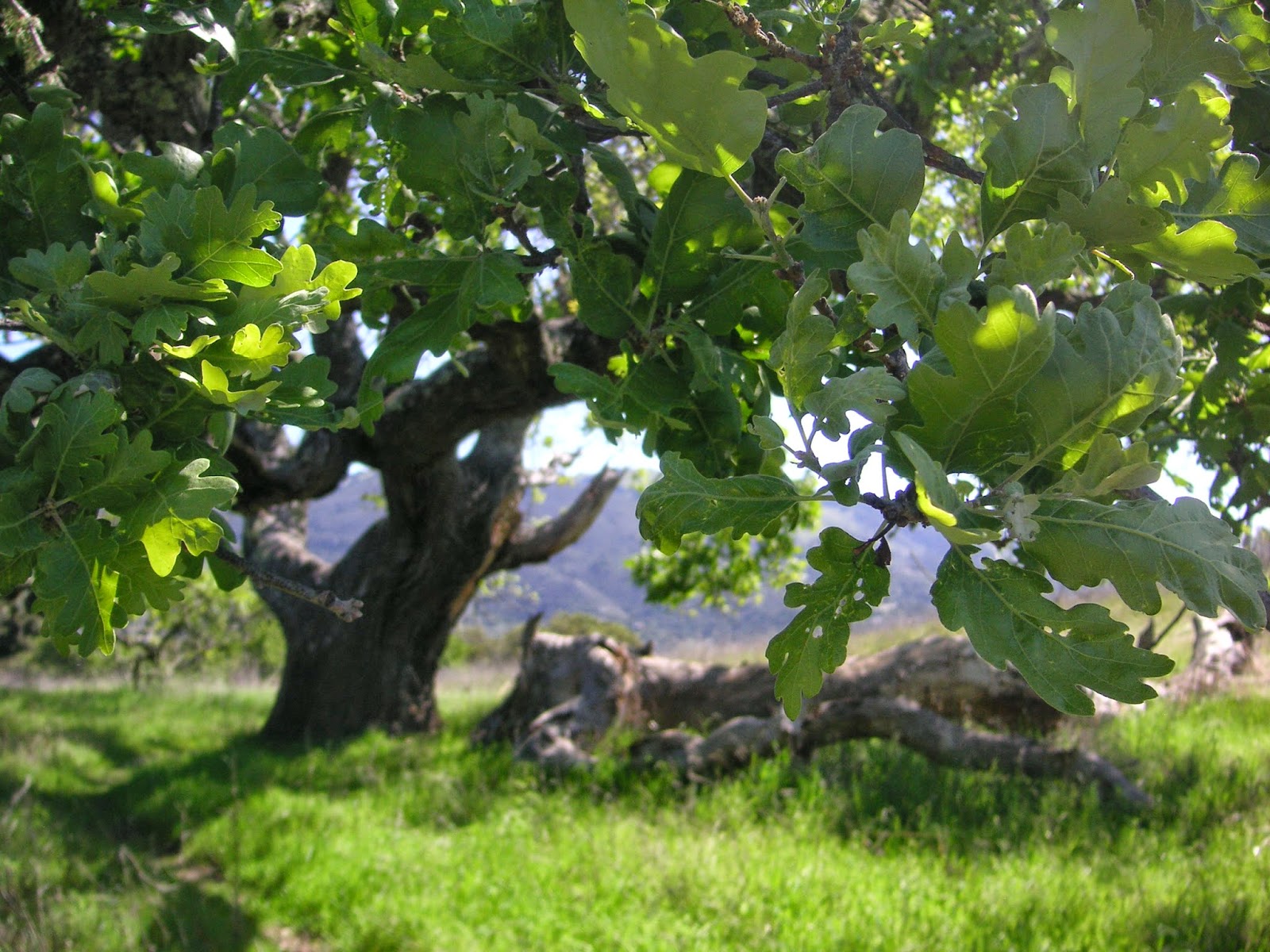
I think it's cool that Andy and I have made it a tradition to hike to our wedding tree on or around our anniversary.  It's not like we don't visit any other time of year, e.g., last November when it was dry, dry, dry or in February before the leaves come out.  It's been particularly interesting to look at my photos of this tree on an annual basis, showing variations in the timing of spring leaf-out and subtler, annual changes as the tree ages, not to mention the weather (it snowed on us in 2011!).  This year, the leaves were fairly progressed; some had already toughened up and were very shiny like typical summer leaves.  The last time it was anywhere near this leafy on our anniversary was back in 2010 when the catkins were still hanging on.  I don't know what's going on with the swath of no leaves in the last photo.  There's a patch of lace lichen there that hasn't spread much over the years, and supposedly it doesn't hurt the tree.  Also, notice how much greener the grass is in the shade of the tree versus out on the sunny hilltop?  What's that phenomena called?  It's as if mature oaks create their own personal water cache through their own shade.  Since we share this tree with other visitors to Garland, we also take note when other people leave their mark, in this case, a heart painted with... chocolate and vanilla pudding?  Cheers!

Saturday, February 22, 2014

coast live oak ~ 02/22/14 ~ Fort Ord

Fagaceae

I don't know why I keep getting tripped up on coast live oaks, as is evidenced by my past posts March 20, 2011 and March 11, 2012.  In the comments section, Cindy @ Dipper Ranch has provided quick tips on oaks, but my mental block around trees keeps me from remembering most of it.  I now know to look for "underarm hair" on the underside of leaves.  It seems to me that our CA native oaks have a greater degree of variation within spp. than between spp.  Every time I think I've found a different sp. of evergreen oak, it ends up being a coast live oak.  Ugh.  These two sets of photos are two trees growing about 20 feet apart.


Underarm hair?  Check.  But, look how smooth the trunk is, akin to how smooth the leaves are with very few points on the leaf margin.  I know the number of points can be variable, but the trunk, too?  Can anyone confirm for me that this is coast live oak?  Cindy?

For my future reference, and maybe yours, too:
California Oak Identification @ University of California Hastings Reserve
California Native Oaks @ Las Pilitas Nursery 
Oak Identification @ University of California Cooperative Extension, Marin County

Saturday, December 7, 2013

coast live oak ~ 12/07/13 ~ Fort Ord

Fagaceae

As we were driving out to the Creekside entrance on Hwy 68, I noticed most of the oaks had dead tips.  Speeding past, it looked like a deep green mosaic with scattered bits of tan.  I don't think this is sudden oak death, which is caused by a fungus-like pathogen.  I'm guessing it's caused by true fungal diseases, some of which apparently show themselves more when the oaks are drought-stressed, like this year.  I'm not quite sure how that works since fungi generally like moisture.  Right?  This looks very different from the swaths of entirely dead trees I saw last year at Toro Park, which is located right across the street of Hwy 68.  The U.S. Forest Service Pacific Southwest Research Station has an excellent technical report "A Field Guide to Insects and Diseases of California Oaks".  Maybe it's Diplodia quercina branch canker (pp. 88-89) or Cryptocline cinerescens twig blight (pp. 76-79)?  I really don't know.  I'm no tree doctor.  Half the time I can't even distinguish coast live oak from other Quercus spp.  In any case, this widespread dieback is interesting to note.

ps 03/12/14 - An intern from a local paper The Californian contacted me regarding this post.  She wants to use my pictures and information in an article she's writing.  This is the first time I've ever been contacted by a newspaper for Nature ID, so it was an interesting experience... I think for the both of us.  She was sweet but sounded a little nervous.  I gave my photos free of charge, because I didn't want the hassle of creating an invoice and dinging for payment (so many places conveniently "forget" to actually pay).  I'll link to the article once it comes out.  Cool beans.

Sunday, November 17, 2013

wedding tree ~ 11/17/13 ~ Garland Ranch


I love that we have a wedding tree.  And, yes, we do occasionally visit even if it's not our anniversary.  Analogies could be made comparing our marriage to the continuous changes in and around this tree.  With the relatively recent trail closure, I'm having to adjust to taking a different route to reach the tree.  I was resistant at first.  I noticed a new trail has popped up, and maybe next time we'll explore that path.  The leaves were still hanging on.  They were a bit crispy compared to the soft shoots of spring.  I'm not sure when they drop.  January?

ps 11/28/13 - I came across "That Tree: A Year in the Life of a Lonely Oak" on the Sierra Club site, and it reminded me a little of what I'm doing with our wedding tree.  So far, my less-than-artistic photos document 7 1/2 years of this oak tree, and I hope to continue chronicling at least once annually for the rest of our lives.

Sunday, April 7, 2013

wedding tree ~ 04/07/13 ~ Garland Ranch


Hey yo, long time, no?  Has it really been almost 4 months since I last posted to Nature ID?  It's interesting how time seems to become more condensed as I get older.  No offense to anyone but I have a theory as to why elderly folk drive so slow, if an hour feels like half an hour, then going 30 miles per hour feels more like 60 miles per hour.  Whoa.  Time and the unspoken commitments we all make to each other have been looming large in my brain space lately.  I had meant for Nature ID to chronicle nature.  Now I realize it's helped me chronicle the seasons of my life... and I miss the act of recording.  Anniversary.  We did our annual hike a day early with concerns over having enough daylight after school and the possibility that I might be traveling. Imagine our surprise when we found our wedding tree trail closed for rehabilitation.  Fortunately other trails to the tree remain open for now.

Sunday, September 23, 2012

CA oak moth ~ 09/23/12 ~ Toro Park


Coming down through Wildcat Canyon, I found great swaths of dead-looking oaks, yellowish brown and upon closer inspection severely munched upon by oak moth caterpillars.  I don't think the folks who named the canyon had this kind of wild cat in mind.

Sounds of drops like gentle rain and tinkly crunchy chomping surrounded me.  The smell in this area was distinctive, too, but I can't easily describe it.  The trail and nearby ground were completely coated in greenish tan pellets.  Frass.  Caterpillar poop. And lots of it! The most I've ever seen... which really doesn't mean much considering I don't follow the fluctuating annual cycles of oak moth populations all that closely.  I believe there are people who use frass mass to estimate population densities, so my assertion isn't totally out of the blue.  This past spring, I did casually notice oak moths were on the wing in full force unusually early on with a second generation flying in June or July.  Unfortunately, I didn't take notes of the timing and my recollection isn't specific, only that it was significant enough that I commented to a couple of Monterey City forestry fellows at the local farmers' market how I predicted this was going to be a booming oak moth year.  They laughed me off and politely disagreed.

The few green leaves I found here had become veritable buffet lines for caterpillars. What surprised me was finding so many feeding on dead leaves. Their mandibles have got to be industrial strength to masticate crispy dried evergreen oak leaves.  There were plenty of dead caterpillars that simply looked dessicated, but there were also numerous dead caterpillars hanging by their first prolegs, a sure sign of a viral and/or bacterial infection.  Interestingly, I did not find a single chrysalis (yes, I use this term for moth pupa in addition to butterfly pupa, if it's not covered in hairs or silk and hangs by a stalk).  I wonder if this 3rd seasonal generation will successfully pupate and emerge in the next few weeks, or if this is an early sign of a natural population crash.

Even when everything else is dried up, live oaks usually remain green all year round.  I doubt the caterpillars were directly responsible for the dried oaks, because I suspect their heavy feeding did not actually kill the trees.  Our unusually mild winter with very little rain was gentle on last year's overwintering early instar caterpillars and also water stressed the oaks.  However, there were numerous other oaks in the park that were still green and with significant numbers of oak moth caterpillars.  There is a part of me that wonders if this area, easily accessible to group picnickers, had been hit by Sudden Oak Death or an Armillaria oak root rot fungi.  I will be curious to find out if these oaks have a fresh flush of green leaves after the rains hit.

I blogged about CA oak moths once before, which is an unexpectedly popular post.  I've linked to the UC IPM Online site for CA oakworms in the scientific name ID above, and I don't recall why I didn't include it in my previous oak moth post since it's chock full of great information. Also, while doing another oak moth search, I found this fellow blogger Garden Wise Guy's post to be quite entertaining.

ps 09/26/12 - Thanks to Cindy at Dipper Ranch who commented and always gets me thinking about things.  I have such a difficult time IDing trees, let alone the confusing complex of oaks. I've edited the post above to include the possibility that the oaks I saw were interior live oaks and the possibility the browned leaves were due to an oak root rot fungi.  I'll see what I can do about contacting the proper agencies to check into this, because SOD is closely monitored.

Saturday, August 4, 2012

golden chinquapin ~ 08/04/12 ~ Henry Cowell Redwoods


posted 08/06/12 - Chinquapin. I'm amazed at the various pronunciations of this word, just like I was surprised at how quinoa is inconsistently pronounced. The etymology of chinquapin supposedly has an Algonquian reference to chestnut.

Unfortunately, I will now always associate the word with inexplicable mass shootings. Why? On our way home from camping at Mt. Madonna on Friday, July 20, with thoughts of blogging about the pictures of chinquapins that I took there, we heard on the radio of the mass shooting in a Colorado movie theater. Then, yesterday morning Sunday, August 5, as I was about to blog on the pictures shown above, I found the news of another mass shooting at a Sikh temple in Wisconsin. What is wrong with people!?! Add in the current chaos in Syria, and I barely want to go online to check e-mails, blogs, or Olympics upates.

Nature is starting to cease being a comfort to me. I can't seem to bury my head in the sand deep enough. I can feel the currents of tension in the air. It is filled with sadness and grief. Chinquapin.

Wednesday, July 18, 2012

tanbark oak ~ 07/18/12 ~ Mt. Madonna

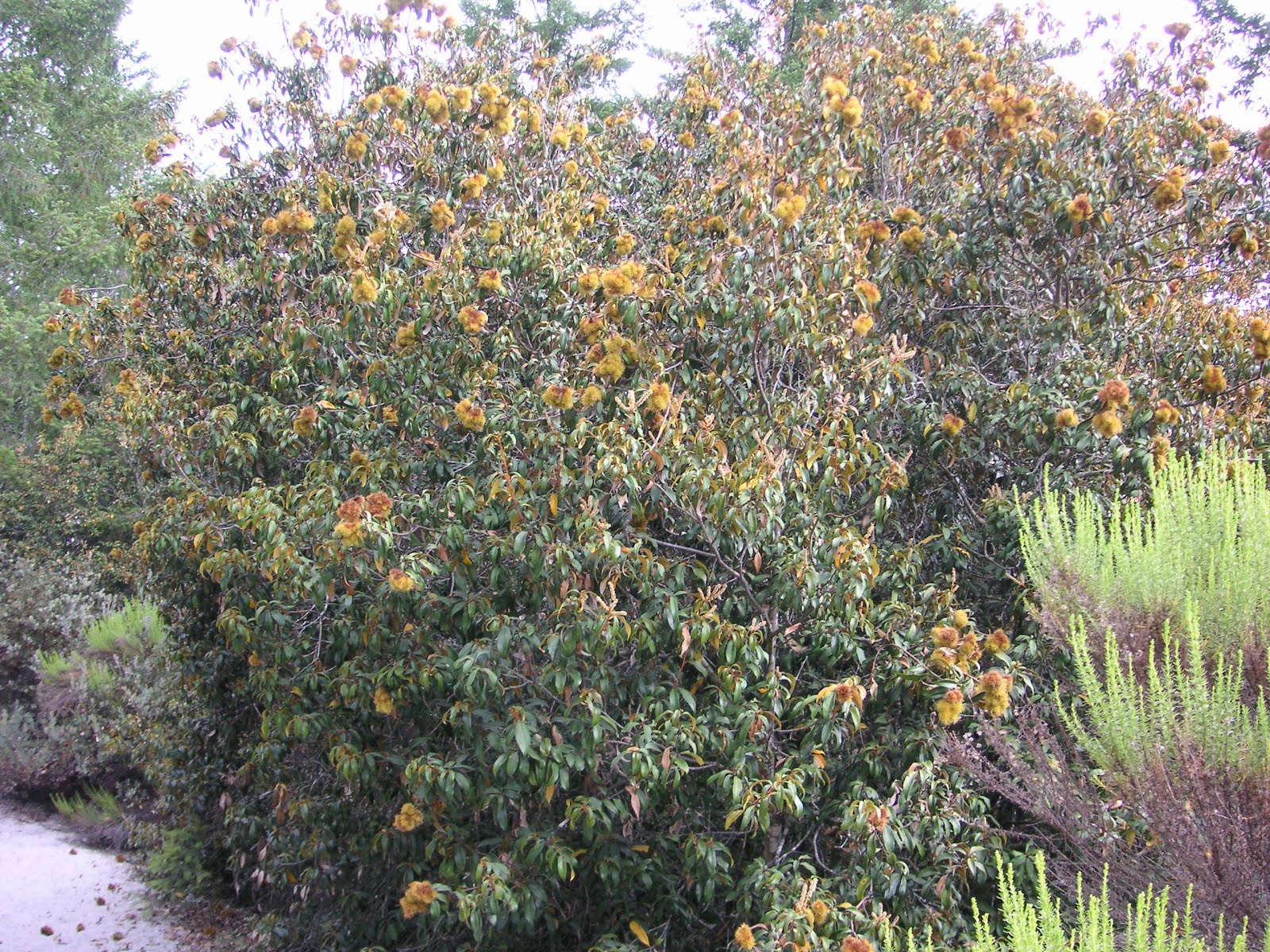
posted 08/03/12 - When we last camped at Mt. Madonna in December 2010 I noticed great swaths of tanbark oaks had been recently chopped down. At the time I wasn't positive about the ID of this tree, nor did I hazard a guess as to why so many of these trees had been cut. Thanks to Randy at Way Points I learned more about Sudden Oak Death, which can affect tanbark oaks and Quercus spp. I suspected the clearing had to do with this disease, but I was wrong. As I looked into Santa Clara County Parks for this blog post, I discovered their best management practices included monitoring for pathogens such as Armillaria oak root rot fungi and others. What? It never occurred to me that mushrooms could kill trees. Clustered fruits, such as honey mushrooms (Armillaria mellea), may indicate the presence of deadly diseases. I now wonder about the ID of the possible sulfur tufts I found. Hmm, always learning something new.
Sunday, April 8, 2012

wedding tree ~ 04/08/12 ~ Garland Ranch


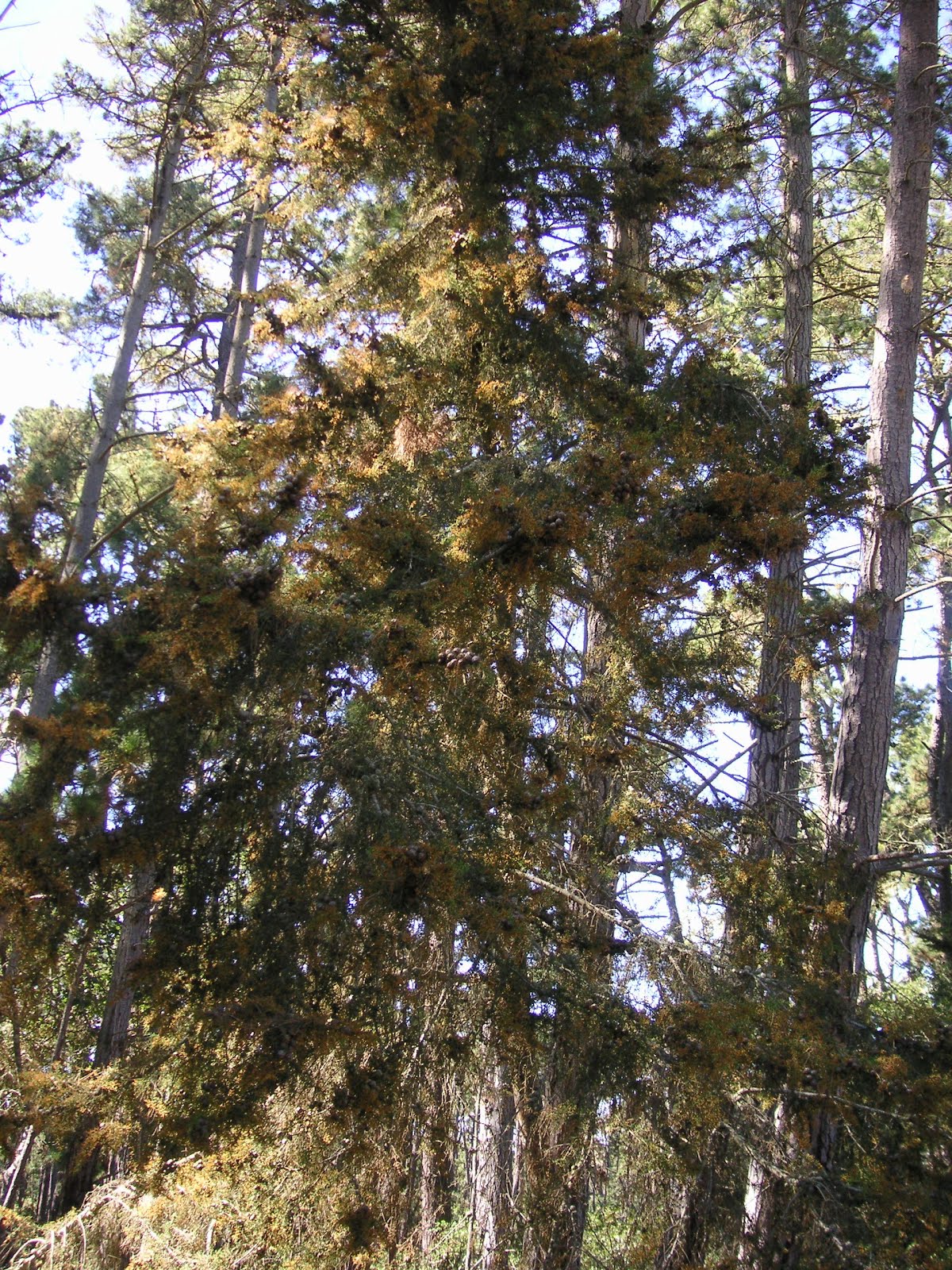
How often will our wedding anniversary land on Easter? While extending our regrets for leaving the Highlands shin-dig early, a sentimental fellow best known as "Boo" suggested we take Easter egg offerings for our wedding tree. That's exactly what we did! Once the kids' egg and adults' beer hunts were finished, we found cracked eggs we liked and wrapped them up for our hike up to the mesa. It was great fun selecting our own hiding spots on our tree. Notice the ant on mine? Many ants came to check it out. Andy hid his high in a nook. The vernal greenery on this deciduous oak was notably varied this year with clusters of tight buds to soft unfurled leaves. Click to see this tree on April 8 in 2006, 2008, 2009, 2010, and 2011.

ps 04/12/12 - I looked for fairy fingers and could not find them.

Sunday, March 11, 2012

oak ~ 03/11/12 ~ Pogonip

unidentified oak
Quercus sp.
Fagaceae

I need help (heh, probably in more ways than one) for this ID. Unfortunately, since this is a city park in Santa Cruz and it's beyond the range of my usual double-check option of our local CNPS Montery Chapter plant lists, I resorted to Calflora's What Grows Here. There are three species recorded for this area: coast live oak (Quercus agrifolia), Santa Cruz island oak/Shreve oak (Quercus parvula), and interior live oak (Quercus wislizeni). We have a coast live oak tree at the end of our driveway, and I feel I'm now very familiar with this tree; it has new fresh green spring growth but nothing like the pretty pink flower-like sprouts as shown above. If anyone can help ID this oak tree for me, I'd be very appreciative.

Sunday, March 4, 2012

acacias ~ 03/04/12 ~ SFB Morse Botanical Reserve

prickly Moses / star acacia
Acacia verticillata
Fabaceae

prickly Moses (left shrub) and golden wattle (right tree)

everblooming acacia
Acacia retinodes
Fabaceae

Wow, I didn't know there was such a variety of acacias. Usually when I see the prolific bright yellow blooms, I'm speeding down a highway, like Hwy 1 from Watsonville to Santa Cruz and Hwy 68 from Monterey to Salinas. During this hike, I noticed the leaves and blooms were very different shapes, so I took pictures. All these trees and shrubs featured here are native to Australia.

When I saw my doctor last month for a check-up, he blamed the acacia trees for my runny nose. I'm not sure that's entirely correct, since right along the coast where we spend most of our time, there are no acacias that we've seen. The nearest one is at the Pacific Grove Golf Course a mile away. I'm guessing my and Andy's late January to early March allergies are due to the Monterey pine.

Gowen cypress ~ 03/04/12 ~ SFB Morse Botanical Reserve

yellow male pollen cones with brown female seed cones

female seed cones

Gowen cypress
Hesperocyparis goveniana (formerly Cupressus goveniana ssp. goveniana)
CNPS 8th Edition Inventory
Cupressaceae

When I first took pictures of these short-statured trees I thought, "Oh good, I can finally get close-up shots of a Monterey cypress (Hesperocyparis macrocarpa) for my blog, since they're usually too tall or perched on a cliff to take decent detailed pictures." Wrong? Maybe, maybe not? Gowen cypress is my best guess based on the CNPS plant list for SFB Morse Botanical Reserve, which does not include Monterey cypress. However, the female seed cones seemed bigger than described in Jepson compared to the larger Monterey cypress seed cones, but I'm aware visual perception can often be deceptive. I really should carry a ruler with me when I go hiking, since memory and photographs are proving to not be enough to distinguish species. I checked our neighbors' cypress trees, and there's quite a bit of variation outside of the reported dimensions. I guess theirs could be garden hybrids though. Erg. Come to find out the Gowen cypress is a federally threatened species. For more information about cypresses, check out Wayne's Word and Point Lobos Association.

Saturday, February 4, 2012

almond blossom ~ 02/04/12 ~ Cooper Molera Garden

Rosaceae

Given my total confusion about early blooming blossoms (is it a cherry, or plum, or cherry plum?), I had no difficulty identifying this particular blossom tree. Why? Because there was a handy-dandy ID sign at the Cooper Molera Garden, which is filled with various fruit trees restored or representative of the 1860s. Really, I should be able to recognize this tree anyways, since I spent many CA winters playing underneath 2 almond trees that my dad planted next to my swing set. I used to pretend the white fallen petals were snow. Aw, fond memories!

I liked harvesting almonds with their split fuzzy hull and especially liked eating them. So, it came as a bit of surprise that I haven't liked almonds purchased at the store for a while, and I couldn't figure out why. Then, a friend recently gave me almonds from his dad's farm. They taste fresh like how I remember from when I was a kid. He said they're unpasteurized. As I was researching this post, I learned that there's now a mandatory pasteurization program for CA almonds shipped in North America. Who knew? Like with fresh apple cider, I do think some foods do taste better unpasteurized.

Friday, February 3, 2012

CA bay ~ 02/03/12 ~ Mt. Madonna

California bay / Oregon myrtle
Umbellularia californica
Lauraceae

I simply want to document the seasonal changes of the CA bay and show the yellow umbels of this native evergreen tree. To read about my experience of eating ripe bay nuts off the tree, click here. To see all 3 posts about CA bay through the year, click the ca bay label. It's hard for me to believe now, but I never noticed this common tree until I started blogging. Nature ID has served me well for learning about and paying better attention to the local natural world.

Saturday, January 14, 2012

blossom ~ 01/14/12 ~ Monarch Grove

blossom
Prunus sp.
Rosaceae

Blossoms in January!?! Since I started Nature ID in 2009, I have been attempting to be mindful that what I observe has its limitations, most likely based on my poor understanding of what is what, or based on when I am actually outside to observe whatever it is that strikes me as unusual, or based on my poor memory. When I first saw these blossoms, I kinda figured this year's mild winter weather must have something to do with it. Is it global warming? Maybe not. I remembered seeing a recent post by Marie at 66 Square Feet about cherry blossoms that are typical in New York City in December, a place that often gets decent snow in the winter (I've been there for work and have had flights cancelled due to too much snow, so I remember the weather well from first-hand experience). I have also commented on John at Sinbad and I on the Loose blog stating that I believe I'm noticing local flowers more this January simply because the weather is warm and I'm actually outside to see the beauty. So then, when I started writing this post and looked through my labels, I found I already have a couple posts of other ornamental blossoms in January. Hmph! Truth be told, blossoms could be about 10 days early this year, but I can't really say or proffer the cause. I now am aware that different species bloom months later like our neighbor's unidentified April blossoms, whereas our native cherry species blooms in June. It's been helpful to have the actual dated records on Nature ID to remind me of the seasonal changes, rather than relying on my fickle memory.

ps 02/11/12 - I originally posted this as cherry blossoms, but I looked at a post from last year by Katie of PhyteClub of Prunus cerasifera, commonly called a cherry plum. Ya! Now I'm confused. How can one tell the difference between cherries and plums when they're blossoming? A quick search online showed me that many other people are confused, too, even in Japan where spring blossoms are regularly celebrated. Some say look for a notch in the petals (notch = cherry, no notch = plum), the shape of the petals (oval = cherry, round = plum, or vice versa), the length of the blossom stem (long = cherry, short or none = plum), the timing of the blooms (late = cherry, early = plum), and all of these have exceptions because there are so many cultivated varieties and crosses. Erg. Two sites I found informative are Quirky Japan Blog and Japan-Guide.com.

Sunday, December 25, 2011

Monterey pine and coast live oak ~ 12/25/11 ~ Jacks Peak


coast live oak
Quercus agrifolia var. agrifolia
Fagaceae

This post is for Cindy of Dipper Ranch based on her recent comment. I wish I had better pictures of how the ends look chewed. I noticed before at Jacks Peak that tips of Monterey Pine litter the trail. This is the first time I noticed tips of coast live oak also on the trail. To me they look like they've been chewed off, but I don't really know. We haven't had any wind storms lately, so I don't think that's the reason. It just seems a bit unusual to find tips of trees on the forest floor. Maybe a pruning-happy tree squirrel did this? Anyone have any ideas as to why this happens?

Saturday, December 24, 2011

poinsettia ~ 12/24/11 ~ Monterey

poinsettia / flor de nochebuena
Euphorbia pulcherrima
Euphorbiaceae

Have you ever seen a 2-story tall poinsettia? While several neighborhood yards have blooming poinsettias that are the size of bushes, this is the tallest one I've found. Poinsettias originate from Mexico. Today we went for a sunny afternoon walk just so I could take a picture for Nature ID. Wishing everyone a very merry Christmas!

Saturday, December 10, 2011

CA buckeye ~ 12/10/11 ~ Los Padres Dam

California buckeye
Aesculus californica
more information
Sapindaceae (formerly Hippocastanaceae)

I wanted to show how big our CA buckeye seeds get, much larger than the native buckeyes (A. glabra and A. flava) and introduced horse chestnut (A. hippocastanum) seeds I found when I lived in Ohio. During our hike, we had a fun time rolling the prolific seeds down the ravines to see how far they would go; it was like rolling bocce jacks over a rough terrain.

I'm surprised I don't have additional seasonal posts of the CA buckeye, considering it's noticeably one of the first trees to sprout leaves in late winter and one of the first trees to drop leaves in late summer, which I read somewhere was due to lack of water. I'll have to rectify this posting deficiency. For much better information than I could ever provide, check out Clare's buckeye post at Curbstone Valley Farm.

Saturday, November 19, 2011

CA bay ~ 11/19/11 ~ Garland Ranch


After a full year of thinking about it and posting about it back in July, I finally had my first taste of a California bay nut. Well, actually, being the piglet I am and wanting to compare, I tried 3 bay nuts. I was so excited I didn't get a picture of the first one, but it was reddish and squishy like the first photo above. The flesh had the texture and taste that reminded me of a cross between a firm avocado and an unripe mango, mild, slightly sweet, and with only a hint of bay. The second one I tried was a bit greener yet also soft. I barely nibbled it before I spat it out. It had a very, very strong bay flavor. It left a burning tingle in the back of my throat, similar to the effect I get when I eat fresh mangoes - I've already looked it up, CA bays are related to avocados but not mangoes. Hoping to try another ripe bay nut, I ate a third that was somewhere in between. Had I been prudent, I would have simply saved them and waited until I got home to taste them; for the rest of my hike, my throat tingled and every exhale tasted like bay. My stomach was not a happy camper by the time I finished my hike.

Interesting to note the seed of the first ripe one was very dark, whereas the seed of the second green one was a much lighter color. In the third photo I also want to show there are buds on the evergreen CA bay already. And the last picture shows a very large and mature CA bay tree.

ps 02/06/12 - I initially posted the last picture believing the large tree was an oak (Quercus sp.) next to a smaller CA bay. The significance of this is that the CA bay serves as a host to a pathogen that causes Sudden Oak Death, which also affects tanbark oaks (Notholithocarpus densiflorus). For a very informative blog post about SOD, check out Randy at Way Points. I'm always amazed at the things I learn from fellow bloggers. During another hike at Garzas Creek on 01/16/12, I took a second look at the large tree and realized I had been mistaken about its ID. I've still got a lot to learn about trees.