Thursday, September 4, 2014

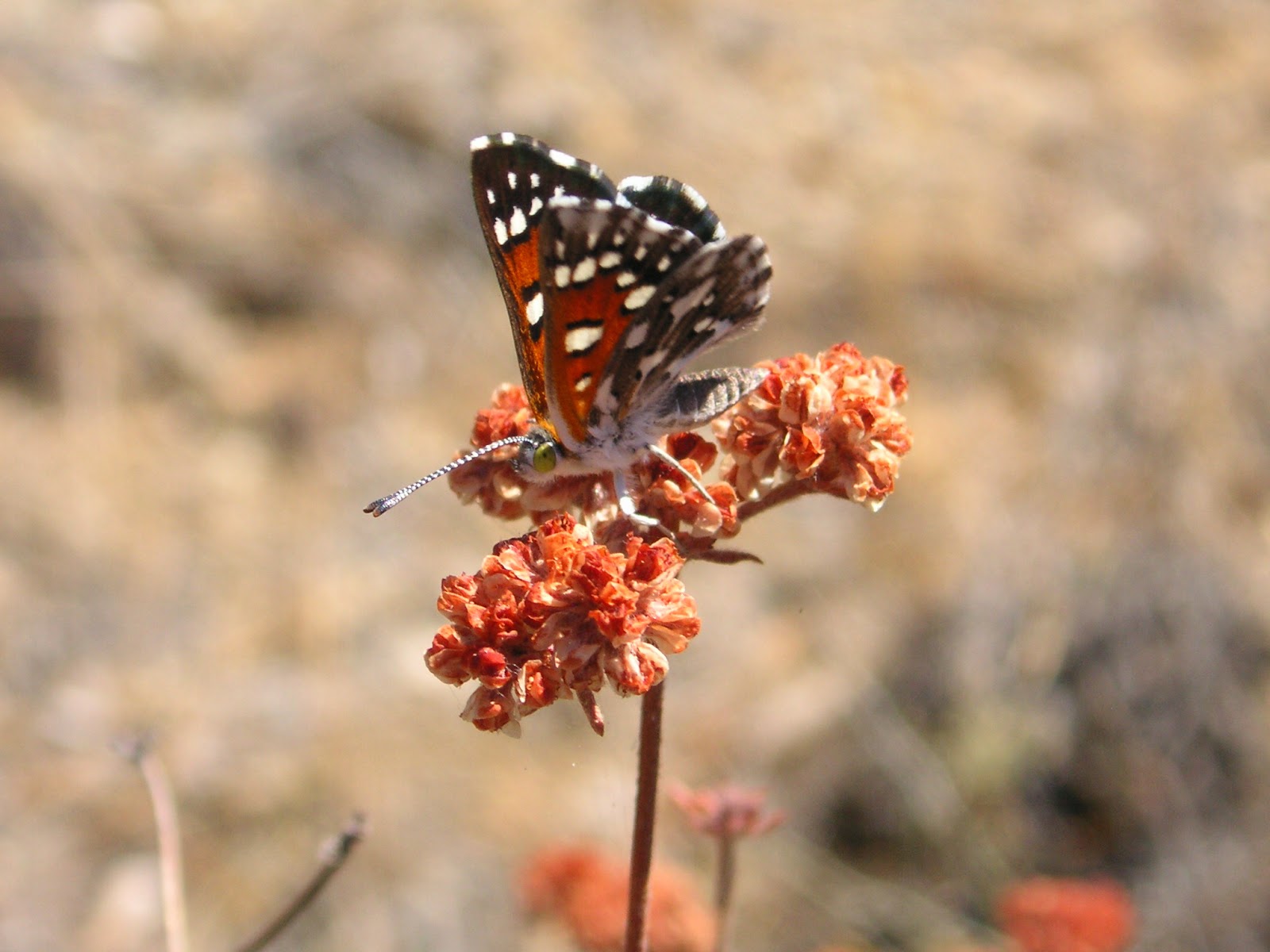
Mormon metalmark ~ 09/04/14 ~ Pinnacles

Polygonaceae

Spotting a metalmark in flight out of the corner of my eye really gives the impression of a small grey butterfly, and I wondered at first if it was a blue or a copper.  However, the bright white spots are glaringly obvious once I can get a good line of sight on them.  I don't think there's anything else that looks remotely like them here.  They'll zip around the same area for a minute or two, briefly landing at different spots, before completely disappearing.  I even saw several pairs swirling in what seemed to be territorial chases, with one always quickly exiting.  I found one significantly larger metalmark, and based on published information, I'm assuming it was a female.  And therefore, I'm assuming the above smaller version is a male.  I could be wrong.

I'm thrilled to have gotten a halfway decent picture of this zippy little butterfly.  It's gorgeous (and surprisingly well-camouflaged - see below)!  I believe I saw my first metalmark two weeks ago on August 19, but I missed getting a better look as an off-duty ranger and his wife caught up with me on the trail and started a conversation.  I do much better tracking butterflies if I'm alone and without other trail travelers.  I have to laugh, because I recently overheard another hiker comment about how grouchy I was to her companion after they had passed me.  Sound really carries in the canyons.  Oh dear.

I found several Mormon metalmarks this day around separate CA buckwheat patches.  However, nude buckwheat (Eriogonum nudum) is the reported host plant for this region, so I'm not sure what it's doing on dried CA buckwheat (Eriogonum fasciculatum) flower stalks.  Certainly the nectar has all dried up.  There are a couple other buckwheats just starting to show buds in other locations, but I haven't ID'd them yet.  As a note for me later, I'm still not sure of the difference between the two reported CA buckwheat vars. in the area, polifolium or foliolosum.  I'm checking into it...

Find the Mormon metalmark among the CA buckwheat.

ps 09/10/14 - I've changed the ID above to foliolosum, even though I believe the hairier and grayer polifolium is also found in the area.

Tuesday, August 26, 2014

photo series ~ 04/08-08/26/14 ~ Pinnacles National Park - west

April 8, 2014 to August 26, 2014
Pinnacles National Park - west entrance

posted 09/02/14 - My weekly Tuesday Pinnacles practice visits have come to an end.  It's been quite a journey and an utterly unique experience that began essentially 6 months ago when I visited Pinnacles on February 25, 2014.  This vantage point from the westside parking lot doesn't highlight the seasonal changes as dramatically as some of my other photo series (posted here or in my archives), however it is the longest continuous run I have at 21 weeks.  They were not my primary purpose, but it was easy to do and I liked seeing the changes over time.  It never rained on me once in this record-breaking drought year.  I surprised my finicky self, so dedicated to this project that I even went out hiking in 105°F weather.  Good golly, that was hot, hot, hot!  Now that it's done, maybe I'll get around to backposting more of my photos?  

CA striped racer ~ 08/26/14 ~ Pinnacles


While I don't go out of my way looking for snakes, I get a thrill when I do find them.  This is only my second time knowingly spotting a striped racer; the last time was at Fort Ord over 3 years ago!  True to its name, it quickly skedaddled when I attempted to get a closer picture.  And, yes, my location label below is correct for the east side of Pinnacles.  This was the first time since camping back in 2011 that I've hiked from one side of the park to the other.  I'll admit, I'm a bit of a hiking wimp, especially in the heat on hills.  It was worth the trek.

yellow star-thistle ~ 08/26/14 ~ Wishing Well

Asteraceae

This cheery yellow flower is easily in my top 5 most despised plants in the state of CA, which gained a foothold here sometime before 1869 and hails from southern Europe and western Eurasia.  It's super pokey and stops me in my tracks while out hiking.  I realized recently that I may have been mistaking another star-thistle tocalote for this yellow star-thistle, so I made a point to find it on the road outside the west entrance to Pinnacles National Park to take a closer look and these pictures.  If only it weren't such a great reported butterfly nectar source...