Showing posts with label * camouflage. Show all posts

Thursday, September 4, 2014

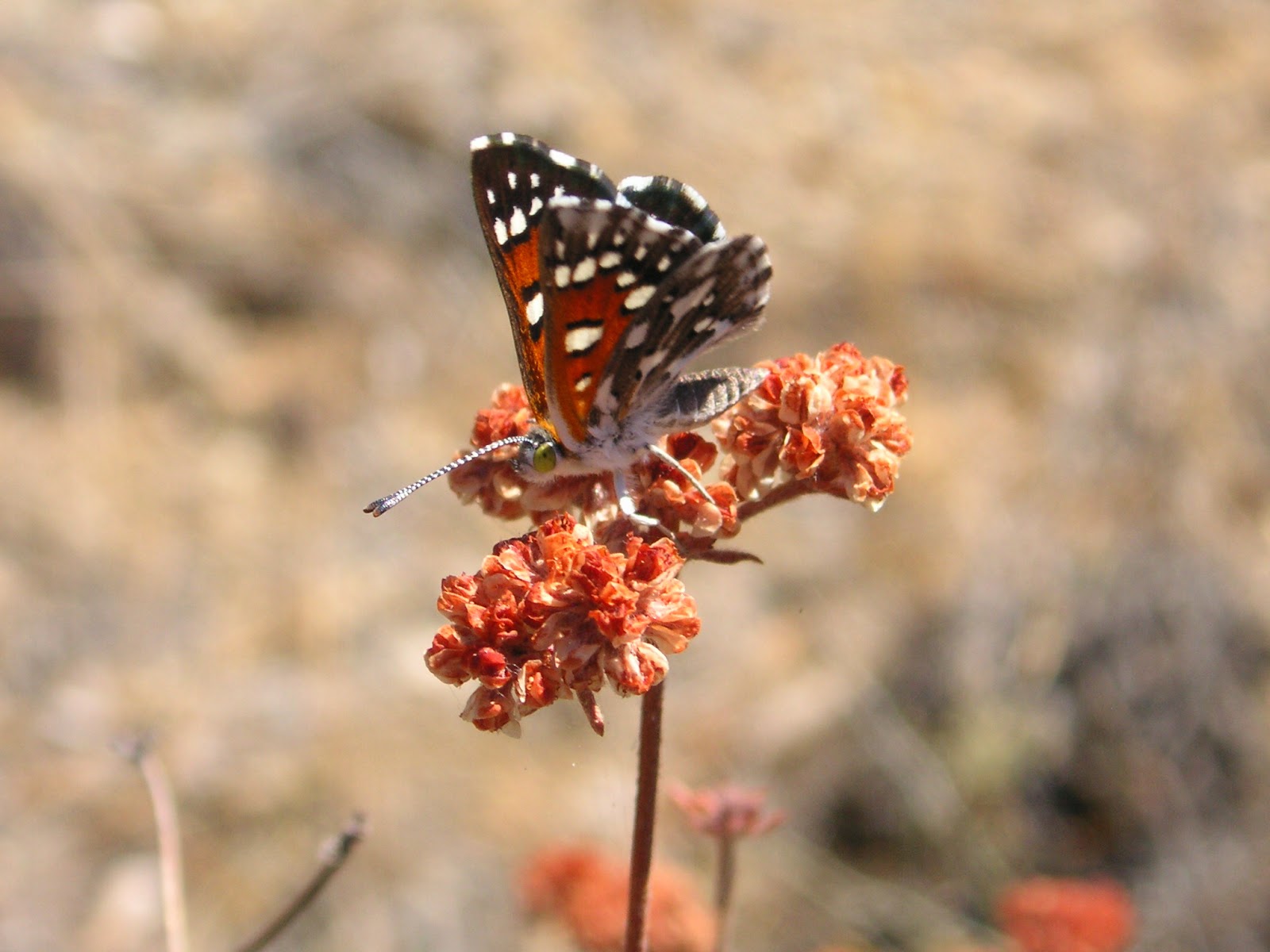
Mormon metalmark ~ 09/04/14 ~ Pinnacles

Polygonaceae

Spotting a metalmark in flight out of the corner of my eye really gives the impression of a small grey butterfly, and I wondered at first if it was a blue or a copper.  However, the bright white spots are glaringly obvious once I can get a good line of sight on them.  I don't think there's anything else that looks remotely like them here.  They'll zip around the same area for a minute or two, briefly landing at different spots, before completely disappearing.  I even saw several pairs swirling in what seemed to be territorial chases, with one always quickly exiting.  I found one significantly larger metalmark, and based on published information, I'm assuming it was a female.  And therefore, I'm assuming the above smaller version is a male.  I could be wrong.

I'm thrilled to have gotten a halfway decent picture of this zippy little butterfly.  It's gorgeous (and surprisingly well-camouflaged - see below)!  I believe I saw my first metalmark two weeks ago on August 19, but I missed getting a better look as an off-duty ranger and his wife caught up with me on the trail and started a conversation.  I do much better tracking butterflies if I'm alone and without other trail travelers.  I have to laugh, because I recently overheard another hiker comment about how grouchy I was to her companion after they had passed me.  Sound really carries in the canyons.  Oh dear.

I found several Mormon metalmarks this day around separate CA buckwheat patches.  However, nude buckwheat (Eriogonum nudum) is the reported host plant for this region, so I'm not sure what it's doing on dried CA buckwheat (Eriogonum fasciculatum) flower stalks.  Certainly the nectar has all dried up.  There are a couple other buckwheats just starting to show buds in other locations, but I haven't ID'd them yet.  As a note for me later, I'm still not sure of the difference between the two reported CA buckwheat vars. in the area, polifolium or foliolosum.  I'm checking into it...

Find the Mormon metalmark among the CA buckwheat.

ps 09/10/14 - I've changed the ID above to foliolosum, even though I believe the hairier and grayer polifolium is also found in the area.

Thursday, August 7, 2014

coast horned lizard ~ 08/07/14 ~ Podere di Farfalla


It's August.  That means it's baby lizard time around these parts.  This one puffed itself up as I continued to follow it to the shade.  Unbothered, it can look quite flat and deflated.  Still, so tiny. Cute.  And, well camouflaged.  There's an unusual growth near its tail.  Don't know what that's about.

Can you find the horned lizard?

Tuesday, August 5, 2014

CA kingsnake ~ 08/05/14 ~ Pinnacles


There is something to a 6th sense, I gotta tell ya.  I spotted a patch of narrow-leaf milkweed about 20 ft. off trail and was excited it was still in bloom.  I wanted to take a closer look for nectaring leps, and as I lifted my leg to go, a voice in my head shouted "Look for snakes!"  Sure enough, in the shadow of my boot was this cryptic CA kingsnake.  Whoa.

Who would have thought that someone out looking for butterflies also has to keep a keen eye out for snakes?  Fortunately, every organized field trip I did this spring came with stern warnings about rattlesnakes and watching where you step.  I try to keep snakes in mind at all times... that is, if I'm not too distracted by some other new find.

While I probably would have done more damaged to this snake than it to me, I'm glad I didn't step on it.  I have to say those stripes do a good job hiding it in the grass.  The only other time I've seen a CA kingsnake was a freshly flattened one on the road out of Pinnacles, and the camouflage made little impression on me then.

This was the only picture I managed to take.  Once it deemed I was interested, it quickly slithered backwards into what looked like a gopher hole.  Given that I had already seen an unusual number of fence lizards, both juveniles and adults, I figured it would be safer for me to stay on trail for the remainder of my hike.  Something about this day made it a good one for finding snakes and lizards out and about.  It could have been my startling heightened awareness, or the sunny temps were just right for sunbathing reptiles?

ps 08/14/14 - We also saw a CA kingsnake at Podere di Farfalla in Monterey Co. on August 7, 2014 not very far from where we saw a juvenile horned lizard.  Maybe baby lizards make great snake snacks?  It's the season, apparently.

Wednesday, July 2, 2014

crab spider ~ 07/02/14 ~ Donner Pass


posted 09/28/14 - If I were to hazard a guess as to the type of crab spider, I'd say it's a flower crab spider (Misumena), more specifically the goldenrod crab spider (Misumena vatia).  Another possibility could be the whitebanded crab spider (Misumenoides formosipes).  However, I'm guessing it's near impossible to tell from my photo, even if I knew what diagnostics to look for.  Eh, I'm not too fussed about the spider ID.  I'm guessing there are more spiders on flowers than I ever notice, because good nectar sources are essentially ready-made butterfly buffets, bee buffets, you name it, for hungry spiders.  Seriously, crab spiders are extraordinarily good at camouflage.  Art thought the Montana here is most likely a female.  Ya.  Hey, I'll take whatever photos I can get.  This is one of my better ones.

ps  - I found Ed Nieuwenhuys' Australian crab spider page to be fantastic.

Sunday, February 16, 2014

CA newt ~ 02/16/14 ~ Los Padres Dam

Taricha torosa
Salamandridae

Well, color me orange!  More newts!  This seems to happen to me all the time; once I see something and learn to recognize it, I tend to notice a lot more of them.  We found a couple dozen, and in much drier areas than I would ever expect to see them.  Click on the picture above to take a closer look at the amazing newt iris.  Very cool.

possible rough-skinned newt intergrade?
possible Taricha granulosa intergrade?

Supposedly, rough-skinned newts have not been found in this area before, but I'm still closely examining my photos with Gary Nafis' Taricha spp. comparison.  I dunno, do the eyes "extend past the margin of the head"?  Would it help if I said the lower eyelids on this individual were ambiguously dark?  Erg.  Erg.  Erg.  I may have to throw in the towel on being able to separate the 2 spp.


How many newts?

Answer: 2.  It could well have been the different lighting and moisture level (sunny vs. the overcast skies under tree cover at Stevens Creek from last week), but it seemed to me the newts here at Los Padres Dam have more of a reddish coloring on top.  In fact, I'd say their red was almost a perfect match with the madrone bark.

in the Carmel River

Good-bye, newts.  See you next time.  Have a lot of love and lay a lot of eggs.

Monday, February 10, 2014

CA newt ~ 02/10/14 ~ Stevens Creek

Taricha torosa
Salamandridae

 possible rough-skinned newt intergrade? 
 possible Taricha granulosa intergrade?

Squee!  I thought I had died and gone to newt heaven.  With 4 days of decent rain, we had high hopes in finding newts.  And, we did.  A couple hundred of them.  Yes, hundreds.  I stopped keeping track of count after a few hours.  We must have hit the timing jackpot, because I don't believe sightings like this are typical.  Or maybe they are?  This year's winter has been so wacky with the lack of rain, that the newts may not have been very active before now.  Many looked like skin and bones, with tiny little hips sticking out, and yet just as many others were quite plump and very healthy looking. Lots of thanks to Cindy @ Dipper Ranch for getting us bloggers together for this excursion.

If left to my own amateur ID skills, I would have said the above two newts were both CA newts.  Many online pictures show rough-skinned newts as being much darker, practically a charcoal color, with the area under the eye also quite dark.  Ken @ Nature of a Man suggested the ones we found may be intergradesHybrids?  With so many newts around to compare, there was quite a bit of subtle variation in how much the eyes bulged and combinations of coloring (mustard yellow to cheddar orange to chocolate brown).  As I picked up several, I noticed an immediate tactile textural difference.  Those that felt rougher indeed had slightly darker coloring under the eyes; perhaps that's how they got their name.  I honestly don't know if the way they feel in the hand could be considered diagnostic, because I haven't handled that many newts before.  Plus, we found newts in many different stages, from itty-bitty 2 1/2" (head to tail tip) juveniles to hefty males with, eh-hem, bulges.  Check out Gary Nafis' California Herps for the best side-by-side Taricha spp. comparison.


 How many newts?

Answer: 3.  Only after one or two had been pointed out to me did I begin to recognize their movement in the douglas-fir leaf litter.  Pretty much they plod along on their little legs, but they will freeze momentarily when approached.  I can see why some parks will close roads for newt crossings.  They're perfectly colored to blend in with their surroundings and are not easy to spot.  I'm guessing I've passed many newts during my hikes and simply have rarely noticed them before.  Sadly, they're collected for the pet trade as "Oregon newts". Along with the convergent lady beetles, this was yet another reason for our discussion about the implications of sharing nature finds online.  Hey, I'm not giving out trail names or GPS points, so collectors can hike around just like everyone else to maybe find them.  They'd better be in good shape.


A 5th leg!

Given the number of newts we found this day, the chances of finding a mutant were good,  obviously considering we found one.  I don't understand how mutations work in newts.  Does it originate in the egg?  Or does it happen sometime when transforming from aquatic larva to terrestrial adult?  How much does the quality of the environment affect newts?  Or even an accident later in life?  Apparently, they're able to regenerate lost limbs.  These are definitely animals I want to learn more about.  Does anyone have a recommendation for a good, scientific, but not too dry, newt book?

Wednesday, August 4, 2010

coast horned lizard ~ 08/04/10 ~ Fort Ord


juvenile coast horned lizard
Phrynosoma blainvillii

It was love at first sight! I'm usually not this effusive, but these juvenile horned lizards were so tiny and flat-out cute. As CA Herps states (linked in the scientific name above), the Coast horned lizards have two rows of fringed scales on the sides. Apparently, they can shoot blood from their eyes. I'm glad they didn't do that when I picked them up, because I would have felt awful for handling them. To get the spotted belly picture above, I did the "stroke the throat" trick to make it lay still. With the last picture above, it's easy to see why they are so difficult to find. Before now, I've only ever seen 1 adult male at Pinnacles 5 years ago.

ps 08/07/10 - Janet, a regular commenter on Nature ID with several blogs, has posted one of the pictures above on her tumblr account. I'm glad she let me know.