Showing posts with label x: Pinnacles Nat'l Monument - east. Show all posts

Friday, September 26, 2014

European mantis ~ 09/26/14 ~ Pinnacles


I was pleased as Punch to find this mantid.  Usually, if I find a butterfly being eaten, it's more likely to be a crab spider chowing down.  Interesting to note, I rarely find mantids these days, even though they're my favorite insect (eh-hem, not Lepidoptera) as evidenced by my 2nd grade show and tell story.  It's funny, after all these years, I'm essentially doing show and tell with my blog.  Thanks to researching links for this post, I discovered that the numerous mantids I found as a child around the family farm in the Central Valley were Mediterranean mantis (Iris oratoria), another non-native.  I'll admit, it would be awesome to find a native California mantid (Stagmomantis californica) in this very remote spot (read: far away from any wannabe garden do-gooders).  Do you think there would be more native mantids around had we not inadvertently introduced exotic spp. and now purposely sell and distribute them for pest control?  They do eat each other, after all.  Nom nom nom.

European mantis details: 65mm long with white spot bordered by black on inside front coxa

Mantis religiosa in praying position

Tuesday, August 26, 2014

CA striped racer ~ 08/26/14 ~ Pinnacles


While I don't go out of my way looking for snakes, I get a thrill when I do find them.  This is only my second time knowingly spotting a striped racer; the last time was at Fort Ord over 3 years ago!  True to its name, it quickly skedaddled when I attempted to get a closer picture.  And, yes, my location label below is correct for the east side of Pinnacles.  This was the first time since camping back in 2011 that I've hiked from one side of the park to the other.  I'll admit, I'm a bit of a hiking wimp, especially in the heat on hills.  It was worth the trek.

Sunday, June 1, 2014

CA hairstreak ~ 06/01/14 ~ Pinnacles


Here's another worn-torn individual shown nectaring on CA buckwheat.  It's superficially similar to the grey hairstreak, down to similar bite marks out of the hind portion of their wings.  Those tail-end bright spots sure seem to do their job in keeping these little snack-sized morsels alive long enough to get to the worn-torn looking stage.  Cool beans.  I wonder what the spots look like under UV for bird predators?  Girl?  I can't tell.

gray hairstreak ~ 06/01/14 ~ Pinnacles

Strymon melinus
(Shapiro and Tenney)

I have another photo (a bit too fuzzy to post) where there's a hint of barely there orange on top of the abdomen.  And, given how pointy the butt is, I'm guessing it's a boy.  Female gray hairstreaks have gray colored abdomens.  I'm glad to have him for the count, even if he's a bit worn.  Fresh grays are quite stunning and reportedly very common.  I first caught him on woolly yerba santa, and then he hopped over to CA buckwheat for another pose.

I noticed I'm developing a fondness for butterflies that tend to perch at about my waist-height, and at Pinnacles that usually means CA buckwheat and woolly yerba santa.  They're the ones I'm most likely to capture a natural pose with my point-and-shoot.  I've really enjoyed looking at my own macro shots, because I'm seeing details that are impossible in-person.  It's kind of a funny thing, I have an excellent dissecting scope with snake lights and several pairs of binoculars, but I don't like using them as visual aids.  It's just one of those quirks.

Friday, May 23, 2014

sylvan hairstreak ~ 05/23/14 ~ Pinnacles

(Tenney)

Compare the above to what most sylvan hairstreaks look like.  Notice something missing?  Like tails?  No, they're not broken off, like what frequently happens.  This fatty female(?) never had them, hence the ssp. dryope.  Crazy, huh?

coast horned lizard ~ 05/23/14 ~ Pinnacles


Apparently, this cool lizard is now supposed to be called Blainville's horned lizard?  Sigh.  I can't keep up with all the name changes, scientific or common.  Eh, that's not the point of this post, anyways, even though I have seen a few impressively large horned lizards during my many recent activities.

Paul has suggested I try iNaturalist as a way to document and share what I find during my weekly Pinnacles visits.  I haven't decided yet, because I have questions about macro photo quality and GPS capability in a smart phone where there's no cell service.  Click here to see Paul's photo of this same horned lizard using his iPhone 5 (don't know which letter c or s), and then click on my photo above to enlarge.  What do you think about the photo quality comparisons?  I think Paul's appears very tan colored and a little flat, even though my depth of field is shallow.  I'll mainly be taking photos of little butterflies about the size of the lizard's head anyways, but coloring is important.  And, I'm still unsure how to resolve the pseudo-GPS in phones issue.  I heard there are GPS units that bluetooth to the phone, but what a pain and more crap to carry.  Does anyone have any suggestions to obtain accurate GPS linked to a phone-generated photo?  Are there actual GPS phones, not the fake ones reliant on cell service?

Oh, have I mentioned I don't currently have a smart phone?  I've had my flip phone since 2006, which I think is the responsible thing to be aware of in this day and age of disposable everything, including electronics.  I had my last computer for 10 years before I upgraded to iMac.  I really don't need the latest and greatest toy, but it may be time to update.  Plus, we've been needing to switch carriers for some time since many of my calls get dropped at home on the Peninsula where ocean meets spotty cell coverage.  We never had a land line.  There was a bit of a city hall brouhaha over additional cell towers being installed.  On one side were the monarch butterfly lovers who didn't want the overwintering butterflies or themselves to be radiated (is that the term?), and on the other side was the city needing to offer basic public services, like cell phone coverage for emergencies.  The towers went in, cleverly disguised as chimneys.  Are we all being microwaved now?

ps 05/30/14 -  One of the take-aways I got from the Citizen Science Session of the Ocean Science Trust Conference last month was that citizen science could and should be able to provide data rigorous enough for scientific review (Thanks, Lisa Emanuelson!).  So, when a few days later CalAcademy announced their acquisition of iNat, I paid attention.

Ken-ichi Ueda, co-founder of iNaturalist, has been kind enough to reply to my numerous criticisms (hopefully, constructive!) and questions as I figure out the best recording method(s) for my project, which in an unexpected way could also help shape its initial purpose.  With Ken-ichi's permission, here's what he said, "Ok, let's talk tech. For iNat, my recommendation is to get the latest iPhone. Our iOS app is quite a bit better than our Android app, and the iPhone's GPS and camera are great. Here's are some particulars:

IMAGE QUALITY
As you pointed out in your post, the iPhone isn't quite as good as a conventional camera, but it's still pretty good. It doesn't give you much DoF control, but it can be quite sharp, particularly for stable subjects that are close.

GPS
Any device with a real GPS chip should get coordinates *anywhere* it has a clear view of the sky, since it works by communicating with satellites, not ground-based towers. Reception may vary depending on weather, topography, or the particular configuration of satellites in line-of-sight from your position. Devices like the iPhone can improve both the speed of coordinate acquisition and the accuracy of those coordinates by using cell tower and wifi signals, but they aren't required. Almost every cell phone has a real GPS chip on board, including every iPhone and most Android phones. Note that the majority of tablets do NOT have onboard GPS. This includes the iPad.

In my experience the iPhone's GPS functionality is very accurate. If you get a chance to look over someone's shoulder, you'll see that the iNat works by continually acquiring coordinates until it gets the precision below 5m."

To keep this from becoming free advertising for phones and plans, I'm skipping some of what Ken-ichi recommends.  Then, he goes on to say, "Regarding iNat recording devices, keep in mind you don't need a phone to use iNat! You can upload images directly. My usual practice is to use my phone for most observations, but to also carry around my SLR and a handheld GPS in my pack. The GPS is always recording a track, which I use to add geotags to my SLR photos later (I use http://www.earlyinnovations.com/photolinker/ for this, but there are many other such applications, including Lightroom). The SLR is much faster and sharper, so for things like butterflies, that's usually what I'm going to use. Getting identifiable lep shots with a phone takes more time and patience than you can probably spend if you're doing a research project. Most high-end point-and-shoots would probably be as good or even better (in terms of flexibility) than my SLR setup."

Then, I asked questions about iNat itself.

I haven't found where it explains the different color map markers (red, blue, green?).
"Colors relate to the "iconic taxon" of the thing observed: blue for most animals, orange for insects / spiders / molluscs, green for plants, purple for slime molds, brown for chromists, pink for fungi. It isn't really explained anywhere. There are a lot of things on the site we just assume people will figure out for themselves."

I also don't understand how the "Redo search in map area" works, because it comes up with new and different points depending on the zoom level on the map.
"It redoes the search using the bounding box of the current map. It loads different observations because some of the observations in your previous search will be outside the bounding box."

Then, how do you select the marker that sits just below another one when on max zoom?
"I guess you don't, but you can see them all in the list on the right. You can also zoom in much farther with the satellite tiles."

Is it possible to select by week number to see everything found at a particular location in that week of any year?
"You can't look up observation by week, but you can do it by month. If you go to http://www.inaturalist.org/observations and click the "Search" button you'll see a bunch of filters, one of which is a month filter. If you set that and leave year and day blank, you'll see all the observations added in that month, regardless of year."

... He did say he privatizes his locations, does not carry a GPS unit, guesses based on a google app, so maybe that was the result of being "obscured" as well.  It doesn't seem like that should qualify for "research grade".
"... his observations for that day is due to the fact that he obscures the coordinates, which means each observation is displayed at a randomly chosen location somewhere within 10km of the true coordinates. iNat's "research" quality grade doesn't consider how precise the coordinates are, just that you've added them. The name "research" was probably a poor choice since it seems to get people's ire up, but it just means observations of that grade are probably more accurate / complete than others. Then again, the definition of "research" is pretty flexible. For some studies, precision of 50k might be adequate."

Finally, in the spirit of encouragement to become better, I had the audacity to question Ken-ichi's algorithms.  It's a bit meta, and I've noticed not everyone appreciates the different perspective.  In fact, he seemed very receptive to it.  I agreed with him that the freedom to make errors is educational, which is why this hobby blog has been so liberating for me over the past 5 years.  By being okay to make mistakes, being honest in the not knowing, asking those questions, and accepting of others' help, I have learned so much.  Here's Ken-ichi's reply to my algorithms charge:
"I would argue that our crowdsourcing approach generates data that is close to the accuracy of professionally collected data, with the added benefit that it usually comes with media evidence for independent verification. It is generally not as comprehensive as professionally collected data (most casual naturalists aren't going to identify every carabid under a log in the way that a working coleopterist would), but if you look at the inaccuracies present in supposedly professional collections at museums or in GBIF, you will find most of the same geographic biases (no collections far from roads or trails), identification mistakes, and taxonomic confusion... except it's really hard to see this errors because either there's no associated media evidence or you have look at a specimen. An actually quantitative comparison between professional and crowdsourced data collections like this would be a pretty cool outcome of being at CAS. We shall see."

This is all very helpful information for me.  Thanks, Ken-ichi!

The future of natural history documentation is at our feet, a path extending into the digital age through the eyes and hands of millions of curious participants.  I know that sounds corny, but it's true.  This is exciting stuff!  It's too bad it currently selects for the well-to-do with expensive phone requirements, GPS devices, and fancy cameras.  The reality of the situation is nature is available to pretty much everyone... and it's free, if we just put down our electronic devices.

lippia ~ 05/23/14 ~ Pinnacles

Verbenaceae

I really liked this flower and how it carpets the ground.  I would totally have this in my garden, if I had a garden.  It's native to CA and beyond, all along the lower half of the U.S.  It also has an incredibly fun (yet hard to say really fast) common name of turkey tangle fogfruit.  Seriously, I didn't make that up.

Douglas' spineflower ~ 05/23/14 ~ Pinnacles

Polygonaceae

Because of the spineflowers' family relationship to buckwheats (a fave butterfly host plant), I'm keeping an eye on them.  I first started seeing Douglas' this year April 29 on the westside.  These are small plants, which may have tiny caterpillars, too.  Don't know yet.  In addition to the Douglas' shown above, here are the known spineflowers found at Pinnacles National Park (with my common name updates taken from Jepson eFlora):

(CalPhotos) - (Calflora) - (Jepson) - none of the below with CNPS status
red triangles/Thurber's - Centrostegia thurberi (formerly Chorizanthe) - common, sand or gravel

variable checkerspot ~ 05/23/14 ~ Pinnacles

variable checkerspot / chalcedon checkerspot
(Shapiro and Tenney)

I love the face she's giving me, as if she's sticking out her tongue.  Technically, what I call "tongue" is her proboscis, a long, coiled and extendable mouthpart that functions like a drinking straw to suck up various liquids, such as nectar from flowers, water from mud, and moisture from poop (or so I've heard - I used to have a volunteer who would travel with domestic cat poo in a baggie for just this purpose...  I wonder how he explained at customs?).  With enough patience and a quick trick, I find butterflies are regularly agreeable to climbing on my finger so that I can take a closer look.  Paul took a picture of me with her on my finger.  I think he found my doing this rather peculiar. 

If it's not obvious from my photos, I prefer not to carry a net.  More traditional lepidopterists use a net to either collect and/or catch and release for a closer look.  This can be a legal issue in public parks or in areas where endangered butterfly species are found.  I'm still solely a collector of photographs (and trailside litter, especially glass bottles).  I'll admit that I've been dragging my feet writing up a request to obtain a collecting permit, which will also cover any primary catch and release activities for my project.  Eh, I'm in no hurry to start hauling around a bunch of collecting crap up and down hot hills.  Carrying enough water for myself is heavy enough, thank you (136 fl oz = 8.5 lbs ≈ 4 L ≈ >1 gallon ≈ 8 hours for me).  Photographs are working just fine for my needs right now.

Note her dark topside, which is very typical of the variable checkerspots found at Pinnacles.  This individual also shows solidly colored pumpkin-orange antennae, compared to the look-alike Edith's checkerspot, which has black-striped stems dipped in various curry colors at the tips. I find it impossible to distinguish the underside patterns between the two look-alikes in photos.  However, when both of these butterflies are on the wing together at Pinnacles and can be seen chasing each other, the variable flashes black and yellow, while the Edith's has a definite reddish background color.

Oh, I should mention that I'm not 100% positive she's a she.  I'm only guessing based on the hefty girth of the abdomen (fatty, fatty).  Honestly, I don't know how to sex most butterflies. Some can be obviously sexually dimorphic, but I have to be careful when there are look-alike spp. found in the same area and flying at the same time (there's a practical distinction between physical and temporal proximity), when one sex looks like the opposite sex of another sp.  It's a strange phenomena that I'm starting to notice.

As a last note, I generally don't use the name chalcedon to ID this butterfly.  It's the Bay Area folks from whom I first heard the name, probably to distinguish it from the federally threatened Bay checkerspot, which they do not call Edith's, btw, even though it is.  Plus, I mangle the pronunciation of chalcedon.

Edith's checkerspots ~ 05/23/14 ~ Pinnacles


I call this butterfly p0rn.  It's a bit perverted, I know, but the term tickles my funny bone, so it stays.  Sigh.  It was initially challenging for me to distinguish between the look-alike Edith's and variable checkerspots, mainly because the variable are indeed quite variable from place to place.  Paul was helpful in pointing out how much redder the Edith's look on the wing, compared to the very dark version of variable found at Pinnacles.  Also, in nice close-up photos (click pic to enlarge), notice the black-striped antennal stems with clubs dipped in curry colors, compared to the completely solid pumpkin-orange of the variable checkerspot (this may also be variable, unfortunately).  I'm making the guess that the female is on the left and the male is on the right, based on whose belly is hanging down, looking a little pregnant (i.e., filled with fat and eggs).  They're getting their groove on perched on blooming woolly yerba santa (the butterfly version of the neighborhood pick up joint).

ps 05/31/14 - Considering it is so hard to differentiate variable from Edith's, I asked Dr. Shaprio's opinion on these.  He said, "But the mating pair may be editha. Can't see the abdomens, but the antennae match editha, and the male has a vaguely 'cold' yellow color that is editha-ish, as well as a rather rounded FW apex."  Based on the photo samples he sent me, the female is on the left like I guessed, and the rounder FW apex male (it's hard for me to "see" this) is on the right.  To me the female FW is wider and less pointy than the male's.  Paul mentioned that at Pinnacles, Editha's tend to have orange rings on the top side of the abdomen.  There are rings shown here, but both sp. can have them on the underside of the abdomen, so that's not conclusive.  Does this make sense?  Overall vote, Edith's checkerspot.

Tuesday, February 25, 2014

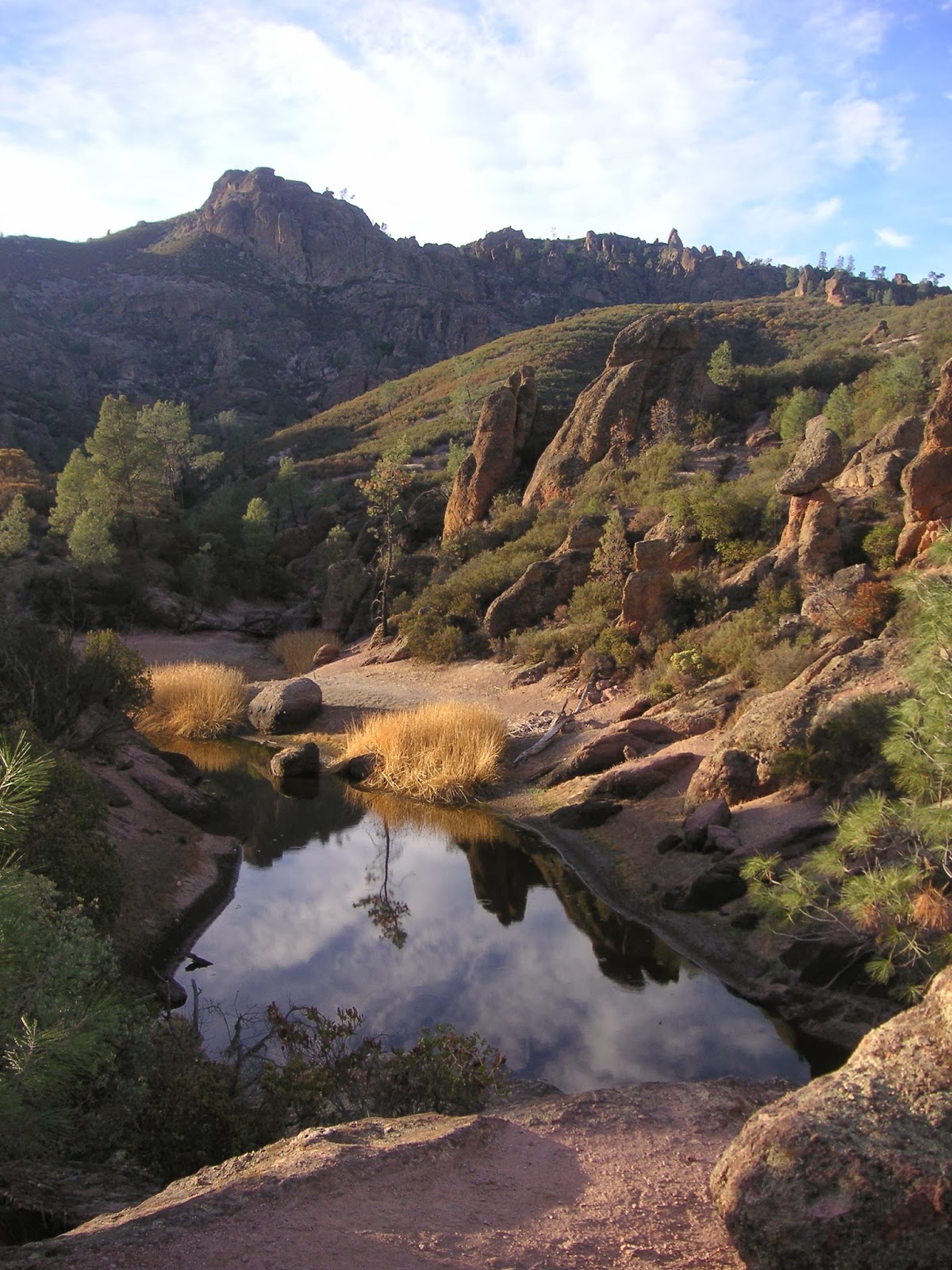
habitat ~ 02/25/14 ~ Pinnacles National Park

February 25, 2014

Researching location labels for Nature ID has had an unforeseen benefit in that I'm now more appreciative of local parks.  I used to take them for granted.  Their ownership and management are not always the same entity and can change over time.  Pinnacles changed from a National Monument to a National Park on January 10, 2013 when President Barack Obama signed an act into law.  (Is this a different legal process than when he signed a proclamation on April 20, 2012 changing former Fort Ord Public Lands into a National Monument? I'm mildly curious to know how all this works.)  Eh, I've been griping about the lack of progress I see around me, e.g., this recent Hatton Canyon habitat post, yet I haven't given enough credit to the changes that have been made.

So, I've added a new location label for Pinnacles National Park.  I'm still undecided if I'll update my past National Monument labels.  For the record, they include:
west entrance location (habitat + IDs)
east entrance location (habitat + IDs)
all Pinnacles habitat
west habitat
east habitat

giant slalom section of the "butterfly highway"

I decided on this last-minute trip to Pinnacles hoping to find 2 specific butterflies before the week's heavy rains hit.  One was the margined white, which is not included in the Pinnacles Butterfly Checklist.  I queried Paul Johnson (it's his list) and Art Shapiro (my go-to CA butterfly expert) about why it might be missing, because there are plenty of milkmaids (host plant) at Pinnacles.  Paul's been looking for over a decade, but he admitted he's had doubts around some look-alike checkered and cabbages he's seen.  Art challenged me to go find them myself.  OK!  Considering I spotted margined at 2 very different locations in the past few weeks, I figured the sooner I get out to Pinnacles, the better chance I have at finding them, if they are there.  Nope.  It's dry.  Very dry.  Very few milkmaids are up yet.  And very few butterflies are out.  Without any clear photographic evidence, I spotted a red admiral, a couple mystery Vanessa ladies, a handful of echo blues, and...

large rocks covered with Dudleya (host plant) and Sedum

... a couple Sonoran blues.  Woohooo!  It's thanks to Ken @ Nature of a Man who sent me a recent picture of one to ID that I even remembered I've been wanting to get a picture of my own ever since Chris Grinter commented on my Dudleya post from 3 years ago.  I was so close to getting a good shot, but then I was afraid of falling off the rock.  You understand.

standard west entrance shot from the parking lot

As I debated whether I wanted to try another trail where I know more stonecrops grow, I marveled at the incredible palette Pinnacles provides even in this record dry winter we've had.  The iron red color of the buckwheats is starting to float my boat.  Given my relative lack of success, I wasn't so gung ho on butterflies anymore.  Plus, I was still feeling kinda icky and was a bit parched and craving the sight of water.  There are plenty of strenuous trails but no connecting roads through the park.  So, in an unusual move for me, I decided to drive over to the east entrance and hike to the reservoir. 

Bitterwater Road

The bleached out grey, died, dead was oppressive, and yet fascinating at the same time because it's so extreme.  I feel badly for the cows and the farmers.  Anyone else hoarding butter in their freezer like I am?  It's going to be worth its weight in gold.

Bear Gulch Reservoir

Ahhh.  It was so worth the long day of driving and hiking through the ick to get here, to this spot, to watch the shadows from the late afternoon sun, and to contemplate life.

Friday, June 10, 2011

habitat ~ 06/10/11 ~ Pinnacles National Monument - east


After the previous day's hot hike in the full sun, our hike to Bear Gulch Reservoir in the shade of rocks and trees was a welcomed change of pace. For all the times we've been to Pinnacles, this was the first time we've done this short loop. Unfortunately our timing never seems to coincide with when Bear Gulch Cave is open. As shown by the sign, the cave is often closed when the Townsend's big-eared bats are raising their young. Plus, this past March I know the Balconies Cave was closed due to high water, but I don't remember if Bear Gulch Cave was also closed.

While we prefer going to the west entrance in May for a day trip, this was our first time camping at Pinnacles. The last picture shows our campsite's "backyard" with a creek. It looks lovely, doesn't it? Come nightfall, marauding racoons used that creek to sneak into every campsite along the water. We could hear the series of shrieks and yells from the campers with only a minute or so between hits. We were sitting only feet away at the campfire when a couple very large raccoons hopped on our table and grabbed our just-opened bag of marshmallows. We got off easy. Our neighbors chased after a raccoon which disappeared with an entire knapsack. Overall, this Pinnacles trip was great and I'm looking forward to going back.

ps 12/15/11 - For pictures of this trail in mid-December, check out My Back 40 (Feet).

northern bluet ~ 06/10/11 ~ Pinnacles

northern bluet
Enallagma annexum (formerly E. cyathigerum)

So much for looking at wing position to distinguish bluets (Enallagma spp.) from dancers (Agria spp.). Supposedly bluets have wings held close to the body, whereas dancers hold their wings up and away from their abdomens. Here's the second time where my pictures show the exact opposite of this. I've used the advice given by Jim Johnson at Northwest Dragonflier and Odonata.Bogfoot.net from my previous vivid dancer post to look at the color of the last (i.e., 10th) abdominal segment, at least in western damselflies. If it's mostly black on top, it's a bluet, and if it's all blue, it's a dancer. Again, another one of those naming things that doesn't mesh with what I now know to look for.

There are 4 Enallagma spp. reportedly found at Pinnacles: E. annexum, E. civile (familiar bluet), E. carunculatum (tule bluet), and E. praevarum (arroyo bluet). I ruled out the tule and arroyo bluets, because their abdominal segments are mostly black. I then ruled out the familiar bluet, because it has smaller eyespots and a triangular "fin-shaped" appendage at the tip of the abdomen. Finally, there is the possibility this could be an almost identical boreal bluet (E. boreale), but the distinction is in the tiny cerci (compare b with e) and not anything I can tackle with my point-and-shoot. Now, as before, I could be totally wrong with this ID. Jim?

The second picture above is a cast exoskeleton (aka exuvia) from a damselfly naiad. I love how they hug the tule/bulrush, something I'm not going to try to ID. What would damselflies do if there wasn't any tule around to hug?

bluewitch ~ 06/10/11 ~ Pinnacles


Solanaceae

Posted 07/16/11 - Popping out another post this evening and trying not to take myself too seriously. Sometimes my point-and-shoot simply refuses to cooperate or the subject moves, hence the crappy photos label. I always wondered what a bluewitch was. Now I know.

acmon blue ~ 06/10/11 ~ Pinnacles


acmon blue
Plebejus acmon
for more information click here and here

Oy! This was play the game of spot the difference between the individual shown above and the bernardino dotted blue I posted from the previous day. Here are my own (layman) explanations of why I'm leaning towards an acmon blue ID:
1) Almost every picture of bernardinos I've seen have a black spot that touches the costal margin (leading edge of the forewing) at around the 3rd row of spots down from the outer margin. It is missing here as it is with acmons.
2) The overall appearance of the spots on the forewing are rounder like with acmons, rather than squarish with bernardinos.
3) Most pictures of bernardinos I've seen have 4 spots on the hindwing between where the wing attaches to the body and the cell-end bar (dash in the middle of the wing). The 2nd spot up from the hindwing trailing margin (wing edge along the abdomen) is missing, again, like with acmons.
4) Bernardinos have flat black spots on the outer edge of the hindwing and acmons have iridescent blue spots. Either they were worn off on this older butterfly or the backlighting hides the effect such that the spots appear all black.
5) It is not obvious that this butterfly has checkered fringes on the forewing, which is common in in bernardinos. Yet, there is the possibility they were worn off of this older butterfly.
6) Speaking of worn, older butterflies, I also posted a top-side view of an acmon blue from the previous day. This tells me the flight period is almost exactly the same, whereas the bernardino blue was fresh.

Sigh, this is probably way more detail than anyone wants to read. Lepidopterists must be excruciatingly nitpicky, closely followed by botanists. Can you imagine if we applied these same miniscule differences to other living things? To humans? Well, this person has green eyes and that person has hazel eyes, so they "must" be different species. I have to laugh at myself, because what the heck am I doing with this blog? Two years ago I couldn't even tell you the difference between chinese houses and sky lupine, and now I'm counting the dots on a tiny butterfly's wing.

pitcher sage ~ 06/10/11 ~ Pinnacles


Edited 07/16/11 - I originally posted with pictures from 06/09/11, but I like these photos better. The previous day the pitcher sages were so fragrant that it stopped us in our tracks. I've seen these at Fort Ord before, but I never noticed its incredibly wonderful scent. Maybe the very warm day helped spread the smell. I wonder if the flowers and leaves can be eaten. I would definitely include this in my dream garden.

valley garter snake ~ 06/10/11 ~ Pinnacles


valley garter snake
Thamnophis sirtalis fitchi
(ssp. of common garter snake) 

This swimming snake was a fun find. It amazes me they can use a similar serpentine movement to swim as moving across ground. It was good to revisit garter snake ID, because I found an error in a previous post that I had originally identified as a coast garter snake.

ps 04/01/14 - I had briefly changed the ID to Diablo Range garter snake (Thamnophis atratus zaxanthus), an aquatic garter snake.  However, Diablo do not have red on their sides like this one shows.

imbricate phacelia ~ 06/10/11 ~ Pinnacles

Phacelia imbricata ssp. imbricata
Boraginaceae

If I didn't have Pinnacles plant list and Calflora's distribution map, I'd have a hard time distinguishing this plant with its relative variable-leaved phacelia (Phacelia heterophylla ssp. virgata), which is found further north. Species of Phacelia are aka scorpionweed. I figure the name comes from the curly inflorescence like the curl of a scorpion tail. However, this isn't the entire story. Apparently, contact with some scorpionweeds (like P. crenulata) can produce dermatitis venenata in susceptible people, similar to poison-oak and sumac reactions. Interestingly, other species of scorpionweeds (like P. neomexicana) were used by Native Americans to actually treat rashes. It's difficult to track down accurate and original online information of which species of scorpionweed does what, so as Santa Fe Botanical Gardens recommends, it's probably safer to stay away from the stuff.

ps - The purple flower in the background is elegant clarkia.

honey bee ~ 06/10/11 ~ Pinnacles


While Pinnacles has the highest known bee diversity in the world, I'm guessing these are typical European honey bees (Apis mellifera) that were introduced to North America close to 400 years ago. I took the pictures of the bees collecting water from the same standing spot as the nest, and I'm assuming the bees are from the nest. This is the second time I've seen comb on the outside of a tree trunk, as opposed to a swarm. I also found several online pictures of North American hives hanging from branches. However, I usually think of feral hives as being in cavities, like tree holes and chimneys. I wonder why honey bees pick different locations for their hives. Perhaps the nest is not an Apis mellifera feral hive? I had a difficult time finding any information about wild honey bee nests and their locations since most search results ended with beekeeping info. The Food and Agriculture Organization of the United Nations site and trusty Wikipedia discuss honey bee nest locations.

holly-leaved cherry ~ 06/10/11 ~ Pinnacles


Here's my first native, non-garden blossom post. Apparently holly-leaved cherries are edible. I'll have to keep my eye out for them come September and October. I find the autumn timing of this wild fruit to be interesting considering commercial cherries are the first summer fruits available. In fact, we passed numerous roadside cherry stands on our way to and from Pinnacles.