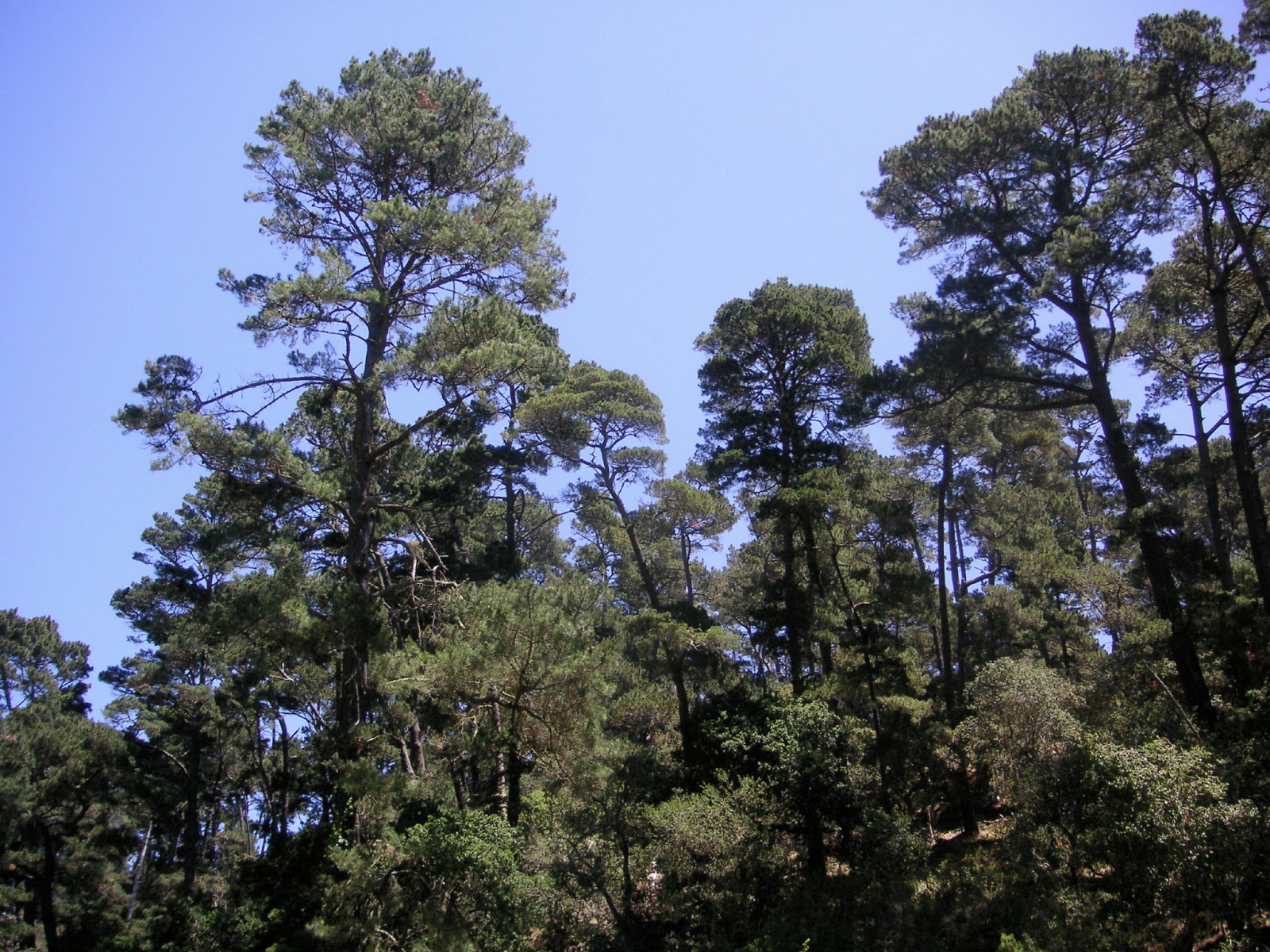
After I first visited Hatton Canyon back on February 4, 2011, I wasn't terribly impressed by the proliferation of non-native plants and haven't had a huge desire to return. I do remember the auditory intensity of bird songs, which prompted a second worthwhile visit this past March 10. Unfortunately without accompanying photos, it didn't inspire me enough to break out of my winter blogging hiatus to write about the birds. Then when Monterey County butterfly guy Chris Tenney and I were figuring out
where to meet for the first time, he suggested Hatton. Oh? Turns out this place is a butterfly hot spot. So, while there are mostly invasive plants, like poison hemlock, nestled adjacent to rare native stands of Monterey pines, the fauna density is quite impressive. It's amazing what a few short years can do to change my opinions. I was starting to get sucked into nativism, just shy of biological xenophobia, something that's been in the forefront of my consciousness lately. Maybe it doesn't really matter, beyond the concerns of humans, if the thriving plants originated here or elsewhere? The animals certainly don't seem to mind too much. Maybe it's better to let nature run its course?
Showing posts with label * biological xenophobia. Show all posts
Friday, May 31, 2013
Tuesday, May 14, 2013
lustrous copper ~ 05/14/13 ~ Lang Crossing
Brassicaceae
Dr. Shapiro sent me a list of butterflies he recorded for Lang Crossing 3 days before our excursion. I was very disappointed to discover I wouldn't see the gorgeous lustrous copper at Washington and told Art as much. So, late in the afternoon, parched from the extremely warm day, as the shadows filled in the primo butterfly hangouts, we faced a dilemma: go straight to the Washington Hotel for some much needed liquid refreshment and call it a day, or go 10 miles up the road for me to see my first ever Lycaena cupreus at Lang. It was Art's wife who suggested doing both, but only after making him guarantee that I would see a copper butterfly. That guarantee looked like it was going to be a bust, because we failed to find any coppers at the spot Dr. Shapiro saw them previously. Fortunately, in a moist meadow across the river, we hit the coppery mother lode. I have so many pictures of this wildly, brilliantly, bold butterfly, including the last one above where a greenish blue wanted to get in on the photo shoot action. Tired as I was, I was extremely glad we made the extra hour and a half round-trip.
Some additional notes - If I hadn't known what to look for, I could have easily brushed off the resting butterfly in the second picture as the more-familiar-to-me acmon blue, with only the underside of the hindwings showing. It's easy to distinguish when they're flashing their brilliant copper tops or are still in a photograph, but from a distance and hiding in real life, it's not so easy.
There's some question how the lustrous copper larvae feed primarily on the moderately invasive sheep sorrel. With all the recent heavy bashing of non-native plants [I'm a believer in if it's alive, then why kill it? Unless it's doing great harm to others, our ever-changing opinions should not be the sole reason for death, which extends to humans and wars.], it's interesting to note that some native butterflies have taken to them and likely depend on them for their survival. Or do they? Art wonders if our local sheep sorrel (Rumex acetosella) has been incorrectly deemed an Old World species, and could be found native through genetics techniques. Hmm?
What tripped me up throughout the day was mistaking the blue moth (Caenurgina caerulea) for one of the blue butterflies. Now that I looked it up, it doesn't look blue at all. Weird. And finally, I would have had a difficult time figuring out which fuzzy blue butterfly is in the last picture, not to mention yellow mustard-looking plant, if it wasn't for Art's continuing patient guidance via e-mail. Thanks, Dr. Shapiro!
There's some question how the lustrous copper larvae feed primarily on the moderately invasive sheep sorrel. With all the recent heavy bashing of non-native plants [I'm a believer in if it's alive, then why kill it? Unless it's doing great harm to others, our ever-changing opinions should not be the sole reason for death, which extends to humans and wars.], it's interesting to note that some native butterflies have taken to them and likely depend on them for their survival. Or do they? Art wonders if our local sheep sorrel (Rumex acetosella) has been incorrectly deemed an Old World species, and could be found native through genetics techniques. Hmm?
What tripped me up throughout the day was mistaking the blue moth (Caenurgina caerulea) for one of the blue butterflies. Now that I looked it up, it doesn't look blue at all. Weird. And finally, I would have had a difficult time figuring out which fuzzy blue butterfly is in the last picture, not to mention yellow mustard-looking plant, if it wasn't for Art's continuing patient guidance via e-mail. Thanks, Dr. Shapiro!
Monday, February 20, 2012
curly dock ~ 02/20/12 ~ Pinnacles
I was a little disappointed to see this weed at Pinnacles, a place I consider relatively pristine. To my knowledge, Pinnacles has never been farmed or used for any other purpose than pure enjoyment. I wonder how much hikers inadvertently bring in weedy seeds or spores on their shoes, clothing, and camping gear.
At the research reserve in Elkhorn Slough, they require every visitor to step into bleach water with hopes to keep out Sudden Oak Death (SOD). I don't mind at all. Hehe, this reminds me of the time our camping gear was held for several days at the Auckland airport upon arrival in New Zealand. Andy didn't have a lick of spare clothing, and we were in Tairua by the time an airport shuttle finally delivered his backpack. It wasn't all bad; he got a now-favorite holiday shirt from a second-hand store along with some swim trunks, and we stayed in a lovely cabin since we couldn't camp.
ps 09/13/14 - It's been interesting reading through my older posts. I have to say, now that I know the lovely great copper butterfly uses dock as a host plant, I very much like seeing this very distinctive reddish plant around. I'm amazed at how I was getting caught up in the biological xenophobia that's been going around. I don't want to be in the mind frame that it's okay to kill things and be super distructo simply because, today, I deem it somehow to be bad. Tomorrow, I may change my mind and deem it be good (as shown here), but then it's too late. And, also during a recent visit to the Park, I talked with a couple historical researchers who told me that a part of the property was once a copper mine claim. They'll have that information available in the next year on the website. Cool. Also, I'm trying to make it a habit to clean my hiking shoes and gear before I leave a place, so that I can minimize anything I might potentially spread at my next hiking destination.
At the research reserve in Elkhorn Slough, they require every visitor to step into bleach water with hopes to keep out Sudden Oak Death (SOD). I don't mind at all. Hehe, this reminds me of the time our camping gear was held for several days at the Auckland airport upon arrival in New Zealand. Andy didn't have a lick of spare clothing, and we were in Tairua by the time an airport shuttle finally delivered his backpack. It wasn't all bad; he got a now-favorite holiday shirt from a second-hand store along with some swim trunks, and we stayed in a lovely cabin since we couldn't camp.
ps 09/13/14 - It's been interesting reading through my older posts. I have to say, now that I know the lovely great copper butterfly uses dock as a host plant, I very much like seeing this very distinctive reddish plant around. I'm amazed at how I was getting caught up in the biological xenophobia that's been going around. I don't want to be in the mind frame that it's okay to kill things and be super distructo simply because, today, I deem it somehow to be bad. Tomorrow, I may change my mind and deem it be good (as shown here), but then it's too late. And, also during a recent visit to the Park, I talked with a couple historical researchers who told me that a part of the property was once a copper mine claim. They'll have that information available in the next year on the website. Cool. Also, I'm trying to make it a habit to clean my hiking shoes and gear before I leave a place, so that I can minimize anything I might potentially spread at my next hiking destination.
Wednesday, July 27, 2011
broadleaf helleborine ~ 07/27/11 ~ Butano
We were really excited to find an orchid that we haven't seen yet. I also posted a picture taken the following day showing the color variation on Flickr. It was common at Butano State Park along the creekside trails under the redwoods. However, I was a bit disappointed to discover the broadleaf helleborine comes from Europe. In fact, it is the only non-native orchid listed in Calflora. I've mentioned before about my developing negative prejudice against non-native plants and animals, which taken to the extreme is what The Biology Refugia calls "biological xenophobia." Before doing this blog and placing labels on everything under the sun, I was pretty content finding something new and simply being in awe. I want to get back to that innocence and unbiased admiration of nature. Interestingly enough, Jennifer at A Passion for Nature recently posted about the broadleaf helleborine blooming in western New York. She's a blogger after my own heart in how she researches for her posts. Also, David at Orchids, Nature, and My Outdoor Life posted finding a broadleaf helleborine across the pond.
Thursday, June 9, 2011
purple western morning glory ~ 06/09/11 ~ Pinnacles
purple western morning glory / Pacific false bindweed
Calystegia purpurata ssp. purpurata
Convolvulaceae
Calystegia purpurata ssp. purpurata
Convolvulaceae
I've avoided adding morning glories to Nature ID, because I assumed they were non-native and would be difficult to identify. Not entirely so. In fact, most of the 37 sp./ssp. of Calystegia found in CA are native, but they are difficult to ID. I admit to holding unfavorable prejudice towards non-natives. I don't like this attitude of mine, particularly in light of the fact I'm not exactly native to CA, or the USA for that matter. Interesting... and why is it that I prize rare, threatened, or endangered native plants? It's not like I hang out with plant people or any serious biology/ecology folks. I do know I've picked up this attitude regarding plants since I started blogging. Hmm? Anyone care to put in their two cents about plant prejudices?
ps 07/12/11 - As I was looking up additional plants from the Pinnacles area, I noticed there is also non-native field bindweed (Convolvulus arvensis) that looks very similar.
pss 08/04/11 - This morning I found this post from The Biology Refugia talking about biological xenophobia. Interesting.
ps 07/12/11 - As I was looking up additional plants from the Pinnacles area, I noticed there is also non-native field bindweed (Convolvulus arvensis) that looks very similar.
pss 08/04/11 - This morning I found this post from The Biology Refugia talking about biological xenophobia. Interesting.