Saturday, November 12, 2011

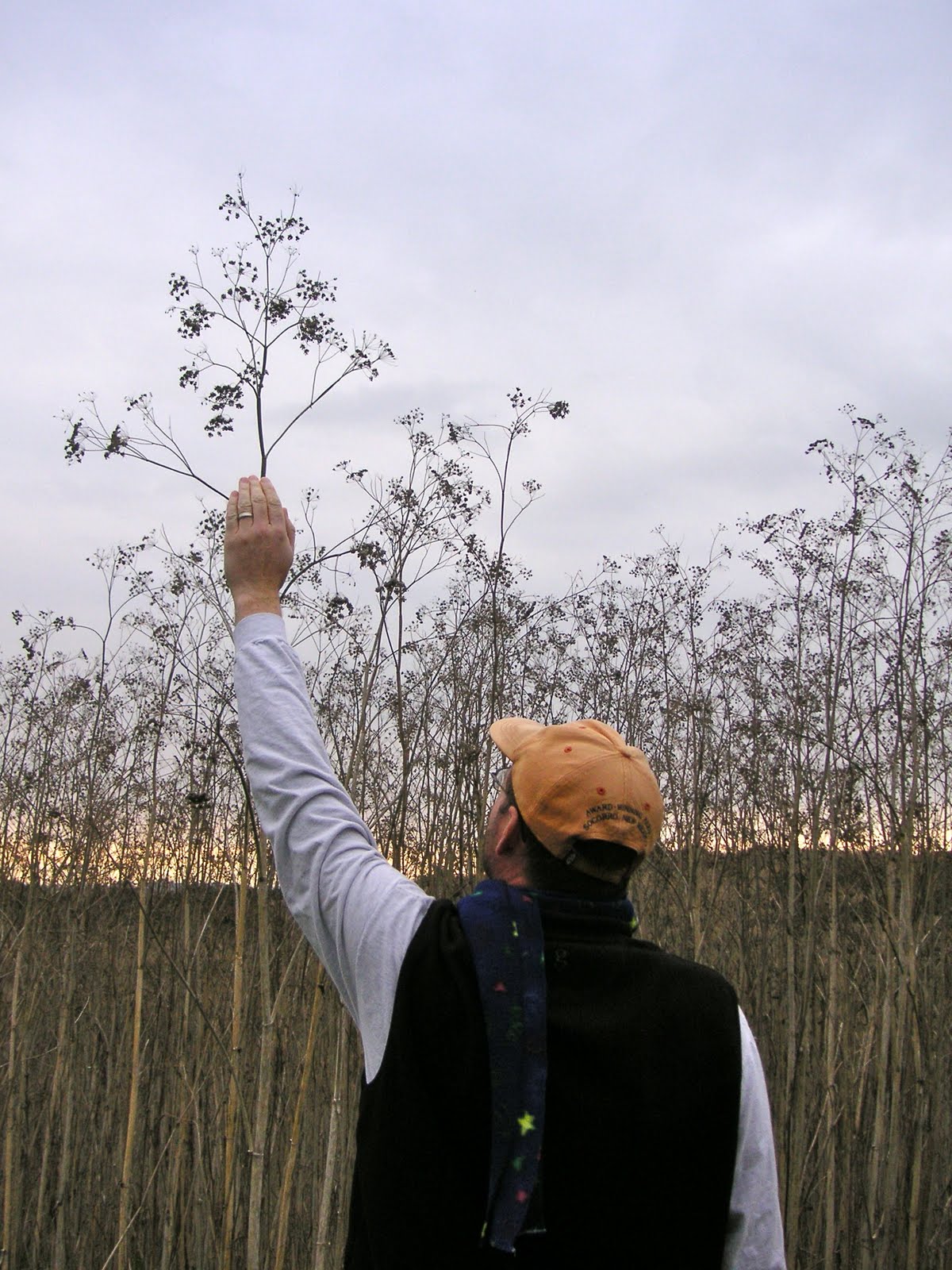
poison hemlock ~ 11/12/11 ~ Elkhorn Slough


While poison hemlock gets very little mention on the recently revised official Elkhorn Slough site, in my humble opinion, it is the single most dominating weedy species on their coastal, publicly-accessed grasslands. There are massive stands of it, not only in the expansive area it encompasses but also in height. Andy was kind enough to provide a size comparison for me to show it readily grows to 8 feet tall at Elkhorn.

Per my m.o. for Nature ID, all these photos were taken on November 12, 2011. This means the typical blurb repeated everywhere from books to online that C. maculatum flowers from April to July is not entirely correct. It's obviously flowering here in November, so it's no wonder it's such a productive plant. The flowers and leaves remind me very much of Queen Anne's lace and garden carrots.

I was sorry to see Land Steward ceased blogging about Elkhorn Slough. In fact, I discovered several blogs that featured Elkhorn Slough have stopped abruptly in the past two years, which makes me wonder if all the staff and volunteers were asked to stop blogging about their experiences. I now receive weekly, glossy, sugar-coated e-mail updates on what is going on there. It's too bad; I preferred the nitty-gritty and personal perspective of the reality of land management.

Did you notice the other unwanted resident in the first photo, a cucumber beetle?

Oop, I guess I should also note that there are other hemlocks out there besides the ones in the Apiaceae, aka carrot family, such as those in the pine family like Tsuga spp.

harding grass ~ 11/12/11 ~ Elkhorn Slough


Sigh... off the beach and back to drier land. My brain has to switch some serious gears for Nature ID. I occasionally overlook the fact that Elkhorn Slough used to be a farm. I'm often so preoccupied simply being in awe of the estuary, or looking for birds close enough to photograph, or seeking out native plants, which, pardon the expression, is like looking for a needle in a haystack. The official Elkhorn Slough site has a nice write-up on this common grazing grass.

Thursday, November 3, 2011

habitat ~ 11/03/11 ~ Morro Strand State Beach


When I first started Nature ID back in May 2009, Andy I were visiting San Luis Obispo County a little more frequently than we do now, and my blog subtitle was "from the Central Coast of California." Thanks to school and changes in our lifestyle, we stay closer to home in Monterey County these days, so I've re-subtitled Nature ID to reflect the change of location focus.
However, it's only been 3 weeks since I last visited this beach on October 12, 2011 in Morro Bay, about 150 miles southeast of Monterey Bay. The weather couldn't have been more different with a high of 67.5°F compared to the 92.8°F previously.

My friend Jennifer, who is also a regular commenter on
Nature ID, loved my sand dollar shots. Since she had never really been to Morro Bay, I thought it'd be a good idea to play hookey from our responsibilities and do a girls' trip. And, yes, she found many, many sand dollars, not to mention added new bird sightings to her brother's Birdpost [no longer available] site.

Heavy sigh... Morro Strand State Beach is on the list for closure in the coming year along with 69 other CA State Parks. Unlike back in 2009 when Mr. Terminator proposed closing 80% of CA's 278 State Parks, this year's threat of closure feels realistic and more serious. While I can see them closing and fencing off the campground, I just can't imagine any agency being able to keep people off this awesome 3-mile beach. With no restrooms, no refuse containers, or other maintenance and management, I predict the quality of this beach will quickly go downhill. Public-private partnerships have been organized to attempt to fill the gaps throughout the state, but it takes a cadre of folks willing to volunteer their money, time, sweat, and expertise. Randy at Way Points has been vocal with his posts about Trail Closure at Garrapata and Henry Coe gets a Reprieve. I'm surprised other CA nature bloggers I follow haven't said much on this very important and relevant topic. Save Our State Parks seems to me to be the best organization out there spreading the word.

ps 05/31/12 - The Central Coast Natural History Association Executive Director contacted me and asked if they could use my last picture of the SOS sign alongside the standard brown State Parks sign on the cover of their "Nature Notes" newsletter. They're a non-profit that raises money for their local SLO County State Parks and have been fighting to keep these special parks open for over 4 years. Of course, they have my permission! I sent to her a few higher resolution image files from which to choose.

terns ~ 11/03/11 ~ Morro Strand Beach


edited 11/11/11 - These were the funniest looking birds I've seen in a long time, like gulls with clown outfits on. It's too bad we lost sight of the Morro Bay Winter Bird Festival leader who pointed out the surfbirds for us.

I originally posted these as all being elegant terns, but I was unsure and considered royal terns as an option. I asked if anyone could help me tell the difference between the two species, because I was pulling my hair out thinking they all had to be either elegant terns or all royal terns. I tried to convince myself the variations I spotted were due to some being younger birds. As I've blogged before, I'm aware I often make the incorrect assumption that similar looking things near each other must be the same. Thanks to commenters Neil and Jennifer, I agree there are actually two species of birds hanging out together. Neil provided an excellent link to the San Diego Natural History Museum Focus On Royal and Elegant Terns. Thanks to you both!


royal terns with 1 elegant tern 2nd from right
S. maxima with 1 Sterna elegans 2nd from right

The royal terns have white tops of the heads, like a man balding on top, and thicker, pumpkin-colored bills. They look stockier than elegant when standing side by side.

elegant terns with 1 royal tern 2nd from left
S. elegans with 1 S. maxima 2nd from left

The elegant terns have heads with black hoods that touch their eyes, thinner, sharper bill, and slightly smaller overall size. Note the yellow legs of the juvenile elegant tern.


mixture of elegant and royal terns

Now, can you spot the differences above? With all the variations in plumage within a species, depending on time of year, age of the bird, and sometimes sexual dimorphism (other birds), I hope my confusion can be easily understood. Now that I know what to look for, the differences seem obvious. It'd be more of a challenge distinguishing these terns in their breeding plumage. I'm just glad a caspian tern (Sterna caspia) was not in the mix, too.

Somehow it's comforting to know other people have a hard time IDing these terns, e.g., Ben's Blog - In Search of Nature, Birds, Butties & Bugs, and John Wall's Natural California (does he have a mix of both species, too?).