
Showing posts with label salamanders/newts. Show all posts
Showing posts with label salamanders/newts. Show all posts
Wednesday, February 4, 2015

Monday, March 10, 2014
arboreal salamander ~ 03/10/14 ~ Midpen Preserve


I should note that we did not happen across this arboreal salamander resting on top of the log as pictured. I think Ken found it under some bark, but that makes it difficult to photograph. Normally, I don't go actively hunting for herps, but I'm also not documenting spp. for a preserve. This individual is not as spotty as the one-eyed arboreal salamander Andy found near home 4 years ago. I can't believe how gushy I was with my first find. I think I appreciate the random encounters a little more, but this was definitely eye-opening as to how much is hidden just out of sight.
CA newt ~ 03/10/14 ~ Midpen Preserve


Taricha torosa
Salamandridae
Salamandridae
OK, what are they feeding the amphibians at this preserve? Good golly, they're fat and huge, just like the Pacific chorus frog we found. Seriously, no one is actively feeding these wild-found animals, but there must be plenty of food stuff available and plenty of comfortable habitat. In one month's time, the CA newts have gone from skin and bones, like at nearby Stevens Creek on February 10, 2014, to fat, fat, fat. Ya, the two locations have very different habitats, but still! I'm unsure if the one in my hand is male or female. Are those male nuptial pads on the toes? Do you know?

a Rubenesque California newt
Monday, March 3, 2014
CA slender salamander ~ 03/03/14 ~ Purisima Creek


Cutie. This is a fairly small salamander, thinner than the width of a pencil. It looks pretty much like the Santa Lucia Mountains slender salamander (B. luciae) that I found April 29, 2012 as I was digging around at home. Well, okay, this one is not covered in dirt and has a longer tail. Field markings are almost no help for several look-alikes, because they
appear to have just as much variation within as between spp. Thanks to the expert ID I received from Gary Nafis @ California Herps and John Sullivan @ Wild Herps for my B. luciae, I understand the currently acceptable way to distinguish slender salamanders is to pinpoint location found. Here's a map of Batrachoseps spp. distribution. It doesn't seem very intuitive, but whatever, I'll go with it. I kinda wish I had retaken molecular genetics back when I transferred to a larger (read: better funded) university, because I might have appreciated what the PCR craze is all about. As it is, the statistical models, like Tajima’s D and Fu’s Fs, sound like rap names to me. Eh, I guess I'm getting old and staid.
rough-skinned newt ~ 03/03/14 ~ Purisima Creek

Salamandridae
Often, I have to see something in person to really "get it". Ken @ Nature of a Man showed me these very clearly defined rough-skinned newts. Their dark color is distinctive, especially with a sharp, solid color divide, under the eye area, extending around the upper lip. I found the color in my newt pictures can be wholly misleading from what I remember, depending on lighting conditions, and/or if a camera flash is used, and/or what the predominant surrounding color is, like these redwood needles here. They look much darker in real life than my pictures indicate.

OK. Love, love the toes. Four in front, five in back and all dipped in yellow around the purlicue. I find myself silently squealing like an 80's Valley Girl, "Like, oh my god! Awesome!"
Yeah, but... I still don't get the eye margin and lower eyelid diagnostics when compared to CA newts (T. torosa). We've noted quite a bit of gradation of characteristics among individual newts, especially at Stevens Creek where we saw so many. It seems like T. granulosa and T. torosa intergrade, but I'm not sure that's known for a fact. I believe Ken is gathering observational evidence.
I dunno, everyone sees things a little differently. A friend once claimed that different cultures see colors very differently, and I suspect he was right. I didn't necessarily agree with his claim of cultural basis, although that could very well be true. I figure different groups of people would have natural genetic differences in how their eyes physically process information. It's like how I, an Asian, can squat very low, and my husband, a Scandanavian, can barely cross his legs. Same difference.

regenerating newt tail
It's crazy cool how newts can regrow body parts. Remember for a while there, I had considered going back to school to study salamanders? After talking it over with numerous people, I have decided it's not the best idea for me. First, I didn't have any pressing questions about them. What would I research? I already know I don't like working on someone else's passion project, particularly when they die on me and leave me with a mess of handwritten scraps. I want to follow my own questions and paths. Plus, if I were honest, I truly only wanted to raise newts and salamanders 'cause they're cute, but under the guise of "in the name of science" (hey, it happens). To do this, I'd have to handle them a lot. Guess what? They're toxic, very much so, producing tetrodotoxin (TTX), "the most poisonous nonprotein substance known to scientists." Yeah, sure, you can be careful washing hands and such, but can you be sure to be careful all the time? Ever since my first collegiate research project involving the unusual mating ritual of an x-large, yet incredibly beautiful, tropical mosquito (Limatus durhamii), I knew fairly quickly from first-hand experience (i.e., many itchy, sleepless nights with arms swollen from a colony's worth of female mosquito bites) that I did not want to study anything that sucks blood, bites, stings, poisons, or kills. Seriously. Then, there's another conundrum surrounding all herps, the dratted pet trade. I don't know if it is "dratted" and bad, but it's what I've heard. So that leads to a lot of secrecy, loads, so secret the CIA... uh, nevermind.
CA giant salamander ~ 03/03/14 ~ Purisima Creek

California giant salamander larvae
Dicamptodon ensatus larvae
Dicamptodontidae (formerly Ambystomatidae)
If I had grown up in the Santa Cruz Mountains, you probably would not have been able to get me out of the creek. As it was, my mother would express disgust at how muddy I got when playing in our irrigation ditch looking for crawdads and toads. Hey, I'm thrilled to learn of the CA giant salamander. For better pictures of this individual, check out randomtruth's flickr here and here. This larvae is good sized and very comparable to the size of most adult newts that I've found. They can be quite quick in the creek (say that fast 3 times). Ken told me he had one bark at him. Although, to me this recording from CA Herps sounds more like a fart than anything fearsome. Read all about Ken's first-hand encounters with full-on beasties at Nature of a Man. They're not named "giant" for nothing. Lastly, as a comparison, Blue Jay Barrens has a recent post of a fatty salamander in his Ohio backyard.
Sunday, February 16, 2014
CA newt ~ 02/16/14 ~ Los Padres Dam

Taricha torosa
Salamandridae
Salamandridae
Well, color me orange! More newts! This seems to happen to me all the time; once I see something and learn to recognize it, I tend to notice a lot more of them. We found a couple dozen, and in much drier areas than I would ever expect to see them. Click on the picture above to take a closer look at the amazing newt iris. Very cool.

Supposedly, rough-skinned newts have not been found in this area before, but I'm still closely examining my photos with Gary Nafis' Taricha spp. comparison. I dunno, do the eyes "extend past the margin of the head"? Would it help if I said the lower eyelids on this individual were ambiguously dark? Erg. Erg. Erg. I may have to throw in the towel on being able to separate the 2 spp.

How many newts?
Answer: 2. It could well have been the different lighting and moisture level (sunny vs. the overcast skies under tree cover at Stevens Creek from last week), but it seemed to me the newts here at Los Padres Dam have more of a reddish coloring on top. In fact, I'd say their red was almost a perfect match with the madrone bark.

in the Carmel River
Good-bye, newts. See you next time. Have a lot of love and lay a lot of eggs.
Monday, February 10, 2014
CA newt ~ 02/10/14 ~ Stevens Creek


possible rough-skinned newt intergrade?
possible Taricha granulosa intergrade?
Squee! I thought I had died and gone to newt heaven. With 4 days of decent rain, we had high hopes in finding newts. And, we did. A couple hundred of them. Yes, hundreds. I stopped keeping track of count after a few hours. We must have hit the timing jackpot, because I don't believe sightings like this are typical. Or maybe they are? This year's winter has been so wacky with the lack of rain, that the newts may not have been very active before now. Many looked like skin and bones, with tiny little hips sticking out, and yet just as many others were quite plump and very healthy looking. Lots of thanks to Cindy @ Dipper Ranch for getting us bloggers together for this excursion.
If left to my own amateur ID skills, I would have said the above two newts were both CA newts. Many online pictures show rough-skinned newts as being much darker, practically a charcoal color, with the area under the eye also quite dark. Ken @ Nature of a Man suggested the ones we found may be intergrades. Hybrids? With so many newts around to compare, there was quite a bit of subtle variation in how much the eyes bulged and combinations of coloring (mustard yellow to cheddar orange to chocolate brown). As I picked up several, I noticed an immediate tactile textural difference. Those that felt rougher indeed had slightly darker coloring under the eyes; perhaps that's how they got their name. I honestly don't know if the way they feel in the hand could be considered diagnostic, because I haven't handled that many newts before. Plus, we found newts in many different stages, from itty-bitty 2 1/2" (head to tail tip) juveniles to hefty males with, eh-hem, bulges. Check out Gary Nafis' California Herps for the best side-by-side Taricha spp. comparison.

How many newts?
Answer: 3. Only after one or two had been pointed out to me did I begin to recognize their movement in the douglas-fir leaf litter. Pretty much they plod along on their little legs, but they will freeze momentarily
when approached. I can see why some parks will close roads for newt
crossings. They're perfectly colored to blend in with their surroundings and are not easy to spot. I'm guessing I've passed many newts during my hikes and simply have rarely noticed them before. Sadly, they're collected for the pet trade as "Oregon newts". Along with the convergent lady beetles, this was yet another reason for our discussion about the implications of sharing nature finds online. Hey, I'm not giving out trail names or GPS points, so collectors can hike around just like everyone else to maybe find them. They'd better be in good shape.

A 5th leg!
Given the number of newts we found this day, the chances of finding a mutant were good, obviously considering we found one. I don't understand how mutations work in newts. Does it originate in the egg? Or does it happen sometime when transforming from aquatic larva to terrestrial adult? How much does the quality of the environment affect newts? Or even an accident later in life? Apparently, they're able to regenerate lost limbs. These are definitely animals I want to learn more about. Does anyone have a recommendation for a good, scientific, but not too dry, newt book?
Sunday, April 29, 2012
Santa Lucia Mountains slender salamander ~ 04/29/12 ~ at home

Santa Lucia Mountains slender salamander
Batrachoseps luciae
(map of distribution)
Plethodontidae
Batrachoseps luciae
(map of distribution)
Plethodontidae
I ran out of potting soil, my compost isn't ready, and my favorite commercial soil mix is out of stock for a week. Sigh. So, I decided to pull out some of the prolific Vinca major under the douglas-fir and collect what turned out to be very rich soil. As I was sifting the soil for rocks and debris, I found what I figured was an earthworm. "Oh, good!", I thought, because I've been adding earthworms to my largest container with nasturtiums. Hmm... but hey, this little one has short legs and the cutest toes that put me over the edge of aww!
Oh man, I have had such a difficult time figuring out which species this slender salamander is. According to different sources, in CA there are anywhere from 19, 20, to 21 species of Batrachoseps. AmphibiaWeb shows an old map of relictual slender salamander (B. relictus) as being in this area; whereas California Herps shows both Gabilan Mountains slender salamander (B. gavilanensis with map) and Santa Lucia Mountains slender salamander (B. luciae). However, I wonder if it might be a California slender salamander (B. attenuatus with more information). I'm sending e-mails to some experts to help me, but if you know, please comment. Don Roberson of Creagus has an excellent site on slender salamanders.
ps 05/04/12 - I heard back from Gary at California Herps; he's continually creating the best CA herp site I've found. With his permission, here's what he said, "Fortunately there is only one species of slender salamander in that area [at my home] - the Santa Lucia Mountains Slender Salamander. Since all of the species look the same, you need to go by the range in order to identify most slender salamanders. Old books call it the relictual slender salamander, but that name was changed around 10 years ago. The Gabilan Mountains Slender Salamander does get up to Monterey Bay, but only north of the Monterey peninsula up near the Elkhorn Slough area. The California slender salamander is found north of there. You are welcome to quote me, but I wouldn't call myself an expert." Ha! Thank you very much, Mr. Nafis, aka Mr. Herp King.
Oh, I want to mention that I believe Batrachoseps spp. are the only genus of salamanders with 4 toes on their hind feet; all other salamanders have 5 toes on their hind feet along with the always 4 front toes. Cool! Right?
pss 05/07/12 - I also heard back from John at Wild Herps. I forgot to provide him specific location information. With his permission, here's what he said, "Your salamander is a Batrachoseps (slender salamander) species. Exactly which Batrachoseps species can probably be determined only by where you found it, as there are a bunch of nearly identical species in California. If it was in Monterey or Pacific Grove then it would be Batrachoseps luciae. Check out the range maps at <http://californiaherps.com/salamanders/salamandersmaps.html>." Thank you, John! Hope your trip was amazing.
pss 06/05/12 - I found another slender salamander in soil I had collected several weeks ago in a bucket and just now got around to sifting through it. It looked different than the one above by not having the reddish back. I wonder if there are loads of slender salamanders hidden among the Vinca major.
Oh man, I have had such a difficult time figuring out which species this slender salamander is. According to different sources, in CA there are anywhere from 19, 20, to 21 species of Batrachoseps. AmphibiaWeb shows an old map of relictual slender salamander (B. relictus) as being in this area; whereas California Herps shows both Gabilan Mountains slender salamander (B. gavilanensis with map) and Santa Lucia Mountains slender salamander (B. luciae). However, I wonder if it might be a California slender salamander (B. attenuatus with more information). I'm sending e-mails to some experts to help me, but if you know, please comment. Don Roberson of Creagus has an excellent site on slender salamanders.
ps 05/04/12 - I heard back from Gary at California Herps; he's continually creating the best CA herp site I've found. With his permission, here's what he said, "Fortunately there is only one species of slender salamander in that area [at my home] - the Santa Lucia Mountains Slender Salamander. Since all of the species look the same, you need to go by the range in order to identify most slender salamanders. Old books call it the relictual slender salamander, but that name was changed around 10 years ago. The Gabilan Mountains Slender Salamander does get up to Monterey Bay, but only north of the Monterey peninsula up near the Elkhorn Slough area. The California slender salamander is found north of there. You are welcome to quote me, but I wouldn't call myself an expert." Ha! Thank you very much, Mr. Nafis, aka Mr. Herp King.
Oh, I want to mention that I believe Batrachoseps spp. are the only genus of salamanders with 4 toes on their hind feet; all other salamanders have 5 toes on their hind feet along with the always 4 front toes. Cool! Right?
pss 05/07/12 - I also heard back from John at Wild Herps. I forgot to provide him specific location information. With his permission, here's what he said, "Your salamander is a Batrachoseps (slender salamander) species. Exactly which Batrachoseps species can probably be determined only by where you found it, as there are a bunch of nearly identical species in California. If it was in Monterey or Pacific Grove then it would be Batrachoseps luciae. Check out the range maps at <http://californiaherps.com/salamanders/salamandersmaps.html>." Thank you, John! Hope your trip was amazing.
pss 06/05/12 - I found another slender salamander in soil I had collected several weeks ago in a bucket and just now got around to sifting through it. It looked different than the one above by not having the reddish back. I wonder if there are loads of slender salamanders hidden among the Vinca major.
Wednesday, July 27, 2011
CA newt ~ 07/27/11 ~ Butano


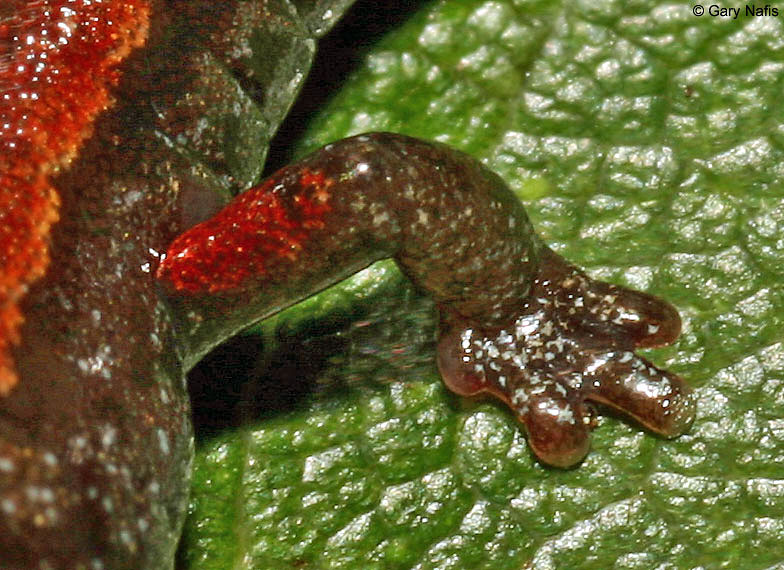

I knew Butano State Park was known for their newts based on our brief visit in the rain on October 24, 2010. According to the brochure, February is a good month to spot newts. I didn't expect to find any in the middle of summer. We actually saw a few, both on land well away from any water and in Little Butano Creek. Andy pointed them out to me. I'm discovering he has quite the eye for finding newts/salamanders.
Butano has two similar looking species of newts, the CA newt and the rough-skinned newt (Taricha granulosa). Based on the bumpy skin of the individual I photographed above, I figured I had a rough-skinned newt. Nope. Thankfully, CaliforniaHerps.com has this handy-dandy Taricha ID guide. Both transform to a smoother skin during their aquatic reproductive phase - never heard of this before researching for this blog post. Plus, both have yellow patches in the eyes. What sold me on the T. torosa ID was the light-colored lower eyelid.
I'll admit to picking up this fellow to keep him from sashaying into the water before I could get a couple of pictures. We later read that it has poisonous skin secretions. I need to learn to not pick up wild, unknown things, even if they're irresistibly cute. The toes totally get me laughing. Four in front and five in back. As a side note, it looks like this one still has its nuptial pads. Shoot, forget caterpillars and tadpoles, I think I may want to raise a few newts, ones without poisonous secretions.
ps 02/17/14 - Given my outing with fellow bloggers on February 10, 2014, I'm now wondering if this might be a rough-skinned newt intergrade. Erg.
Butano has two similar looking species of newts, the CA newt and the rough-skinned newt (Taricha granulosa). Based on the bumpy skin of the individual I photographed above, I figured I had a rough-skinned newt. Nope. Thankfully, CaliforniaHerps.com has this handy-dandy Taricha ID guide. Both transform to a smoother skin during their aquatic reproductive phase - never heard of this before researching for this blog post. Plus, both have yellow patches in the eyes. What sold me on the T. torosa ID was the light-colored lower eyelid.
I'll admit to picking up this fellow to keep him from sashaying into the water before I could get a couple of pictures. We later read that it has poisonous skin secretions. I need to learn to not pick up wild, unknown things, even if they're irresistibly cute. The toes totally get me laughing. Four in front and five in back. As a side note, it looks like this one still has its nuptial pads. Shoot, forget caterpillars and tadpoles, I think I may want to raise a few newts, ones without poisonous secretions.
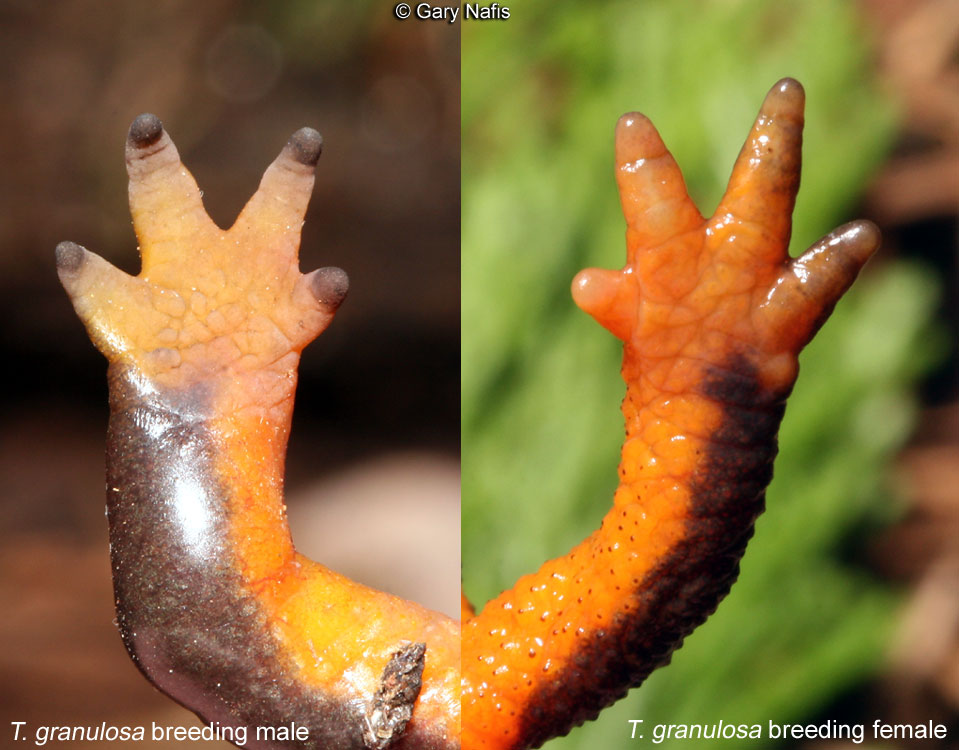
ps 02/17/14 - Given my outing with fellow bloggers on February 10, 2014, I'm now wondering if this might be a rough-skinned newt intergrade. Erg.
Tuesday, December 21, 2010
yellow-eyed Ensatina ~ 12/21/10 ~ Mt. Madonna


Plethodontidae
posted 12/31/10 - For my last post made in 2010, I really wanted to have something with a face. Seeing a salamander out in the wild was one of my goals this year and voilà! Actually, Andy found this salamander after he rolled over a log and called me over to take pictures - gotta love the fella for supporting me in my quirky nature obsession. For more information on this very cool Ensatina with yellow spots in the top half of its eyes, make sure to click on the embedded links above.
I was amazed at the color and diversity we found during our hikes in the rain and at the end of December. And to think, I almost canceled our reservations to "camp" in a yurt on Mt. Madonna due to fierce winter storm forecasts. It was a bit cold and very wet, but we had an incredible time. Sometimes you just have to go for the experience and hope for the best.
Wishing all my blog readers the best for 2011. May it be a new year filled with love, laughter, and the making of fond memories!
ps 01/06/11 - For a much more informative blog post than mine, check out Curbstone Valley Farm.
ps 03/16/14 - I edited the text, because now I know this was not a newt, rather a lungless salamander in the Plethodontidae family.
I was amazed at the color and diversity we found during our hikes in the rain and at the end of December. And to think, I almost canceled our reservations to "camp" in a yurt on Mt. Madonna due to fierce winter storm forecasts. It was a bit cold and very wet, but we had an incredible time. Sometimes you just have to go for the experience and hope for the best.
Wishing all my blog readers the best for 2011. May it be a new year filled with love, laughter, and the making of fond memories!
ps 01/06/11 - For a much more informative blog post than mine, check out Curbstone Valley Farm.
ps 03/16/14 - I edited the text, because now I know this was not a newt, rather a lungless salamander in the Plethodontidae family.
Sunday, February 21, 2010
arboreal salamander ~ 02/21/10 ~ Pacific Grove


 arboreal salamander
Aneides lugubris
more information
Plethodontidae
My husband came home from an evening walk and announced he saw what might have been a dead lizard, newt, or salamander on the corner. I tossed on my shoes and ran back out with him to see what he found in the dark.
I was happy to discover this live salamander! My pictures were a bit fuzzy, so I brought him home to take a closer look. The salamander was surprisingly quick and agile.
I'm not 100% positive about my ID here, especially considering that before we looked it up online, I was trying to remember back to my basic biology class in college - something about 4 or 5 toes (lizards, btw!) and what was the difference between newts and salamanders. Haha! I did find this great herp site and from a fellow Pacific Grove resident to boot!
I fell in love with his sets of four moist toes and briefly considered keeping him as a pet. After repeatedly exclaiming how cute he was, even with his missing eye, we let him loose in the park below our balcony by the big oak tree instead of back on the street corner. I likened it to being picked up by a giant and plopped down in Nevada, but I figured he'd be much safer away from cars and evening dog walkers.
May you live long, my cute, one-eyed arboreal salamander!
ps 03/30/14 - After looking at my pictures of another arboreal salamander, I think the toe count is supposed to be 4 in the front and 5 in the back. This individual is missing more than an eye, as its toe count is off. I believe the slender salamanders (Batrachoseps spp.) are the only group with a max of 4 toes in the back. Right?
I was happy to discover this live salamander! My pictures were a bit fuzzy, so I brought him home to take a closer look. The salamander was surprisingly quick and agile.
I'm not 100% positive about my ID here, especially considering that before we looked it up online, I was trying to remember back to my basic biology class in college - something about 4 or 5 toes (lizards, btw!) and what was the difference between newts and salamanders. Haha! I did find this great herp site and from a fellow Pacific Grove resident to boot!
I fell in love with his sets of four moist toes and briefly considered keeping him as a pet. After repeatedly exclaiming how cute he was, even with his missing eye, we let him loose in the park below our balcony by the big oak tree instead of back on the street corner. I likened it to being picked up by a giant and plopped down in Nevada, but I figured he'd be much safer away from cars and evening dog walkers.
May you live long, my cute, one-eyed arboreal salamander!
ps 03/30/14 - After looking at my pictures of another arboreal salamander, I think the toe count is supposed to be 4 in the front and 5 in the back. This individual is missing more than an eye, as its toe count is off. I believe the slender salamanders (Batrachoseps spp.) are the only group with a max of 4 toes in the back. Right?