Showing posts with label lily family. Show all posts

Tuesday, May 14, 2013

naked mariposa lily ~ 05/14/13 ~ Lang Crossing

naked mariposa lily
Calochortus nudus
 Liliaceae

posted 06/02/13 - This is my best guess. The other possibility is the Sierra mariposa lily (Calochortus minimus). Ya, I looked at Jepson eFlora for both nudus and minimus, and I can't make heads or tails out of it. Regardless of what it is, I like it! If anyone knows for sure which species, please comment.

yellow star-tulip ~ 05/14/13 ~ Washington

Liliaceae

I was pleased to find yet another Calochortus.  I wonder if these yellow star-tulips might be bigger if they were on better soil, kinda like how fairly lanterns are incredibly small at Fort Ord compared to all the other places I've found them.  It's interesting that the common names seem to divide the genus into globe lilies, mariposa lilies, and star-tulips.  Considering the current enthusiasm for renaming everything under the sun, I'm betting Calochortus will be split apart at some point in the future.

ps - I'm still hoping someone out there knows which x-some deletion causes short pinky fingers.

Leichtlin's mariposa lily ~ 05/14/13 ~ Washington

Liliaceae

Calochortus are quickly becoming one of my favorite groups of flowers.  They're common enough that I'm rarely disappointed at not seeing any, and they're distinctive enough that they stop me in my tracks.

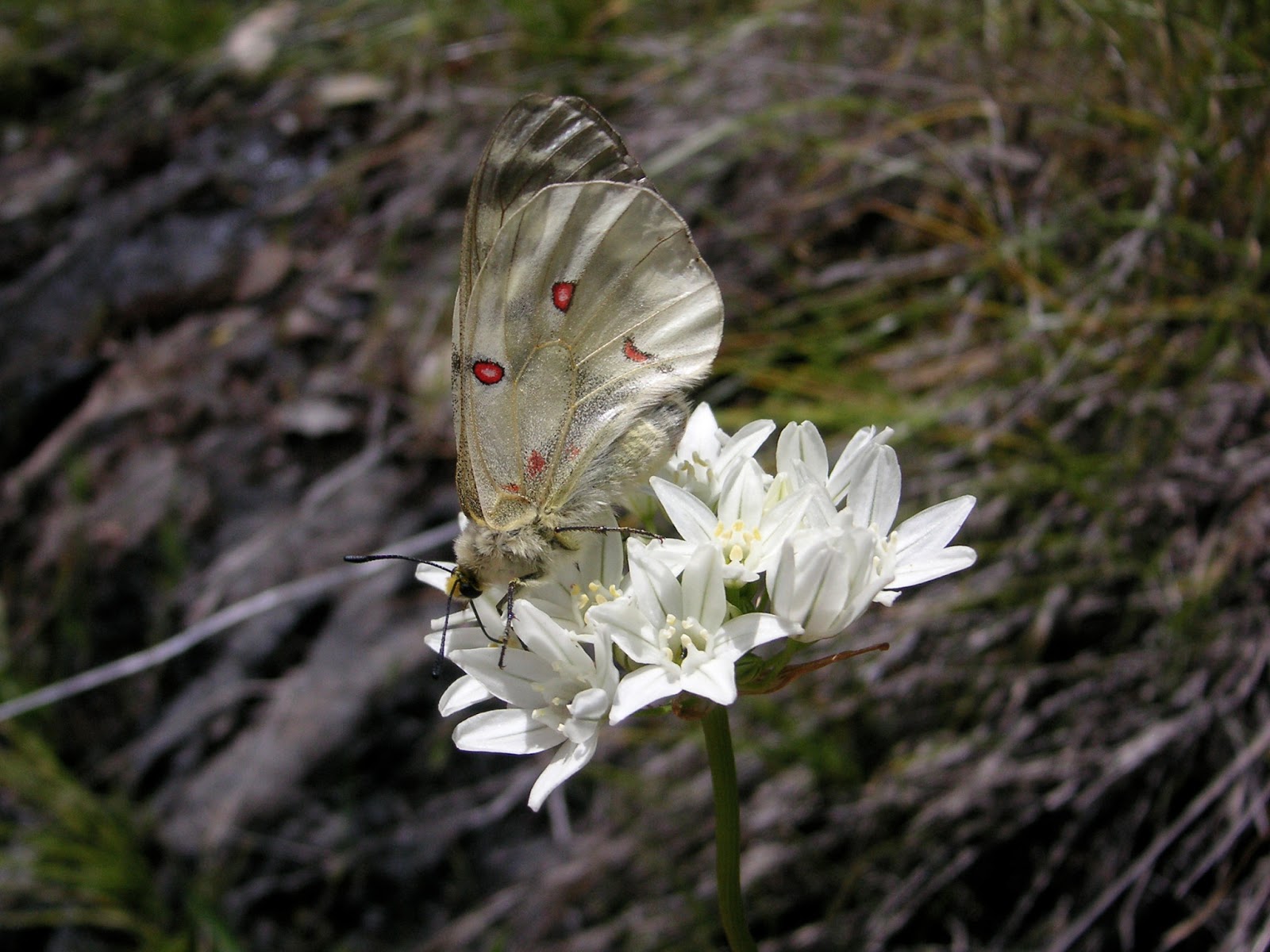
clodius parnassian ~ 05/14/13 ~ Washington

Themidaceae (formerly Liliaceae)

Isn't it pretty? Those red spots make me want to pull out my art markers and draw butterfly spots. When I first saw Parnassius about 15 years ago in the Ohio museum collection where I worked, I initially thought someone had grossly misfiled the drawer in the swallowtail (Papilionidae) cabinet. I figured they should be with the whites and sulphurs (Pieridae). Wrong! They are somehow classified along with swallowtails but in their own subfamily Parnassiinae, aka apollos. After looking at the pinned labels and discovered none were found anywhere near OH and several were collected in CA, I wished I had become more familiar with butterflies before I had left my home state. Not thinking I would ever return to CA at the time, I was a little sad at the prospect that I'd probably never see one on the wing. Wrong, again! When Dr. Shapiro mentioned we might spot early seasonal individuals of this high altitude butterfly, I got very excited. There used to be ssp. strohbeeni in the Santa Cruz Mountains closer to home, but it is now assumed extinct. Sure enough, there were numerous P. clodius ssp. sol fluttering about along the South Yuba River. Yeah! I was amazed at how large they appear. This one looks very fresh and notably still slightly crumpled in the wing. As an additional note, it seems whenever Parnassius are mentioned, the butterfly version of a "closed for business" sphragis is also mentioned. For great pictures and a brief discussion of what this means, check this out.

As for the white brodiaea, I kinda surprised myself at how easily I tracked down its ID. Closer to home the coast pretty faces have made an incredible showing this year, and these white flowers reminded me of them as well as dwarf brodiaeas. I guess I'm getting slightly better at recognizing related plants.

Sunday, April 7, 2013

checker lily ~ 04/07/13 ~ Garland Ranch

 Liliaceae

posted 05/05/12 - The only time I have ever found this lily before was during our wedding tree hike in 2009.  I'm posting these photos, because they're a vast improvement from my original entry.  The checker lily is generally not considered a rare plant, but it's rare to me.  Based on this sighting, I told the president of our local CNPS chapter that I predicted this year was going to be a great flower year for our annual wildflower show.  He was more concerned with how dry some areas of the county were.  Turns out we had an unofficial species count of 715 blooming flowers, the second highest count in the 50+ years our wildflower show has been held.  And, if my memory is correct, I believe 2009 was the highest count on record with over 735 spp.  To put this into perspective, we usually have maybe 625-675 spp. in the show, and many other regional wildflower shows may have 100-400 spp. at the most.

Sunday, May 13, 2012

oneleaf onion ~ 05/13/12 ~ Fort Ord


oneleaf onion
Allium unifolium
Alliaceae (formerly Liliaceae)

posted 06/09/12 - I think this is one of the prettiest onions around. I particularly like the tapered shape of the filaments (structures that hold the light-yellow, pollen-bearing anthers) and the delicate pink color gradation. Because the flowers reminded me so much of superficial crosses between Triteleia, Brodiaea, and Toxicoscordion, all of which were also once placed in the lily family, I went on a futile search of Themidaceae and Melanthiaceae and totally ignored the onion-like appearance. The next time I'm crying my eyes out as I'm cutting up a cooking onion, I'll try to remember how beautiful the flowers can be.

Friday, May 11, 2012

fritillary ~ 05/11/12 ~ Fort Ord

possible new to science fritillary
Fritillaria sp.
Liliaceae

Master's Student Sean Ryan from California State University, San Diego (aka San Diego State University) believes this may be an undescribed species of Fritillaria. Checker lily (Fritillaria affinis), which I've only seen once at Garland Ranch, tends to have wider leaves and is the only Fritillaria currently recorded from Fort Ord. I received Sean's permission to post these pictures online just in case it does end up being a new species. He said something about this fritillary being dispersed through bulblets, but then my notes got iffy as I was focusing more on taking pictures. Sean took the seed pod back to SDSU for study. I believe he attended this field trip since he did his undergraduate work at Cal Poly SLO and is still in contact with his former professors. I'll be curious to hear back from him with his findings.

Sunday, March 11, 2012

Pacific trillium ~ 03/11/12 ~ Pogonip

Pacific trillium / western wake-robin
Trillium ovatum
Melanthiaceae (formerly Liliaceae)

It seems that I've seen quite a number of trilliums highlighted in blog posts recently. Here in CA, common ones are Pacific trilliums and giant trilliums, as shown on John Wall's and Way Points. The rare snow trillium has made a show in Indiana and Ohio, as pictured on Get Your Botany On! and ohio birds and biodiversity. I find it interesting that patterns like this become apparent while perusing blogs, just like the past few months I've seen more snowy owl posts than ever before. Has this unusual winter played a role in these sightings, or is it mere coincidence?

From our own experience at Pogonip, we were delighted to find so many Pacific trilliums and two lone giant trilliums. I wish I had a better picture to show how prolific the Pacific trilliums were under the redwoods. In one section of the trail, they spread out as far as the eye could see. As I was looking up information on the Pacific trillium, I discovered from Jepson that the flowers start out white and age to pink. I've heard other flowers change colors once they're pollinated. Nature continually amazes me. For a well-researched blog post, check out Curbstone Valley Farm.

Saturday, March 3, 2012

what do other blogspot bloggers do?

Fremont's star-lily / death camas
Toxicoscordion fremontii (formerly Zigadenus fremontii)
Melanthiaceae (formerly Liliaceae)

While I was examining a couple shoots, a lady stopped to chat with me. She had a well-behaved dog who sat there panting patiently while we talked. Shocking, right? The dog didn't jump all over me or knock me over into the dirt, it didn't bark and growl at me, it didn't stick its slobbery nose up where it didn't belong, and it didn't rub me all over with poison oak. OK, I've previously maligned dog owners on trails, so, to be fair, I need to point out that I also meet many dogs and their owners who are quite respectable.

This lady is a local who regularly walks the trails at Jacks Peak. She remarked how all the star-lily blooms were very early this year because of the mild winter we've had. Yes, it has been an unusually mild winter here in CA, but I disagreed with her observation of early blooms (this is not to say early blooms haven't happened elsewhere). I told her I believed it was, in fact, the right time for star-lilies to be blooming. She was highly skeptical. Too bad I didn't have access to my blog, because I have photographic records of these plants blooming 3 weeks earlier in the season on February 11, 2011 here at Jacks Peak. I also have records of them blooming at Wilder Ranch on March 7, 2010 and Fort Ord on March 14, 2009. To me it's not surprising to see them blooming right now. Of course, they could continue to bloom for a while.

Part of why I started Nature ID and am so persnickety about backdating picture IDs to the date of my photos is to record when things occur. I already knew my memory is fickle. Had I not been keeping track of bloom dates like the Fremont's star-lily, I would have come to the same conclusion as the lady with her dog. However, I've slowed down in posting repeat IDs unless the date or some other observation is unusual. The reason for this is I've reached 66% of my blogspot storage capacity, and I'm starting to wonder what I'll do once I reach max capacity. I'd like to continue my blog for a while, because I know I have many more new IDs yet to make. One can purchase additional storage, but I'm not sure I want to go down that road.

What do other blogspot bloggers do when they reach maximum free photo space?

In addition, google made major changes throughout February 2012 with the way people can comment on blogspot. In response, I've been testing out the different comment features, which will be ongoing. I removed the CAPTCHA, because the word verification test to make sure you're not a robot became extraordinarily difficult to decipher. I'll admit that I sometimes skip commenting on someone else's blogspot if the CAPTCHA is too murky. For a couple weeks I was inundated with anonymous spam once I turned off word verification, but now for some reason those kinds of comments have ceased. Then, I also switched from my favorite of pop-up window to embedded comments. Embedded comments are now the only way they can be subscribed, but only if you have a gmail account (see lower right below the comment box). I haven't taken advantage of the new reply to comment feature available in the embedded comments options, since I don't want to inundate those who subscribe with extra emails. In my search for fixes to google's changes, I found a quote I liked, "You're not a customer of google; you're their product."

What do other blogspot bloggers do to fix their comment features?

ps 03/19/12 - Looks like google blogspot bloggers are not the only ones having issues; WordPress has also apparently changed its comment settings. Very odd.

Friday, February 3, 2012

fetid adder's tongue ~ 02/03/12 ~ Mt. Madonna

fetid adder's tongue / slink pod
Scoliopus bigelovii
for more information click here and here
Liliaceae

Yay! Yay! Yay! It's been a while since I've been this excited about finding a plant in bloom. One of the very cool aspects about following other nature bloggers, especially fairly local ones, is I get turned onto new discoveries. Many thanks to John Wall for his recent post alerting me that fetid adder's tongues are blooming now. In fact, it was one of John's posts this time last year that the name fetid adder's tongue caught my attention for the first time. Then I started seeing other bloggers post about this stunning little lily, and I made a list o' links for my online archive. So, I've been waiting a whole year to see FAT blooms in person. To actually read anything informative about FAT, such as flower parts and its relatively limited distribution, check out the two links in the ID section above "for more information."

I'll continue this post later, but right now I want to get outside to enjoy the beautiful, sunny 64°F!

ps 02/05/11 - For the record, the temperature in Monterey reached 72.3°F on Saturday. I spent most of yesterday morning researching FATs and ran out of time to finish this post. I usually give myself a time limit for creating a post, which hopefully explains why I often feel the need to edit and postscript my crappy writing. However, this time, I got a bit obsessive with finding my own information. I looked at over 240 online pictures (from flickr and CalPhotos, both linked in the common names above). I even created a spreadsheet of the photographic collection data, excluding those without flowers, without location information or specific dates, repeats from the same trip from the same person or from the same hiking group, cultivated plants, and misidentified and potentially incorrectly dated photos. Yep, that's definitely obsessive, and no, I rarely do this for any post on Nature ID.

Perhaps, I should have looked into FATs a little more before heading to Mt. Madonna with the belief that if I didn't get out last week, I would miss my opportunity to see this lily bloom for another year. I truly felt a sense of urgency to get my butt and camera to the nearest redwood grove ASAP. I'm not sure how I got that impression. Come to find out the earliest published record of FAT blooming is December 15 from A California Flora and supplement 1959 & 1973 by Philip A. Munz and David D. Keck. Since I don't have that book as a reference, I found something even better (for me anyways), a flickr photo by G. Dan Mitchell dated December 18, 2009. The latest believable seasonal online reference I found is a flickr photo by Michael Graupe dated March 29, 2008, even though I also found a few photos claiming they were taken at the end of April, May, and even August. While published bloom times vary from January to February or February to March, I found this information to be too vague. From my own photographic survey, I figure the peak bloom period occurs from the last 10 days of January through February and into the first 10 days of March. Well, gee, I guess I didn't need to be in such a rush after all.

For some miscellany...

Several online blogs, photos, and sites commonly state one has to get down on hands and knees to spot this 2" tall lily. Bah! The ones shown in my photos above were easily 6" tall from ground to sepals, with some in the area even taller. I was actually quite surprised by how big they were.

We were undecided between going to Mt. Madonna (Santa Clara Co.) or Nisene Marks (Santa Cruz Co.) for the nearest redwood groves, so I looked at Calflora before we left and discovered they've added a cool new location closeup feature to their site. While redwood forests are the most common habitat, they can also be found in chaparral and other areas, as Katie from PhyteClub shows.

Oh, I included the pic of the banana slug munching on a seed pod above, because I had a good laugh when I found a gardening site state the seed pods are "virtual gastropodic picnic baskets." Unfortunately, I was unable to capture a picture of a tiny fly that checked out several flowers. It didn't look like any of the fungus gnats I've found referenced as pollinators, but it did look like it fit perfectly in the center grooves of the sepals with its head positioned under the anthers. And, no I didn't catch any fetid whiff while I was so close observing the fly.

Sunday, December 25, 2011

wavyleaf soap plant ~ 12/25/11 ~ Jacks Peak

wavyleaf soap plant
Chlorogalum pomeridianum var. pomeridianum
Asparagaceae (formerly Agavaceae, Hyacinthaceae, & Liliaceae)

Edited 01/03/12 - I originally posted this as a sprout of Fremont's star-lily, but thanks to my commenters, I've corrected the ID above. It's been a goal of mine to track the seasonal evidence of both death camas, aka Fremont's star-lily, and soap plant, especially in areas where they literally grow from the same spot of ground like at Jacks Peak. I've made a fuss about how several online sites have them mixed up, and I've admitted I get them confused, too, when they only have green leaves - the flowers are too distinctive to ever get them mixed up. I've now concluded that death camas is an early flowerer compared to 3-4 months later in the season soap plant.

Thursday, August 4, 2011

wavyleaf soap plant ~ 08/04/11 ~ Jacks Peak


posted 01/03/12 - This is the exact area I photographed death camas back on February 11, 2011. When I took these pictures, especially the middle one above, I truly believed I had finally captured both soap plant and death camas together. Now that I've had the space of time to look at the pictures, all the fallen leaves look like wavyleaf soap plant.

Thursday, July 28, 2011

red clintonia ~ 07/28/11 ~ Butano

Liliaceae

Hey, that's not red! I need to keep my eye out for the scarlet red blooms next year. It seems I only ever notice the large deep-blue berries under redwood trees.

Thursday, July 14, 2011

fairy lantern ~ 07/14/11 ~ Garland Ranch

fairy lantern / white globe lily
Calochortus albus
Liliaceae

I remember hiking past fairy lantern seed pods in the past and not knowing what they were at all. Now that I'm beginning to recognize a decent set of local flowers, I'm gradually discovering the beauty and identity of the structures that surround seeds, such as pods and fruits. It's a natural progression of my learning curve.

I've recently reorganized my labels for plants and have edited and added new labels, such as *fruits/seeds. My eventual goal is that someone visiting my blog can click on a name in the labels (at the bottom of every post) and see how a plant looks throughout the year and note some locations it can be found. I've mostly done this for poison-oak already since it is ubiquitous. Plus, you may start seeing labels with a number added to the end, like poison-oak 2. I'm designating the numbered labels for when the plant is pictured but is not the focus of the post. I'm hoping this will help give a sense of the habitat and what other plants can be found with it.

As a final blogging brief note, I often choose a less attractive photo for posting to Nature ID if it shows the features I want to highlight, such as the three part seed pod of the fairy lantern. This sometimes makes for a less visually appealing blog, but that's not my primary purpose.

fat solomon ~ 07/14/11 ~ Garland Ranch

Maianthemum racemosum (aka Smilacina racemosa)
Asparagaceae (formerly Ruscaceae & Liliaceae)

As with slim Solomon, another false Solomon's seal, there's quite the variation of names. The berries are pretty. Most of the fat Solomon we found along the trail had missing berries and stems as shown in the second pic above. I wonder if deer or horses like to eat them. This trail is a popular horse riding route with several stables nearby.

Now here in CA, we don't have actual Solomon's seal. There are numerous websites devoted to herbal uses. Two that have some name origin and historical use information, not soley trying to hard sell you on their products, are Botanical.com (Polygonatum multiflorum native to Europe and Asia) and Cortesia's Solomon Seal blog (P. biflorum native to eastern North America). There's also a nice online chapter of The Book of Herbal Wisdom by Matthew Wood. I wish I could find as much information about indigenous peoples' uses of CA native plants.

ps 07/20/11 - Thanks to Particia Lichen's comment below about the general confusion around Solomon's seal ID, both the real dealio and the false ones, I'm repeating my reply. When I was in OH, I never could remember which had flowers hanging from the underside of the leaf stalks (true) and which had flowers on the ends (false). Until researching for this post I wasn't aware we didn't have Polygonatum (true) here in CA. As for the false Somolon's seals, fat and slim refer to the overall look of the leaves. The one shown above has wide leaves and the slim Solomon has skinnier leaves. Feathery and starry are also descriptive of the look of the flowers. These common name descriptors are helpful to remember since I found both plants in the same park.

Thursday, June 30, 2011

coast pretty face ~ 06/30/11 ~ Fort Ord

coast pretty face / golden brodiaea
Triteleia ixioides ssp. ixioides

Themidaceae (aka Asparagaceae and formerly Liliaceae)

This pretty face is locally common and looks similar to the related goldenstar I found inland at Pinnacles. There are 5 subspecies of golden brodiaea (T. ixioides), and I used the Fort Ord plant list to narrow this down. For some reason I started calling this "yellow dick" a couple years back, perhaps because it's also related to the blue dick. It's my own made-up name. To read a better blog post of golden brodiaea, check out Sierra Foothill Garden.

Thursday, June 9, 2011

common goldenstar ~ 06/09/11 ~ Pinnacles

common goldenstar
Bloomeria crocea
Themidaceae (aka Asparagaceae and formerly Liliaceae)

When I took this picture, I thought it was coast pretty face, aka golden brodiaea (Triteleia ixioides ssp. ixioides), which is commonly found near home at Fort Ord and Garland Ranch. Nope. Just goes to remind me to take a closer look and to not assume what I see at home is what I see even one county away.

butterfly mariposa lily ~ 06/09/11 ~ Pinnacles

Calochortus venustus among Avena fatua
Liliaceae and Poaceae

We saw whole hillsides of this beautiful lily in various shades from white to pink. Unfortunately, the invasive wild oat was taller than the lilies and made them difficult to spot in photographs.

ps 08/07/11 - Thanks to Way Points post on mariposa lilies, I looked at these again to double-check the IDs. Many of the 45 kinds of mariposa lilies found in CA look very similar. I'm not familiar enough to know the tricks to look for to distinguish between the species and Jepson's descriptions confuse me. Here are links to Flickr groups that highlight mariposa lilies, CaliFlora and Calochortus beauty. I wonder if one or more of these might be clay mariposa lily (Calochortus argillosus) even though it is not on the official Pinnacles plant list. I asked on a Flickr picture with hopes to get an answer. Does anyone know of how to tell the difference between mariposa lilies?

Friday, April 8, 2011

slim solomon ~ 04/08/11 ~ Garland Ranch


OK, folks, I'm starting to get extremely irritated by all these naming changes. I thought this would be a simple post to quickly pump out this morning with perhaps a mention of the biblical reference in the common name, but, oh no, there's been a massive reclassification - not only family (x2!), but genus, species, and common names as well. Now, I'm wondering if the collective is actually talking about the same plant, since some of the photos available online do not look like each other, with one being upright and stiff and the other being loungy and relaxed (as shown in my pics above). I can understand how the official written descriptions can apply to both. Here's where I think actual photographs help clarify where words and archaic terminology can be interpreted differently. Erg. This lovely moist hillside find is often published in a variety of books as Smilacina stellata under the family Liliaceae; good luck if you can find it in an index with all its various names.

ps 07/17/11 - I edited the names and embedded links above, because even I was starting to confuse myself. For a closely related plant, see my fat Solomon post.
As an added note, the green berries of the slim Solomon have 3 dark stripes.