Showing posts with label marine molluscs. Show all posts

Wednesday, July 16, 2014

sea butterfly ~ 07/16/14 ~ Asilomar Beach


pseudoconch of the sea butterfly

Given my fondness for butterflies, I did not, however, make up the name.  There were a handful of these firm, flexible, and bumpy clear things washed up along the tide line.  It resembles and actually fit like one of those rubber finger tips that old school secretaries used to file paperwork.  I liken finding the pseudoconch similar to finding an empty snail shell.  Online pictures of the animal itself make no sense to me.  Click the scientific name above for an excellent diver's summary with gorgeous photos.  Apparently, the sea butterfly is more closely related to the sea hare than the floating sea snail.  Go figure.  Marine life is such an alien world to me.

ps 10/09/16 - Apparently these don't seem to have a particular season.  Andy and I went out to Asilomar today and found numerous sea butterfly carcasses on the beach.

Wednesday, September 18, 2013

CA sea hare ~ 09/18/13 ~ Coast Guard Pier


There's a balcony behind the boaters' bathrooms that offers a direct downward view of the water.  It's a spot I like to check during my daily walks.  I often find interesting things there, like night herons. In past years I've only seen a sea slug here or there off in the distance.  Then, about 2 weeks ago, I started spotting a dozen or more sea slugs on the rocks and hanging on for dear life to waving giant kelp (Macrocystis pyrifera). It's wild. What these pictures don't really show is how huge these are! I'd say the light-colored one in the first picture was at least 14 inches long.  Then that clump of sea slugs to the right of it, had an individual that probably exceeded 18 inches long.  No joke.  Notice the one on top of the clump, and how it does indeed resemble a hare?  These sea hares both fascinate me and gross me out, mainly because of their size.  I still haven't quite figured out how they're related to nudibranchs.  In any case, there's some interesting information about them, partly because they're apparently used extensively in research.  Who knew?  In addition to my usual links in the ID above, here are some more, since this is a new animal for me:
Sea Slug Forum (I'm amazed at the stuff I find online.  A sea slug forum.  Really?)
squidoo (I haven't decided if I like this format yet or not.)

ps 09/25/13 - Amazing!  The CA sea hares laid eggs!  Bright yellow masses that appear to cling to the rocks.  I'm hoping to get back there with a camera.

pss 03/06/14 - Here are a couple colorful sea slug blog posts:  Bourbon, Bastards, and Birds. and Catalogue of Organisms.

Sunday, June 2, 2013

CA market squid ~ 06/02/13 ~ Wharf No. 2

for more information, click here and here

I never realized market squid are so beautifully and intricately patterned when they're still alive and mad at being caught. Usually when I go to the local fish market at the end of the wharf, the squid have been dead for a bit and are ghostly pale white packed on ice.  For a quick primer on why and how squid change their colors, check out U.C. Davis-hosted CA Seafood Council. Usually, the only time I'm aware of the squid fishery in Monterey Bay is when the squid boats light up the bay night. For some reason the boats haven't been around much this year, which is interesting since we're finally having a good grunion year.  I forget people catch squid with poles and multiple splayed hooks that look a bit like miniature tinsel party decorations.  It doesn't take very long to jig a couple times and pull up a squid or two.  These are somewhat smaller than the market squid I've seen conveyor belted off the commercial squid boats.  Calamari anyone?

Saturday, October 27, 2012

Humboldt squid ~ 10/27/12 ~ San Carlos Beach


Very cool!  While I've seen plenty of hand-sized CA market squid (Loligo opalescens, aka Doryteuthis opalescens) offloaded from the squid boats and displayed in, well, the local fish markets, this is the first time I've seen a Humboldt squid alive (i.e., not jarred or dissected at Hopkins).  There were two of these washed up on the beach, slowly flapping those triangle shaped fins.  I would guess this one was a little over 2 feet in length, which apparently is less than half the size they can get in 2 years or less.  

A scuba diver gently lifted them up and returned them to the water.  Another diver told us these good-sized squid have been close to the shore for the past couple of days numbering in the hundreds. Then, yet, another diver proceeded to authoritatively tell some wild story about how these were "queens" and were the only ones that reproduced.  Ha!  I think there's quite a bit of myth surrounding squid, and for good reason.

Humboldt squid have only been seen with any regularity in Monterey Bay for the past 10-15 years since the big 1997-98 El NiƱo event.  MBARI has been using their ROVs to video and record marine animals and have collected data on Humboldt squid.  There are various guesses as to why they have been moving northward from their breeding grounds off the coast of Mexico.  I'll have to read more about them in the coming days.  What impressed me most about these molluscs were those mammalian-like eyes that seemed to convey thought and intelligence.  Their colors were beautiful, too!

 ps 11/02/12 - The Humboldt squid have made our local news at Monterey County Herald and KSBW with about 100 washing ashore near Hopkins on Tuesday.  Both links contain videos.

Thursday, March 29, 2012

floating sea snail ~ 03/29/12 ~ Coast Guard Pier


posted 05/12/12 - It's thanks to Neil's (one who has many online profiles) comment on my previous salps post that I got a lead on the ID of this marine snail. Since it's such a different animal, I've moved it to its own post. And guess what? It eats salps. It was buffet day for this fantastic purple-lipped Carinaria. I had a good time looking for information on this little known animal. Make sure to check out the embedded links above in the ID for informative sites. Very cool. Thanks, Neil!

Thursday, October 13, 2011

CA horn snail ~ 10/13/11 ~ Morro Bay


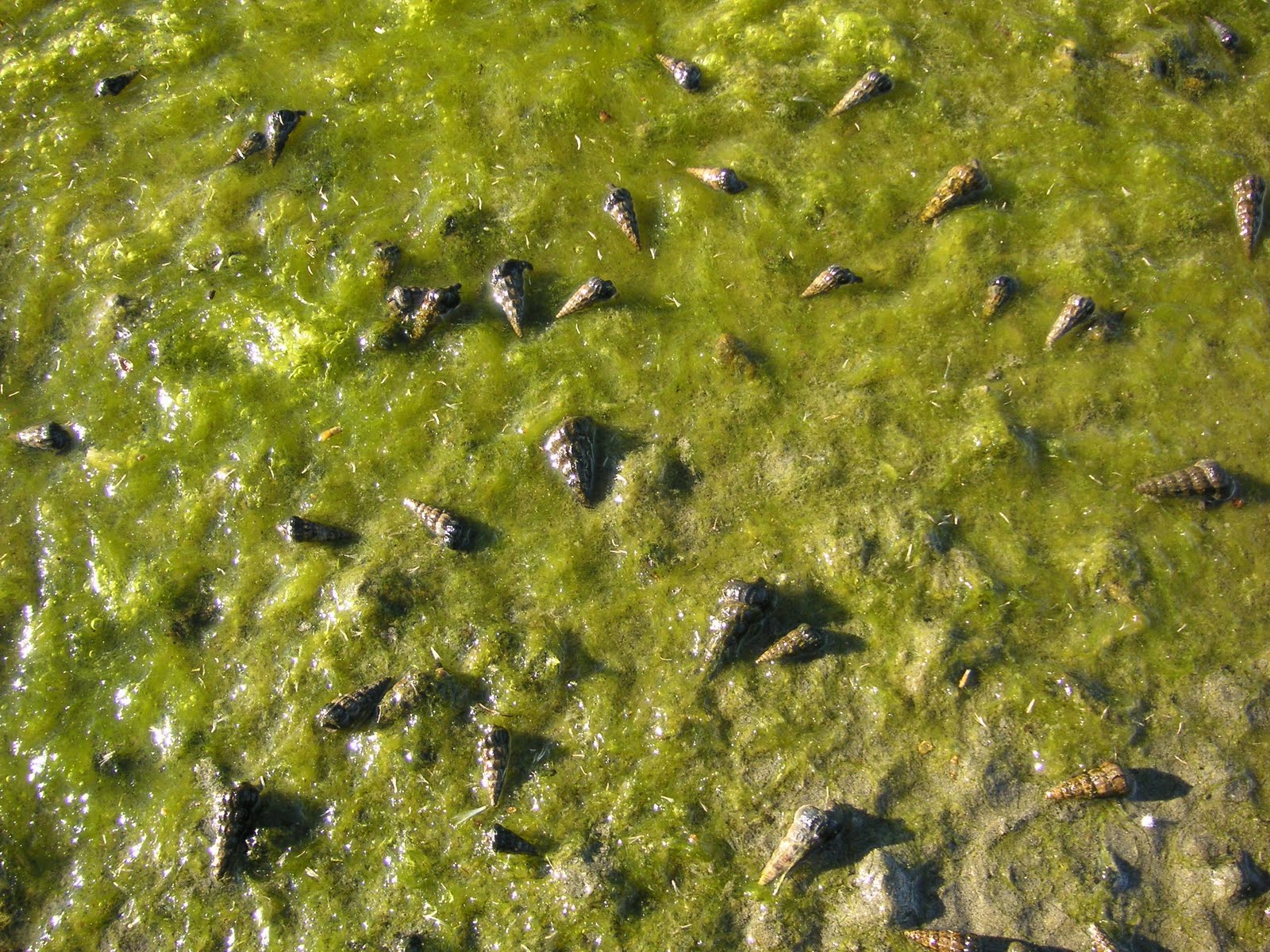
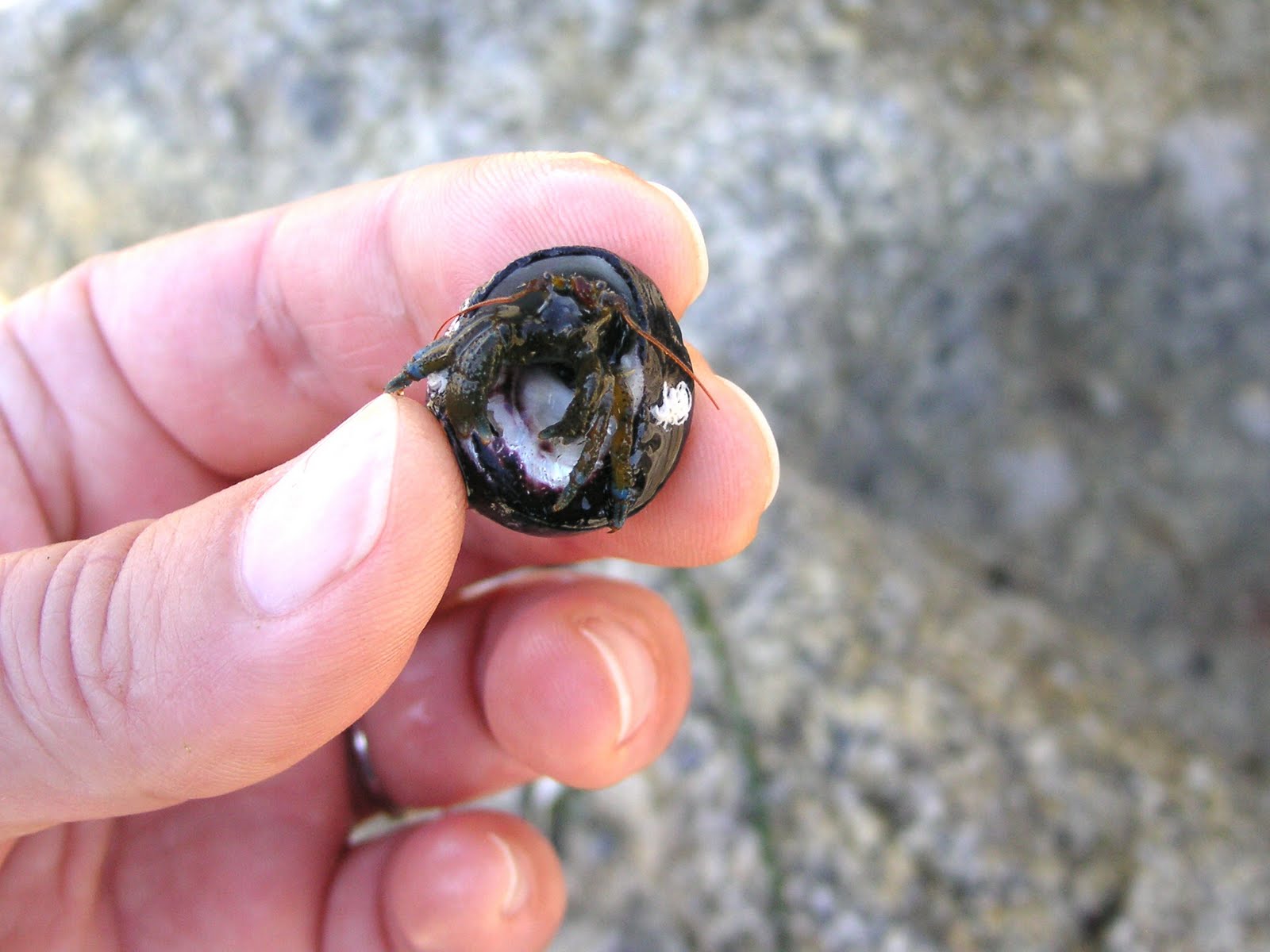
posted 11/03/11 - I wanted to revisit this ID with fresh pictures and conduct another online ID search. What I noticed this visit was that all the snails on the path were dead with their openings facing down in the mud. I thought this was peculiar and probably not random. For the second picture above, I turned one over and cleaned the opening to show the shape of aperture. I reached into the green gunk to take a closer look at an actual live snail. The one I'm holding is about medium sized compared to the larger empty shells.

Walla Walla University still has the best somewhat-local ID comparative description I've found under Batillaria attramentaria (one of two Japanese false cerith snails, with the other being Batillaria zonalis, if indeed it is a distinct species). Plus, this time around I noticed Conchology, Inc. has at least two errors on their Potamididae family page; Batillaria spp. belong to the Batillariidae family page. So, this got me thinking about looking at other similar looking marine snails. WoRMS is great for listing the names of other Cerithioidea families. I looked through the Natural History Museum Rotterdam's site and came up with the following families that have similar looking shells: Batillariidae, Cerithiidae, Dialidae, Potamididae, Scaliolidae, Thiaridae, and Turritellidae. I checked the EOL for the locations of some of the snails, but none are recorded anywhere near central California's coast, except C. californica and B. attramentaria. Nature's variations amaze me.

I don't often post so many pictures for a single ID, but this was a personal quest after my minor hubbub around a permissions request and withdrawal from my first post of CA horn snails. It caused me to go into major blogging existential contemplation, which I wrote about in am I doing the right thing with this blog?

Wednesday, October 12, 2011

Pacific razor clam ~ 10/12/11 ~ Morro Strand Beach


posted 10/29/11 - Through my sheer laziness (or am I simply feeling a bit tired from the increased autumnal dark hours?), I almost posted this as "Oooh, pretty shells! Look at the cool tie-dye effect."

However, I'm glad I took the time to research the shell evidence of this animal. To tell you the truth, I'm not 100% positive this is a S. patula; it might possibly be S. lucida, if I trust Dr. P. Roopnarine, a curator at CalAcademy. Walla Walla University (linked in the scientific name above) has a quick key to Cultellidae (formerly Solenidae or Pharidae). Pictured above are definitely more than 5 cm in length. What we saw in abundance at Morro Strand were several inches in length. The periostracum was well-worn in various stages from the wave action, which makes the shell look like many others from around the world, like S. costata or S. radiata. What made these pictures difficult to positively ID is that I didn't turn over the shells to look at the insides, so to speak. One online page that I found to be extraordinarily helpful is Common Marine Bivalves of California, Fish Bulletin No. 90, written by John E. Fitch, and issued in 1953.

Sunday, October 2, 2011

blueband hermit crab ~ 10/02/11 ~ Shoreline Park

Pagurus samuelis

This is the first time I've really looked up hermit crabs. It's a challenge to find local hermit crab information, because most searches show pet hermit crabs from the Caribbean and Ecuador. I've collected better marine internet sources since my first hermit crab post on 06/04/09.

The blue bands on the legs, solid red antennae, location, and behavior make me fairly confident of this ID. We have a variety of hermit crabs here, including grainyhand hermit crab (Pagurus granosimanus), bering hermit crab (Pagurus beringanus), and hairy hermit crab (Pagurus hirsutiusculus).

Thanks to a nifty new interpretive sign, I learned the black shells with sanded tops and edges were made by black turban snails (Chlorosroma funebralis). There are a couple different snail shells being used by hermit crabs in the last picture. My wild guesses are possible Littorna sp. or Nucella sp. Stanford's SeaNet also has a nice representation of other subtidal shelled gastropods. And, I really like Gary McDonald's UC Santa Cruz's Intertidal Invertebrates of the Monterey Bay Area, CA site.

Make sure to click on any of the highlighted words (embedded links) for more information.

Thursday, August 11, 2011

red abalone ~ 08/11/11 ~ Wharf No. 2

Haliotis rufescens

About 4 years ago my husband and I were watching the boob tube and caught sight of Mike Rowe in a skiff on what looked like the Monterey Bay. Come to find out Discovery's Dirty Jobs was doing an episode on abalone farming and kelp harvesting at a local business. We were surprised to learn the Monterey Municipal Wharf No. 2, aka the commercial wharf, housed an abalone farm. What? Really? Where? I mean, we've walked out there numerous times and never would have suspected there's an abalone farm. We even went out on the nearby touristy Fisherman's Wharf for the sole purpose to see if we could get a better look across the harbor at anything underneath the main deck of the commercial wharf. Nothing doing.


There's very little evidence of the Monterey Abalone Company, except for a small sign, one door, and one window tucked in between larger fish companies. Usually it's closed when we walk by, but I happened to be walking over there yesterday morning and they were open. I stopped and briefly chatted with the nice fellow in the office.

I left with my mind on other sights I had just seen on the commercial wharf, particularly a squid boat unloading its catch onto conveyor belts and hordes of pelicans helping themselves to the moving buffet. After the squid fellas were done packing ice, they fed the pelicans dropped squid as if they were people merely feeding pigeons bread crumbs in a park. I wish I had pictures.

Now, I usually don't carry the camera with me on my morning walks. I've frequently regretted this as I've seen so many amazing sights I would have liked to have included on Nature ID, like mola molas, dolphins, whales, night herons... but I do try to remind myself I have a life outside of this blog.


Ha! With that said and with hopes to capture the amazing squid boat unloading/pelican ritual, I made sure to bring the camera with me this morning. Doh! I didn't see the lighted squid boats last night on the bay and should have figured there wouldn't be a catch this morning. So, armed with the camera, I stopped by the abalone company to take a picture of an old specimen they had in a tank next to the door. Turns out the nice fellow Trevor Fay is a partner of the Monterey Abalone Company, and he asked me if I'd like to see the farm. Oh, yes, please, and thank you very much!


They don't breed the abalone here. They get 1 year old abalone the size shown above from a land-based hatchery in Cayucos (The Abalone Farm), south of Big Sur and just north of Morro Bay. I found this blog post on The Other 95% and I think the video might be from that hatchery. There are only a handful of abalone farms in California. Commercial fishing was banned in 1997, although sport fishing continues in some areas with restrictions.


Down a small hole in the floor I went, clinging dearly to the ladder. It was dark under there like a cave. There's a narrow wooden walkway with low overhanging cement beams. Off to the sides there are ropes hanging down into the water. Each rope is attached to a wire cage. They currently have 200 cages with 200,000 abalone. They now have the capacity to raise 500,000 abalone, but first they had to solve the problem of feeding so many animals during the winter.


So, what do abalone eat? Kelp! And lots of it. As I mentioned before in a previous blog post, there's a seasonal nature to kelp. In the summer it's quite prolific and as the season progresses it can easily be seen floating on the surface off the shore in Monterey and Pacific Grove. Once autumn hits much of the kelp starts washing ashore. Through a grant, the Monterey Abalone Company has experimented with various ways to preserve kelp during the lean winter months. I believe they salt the kelp and store them in giant plastic bags which they stack in bins on the wharf. Unfortunately, curious passersby try to open the bags to see what's inside, which ends up ruining the preserved kelp. I like the fact they use nature-made food, rather than artificial feed formulations. I imagine the company has to comply with all sorts of regulations for harvesting kelp considering Monterey Bay is a National Marine Sanctuary.


They use a 22 foot skiff to hand-harvest the kelp with a kitchen knife. I'm not kidding - no fancy tools. They go out several times a week and fill the skiff to capacity, which takes about 45 minutes each trip and yields about 5 tons every week. Man, here I thought feeding a handful of caterpillars fresh plant cuttings was a chore; this is that multiplied by 32,000. Add in the ocean motion (I get sea sick) and the sheer weight and that's a lot of hard work (and apparently dirty work). Funny enough, after the Dirty Jobs episode aired, most of the calls the company received were from people wanting to know how to get a boat like the one they have.


While I was there, they had just pulled up a cage to check, clean, and feed the abalone. The ones above are about 3 years old. Interestingly enough the abalone grow at different rates, so they move them around and save the fastest growing abalone for the larger sizes they sell.


Here's one of the workers, with kitchen knife in hand, putting fresh kelp into one of the cages. They have to stuff in enough kelp to feed the abalone for a week, and yet not stuff it so full the gastropods suffocate. It's a full-time operation rotating through the 200 cages. At the end of the walkway there was a sea lion, but apparently they're not too interested in the abalone. The sea otters on the other hand are "like kids in a candy store." Thanks to the cages, they don't eat up the farm. I immediately thought of those wire cages people put around the roots of their garden plants to keep gophers from eating their fill.


I asked loads of questions, but I don't remember most of what Trevor shared with me since I didn't take notes. Shown above is a fairly young red abalone at around 3 years old, too young to be able to determine its sex. From an e-mail Trevor says, "The color of their gonad changes when the animal is ripe, fertile and ready to spawn, green for girls and white or cream color for boys." Here's a good link to abalone anatomy and life cycle. The one thing the farm has to watch out for is some kind of disease.


Here's a picture of an order of abalone getting ready to be delivered across the harbor to one of the restaurants on Fisherman's Wharf. They get rinsed in sea water and stacked one on top of the other. They have a handy-dandy flat device that looks like a spackling tool to pick up the abalone off the table. Most of their customers are local. I asked if they shipped to Asian countries. Trevor said they wouldn't be able to keep up with the demand. Plus, the cost of shipping overseas is fairly prohibitive. However, Trevor also provides specimens to an aquarium in Taiwan, which has no problem paying for shipping. They actually have an exhibit of the Monterey Bay. Funny how something so familiar and practically outside my back door has international appeal. There are 8 species of abalone along the coast of California. I think most, if not all, are protected, but I'll have to look that up later as this is getting to be my longest post to date. Are you even reading this still?


All in all, I was very excited to get a personal tour of our local abalone farm, simply because I wanted to virtually collect a new species for this blog. Very cool. I may have to break down and patronize one of the spendy touristy restaurants on the wharf to taste some properly prepared abalone ($60 a plate, more than lobster!) since my favorite local seafood market/restaurant only orders per special request. I like mussels, oysters, and squid, so maybe I'll also like abalone. Trevor says it has a very unique taste. We'll see.

To see the Dirty Job's episode of abalone farming, check out the links on Monterey Abalone Company's media page. It aired October 20, 2007 and is not included in Discovery Channel's online episodes.

ps 08/15/11 - I made a few minor corrections above after an e-mail from Trevor and added/changed embedded links.

Sunday, October 31, 2010

CA horn snail ~ 10/31/10 ~ Morro Bay


California horn snail
Cerithidea californica

These shells are kinda of pretty with the blue on the fat end. It's somewhat odd to me that I found these in a town that I visited for many, many years for holidays where we always went to The Shell Shop. They sold the prettiest, polished shells from around the world for pennies. My mother liked keeping an abalone shell filled with various other shells as decoration on our main bathroom counter. Maybe it was a sign of the times. I don't know. I do remember not being particularly keen on cleaning them when they got covered in household dust during my weekly bathroom chores. Now, I feel a little repulsed by any collection of animal parts on display as art or decoration, without any knowledge of what they are. "Pretty" just doesn't do it for me anymore.

With a quick search online, I didn't find a decent site describing C. californica, but I'm fairly sure of this ID. Several sites mention the CA horn snail is similar looking to the introduced Asian horn snail (Batillaria attramentaria), which I've posted about before. However, when considering the location, relative density of the horn snails, and looking at pictures of each without being completely covered in mud, the visual cues seem fairly obvious. Despite my hesitation to promote online commercial interests, I found Conchology, Inc. to have an excellent pictorial comparison of snails in the Potamididae family.

ps 10/01/11 - I was asked this week for permission to use my photos of CA horn snails by a journalist from Pour la Science (apparently the French version of Scientific American). I was pretty chuffed that someone from France found my pictures and wanted to use them in a respectable publication, online and in print. During our e-mail communications, I pointed out that I am not a malacologist and that my IDs are my amateur best guesses. Hey, I really do try to be honest and up front. I'm not sure how that translated into French, but she ended up declining use and thanked me for my time. I remember how long it took me to make this Cerithidea californica ID, and I'm 95% sure I got it correct. Before granting permission, I admit to holding concerns about knowing exactly what the article was supposed to be about and whether to charge $ for use (more for those bloggers who use their blogs as a way to advertise their own professional photography; personally, I don't have much interest in that kind of thing). I did not ask pay for use, but I did ask to quote her e-mail request. She didn't respond specifically, so I don't have it available here. I was a bit disappointed my photos are not being used, and my ego got bruised. In any case, her article is already out: http://www.pourlascience.fr/ewb_pages/a/actualite-escargots-volants-28027.php. I assume she received permission from Conchology, which I embedded in my original post above, but she also got the credits incorrect - I seriously doubt Haderman had access to e-photography back in 1840. I think it'd be a tough job being a journalist and writing about things you know very little about.

pss 11/03/11 - I visited this place again to get better pictures and to double-check my ID. Please see my new post on CA horn snails.

Thursday, May 13, 2010

Asian horn snail / Japanese false cerith
Batillaria attramentaria

Eww! What are those things? Listen here, I'm generally not a squeamish person, save for slimy, crawly maggots... unless I'm raising flies to feed mantids, but that's a story for another time. For some reason these mud snails really gross me out. They're similar to our native horn snails (Cerithidea californica), but hail from Japan. Simply based on the massive numbers shown above, I'm guessing these are the invasive species. Click on the common names above for more information on local research.