Showing posts with label x: Frog Pond Wetland Preserve. Show all posts

Saturday, December 14, 2013

habitat ~ 12/14/13 ~ Frog Pond Wetland Preserve

Frog Pond Wetland Preserve
December 14, 2013

On our way out to get a steaming bowl of pho, Andy and I stopped at the Frog Pond for a quick walk around.  The air felt much warmer than the ice implies.  We rarely get frozen mud puddles near the coast, and the Frog Pond is less than 2 miles from Monterey Bay waters.  We've had trouble all over town with water pipes bursting under the roads and in buildings.  Although we've had near-freezing nighttime temps for a couple weeks, it wasn't until last week's rain that frost began to appear.  Yeah, it's been that dry.

There were lots of little birds scattered in the sunny pond area and in the willows. Three turkey vultures circled overhead.  And, we heard a red-tailed hawk cry in the distance. Per expected, we didn't see any dragons or damsels.  I have to say the Frog Pond is a very photogenic place.  My favorite photo set was back on January 7, 2012, when 'pond' meant more than a frozen mud puddle.

Monday, November 12, 2012

habitat ~ 11/12/12 ~ Frog Pond Wetland Preserve

November 12, 2012

When we walked down the steps from the newly fortified roadside parking area and looked toward the pond, our jaws dropped.  We have never seen the Frog Pond practically dried up. This year's drought has seriously taken its toll on local ponds and streams.  The shallow puddles that were present, perhaps from the previous week's rains, looked fairly recent with healthy land plants poking out and cracked mud.  The last picture above is from the middle of the pond area looking back at the dock where I usually take pictures of the water for past habitat posts (click and scroll down to see other posts). We had enough rain by this date that fresh green grass was starting to show along the trails.

CA bulrush ~ 11/12/12 ~ Frog Pond

Cyperaceae

edited 11/15/12 - This is not a sexy post.  I've been off my blogging routine the past few weeks thanks to major headlines occupying my morning internet time:  Giants winning the 2012 World Series, Sandy, elections, Petraeus resignation, all interspersed with gruesome murderous plots. I've wanted to write about Buster Posey's incredible comeback one season after his horrific leg injuries, big companies and local neighborhoods utilizing the reach of social media to provide immediate help in the aftermath of Sandy, like Duracell's Rapid Responder, Google's Crisis Map, and Occupy Sandy (ARC could learn a thing or two), Nate Silver's statistical forecasting of elections, post-Petraeus implications for the 1986 Electronic Communications Privacy Act, and how cooking human flesh has become the fashionable way to murder (case in CA, case in NY)... but they're not appropriate for Nature ID.

One thing that has hit home for me is "news" these days is mainly compiled of opinions, speculation, and reporting other's reports.  It becomes a real-life game of telephone.  The facts are few and far between, and by the time they're reported, in many cases in a matter of a few hours in the race to be ahead of the competition, they're disturbingly distorted from the actual truth.  It's unfortunate, but I've seen this with nature information, too, albeit at a slower pace. What one author states clearly in a scientific paper is a wild guess gets referenced, second referenced, down the line until finally another group states definitively that what was once a guess is indeed fact.  Then it gets put into textbooks and field guides. Lovely, eh?  Because of this spectacle, I consciously try my best to focus Nature ID on my first-hand observations rather than rewording "facts" from books or sites.  This practice makes my blog appear to lack content, but at least it's original.

So, getting to CA bulrush.  I've largely ignored grass-like plants on Nature ID, since I have a mental block around them, like with trees, and find them very difficult to ID.  I had to look up the difference between grasses, rushes, and sedges just so I knew which families to search.  I narrowed down the above ID by using the published plant list for the Frog Pond.  It's impossible to tell how tall these bulrushes are from my pictures, but here's a comparison photo with a small human.  Now that I have the basics of this sedge ID, I can look into more information, like these amazing Peruvian tortora horses made out of this plant (tortora is the name for a South American subspecies of CA bulrush and the horses are actually reed boats).  Cool!

blue-eyed darner ~ 11/12/12 ~ Frog Pond


This post is for Graeme at Imperfect and tense for our friendly blogging Odonatathon wager across the pond (so to speak) to see who spots the latest in the season for 2012.  As of this date, I have him beat by 1 day.  My last sightings in 2011 were December 10 at Los Padres Dam (sorry, no pictures).  His last sighting in 2011 was November 27 at HESC, although he says someone else saw the same dragon there December 5.

This is also a tester post.  I've never edited or posted a video before.  It took me a while to figure out how to stabilize and trim the above crappy clip in iMovie.  Google's automatic file reduction makes the video play even worse on the blog.  Oh well.  For both the video and heavily cropped picture above, we tried out a spanking new borrowed point-and-shoot Canon (don't know which one) in a search to upgrade from our crappy photo point-and-shoot Minolta.  While I kind of like the larger file sizes to crop, the touch screen focus features of the Canon did not work at all for close-up shots, even in the macro setting.  Our trusty 8-year-old Minolta still seems to do a better job.  So, our search continues.  For now, I will remain green with envy at the patience and gorgeous dragonfly photo captures other people manage to get with seeming ease.

ps - Oooh, interesting.  The video doesn't show up in Reader.  Hmm?

Wednesday, April 25, 2012

cheeseweed ~ 04/25/12 ~ Frog Pond


Did you ever wonder how a plant got its common name? Cheeseweed, really? This non-native from Northern Africa, Europe, and Asia supposedly has fruiting heads that look like little wheels of cheese. I wonder if cheese fanatic Wallace of Wallace and Gromit was the one who named this plant. It should be noted that this individual was the only one I found at the Frog Pond and is not listed on either the old or the new 2012 CNPS plant list for the Frog Pond Wetland Preserve, Del Rey Oaks.

ps 05/06/12 - I did wonder if this was bull mallow (Malva nicaeensis), but according to Jepson, bull mallow should be trailing along the ground and not erect as shown.

Sunday, March 18, 2012

habitat ~ 03/18/12 ~ Frog Pond Wetland Preserve

March 18, 2012

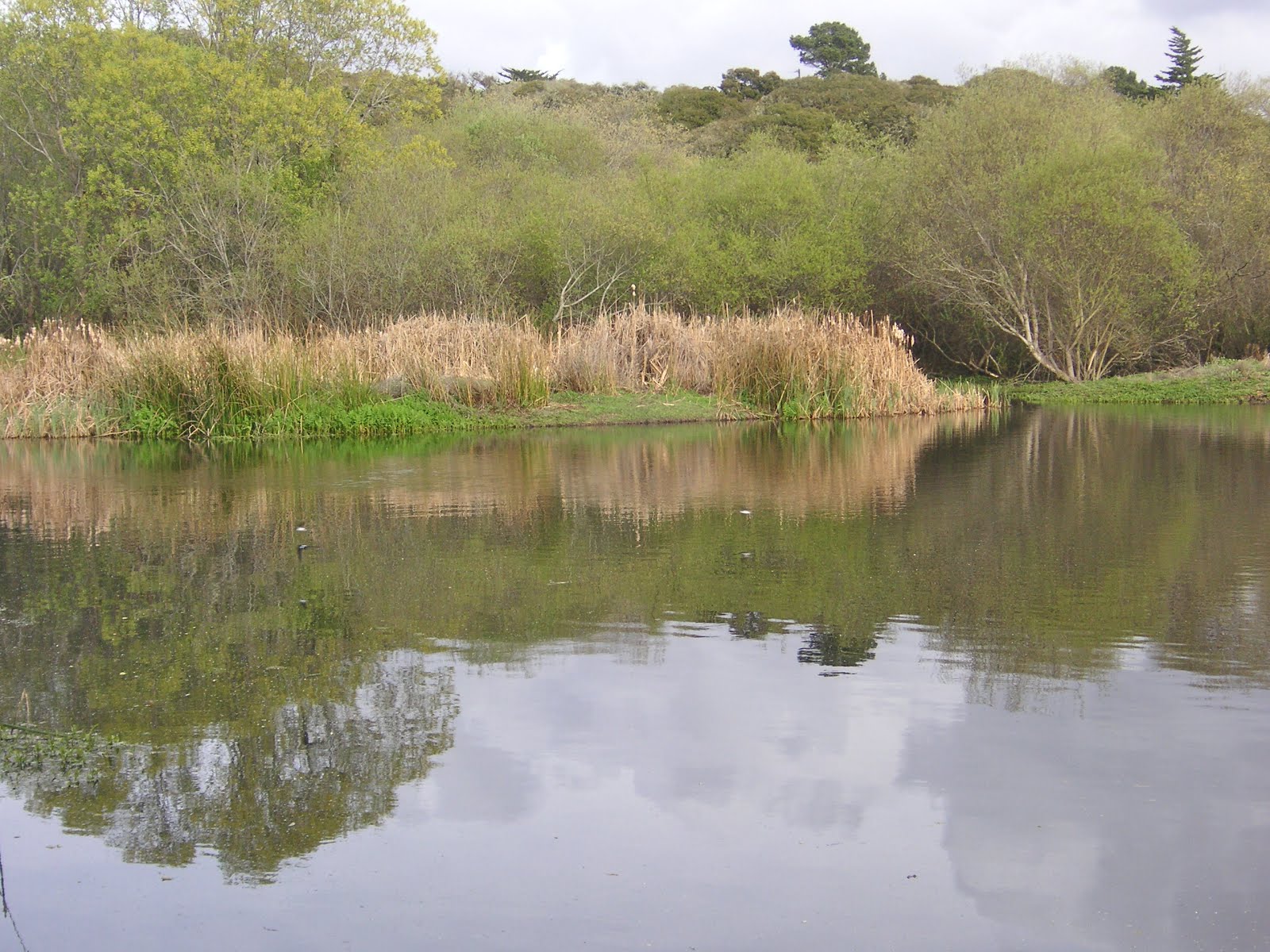
The Frog Pond is a lovely quick jaunt outdoors that feels miles away from the trappings of town, even though this 17-acre natural spot sits in the middle of houses on three sides and a busy Hwy 218. One of the benefits of all those houses is that several have bird feeders in their backyards that abut the Preserve, which creates an amazing bird cacophony that drowns out the rumble of traffic. While I didn't find any dragons or damsels (Odonata) out yet, there were numerous tree swallows flying acrobatically over the pond. We also saw several coots and a few rusty-colored unidentified ducks, possibly cinnamon teals. Andy once spotted a bobcat here, so we always keep our eyes out for them, too. To see the Frog Pond through the seasons, check out my Frog Pond habitat label and scroll down.

As an aside, when I was checking to make sure the swallows we saw with bright white bellies and iridescent blue backs (the two white blurs over the pond in the second picture above) were indeed tree swallows and not barn swallows, I found this incredibly moving series of pictures from Taiwan. It's difficult not to anthropomorphize grief.

phellinus ~ 03/18/12 ~ Frog Pond

a polyphore fungus
Phellinus sp.

If I had to make a guess as to species, I'd say either Phellinus igniarius (click for information and photos here and here), which is often found on willow as I believe is shown above, or Phellinus pomaceus. As I was trying to locate a common name for these fungi, I discovered P. igniarius is sometimes called false tinder polyphore. Of course, I had to look up this unusual name. Come to find out there are true tinder fungus and false tinder fungus of various spp., which were primitively used for creating, keeping, and transporting fire. No kidding! Two sites I found with interesting, albeit somewhat contradictory, information about this tinder ability are Tinder Fungi of Illinois and Wildwood Survival.

Pacific willow ~ 03/18/12 ~ Frog Pond

Pacific willow
Salix lasiandra (aka Salix lucida ssp. lasiandra)
Salicaceae

This is a large shrubby plant with some surrounding shrubs already with leaves out. This section of willows was found on the opposite side of the pond from the observation deck. I'm waiting to hear back from a CNPS member to double-check the accuracy of this ID. Our local Monterey Bay Chapter recently updated their published lists, and I think there may have been a mistake in the name changes that have occurred with Salix. I'll update once I know more.

ps 03/23/12 - I was in such a rush to post as we headed out camping that I didn't take as much time as I would have liked to look for a proper ID. As a quick cheat, I referenced an older saved CNPS Frog Pond Wetland Preserve Checklist and then compared it with the new 2012 version. In addition to arroyo willow (S. lasiolepis), the older version states yellow willow (Salix lucida ssp. lasiandra), the name of which has since been changed to S. lasiandra var. lasiandra. The newest checklist states yellow willow (S. lasiandra var. caudata), which according to both Calflora and Jepson is only found in the eastern part of CA nowhere near Monterey County or any of the surrounding counties. To complicate matters, the name yellow willow is commonly given to S. lutea. Additional native willows found in the local Monterey area are narrowleaf willow (S. exigua), red willow (S. laevigata), Scouler's willow (S. scouleriana), and Sitka willow (S. sitchensis). Confused, yet? Me, too.

After looking at numerous CalPhotos (linked from the pictures on the Calflora embedded links above), I'm starting to think this might be the ubiquitous arroyo willow, even though the stems didn't have the yellowish to reddish color I usually associate with arroyo willows. I want to do another visit to the Frog Pond in a few weeks to check the changes in the catkins and leaves.

Saturday, January 7, 2012

habitat ~ 01/07/12 ~ Frog Pond Wetland Preserve

Frog Pond Wetland Preserve
January 7, 2012

Last week Graeme of Imperfect and Tense blog fame in the UK asked me if dragons and damsels were on the wing this time of year in my region. Hmm? The last time I remember seeing odonates was back on December 10, 2011 at Los Padres Dam, although I was unable to capture any pictures of them. Then, I realized I tend to notice when things are present, but I often neglect to consider what may be absent. This will be something I'll try to keep in mind this year.

As promised like a virtual hiker clear across the globe, off we went on a dragon and damsel hunt at the one local spot I felt sure would have them if they were indeed out in January. Normally, January can be quite stormy here, but so far we've have an extremely mild winter with barely a drop of rain mid-December. Sorry, Graeme, we had no luck in finding dragonflies or damselflies. However, I haven't given up, yet, and will keep my eyes peeled for them.

So often we don't feel like getting in the car on weekends, unless the promise of a good hike is in the offing. It was really nice to get out for a short hike a couple towns away (only 15 minutes by car) on a lazy Saturday when we probably would have taken a walk on the Rec Trail from home. The Frog Pond was the clearest I've ever seen it. There were coots, mallards, and various song birds, which made for a very soothing hike and a nice change of pace from the constant sound of crashing waves at home.

Wednesday, July 6, 2011

habitat ~ 07/06/11 ~ Frog Pond Wetland Preserve

July 6, 2011

This was a quick stop in a day filled with meetings and appointments. It was nice to get out of the traffic and out of the car to take a deep breath and focus on something outside of what needed to be done. Listening to the sounds of the birds and chasing after damselflies was just the thing I needed to slow down my brain and feel centered.

song sparrow ~ 07/06/11 ~ Frog Pond


I have such a difficult time capturing birds with my point-and-shoot that it's a miracle when I do manage to get a picture that isn't just a blur of feathers or tree limbs. Because of the rarity of my bird photos, my bird identification skills are poor. I'm pretty sure of this ID and am hoping those birders out there will correct me if I'm wrong. According to National Geographic Field Guide to the Birds of North America song sparrow subspecies are highly variable in appearance depending on location. With the dark markings, I'd venture to say this might be M. melodia heermanni, which is found in the central coast of CA. I love the songs of this bird. For a blogger who takes incredible bird photos and occasionally also visits this part of CA, check out Shooting My Universe.

yellow-eyed grass ~ 07/06/11 ~ Frog Pond


There are plenty of small yellow flowers about the size of a quarter coin that superficially look like this one. What caught my attention was the multiples of threes in the petals, stamens, and pistils. Add in the grass-like leaves, and my first thought was it looked like a yellow version of blue-eyed grass. It was a good guess as they're both in the same genus Sisyrinchium. One by one, I'm slowly adding new flowers to my repertoire of those that I recognize. I liken it to learning new vocabulary words in a foreign language.

vivid dancer ~ 07/06/11 ~ Frog Pond

vivid dancer
Argia vivida

To distinguish dancers from bluets, I now know to look for the blue 10th abdominal segment. Thanks, Jim! Then I look for the black triangles on the sides of the middle abdominal segments. Check, check.

Another thing I didn't know until recently is that some female damselflies can be either pale (gynomorphic) or blue (andromorphic). The first time I heard this about damselflies was from Dr. Carin Bondar's Biomusings. She is definitely someone with brains who doesn't mind expressing her female flirtation. I'm impressed by her blog. And, she is well on her way to having 4 children. How does she do it all?

Sunday, May 23, 2010

habitat ~ 05/23/10 ~ Frog Pond Wetland Preserve

May 23, 2010

We were hiking maniacs this weekend, hitting Fort Ord, Jacks Peak, and the Frog Pond in 2 days. Of course, it helps that all are within a few minutes from home (not to mention we don't have a garden or kids to toil over). The Frog Pond is not a place I normally go, because the parking on the side of a very fast road makes me nervous. My hubby used to run this pond regularly at lunch, and he was surprised by the carpet of what we think is duckweed over the water.

honey bee swarm
Apis mellifera

07/09/10 - This was a fun find during our casual walk around the pond. I'm actually surprised at the number of swarms I've seen over the years on tree branches around town. My husband has run through an actively flying swarm out at Fort Ord, which he said was a bizarre experience because they seemed to follow him for a ways. Fortunately, from what I've heard, honey bees are fairly tame when they're swarming. However, I have yet to find a feral hive in CA. While I was in OH, I used to take a group of summer science camp kids every year to see an old feral hive on one of the museum's properties. We could always hear them before finding the tree cavity - I've been thinking of that experience lately as I've been watching the World Cup and hearing the background vuvuzelas. Another fairly local blog, Town Mouse and Country Mouse, had their own experience of a honey bee swarm this spring. Interesting.


giant horsetail
Equisetum telmateia ssp. braunii
Equisetaceae

I'm not going to make a guess as to species since I know so little about horsetails. They are elegant in a horsetail kinda way.

ps 02/12/11 - After considering the giant horsetails I recently saw, I'm now making a guess as to species after looking at the two species found in this area. I've made corrections to the ID above.

pss 04/26/18 - Again, I looked at horsetails after our annual anniversary hike. I now understand there are sterile and fertile stems of horsetails (Jepson's here and here), so instead of my common horsetail (Equisetum arvense) ID, I've changed it back to giant.  As a disclaimer, it is quite possible that both species occurs here and my photos of various plants show both, given the extreme variation of growth pattern on the same day.
vivid dancer on unidentified fern
Argia vivida on unidentified fern

This is my best guess for ID. When zoomed in, I think I can see the triangular black streaks in the middle abdominal segments.

ps 02/10/11 - Again, thanks to Jim Johnson at Northwest Dragonflier and Odonata.Bogfoot.net I have confirmation of this ID, "You're right about the second one." See my previous vivid dancer post for more information.