When I'm out looking for butterflies, I try my best to ignore the other cool little animals flying around. It's difficult. Especially, when this fellow repeatedly circled me on the path and perched, begging for a photo op. His face reminds me of those old-fashioned political cartoons with big heads and drunk, rosy cheeks. Given how dry it's been with only a single, shaded pocket of surface moisture (that I've found on the west side), I don't know how the dragonflies are managing. The reservoir on the east side of the National Park must be swarming with odonates. Maybe?
Showing posts with label dragonflies and damselflies. Show all posts
Tuesday, August 19, 2014
Monday, November 12, 2012
blue-eyed darner ~ 11/12/12 ~ Frog Pond
possible male blue-eyed darner
possible Rhionaeshna multicolor
This post is for Graeme at Imperfect and tense for our friendly blogging Odonatathon wager across the pond (so to speak) to see who spots the latest in the season for 2012. As of this date, I have him beat by 1 day. My last sightings in 2011 were December 10 at Los Padres Dam (sorry, no pictures). His last sighting in 2011 was November 27 at HESC, although he says someone else saw the same dragon there December 5.
This is also a tester post. I've never edited or posted a video before. It took me a while to figure out how to stabilize and trim the above crappy clip in iMovie. Google's automatic file reduction makes the video play even worse on the blog. Oh well. For both the video and heavily cropped picture above, we tried out a spanking new borrowed point-and-shoot Canon (don't know which one) in a search to upgrade from our crappy photo point-and-shoot Minolta. While I kind of like the larger file sizes to crop, the touch screen focus features of the Canon did not work at all for close-up shots, even in the macro setting. Our trusty 8-year-old Minolta still seems to do a better job. So, our search continues. For now, I will remain green with envy at the patience and gorgeous dragonfly photo captures other people manage to get with seeming ease.
ps - Oooh, interesting. The video doesn't show up in Reader. Hmm?
Sunday, September 23, 2012
crappy photos no more?
blue-eyed darner
posted 10/09/12 - Here on Nature ID, I've joked about my crappy photos. It's okay. I'm good with it. I'm practically proud, even. While I sometimes get slightly green around the edges with envy over other bloggers' fantastic photographs taken with great skill and fancy equipment, the fact of the matter is I have little desire to grow in that direction myself.
Our trusty 8-year-old Konica Minolta DiMAGE X50 point-and-shoot has served us well. It's lightweight, fits in my front shirt pocket or Andy's running belt pocket, old enough that I don't care if it gets a few raindrops or specks of pollen on it, and meets most of our wants most of the time. I'm someone who begrudgingly carries water and won't even take my smallest pair of binoculars on a hike because it doesn't easily fit into a pocket... well, you get the picture. Or don't you?
As with all electronic gadgets nowadays, things break or become obsolete for whatever reason. Hey, I was "forced" to replace my 10-year-old computer, not because it broke, but because technology and my desire to be online left it in the dust. Sigh, it's time to start thinking about a replacement camera. Andy came across reviews for Lytro. I'm not crazy about the awkward shape. However, capturing an entire light field to create a "living picture" with the capability to refocus after the fact? Anyone hear of it? Does anyone know if these active focus pictures can be embedded in blogger, yet? If so, could you please send me a link to your blogspot? Any other recommendations? Granted, like with my computer this may be a 2-year process before I purchase, and by then this new consumer technology will very likely be even better and cheaper.
Saturday, September 17, 2011
variegated meadowhawk ~ 09/17/11 ~ Wilder Ranch
Sympetrum corruptum
Libellulidae
I love the intricate pattern on this red male's abdomen. Odonates have unique mating position and behaviors. The above is known as the "wheel position", something that could be taken straight out of any ancient sex manual, if only human males also had two sets of genitalia.
Wednesday, July 6, 2011
vivid dancer ~ 07/06/11 ~ Frog Pond
Argia vivida
To distinguish dancers from bluets, I now know to look for the blue 10th abdominal segment. Thanks, Jim! Then I look for the black triangles on the sides of the middle abdominal segments. Check, check.
Another thing I didn't know until recently is that some female damselflies can be either pale (gynomorphic) or blue (andromorphic). The first time I heard this about damselflies was from Dr. Carin Bondar's Biomusings. She is definitely someone with brains who doesn't mind expressing her female flirtation. I'm impressed by her blog. And, she is well on her way to having 4 children. How does she do it all?
Friday, June 10, 2011
northern bluet ~ 06/10/11 ~ Pinnacles
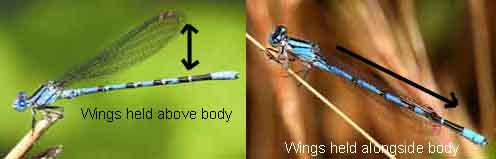
So much for looking at wing position to distinguish bluets (Enallagma spp.) from dancers (Agria spp.). Supposedly bluets have wings held close to the body, whereas dancers hold their wings up and away from their abdomens. Here's the second time where my pictures show the exact opposite of this. I've used the advice given by Jim Johnson at Northwest Dragonflier and Odonata.Bogfoot.net from my previous vivid dancer post to look at the color of the last (i.e., 10th) abdominal segment, at least in western damselflies. If it's mostly black on top, it's a bluet, and if it's all blue, it's a dancer. Again, another one of those naming things that doesn't mesh with what I now know to look for.
There are 4 Enallagma spp. reportedly found at Pinnacles: E. annexum, E. civile (familiar bluet), E. carunculatum (tule bluet), and E. praevarum (arroyo bluet). I ruled out the tule and arroyo bluets, because their abdominal segments are mostly black. I then ruled out the familiar bluet, because it has smaller eyespots and a triangular "fin-shaped" appendage at the tip of the abdomen. Finally, there is the possibility this could be an almost identical boreal bluet (E. boreale), but the distinction is in the tiny cerci (compare b with e) and not anything I can tackle with my point-and-shoot. Now, as before, I could be totally wrong with this ID. Jim?
The second picture above is a cast exoskeleton (aka exuvia) from a damselfly naiad. I love how they hug the tule/bulrush, something I'm not going to try to ID. What would damselflies do if there wasn't any tule around to hug?
There are 4 Enallagma spp. reportedly found at Pinnacles: E. annexum, E. civile (familiar bluet), E. carunculatum (tule bluet), and E. praevarum (arroyo bluet). I ruled out the tule and arroyo bluets, because their abdominal segments are mostly black. I then ruled out the familiar bluet, because it has smaller eyespots and a triangular "fin-shaped" appendage at the tip of the abdomen. Finally, there is the possibility this could be an almost identical boreal bluet (E. boreale), but the distinction is in the tiny cerci (compare b with e) and not anything I can tackle with my point-and-shoot. Now, as before, I could be totally wrong with this ID. Jim?
The second picture above is a cast exoskeleton (aka exuvia) from a damselfly naiad. I love how they hug the tule/bulrush, something I'm not going to try to ID. What would damselflies do if there wasn't any tule around to hug?
Sunday, May 23, 2010
Argia vivida on unidentified fern
This is my best guess for ID. When zoomed in, I think I can see the triangular black streaks in the middle abdominal segments.
ps 02/10/11 - Again, thanks to Jim Johnson at Northwest Dragonflier and Odonata.Bogfoot.net I have confirmation of this ID, "You're right about the second one." See my previous vivid dancer post for more information.
Wednesday, April 14, 2010
Thursday, April 8, 2010
cardinal meadowhawk ~ 04/08/10 ~ Garland Ranch
cardinal meadowhawkSympetrum illotum
Other than the obvious bright red, I was unsure how to identify this dragonfly species. Thanks to my handy little Common Dragonflies of California, I distinguished this from the neon skimmer (Libellula croceipennis) based on the fact this cardinal meadowhawk perches with its wings held down and forward - a trait that definitely caught my eye!
ps 02/20/12 - Jim of Northwest Dragonflier has a recent post about cardinal meadowhawks.
Thursday, May 28, 2009
vivid dancerArgia vivida
I don't have a good ID book for odonates.
We also saw several large, very fast, red dragonflies. I would initially guess that they were big red skimmers (Libellula saturata), but the wings seemed to be entirely red. It's possible they could have been dusty skimmers (Sympetrum illotum), but they seemed bigger than 40 mm. I may never know since I wasn't able to capture a picture of them.
ps 02/06/11 - Well, I finally looked into this damselfly, which was originally posted as an unknown. First, it's a bluet (Enallagma spp.) for sure, because it's wings are held close to the body, whereas dancers (Argia spp.) hold their wings up and away from the body. Since the abdomen appears mostly black from the top view, I've narrowed it down to 2 species: E. praevarum (arroyo bluet) or E. carunculatum (tule bluet). My picture does not clearly show the male appendages, so the next best thing is to consider the habitat. According to Don Roberson (his site is linked in the species names above), arroyos prefer rivers and small streams, while tules prefer marshes and ponds (both appropriately named). Unfortunately, this was taken near where Los Padres Dam spills into the Carmel River. Simply based on photos and previous records from Carmel River, I'm leaning towards E. praevarum. Thanks everyone for your comments!
pss 02/10/11 - Sigh, I've made another correction to the ID above, but I'm keeping my previous postscript to show how I reasoned my incorrect ID of a bluet. Kind thanks to Jim Johnson at Northwest Dragonflier and Odonata.Bogfoot.net for helping me learn what to look for when identifying damselflies. With his permission, here's a snippet from his e-mails, "...because of the angle the wings are obscuring the abdomen and that's why there is so little pattern visible there. One thing that indicates that it's a dancer and not a bluet is the extent of blue at the end of the abdomen. On all the western bluets, the blue is limited to segments 8 and 9, and 10 (the last smallest one) is largely black, especially on the top portions. The western dancers (the blue ones, anyway) are blue across all three segments which is what this ones shows." Jim goes on to say, "The wing position is helpful, but you can't rely on it for distinguishing dancers and bluets." I wish Kathy Biggs, author of Common Dragonflies of California, had stated this versus making a point of dancers (with "wings held above abdomen") and bluets (with "wings at rest held alongside abdomen"). Don't get me wrong, her book is great for novice odonate fans like me and I still recommend it.
We also saw several large, very fast, red dragonflies. I would initially guess that they were big red skimmers (Libellula saturata), but the wings seemed to be entirely red. It's possible they could have been dusty skimmers (Sympetrum illotum), but they seemed bigger than 40 mm. I may never know since I wasn't able to capture a picture of them.
ps 02/06/11 - Well, I finally looked into this damselfly, which was originally posted as an unknown. First, it's a bluet (Enallagma spp.) for sure, because it's wings are held close to the body, whereas dancers (Argia spp.) hold their wings up and away from the body. Since the abdomen appears mostly black from the top view, I've narrowed it down to 2 species: E. praevarum (arroyo bluet) or E. carunculatum (tule bluet). My picture does not clearly show the male appendages, so the next best thing is to consider the habitat. According to Don Roberson (his site is linked in the species names above), arroyos prefer rivers and small streams, while tules prefer marshes and ponds (both appropriately named). Unfortunately, this was taken near where Los Padres Dam spills into the Carmel River. Simply based on photos and previous records from Carmel River, I'm leaning towards E. praevarum. Thanks everyone for your comments!
pss 02/10/11 - Sigh, I've made another correction to the ID above, but I'm keeping my previous postscript to show how I reasoned my incorrect ID of a bluet. Kind thanks to Jim Johnson at Northwest Dragonflier and Odonata.Bogfoot.net for helping me learn what to look for when identifying damselflies. With his permission, here's a snippet from his e-mails, "...because of the angle the wings are obscuring the abdomen and that's why there is so little pattern visible there. One thing that indicates that it's a dancer and not a bluet is the extent of blue at the end of the abdomen. On all the western bluets, the blue is limited to segments 8 and 9, and 10 (the last smallest one) is largely black, especially on the top portions. The western dancers (the blue ones, anyway) are blue across all three segments which is what this ones shows." Jim goes on to say, "The wing position is helpful, but you can't rely on it for distinguishing dancers and bluets." I wish Kathy Biggs, author of Common Dragonflies of California, had stated this versus making a point of dancers (with "wings held above abdomen") and bluets (with "wings at rest held alongside abdomen"). Don't get me wrong, her book is great for novice odonate fans like me and I still recommend it.