Thursday, November 3, 2011

barnacles ~ 11/03/11 ~ Morro Strand Beach


I'm trying to get outside of my comfort zone and ID things I know very little about. Many people would recognize a barnacle, but I think few would know particular species. Indeed, as I was researching, there seems to be conflicting information about the identity of some very common barnacles. I may change the embedded links as I look into this some more.

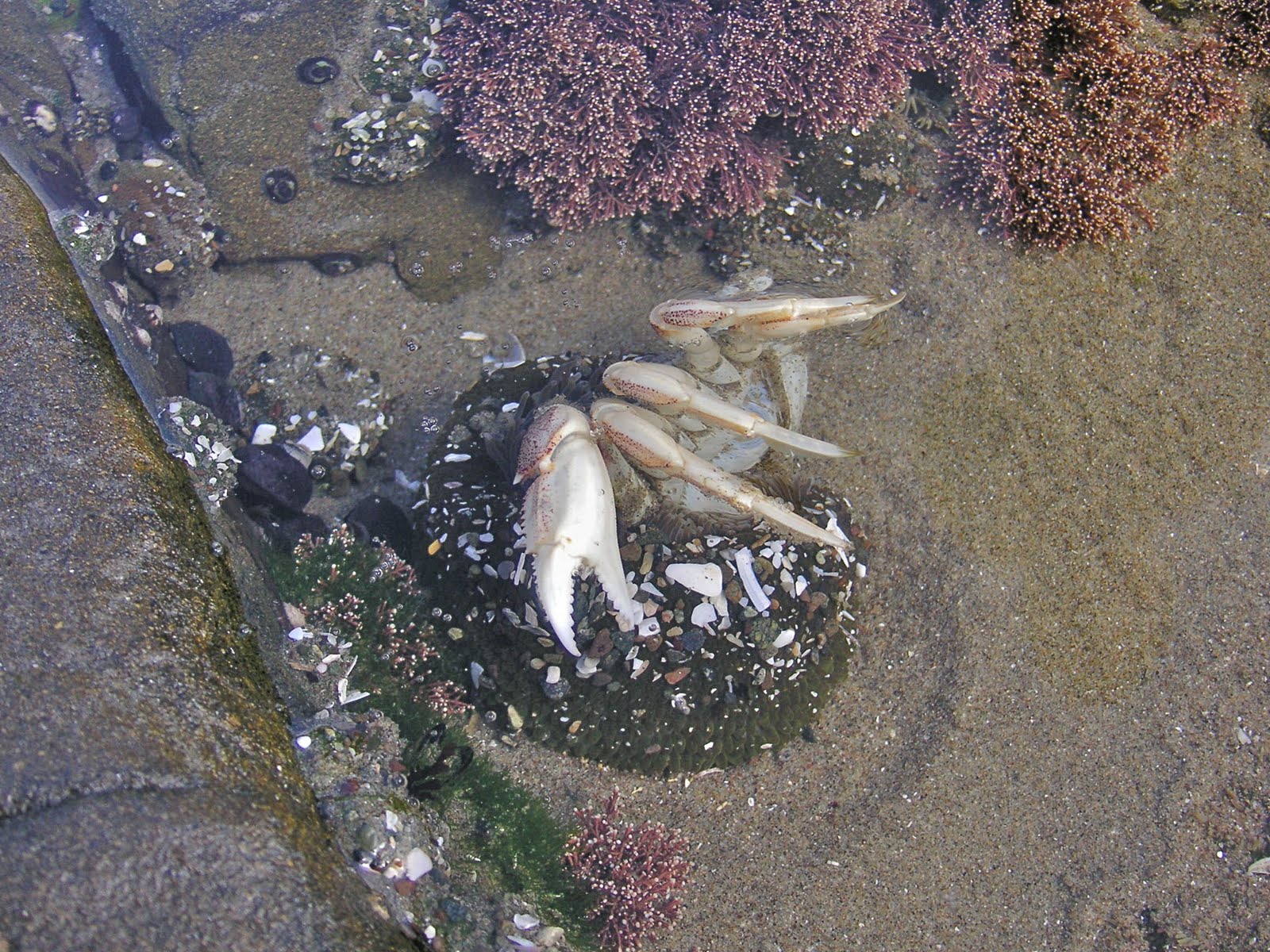
sea anemones ~ 11/03/11 ~ Morro Strand Beach

sea anemones
Anthopleura spp.
more information

As a kid, whenever we'd go to the beach, my mother would repeatedly warn me to never step on sea anemones, because she believed they would sting. Now, I don't step on them for fear I could crush these seemingly delicate animals. I learned through the links included in this post that both ideas, stings to humans and being delicate, are incorrect.

I should note not all sea anemones are in the Anthopleura genus. The two species I have identified below just happen to be in the same genus.


aggregating anemone
Anthopleura elegantissimamore pictures


The aggregating anemone is known to clone itself, hence why they're often found in dense clusters. The Walla Walla site linked in the scientific name above shows some incredible pictures of the dividing process. Some anemones also have green algae (zoochlorellae) or dinoflagellates (zooxanthellae) living symbiotically in their gut lining (but maybe not these ones?). The Monterey Bay Aquarium site has fun information on the aggregating anemone, but it states "Anthropleura" with an extra 'r', which is incorrect. Anthropleura was an ancient giant centipede.


I was lucky enough to get a decent picture of this anemone slightly open to see the lines on the oral disk for a positive ID.

Two additional similar looking species found in our area are the moonglow anemone, aka burrowing anemone (Anthopleura artemisia), and the giant green anemone, aka solitary green anemone (Anthopleura xanthogrammica) - which I believe is shown in the first photograph above, but there is no way for me to know for sure.

For much better photographs of anemones and other tide pool life, check out John Wall's Natural California. It's extremely difficult to get decent pictures through moving water. Most of my attempted shots ended up being lovely reflections of the clouds above.

surfbird ~ 11/03/11 ~ Morro Strand Beach


Surfbird, huh? So, where's the surfboard or the, um, computer with internet connection? I would've never been able to identify these birds, let alone even spot them, if it weren't for the help of a total stranger.

My friend was asking me about marbled godwits that we saw, which for the life of me I could not remember their name even though I had been on this beach only 3 weeks before and blogged about it. So, I took to asking random strangers, especially ones carrying massive cameras and binoculars, if they knew the birds. The first couple I asked replied in a thick accent, "Ve ar' not vrom around hair." The second couple I asked ended up being leaders of the Morro Bay Winter Bird Festival. Bingo! As I was absorbed taking pictures of anemones in the rocks they called us over to look at the surfbirds. Really, since they are actual birds, their name should be "surf bird" as two words.

From a distance, I'm sure I'd get them confused with a lot of other shorebirds, including black turnstone (which were also picking at the mussel-covered rocks for food), least sandpiper (Calidris minutilla), western sandpiper (Calidris mauri), red knot (Calidris canutus), and pectoral sandpiper (Calidris melanotos). As a note about the pectoral sandpiper, even though several reputable books and Cornell's All About Birds site show they are not ever here in CA, both the Morro Bay Winter Bird Festival site and Don Roberson's Monterey Birds book show they are recorded migrants in our area.

cancer crabs ~ 11/03/11 ~ Morro Strand Beach

rock crab carapaces
Cancer
spp.

The interior of Cancer carapaces are amazingly colorful. These almost look like they've been filled with Easter egg dye and sand.

This post was very challenging to research, hence it's link-laden. According to the California Department of Fish and Game, we have 9 species of Cancer crabs. I used an old edition of Light's Manual: Intertidal Invertebrates of the Central California Coast sent to me by Steve at Blue Jay Barrens (Thanks again, Steve!), which listed only 8 species and keyed 6 of those.

I'm attempting to ID based solely on the carapaces, which is the most common body part I saw washed up on the beach. Everything I found were 1-3" in width. Since crabs molt, size is not a significant indicator of a species. I spent quite a bit of time zooming in on each of the photos and counting the carapace spines/teeth. There is very little information online for some of the smaller species. If you're curious to learn more, make sure to click on the embedded links under each photo.


best guess hairy rock crab
best guess Cancer jordani (aka Romaleon jordani)

ps - For a little bit of gutter humor, as I was researching the IDs above using the old Light's Manual and with selective choice of spp. and words... I discovered pee crabs, er, pea crabs (Pinnixa spp. and others) live in penis fish (Urechis spp.) burrows. Haha, who knew!?!