Showing posts with label cypress family. Show all posts

Sunday, March 4, 2012

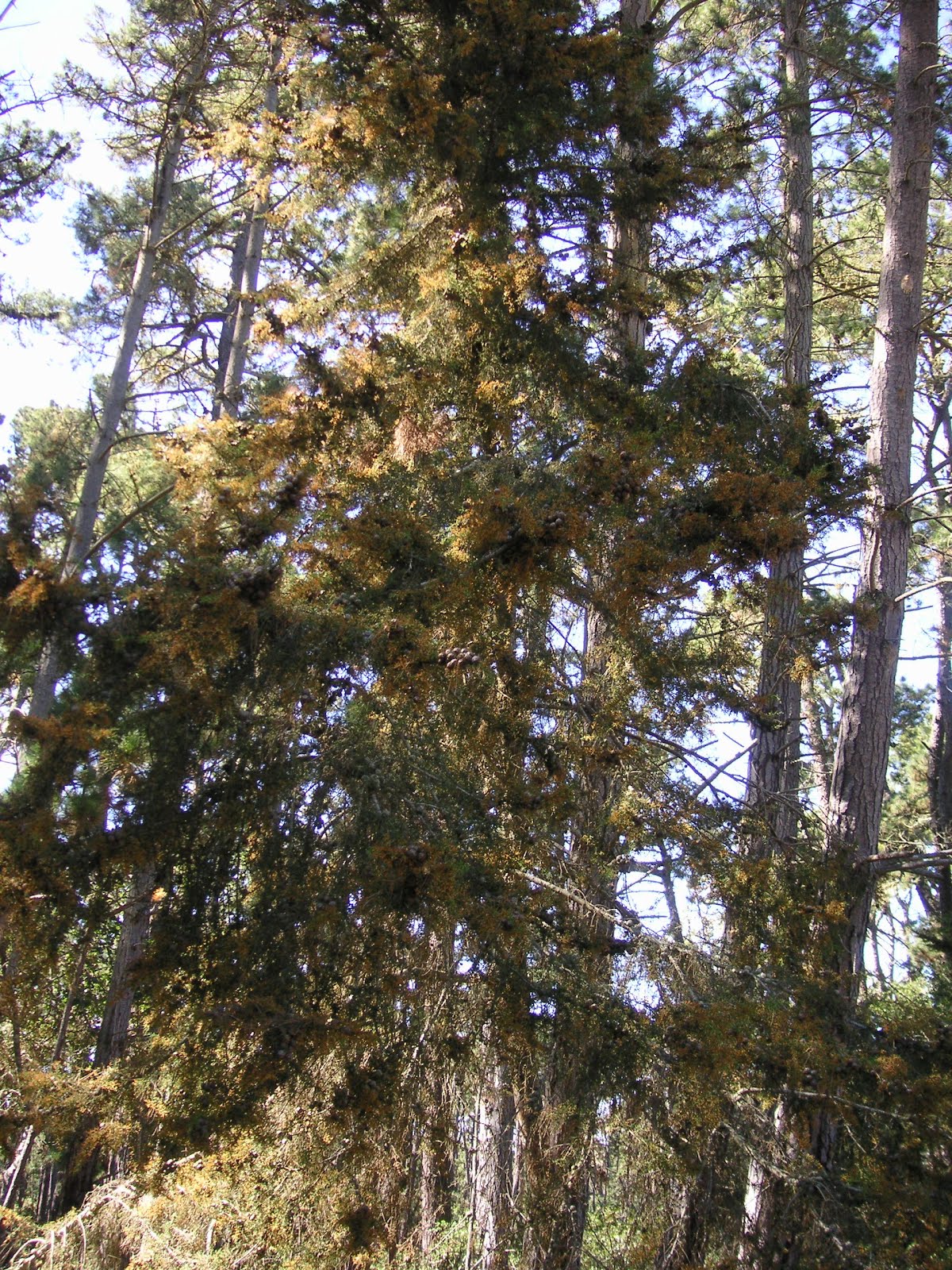
Gowen cypress ~ 03/04/12 ~ SFB Morse Botanical Reserve

yellow male pollen cones with brown female seed cones

female seed cones

Gowen cypress
Hesperocyparis goveniana (formerly Cupressus goveniana ssp. goveniana)
CNPS 8th Edition Inventory
Cupressaceae

When I first took pictures of these short-statured trees I thought, "Oh good, I can finally get close-up shots of a Monterey cypress (Hesperocyparis macrocarpa) for my blog, since they're usually too tall or perched on a cliff to take decent detailed pictures." Wrong? Maybe, maybe not? Gowen cypress is my best guess based on the CNPS plant list for SFB Morse Botanical Reserve, which does not include Monterey cypress. However, the female seed cones seemed bigger than described in Jepson compared to the larger Monterey cypress seed cones, but I'm aware visual perception can often be deceptive. I really should carry a ruler with me when I go hiking, since memory and photographs are proving to not be enough to distinguish species. I checked our neighbors' cypress trees, and there's quite a bit of variation outside of the reported dimensions. I guess theirs could be garden hybrids though. Erg. Come to find out the Gowen cypress is a federally threatened species. For more information about cypresses, check out Wayne's Word and Point Lobos Association.

Monday, February 20, 2012

CA juniper ~ 02/20/12 ~ Pinnacles

I've walked this same trail half a dozen times and never noticed the prolific juniper shrubs (trees?). It's a bit embarrassing, really, especially considering the trail is called Juniper Canyon Trail. Doh! On previous visits I was more focused on the wildflowers and butterflies. I gravitate towards the showy, bright, and colorful. This time I noticed the pretty grey blue berries, my favorite color. They're not actually berries, per se, but female seed cones. I'm not quite sure why some pictures of cones actually look like cones and not berries. Can anyone tell me what's what? There are 5 Juniperus spp. native to CA. This surprised me, because when I think of junipers I think of landscape plants (J. chinensis), bonsai (J. x media and others), and gin (J. communis, common throughout the Northern Hemisphere and also native to CA). Learn something new every day.

Monday, October 10, 2011

trentepohlia ~ 10/10/11 ~ Point Lobos

Good golly! I would have never guessed the orange stuff on cypress trees and rocks is a type of green algae. When I first saw it years ago in this limited area of Point Lobos, I figured it was a mold of some sort. Thanks to the handy-dandy checklist the ranger gave us (I mentioned this in my osprey post from this hike), I now have a name to the genus. When I first searched online, I misspelled Trentepohlia as "Trentepholia" with the 'o' and 'h' switched. I got lots of beautiful pictures, but very little actual information about this living thing. Sigh, gone are the days when my only labels were insects, flowers, and places. I still feel like I should take another general biology class to figure out what all those non-plant/non-animals things are.

ps 06/09/12 - I edited the name and links above to reflect better book and online information about the specific Trentepohlia found at Point Lobos.

Sunday, August 2, 2009

redwood ~ 08/02/09 ~ Rocky Creek

gnome in coast redwood
Sequoia sempervirens
Cupressaceae

This is simply a place-holder post to remind me to add some other pics (plus, it makes me laugh). Over the weekend we were camping down near Bixby Bridge towards Big Sur off of the old Hwy 1 on an 800+ acre private property heaven. A group of us were attempting to blaze a trail to the beach by following the creek. Even with a machete in the lead, we didn't have much success and gave up within an hour to enjoy some cool, canned refreshment. Great fun was had by all! The gnome was a surprise find, sitting peacefully in a burnt-out redwood. No one knew how long it had been sitting there or who had hiked in far enough to place this woodsy watcher.

Wednesday, July 15, 2009


I neglected to take pics of the incredible redwoods during our last trip north to Humbolt on June 13, 2009, so I made sure to take some this trip. According to the wonderful interpretive signs, coast redwoods are the tallest trees in the world reaching heights over 350 ft. and can live 2000 years. We have patches of redwoods near water all along the coast, but the old stands of redwoods up north are truly impressive. The second pic is a nice example of a "chandelier tree."

Sunday, October 23, 2005

Monterey cypress ~ 10/23/05 ~ Point Lobos

Monterey cypress
Hesperocyparis macrocarpa (formerly Callitropsis or Cupressus)
CNPS 8th Edition Inventory
Cupressaceae

If there is one tree that distinguishes this area from any others, the Monterey cypress is it. Click on the links above to learn more about this lonely looking tree hanging on a cliff.

ps 03/18/11 - For other pictures of how our local cliffs affect life, see bigsurkate.

pss 10/22/11 - I noticed the name change as I looked up a new post of green algae that grows on Monterey cypress.