Showing posts with label * cones. Show all posts

Thursday, April 17, 2014

Coulter pine ~ 04/17/14 ~ Chews Ridge

Pinus

These pine cones are gigantic.  Holy cow!  Reminds me of the time I regretted driving over a gray pine cone.  So, I wondered about the relative sizes of Coulter vs. gray pine cones, even though Wikipedia says, "Coulter pines produce the largest cones of any pine tree species."  I found this handy pine cone comparison on Tree Identification blog.  It looks like Coulter is longer, while gray is wider, and both are huge and heavy.  Chris told me he had a Coulter pine drop on his shoulder once.  He said it beat him up pretty badly.  Ouch.

Sunday, March 4, 2012

Gowen cypress ~ 03/04/12 ~ SFB Morse Botanical Reserve

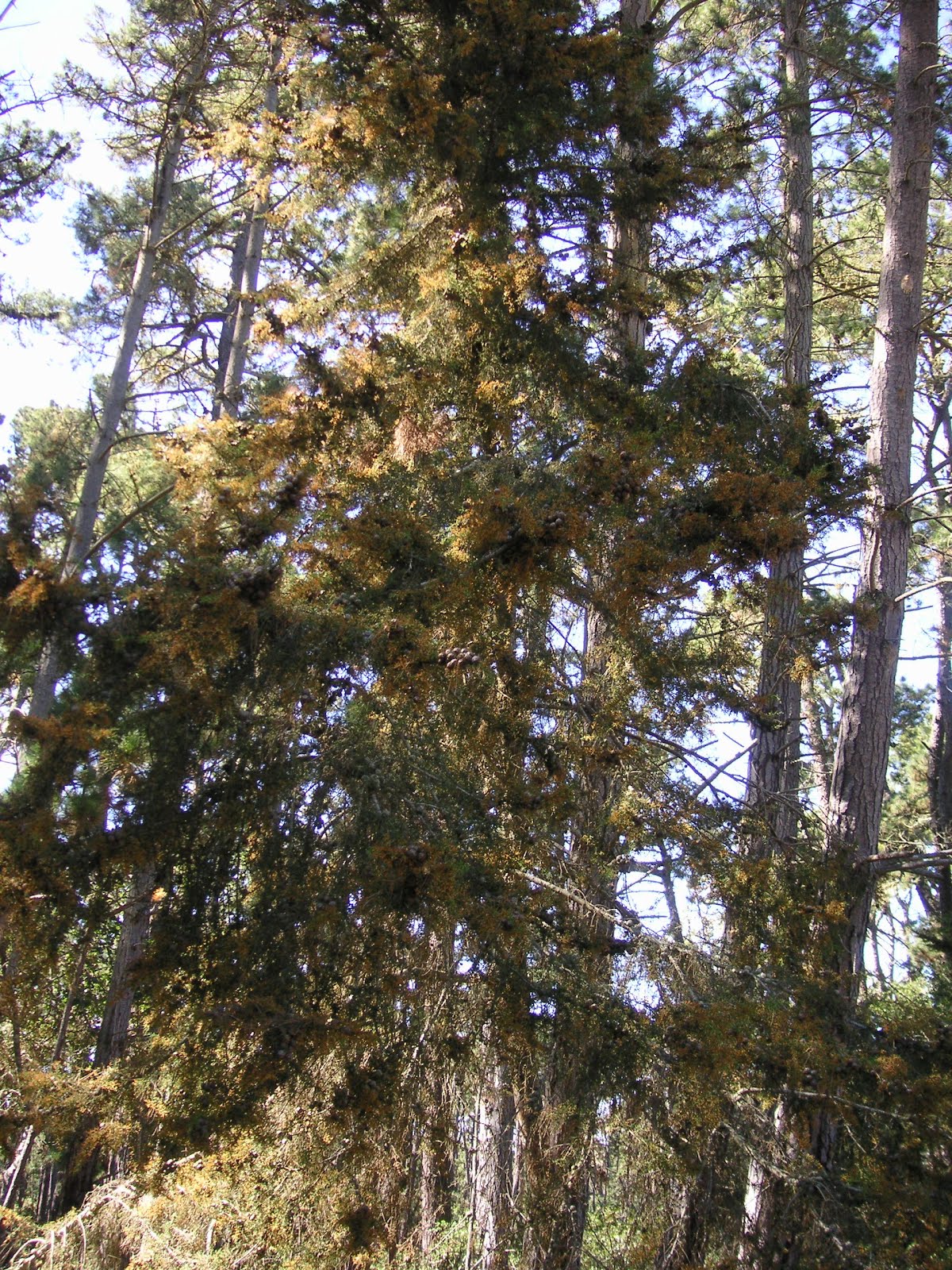
yellow male pollen cones with brown female seed cones

female seed cones

Gowen cypress
Hesperocyparis goveniana (formerly Cupressus goveniana ssp. goveniana)
CNPS 8th Edition Inventory
Cupressaceae

When I first took pictures of these short-statured trees I thought, "Oh good, I can finally get close-up shots of a Monterey cypress (Hesperocyparis macrocarpa) for my blog, since they're usually too tall or perched on a cliff to take decent detailed pictures." Wrong? Maybe, maybe not? Gowen cypress is my best guess based on the CNPS plant list for SFB Morse Botanical Reserve, which does not include Monterey cypress. However, the female seed cones seemed bigger than described in Jepson compared to the larger Monterey cypress seed cones, but I'm aware visual perception can often be deceptive. I really should carry a ruler with me when I go hiking, since memory and photographs are proving to not be enough to distinguish species. I checked our neighbors' cypress trees, and there's quite a bit of variation outside of the reported dimensions. I guess theirs could be garden hybrids though. Erg. Come to find out the Gowen cypress is a federally threatened species. For more information about cypresses, check out Wayne's Word and Point Lobos Association.

Monday, February 20, 2012

CA juniper ~ 02/20/12 ~ Pinnacles

I've walked this same trail half a dozen times and never noticed the prolific juniper shrubs (trees?). It's a bit embarrassing, really, especially considering the trail is called Juniper Canyon Trail. Doh! On previous visits I was more focused on the wildflowers and butterflies. I gravitate towards the showy, bright, and colorful. This time I noticed the pretty grey blue berries, my favorite color. They're not actually berries, per se, but female seed cones. I'm not quite sure why some pictures of cones actually look like cones and not berries. Can anyone tell me what's what? There are 5 Juniperus spp. native to CA. This surprised me, because when I think of junipers I think of landscape plants (J. chinensis), bonsai (J. x media and others), and gin (J. communis, common throughout the Northern Hemisphere and also native to CA). Learn something new every day.

Monday, October 3, 2011

tree year project 2011, #11


In the past week, I've seen more monarchs flying around town on the sunnier days. One was kind enough to rest on the Douglas-fir tree that I'm featuring for The Tree Year project. And, no, those orange-brown blobs in the second picture aren't monarchs; they're cones. I wanted to also show how brown the cones have gotten. Actually they started turning from green to brown back in August, but I'm just now getting a picture of it.

Thursday, July 14, 2011

tree year project 2011, #9


I can't believe how quickly The Tree Year project is going. It feels like just yesterday when I posted the first appearance of spring green on this tree. The first picture above shows the developing female seed cone. Almost all the new cones have sap dripping from them. I wonder why this happens. The second picture is of last year's cone. I vaguely remember reading something about how Douglas-fir is unusual in that it holds onto old cones, but I can't find that reference now. And while I've also read that seed production is irregular, the numerous cones shown in the last picture seems average for this tree.

While writing this post and looking at past tree year project entries, I realized I mistook new female cones as new shoots and failed seed cones as dried new shoots. I'll have to go back and add postscripts to those posts. I'm always noticing and learning something new.

http://thetreeyear.wordpress.com/tree-year-posts/about-the-tree/buds-and-flowers/

ps 08/08/11 - I just noticed the new seed cones are already brown. I haven't been paying attention in the past month. I'll try to get pictures soon.

Thursday, June 9, 2011

gray pine ~ 06/09/11 ~ Pinnacles


gray pine
Pinus sabiniana
Pinaceae

Gray pine cones are much bigger than the Monterey pine cones which I am more familiar with closer to home. I inadvertently discovered this while driving over a gray pine cone during a previous trip to Pinnacles. The very loud crunch, knock, knock, and scrape sounds let me know the bottom of my car did not easily clear the massive cone.

Thursday, March 31, 2011

tree year project 2011, #5


coast Douglas-fir with pride of Madeira
Pseudotsuga menziesii var. menziesii with Echium candicans
Pinaceae and Boraginaceae

Those first green sprouts that appeared the last week of January and first of February dried up into sadly drooping tails of brown. My only guess is that our long month and a half without the usual winter rain and sunny warm temps affected the annual growth of this tree (nope, incorrect guess, see postscript below). No worries, it looks like this old Douglas-fir is sporting a second set of green shoots after the appearance of baby cones and additional rains. For those new to Nature ID, I've committed a small part of my blog to participating in The Tree Year project.

I was really pleased to get a decent picture of the gnarly tree trunk and the purple blooms of the prolific pride of Madeira in its shadow. Actually, I had the camera out with hopes to capture what I believe is a migrant Rufous hummingbird. No luck since it's such an extremely quick flying bright red bird. It does a country line dance move with a head lean and fly to side to side that I swear the sole purpose is to taunt me into trying to take its picture.

http://thetreeyear.wordpress.com/tree-year-posts/about-the-tree/buds-and-flowers/

ps 08/08/11 - I just noticed the lighter brown structures hanging down are dried pollen cones. I'm also guessing the droopy brown tails are unfertilized female cones. And the bright green are indeed new needle shoots; they look very similar to budding female cones. It always helps to take another look at these older posts.

Saturday, February 12, 2011

tree year project 2011, #3


coast Douglas-fir
Pseudotsuga menziesii var. menziesii
Pinaceae

So, it looks like those little green bits from my last post for The Tree Year project are indeed new needles (nope, see postscript below). Today was the first time this year I noticed miniature cones starting to pop down from the branches. The second pic is to show what a great view this Douglas-fir enjoys of the Monterey Bay with decorative sailboats on sunny days. I guess I should mention those upward looking branches in the background on the right are a set of 6 different Monterey pines that have grown, I swear, at least 15 feet in the past 5 years. Our once expansive view of the bay is quickly being overgrown with views of trees.

http://thetreeyear.wordpress.com/tree-year-posts/about-the-tree/buds-and-flowers/

ps 08/08/11 - Correction! Now, I think the light green fluffy bits are female cones and the downward yellowish buds are male pollen cones. Apologies if this is confusing, but I'd like to keep what I originally wrote to show my learning in progress.

Friday, February 11, 2011

Monterey pine ~ 02/11/11 ~ Jacks Peak

male cones with pollen

old female cones

pine trunks in native habitat

Monterey pine
Pinus radiata
CNPS 8th Edition Inventory
for more information click here and here
Pinaceae

posted 02/19/11 - If you click on the first photo to enlarge it, you may be able to see the yellow pollen borne on the air to the right of the pic (no, that speckly stuff isn't due to my poor photography skills). During the last week of January, we noticed the thick annual pollen dusting on many parked cars - I wonder if there's some kind of electrostatic charge that particularly attracts pollen to the metal and glass of cars. There are many species of trees in the area, so I don't know if I can blame the Monterey pines for our non-stop runny noses. The recent rains do seem to help alleviate the allergies.

While the Monterey pine tree has been introduced around the world for lumber, apparently, the Monterey Peninsula is one of the few remaining places of native forests; it's actually considered a rare and endangered plant in California. I do find it interesting how the shape of the tree changes as it ages, from a traditional triangular Christmas tree shape when it's younger to a tall, rounded top shape once they mature.

Tuesday, February 1, 2011

tree year project 2011, #2


coast Douglas-fir
Pseudotsuga menziesii var. menziesii
Pinaceae

The first sprouts of spring green on the Douglas-fir began appearing in the past week, nestled next to old pine cones and last year's growth. We've had an unusually warm January with little rain, but I don't think the weather has impacted the annual progression of this tree.

I'm wondering if the bright green bits are new shoots, new cones, or... I don't know what. I readily admit I know very little about trees and haven't been too eager to learn about them or post to Nature ID. As partial explanation of this brain freeze: for an assignment to key trees on campus, I received my only fail-grade... ever.... I've been harboring a resentment around trees ever since.

If it weren't for the trademark mouse-tail cones, I would never guess the ID of this tree since it's been pruned over many, many years into something that resembles more of a cypress shape than a standard Christmas tree. I'm starting to wonder if this individual tree is a cultivated garden variety due to its relatively short stature and unusual shape.

I have much to learn about this tree in the coming year, and I'm documenting this for The Tree Year project. As is the case of my typical tree ID thingahoo, this is my first post of this old and gnarly pine by itself without pretty birds, deer, odonate or other accoutrements (I suggest simply looking at the pictures from my old posts).

http://thetreeyear.wordpress.com/tree-year-posts/about-the-tree/buds-and-flowers/

ps 08/08/11 - I now believe those buds are female cones.

Sunday, January 16, 2011

my first tree year project post


western scrub-jay perched on coast Douglas-fir
Aphelocoma californica perched on Pseudotsuga menziesii var. menziesii
Pinaceae

I don't often join in blogging groups and group nature activities. Sheesh, keeping up with Nature ID is already enough of a time-consuming hobby for me. However, I immediately liked the The Tree Year project idea: pick a tree, observe it and everything on or around it as often as you can, then share your observations.

I've already been observing this coast Douglas-fir for the past few years, which is located right next to our 3rd story balcony. Click to see all my past posts that include mentions or pictures of this tree. While I plan to write more later, I had a good laugh looking back to when I began this blog - back then, I wasn't sure which kind of jay came to visit me for peanuts or what kind of gnarly tree was growing within a few feet from home.

Similarly, I'm curious to watch how this The Tree Year develops.

Much to my own mixed dismay and delight, I've been hand feeding peanuts to our local western scrub-jays. The particular individual pictured above has continued to visit me through the fall and winter. It often hides the peanuts in the odd looking tailed pine cones of the Douglas-fir. I've wondered whether it knows how to find its stash, but I've since read western scrubs have a very good memory. Last summer I was feeding 4 different jays. They all looked very similar, but each had their own personality and behavior. I wonder what happened to the other 3 jays.

Friday, December 10, 2010

Townsend's warbler ~ 12/10/10 ~ at home


Well, she's not as striking as her boyfriend, but he's off chasing a flashy goldfinch. For me, these bird pictures are not too shabby. I really enjoy watching the Townsend's search through the Douglas fir tree next to our balcony for food. Insects? I don't know. Sometimes they hover like a hummingbird and pick at the tree, which I've learned is called hover-gleaning. I'm amazed at how many birds and insects use this coast Douglas-fir tree. It helps that our balcony is 3 stories up, so I'm able to get an eye-level view of the top of the tree to witness all the action.

I'd like to add that the Townsend's warbler is not mentioned at all in a recently-purchased CA bird guide book, which shall remain nameless until I get a better handle on whether it's a decent bird book or not. I bought it because it was the same style that my mother-in-law uses up in WA. At $20-30 a pop, I've been disappointed with my field guide purchases lately.