Showing posts with label * pollen. Show all posts

Sunday, March 4, 2012

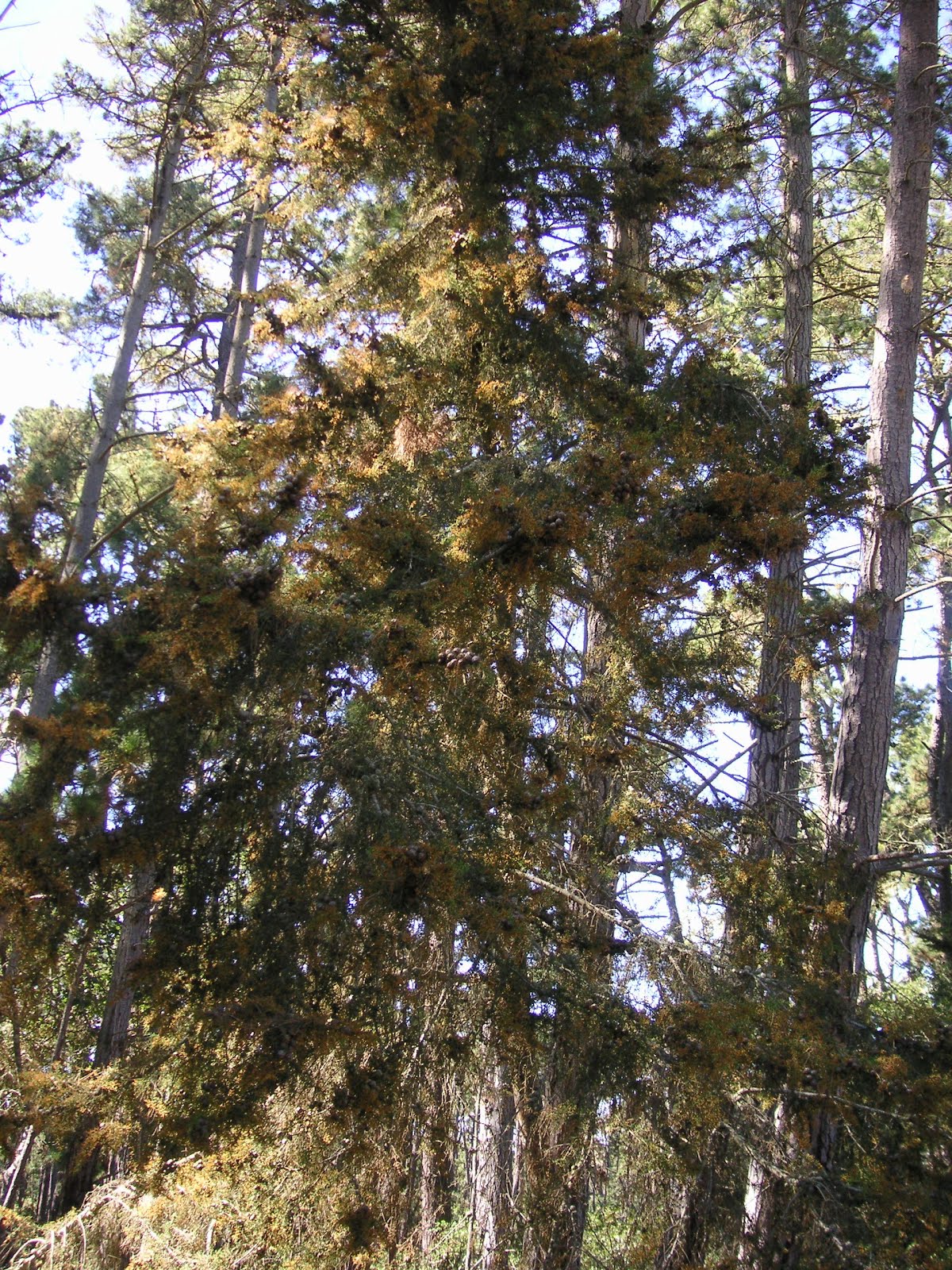
Gowen cypress ~ 03/04/12 ~ SFB Morse Botanical Reserve

yellow male pollen cones with brown female seed cones

female seed cones

Gowen cypress
Hesperocyparis goveniana (formerly Cupressus goveniana ssp. goveniana)
CNPS 8th Edition Inventory
Cupressaceae

When I first took pictures of these short-statured trees I thought, "Oh good, I can finally get close-up shots of a Monterey cypress (Hesperocyparis macrocarpa) for my blog, since they're usually too tall or perched on a cliff to take decent detailed pictures." Wrong? Maybe, maybe not? Gowen cypress is my best guess based on the CNPS plant list for SFB Morse Botanical Reserve, which does not include Monterey cypress. However, the female seed cones seemed bigger than described in Jepson compared to the larger Monterey cypress seed cones, but I'm aware visual perception can often be deceptive. I really should carry a ruler with me when I go hiking, since memory and photographs are proving to not be enough to distinguish species. I checked our neighbors' cypress trees, and there's quite a bit of variation outside of the reported dimensions. I guess theirs could be garden hybrids though. Erg. Come to find out the Gowen cypress is a federally threatened species. For more information about cypresses, check out Wayne's Word and Point Lobos Association.

Thursday, March 31, 2011

tree year project 2011, #5


coast Douglas-fir with pride of Madeira
Pseudotsuga menziesii var. menziesii with Echium candicans
Pinaceae and Boraginaceae

Those first green sprouts that appeared the last week of January and first of February dried up into sadly drooping tails of brown. My only guess is that our long month and a half without the usual winter rain and sunny warm temps affected the annual growth of this tree (nope, incorrect guess, see postscript below). No worries, it looks like this old Douglas-fir is sporting a second set of green shoots after the appearance of baby cones and additional rains. For those new to Nature ID, I've committed a small part of my blog to participating in The Tree Year project.

I was really pleased to get a decent picture of the gnarly tree trunk and the purple blooms of the prolific pride of Madeira in its shadow. Actually, I had the camera out with hopes to capture what I believe is a migrant Rufous hummingbird. No luck since it's such an extremely quick flying bright red bird. It does a country line dance move with a head lean and fly to side to side that I swear the sole purpose is to taunt me into trying to take its picture.

http://thetreeyear.wordpress.com/tree-year-posts/about-the-tree/buds-and-flowers/

ps 08/08/11 - I just noticed the lighter brown structures hanging down are dried pollen cones. I'm also guessing the droopy brown tails are unfertilized female cones. And the bright green are indeed new needle shoots; they look very similar to budding female cones. It always helps to take another look at these older posts.

Saturday, February 12, 2011

tree year project 2011, #3


coast Douglas-fir
Pseudotsuga menziesii var. menziesii
Pinaceae

So, it looks like those little green bits from my last post for The Tree Year project are indeed new needles (nope, see postscript below). Today was the first time this year I noticed miniature cones starting to pop down from the branches. The second pic is to show what a great view this Douglas-fir enjoys of the Monterey Bay with decorative sailboats on sunny days. I guess I should mention those upward looking branches in the background on the right are a set of 6 different Monterey pines that have grown, I swear, at least 15 feet in the past 5 years. Our once expansive view of the bay is quickly being overgrown with views of trees.

http://thetreeyear.wordpress.com/tree-year-posts/about-the-tree/buds-and-flowers/

ps 08/08/11 - Correction! Now, I think the light green fluffy bits are female cones and the downward yellowish buds are male pollen cones. Apologies if this is confusing, but I'd like to keep what I originally wrote to show my learning in progress.

Friday, February 11, 2011

Monterey pine ~ 02/11/11 ~ Jacks Peak

male cones with pollen

old female cones

pine trunks in native habitat

Monterey pine
Pinus radiata
CNPS 8th Edition Inventory
for more information click here and here
Pinaceae

posted 02/19/11 - If you click on the first photo to enlarge it, you may be able to see the yellow pollen borne on the air to the right of the pic (no, that speckly stuff isn't due to my poor photography skills). During the last week of January, we noticed the thick annual pollen dusting on many parked cars - I wonder if there's some kind of electrostatic charge that particularly attracts pollen to the metal and glass of cars. There are many species of trees in the area, so I don't know if I can blame the Monterey pines for our non-stop runny noses. The recent rains do seem to help alleviate the allergies.

While the Monterey pine tree has been introduced around the world for lumber, apparently, the Monterey Peninsula is one of the few remaining places of native forests; it's actually considered a rare and endangered plant in California. I do find it interesting how the shape of the tree changes as it ages, from a traditional triangular Christmas tree shape when it's younger to a tall, rounded top shape once they mature.

Monday, February 8, 2010

pollen

Since I don't have any other place to record these kinds of observations, I'm posting it here. We had quite a bit of rain on Friday and Saturday, after which I noticed massive amounts of this bright yellow pollen collected everywhere. My nose has been running like no one's business for at least a week and I swear I've gone through a whole box of Kleenex! I'm wondering if I have allergies to this pollen. Does it come from the pine trees? Or the oaks?

ps 02/17/10 - My nose is still dripping like mad. Makes me rethink that cold I thought I had last year for 2 months!

pss 02/22/10 - With today's rain, my nose seems to have finally stopped dripping. Yeah!

pss 01/26/11 - Noticed a light dusting of yellow pollen on many parked cars for the first time this year. I still haven't figured out if the pollen comes from the pines or the oaks.