posted 03/03/14 - Rain. Lots of rain. Rivers of rain. Yay! I got totally soaked, and I loved it. And, great rumbling thunder, too!... erm, okay, it was a little scary under the towering, swaying Monterey pines. I've been coordinating another excursion with a fellow blogger, but then it occurred to me that I don't have to drive 2 hours north in order to hike in the rain. It only takes 10 minutes up the hill by car to get to the end of a PG road where I park. Then I walk into Pebble Beach to avoid paying the toll road fee ($10!) to get to Del Monte Forest Conservancy property. Andy regularly runs through here from home. I should visit more often. This SFGate article mentions obtaining a "Pebble Beach Nature Trails" map from the local hotels; I always wondered about the colored trail markers but had no idea how to obtain information. This location includes the surrounding Huckleberry Hill Natural Habitat Area with a cute pygmy Gowen cypress forest. I have plenty of IDs to post from this amazingly diverse location, which is being actively managed. Hopefully, at some point I'll add the details later. But, for now, I'm off on another adventure...
Showing posts with label x: SFB Morse Botanical Reserve. Show all posts
Friday, February 28, 2014
Sunday, March 4, 2012
habitat ~ 03/04/12 ~ SFB Morse Botanical Reserve
March 4, 2012
Pardon if some of this information sounds familiar, but I'm stealing partial descriptions from an earlier post on the federally threatened Gowen cypress...
I've hiked this part of exclusive Pebble Beach more often than I've featured on Nature ID. It's too bad, because this is apparently quite a place of botanical interest due to the numerous rare plants found along this ravine. It doesn't look like the usual muddy water path since it's so dry right now.
After almost 3 years of creating this blog, I'm still amazed how new information is continually presented on the internet and how those tidbits filter through to my brain differently each time I look up IDs. Considering I'm mostly self-taught based on my handful of field guides and park pamphlets (er, now huge piles of books and papers on top of a cabinet next to my home computer), and what I can quickly find on the internet, I casually meander through reported information, not too dissimilar to how I prefer to hike without a map.
So, I was very surprised to find an online PDF about how SFB Morse Botanical Reserve was created to protect the "endangered" Gowen cypress. First of all, I've called this spot Del Monte Forest for the sake of Nature ID, and I wasn't even aware this is a special botanical reserve. Andy and I have called it "poetry rock" for the longest time. From the PDF, I discovered there's another native species of cypress around here, just as I had no idea that there's another pine in addition to the Monterey pine (Pinus radiata) - the Bishop pine (Pinus muricata). Who knew? Both Monterey cypress and Monterey pine are, obviously given their common names, very unique to the local area, each with only 2-4 very specific locations of reported native populations in the world.
I may have to rethink my location labels. For a comparison of a similar photograph nearby under more typical weather conditions, check out my photo from Huckleberry Hill.
I've hiked this part of exclusive Pebble Beach more often than I've featured on Nature ID. It's too bad, because this is apparently quite a place of botanical interest due to the numerous rare plants found along this ravine. It doesn't look like the usual muddy water path since it's so dry right now.
After almost 3 years of creating this blog, I'm still amazed how new information is continually presented on the internet and how those tidbits filter through to my brain differently each time I look up IDs. Considering I'm mostly self-taught based on my handful of field guides and park pamphlets (er, now huge piles of books and papers on top of a cabinet next to my home computer), and what I can quickly find on the internet, I casually meander through reported information, not too dissimilar to how I prefer to hike without a map.
So, I was very surprised to find an online PDF about how SFB Morse Botanical Reserve was created to protect the "endangered" Gowen cypress. First of all, I've called this spot Del Monte Forest for the sake of Nature ID, and I wasn't even aware this is a special botanical reserve. Andy and I have called it "poetry rock" for the longest time. From the PDF, I discovered there's another native species of cypress around here, just as I had no idea that there's another pine in addition to the Monterey pine (Pinus radiata) - the Bishop pine (Pinus muricata). Who knew? Both Monterey cypress and Monterey pine are, obviously given their common names, very unique to the local area, each with only 2-4 very specific locations of reported native populations in the world.
I may have to rethink my location labels. For a comparison of a similar photograph nearby under more typical weather conditions, check out my photo from Huckleberry Hill.
CA huckleberry ~ 03/04/12 ~ SFB Morse Botanical Reserve
Vaccinium ovatum
Ericaceae
I almost gave up on being able to ID this plant and was about to post it as a can you ID? It really had me stumped. Based on the bell-shaped flowers, I figured it must belong to the heath family. The leaves are serrated and shiny, so I didn't think it could be a manzanita. Then I looked at all 176 records in Calflora for Ericaceae. Just my luck, its scientific name starts with a 'v'. Sigh. When we were hiking Huckleberry Hill that last 2 years, I never did get around to looking up what a huckleberry plant actually looks like. Well, now I know.
acacias ~ 03/04/12 ~ SFB Morse Botanical Reserve
Acacia retinodes
Fabaceae
Wow, I didn't know there was such a variety of acacias. Usually when I see the prolific bright yellow blooms, I'm speeding down a highway, like Hwy 1 from Watsonville to Santa Cruz and Hwy 68 from Monterey to Salinas. During this hike, I noticed the leaves and blooms were very different shapes, so I took pictures. All these trees and shrubs featured here are native to Australia.
When I saw my doctor last month for a check-up, he blamed the acacia trees for my runny nose. I'm not sure that's entirely correct, since right along the coast where we spend most of our time, there are no acacias that we've seen. The nearest one is at the Pacific Grove Golf Course a mile away. I'm guessing my and Andy's late January to early March allergies are due to the Monterey pine.
Gowen cypress ~ 03/04/12 ~ SFB Morse Botanical Reserve
Hesperocyparis goveniana (formerly Cupressus goveniana ssp. goveniana)
CNPS 8th Edition Inventory
Cupressaceae
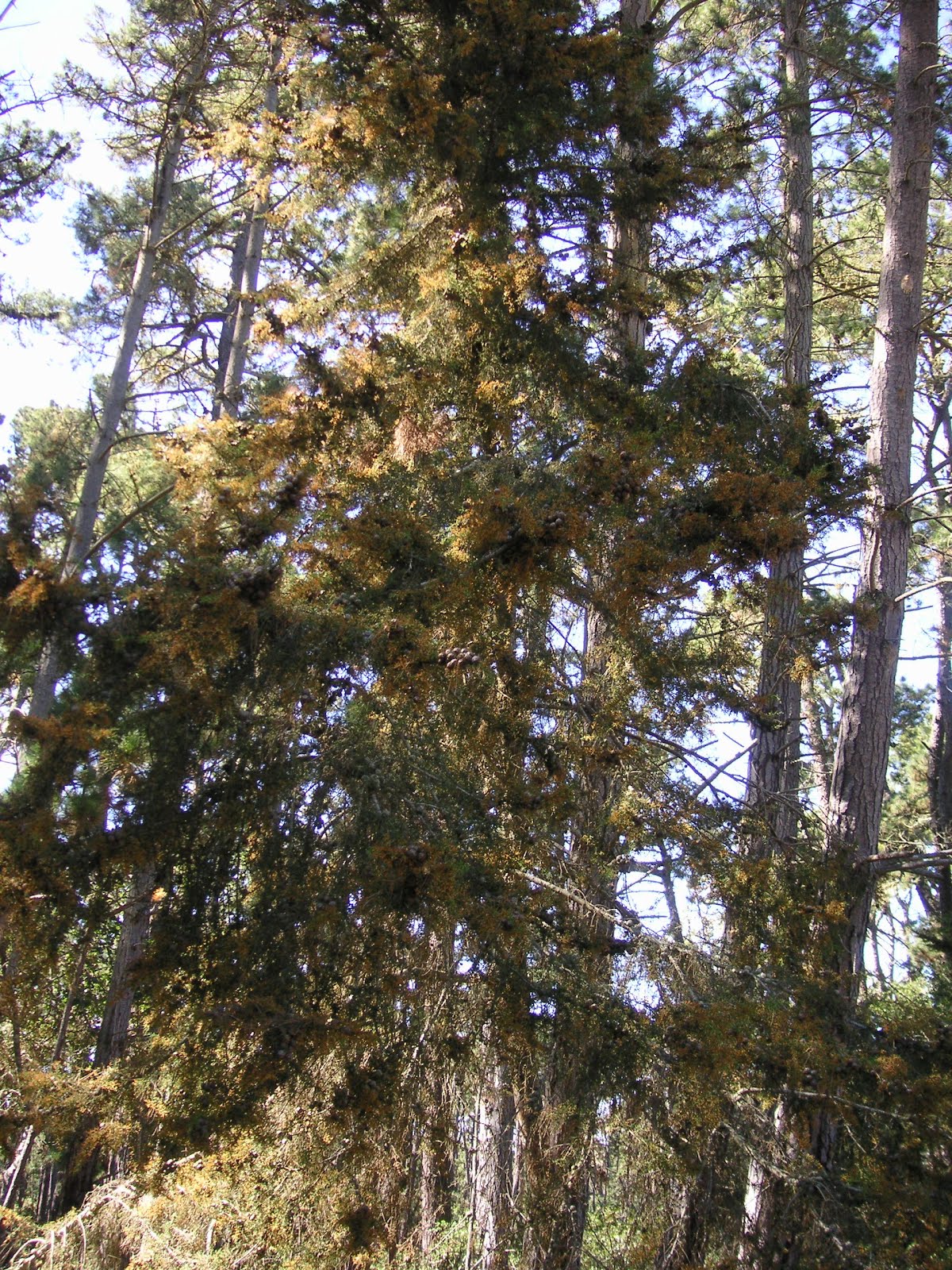
When I first took pictures of these short-statured trees I thought, "Oh good, I can finally get close-up shots of a Monterey cypress (Hesperocyparis macrocarpa) for my blog, since they're usually too tall or perched on a cliff to take decent detailed pictures." Wrong? Maybe, maybe not? Gowen cypress is my best guess based on the CNPS plant list for SFB Morse Botanical Reserve, which does not include Monterey cypress. However, the female seed cones seemed bigger than described in Jepson compared to the larger Monterey cypress seed cones, but I'm aware visual perception can often be deceptive. I really should carry a ruler with me when I go hiking, since memory and photographs are proving to not be enough to distinguish species. I checked our neighbors' cypress trees, and there's quite a bit of variation outside of the reported dimensions. I guess theirs could be garden hybrids though. Erg. Come to find out the Gowen cypress is a federally threatened species. For more information about cypresses, check out Wayne's Word and Point Lobos Association.
pink flowering currant ~ 03/04/12 ~ SFB Morse Botanical Reserve
Ribes sanguineum var. glutinosum
Grossulariaceae
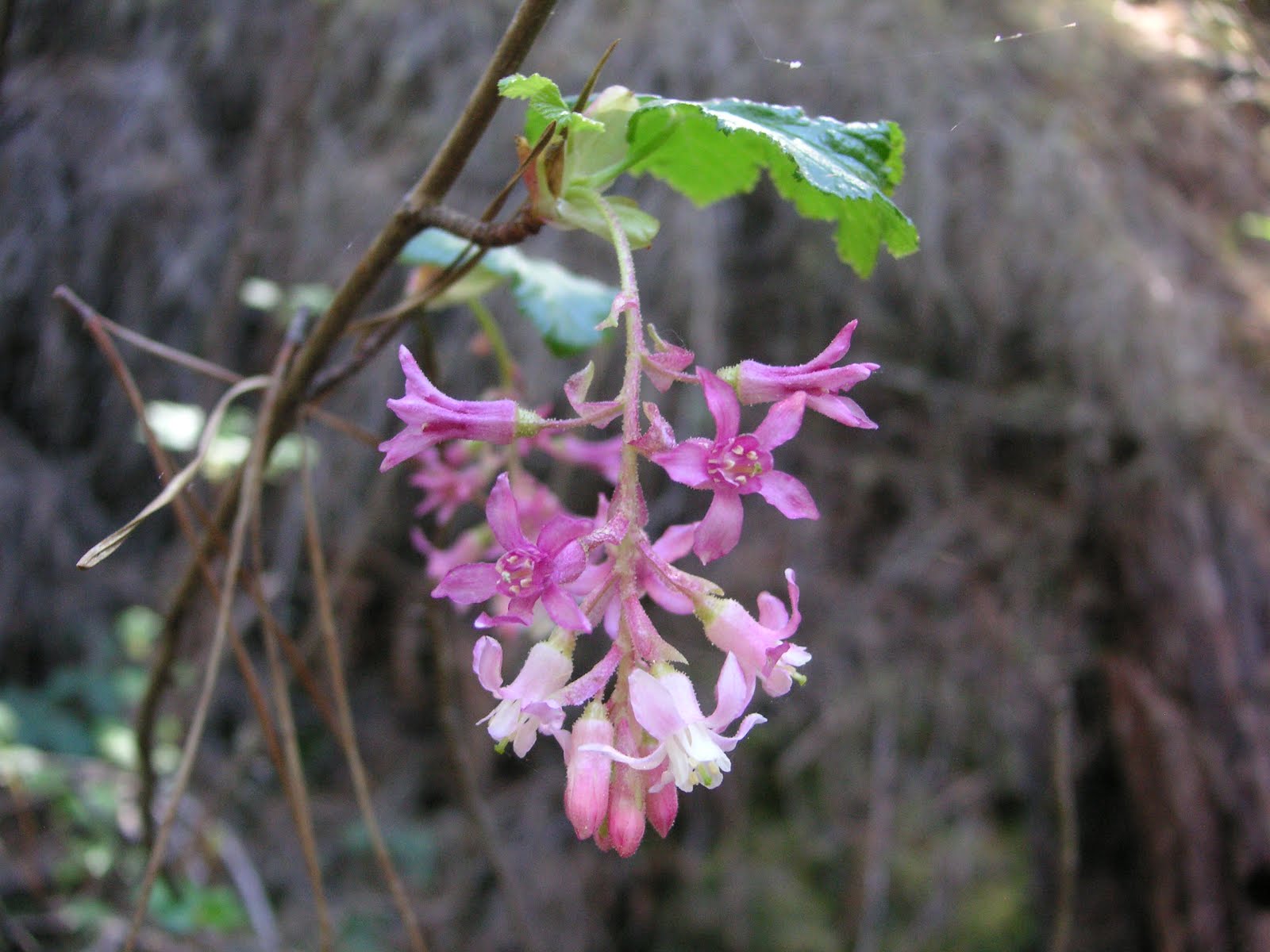
I'm fairly sure of this ID, because the leaves were not very hairy compared to the other possibility of chaparral current (Ribes malvaceum), which is also on the CNPS plant list and reported on Calflora for this location. If anyone can provide helpful hints on how best to distinguish between these two species, I'd greatly appreciate it.
ps 03/14/12 - I have the feeling that other bloggers gain something from my ramblings... of course, it could simply be the matter of timing. For another pink flowering currant blog feature, check out Town Mouse and Country Mouse.
Thursday, May 27, 2010
habitat ~ 05/27/10 ~ SFB Morse Botanical Reserve
May 27, 2010
We affectionately call this place "poetry rock" for the unexpected bronze inscription find, nestled among a couple tree roots. I was caught in the rain here. After attempting to not get too wet, I gave in to the inevitable... and had a fabulous time being wet, listening to the birds, and watching the frisky squirrels. Native roses were blooming everywhere. I resisted the temptation to pull apart old tree trunks to look for lively goodies, because I was thinking I wouldn't want someone ripping open my roof in the rain while I was hunkered down for some cozy. I'm sure I would have found several amazing beetles. Only saw 2 trail runners while trekking through the muddy paths, one being my better half in training for his upcoming trail marathon. It's too bad they want to build, yet another, highfalutin, sterile golf course nearby... to add to the dozens of private backyard courses already built in Pebble Beach as shown above in the last picture.
sneezeweed ~ 05/27/10 ~ SFB Morse Botanical Reserve
Helenium puberulum
Asteraceae
I walked right by these and then stopped in my tracks to take another look. It reminded me of a miniature, stunted sunflower. The yellow ray flowers were so tiny I initially thought something had chewed them off. I looked around some more and found several others looking just like this.
ps 05/28/10 - I originally posted this as unknown flower with a guess as to our native species. After looking some more, I'm fairly confident of this ID now, especially since it was growing next to standing water in an area of little disturbance.