Showing posts with label * dams/reservoirs. Show all posts

Tuesday, February 25, 2014

habitat ~ 02/25/14 ~ Pinnacles National Park

February 25, 2014

Researching location labels for Nature ID has had an unforeseen benefit in that I'm now more appreciative of local parks.  I used to take them for granted.  Their ownership and management are not always the same entity and can change over time.  Pinnacles changed from a National Monument to a National Park on January 10, 2013 when President Barack Obama signed an act into law.  (Is this a different legal process than when he signed a proclamation on April 20, 2012 changing former Fort Ord Public Lands into a National Monument? I'm mildly curious to know how all this works.)  Eh, I've been griping about the lack of progress I see around me, e.g., this recent Hatton Canyon habitat post, yet I haven't given enough credit to the changes that have been made.

So, I've added a new location label for Pinnacles National Park.  I'm still undecided if I'll update my past National Monument labels.  For the record, they include:
west entrance location (habitat + IDs)
east entrance location (habitat + IDs)
all Pinnacles habitat
west habitat
east habitat

giant slalom section of the "butterfly highway"

I decided on this last-minute trip to Pinnacles hoping to find 2 specific butterflies before the week's heavy rains hit.  One was the margined white, which is not included in the Pinnacles Butterfly Checklist.  I queried Paul Johnson (it's his list) and Art Shapiro (my go-to CA butterfly expert) about why it might be missing, because there are plenty of milkmaids (host plant) at Pinnacles.  Paul's been looking for over a decade, but he admitted he's had doubts around some look-alike checkered and cabbages he's seen.  Art challenged me to go find them myself.  OK!  Considering I spotted margined at 2 very different locations in the past few weeks, I figured the sooner I get out to Pinnacles, the better chance I have at finding them, if they are there.  Nope.  It's dry.  Very dry.  Very few milkmaids are up yet.  And very few butterflies are out.  Without any clear photographic evidence, I spotted a red admiral, a couple mystery Vanessa ladies, a handful of echo blues, and...

large rocks covered with Dudleya (host plant) and Sedum

... a couple Sonoran blues.  Woohooo!  It's thanks to Ken @ Nature of a Man who sent me a recent picture of one to ID that I even remembered I've been wanting to get a picture of my own ever since Chris Grinter commented on my Dudleya post from 3 years ago.  I was so close to getting a good shot, but then I was afraid of falling off the rock.  You understand.

standard west entrance shot from the parking lot

As I debated whether I wanted to try another trail where I know more stonecrops grow, I marveled at the incredible palette Pinnacles provides even in this record dry winter we've had.  The iron red color of the buckwheats is starting to float my boat.  Given my relative lack of success, I wasn't so gung ho on butterflies anymore.  Plus, I was still feeling kinda icky and was a bit parched and craving the sight of water.  There are plenty of strenuous trails but no connecting roads through the park.  So, in an unusual move for me, I decided to drive over to the east entrance and hike to the reservoir. 

Bitterwater Road

The bleached out grey, died, dead was oppressive, and yet fascinating at the same time because it's so extreme.  I feel badly for the cows and the farmers.  Anyone else hoarding butter in their freezer like I am?  It's going to be worth its weight in gold.
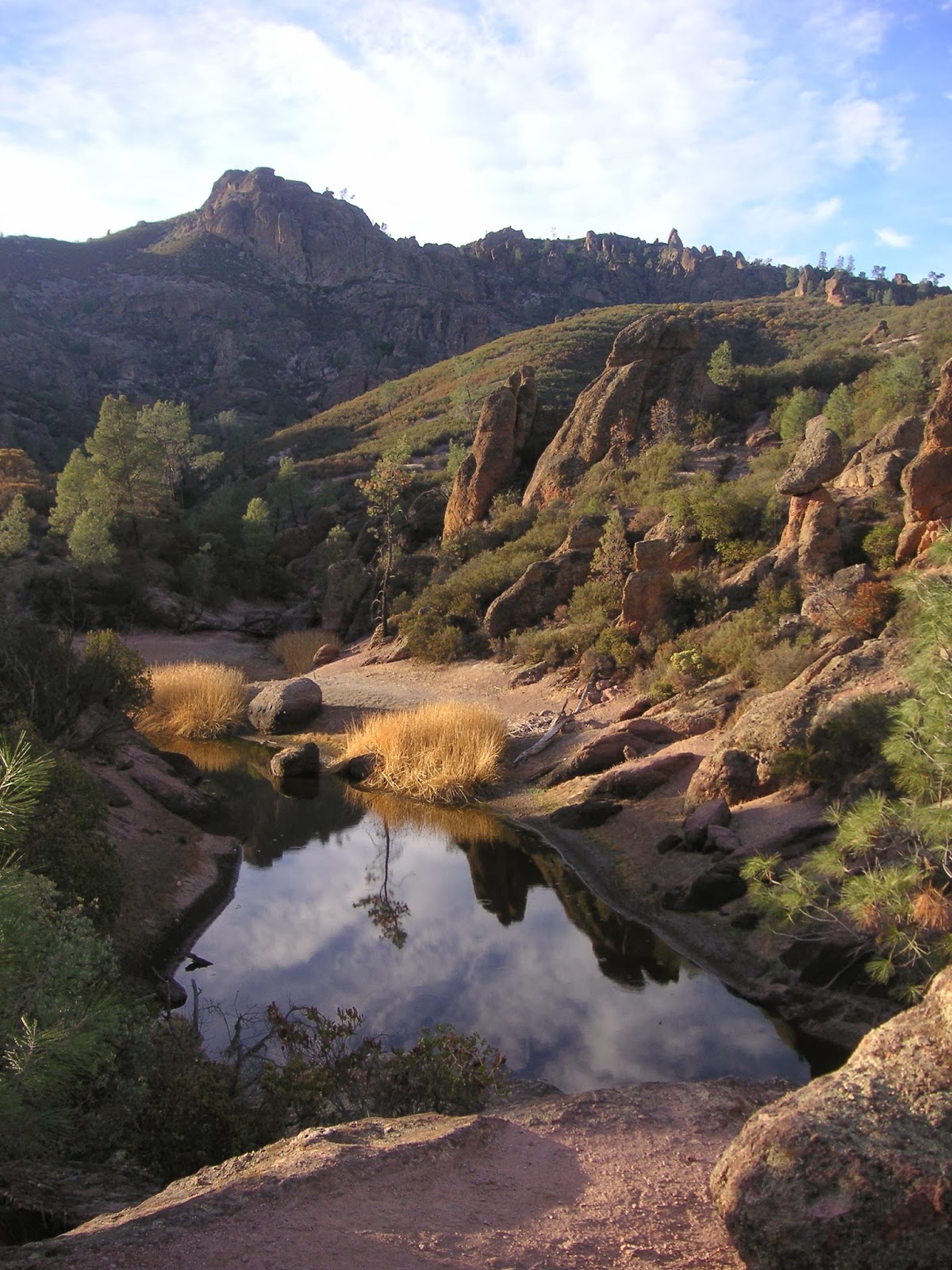
Bear Gulch Reservoir

Ahhh.  It was so worth the long day of driving and hiking through the ick to get here, to this spot, to watch the shadows from the late afternoon sun, and to contemplate life.

Sunday, February 16, 2014

habitat ~ 02/16/14 ~ Los Padres Dam

Los Padres Dam

The Los Padres Dam along the Carmel River is owned by California American Water (CalAm) and is one of several trailheads to the Ventana Wilderness of the Los Padres National Forest.  While it's a popular backpacking destination, I don't particularly have any desire to go myself: it's drier than I prefer; there are way too many mosquitoes, ticks, and poison oak; and quite frankly, some of the die-hard Big Sur folks make me a little nervous.  We've only ever done the Carmel River Trail for very enjoyable short day hikes.  I'll admit I'm woefully ignorant of the heated water politics surrounding the Carmel River, and it's always in the local news.  CalAm is currently removing the San Clemente Dam located downstream.

ps - Does anyone know what causes the orange colored seepage?  Iron bacteria?

Saturday, August 25, 2012

habitat ~ 08/25/12 ~ San Luis Reservoir State Rec Area

August 25, 2012

Yellow, yellow... green? It felt like I had abruptly left black and white Kansas and ended up in Technicolor Munchkinland (see previous post). Instead of a yellow brick road, I had to pass through yellow grassy slopes. The first photo above is a decent comparison shot to the one I posted for November 24, 2011 when those shrubs in the foreground were submerged in water. I don't know if the level of the reservoir water is unusually low this summer given the lack of rain we had last winter.

It's funny, whenever I go through dry grassy CA hills, I see shapes of dinosaurs. This is based on a whole string of myths and erroneous connections from my childhood mind's eye. In the 1970's, I watched episodes of Mutual of Omaha's Wild Kingdom that incorrectly described how elephants traveled to graveyards to die and showed birds on hippos. I didn't make the distinction between large, leathery skinned mammals and dinosaurs. Then, thanks to Sinclair Oil's logo, I figured fossil fuels came from Brontosaurus (properly classified as Apatosaurus). I at least knew dinosaurs were extinct. So, during summer vacations to the coast as we passed through the Kettleman Hills, I came to the conclusion that numerous massive dinosaurs must have congregated there for their final die-off, were loosely covered with drifting dirt through thousands of years, formed the sloping hills with dried grassy blankets, turned into oil underneath, and now had pumpjacks like a flock of monstrous drinking birds on their backs. Ah, the wild imagination of children.

Speaking of the 1970's, I remember studying handout supplements in grade school for renewable energy as a result of the energy crisis. Over 30 years have passed since then, and our progress away from reliance on fossil fuels seems to be slow. Sure, there are two forms of green energy shown in the first picture of the San Luis Reservoir area, hydropower and wind power, but is that enough?

Saturday, December 10, 2011

habitat ~ 12/10/11 ~ Los Padres Dam

Los Padres Dam

This hike was all about contrasts. The reservoir seemed fairly full, but the spillway was bone dry and the Carmel River was very low. Once past the dam, the Carmel River Trail hugs the hills, from sunny to shady, repeatedly. There were dry areas still recovering from the 2008 Basin Complex Fire and other areas which seemed extra lush and green for this time of year. One side of the trail could have chaparral yuccas, chamise, and dried grasses, while the other side could have newly sprouted fiesta flowers, ferns, grasses, and mushrooms. We went through stands of trees to open meadows. Evergreen oaks, madrones, CA bays, and toyon were mixed in with deciduous oaks, CA buckeyes, bigleaf maples, and CA sycamores. Buckwheats, CA fuchsias, CA goldenrods, cudweeds, telegraph weeds, and a variety of other Asteraceae were setting seed and showing fresh blooms. I saw very few insects or hummingbirds that could pollinate the flowers, but I did spot a couple bumblebees, a honkin' huge tachinid fly, other smaller flies, damselflies, and dragonflies. We thoroughly enjoyed being outdoors in December.

I may want visit Los Padres Dam again in January or February. We don't often go there, because it can get blazing hot by May (although the numerous river crossings are refreshing), the trails are not well maintained further in (with loads of poison-oak), and it takes an hour to travel the 25 miles inland (which is almost beyond my patience to drive for a hike). I've found very few nature-related sites about the Los Padres Dam area. It's a very popular access point for the northern area of the Los Padres National Forest, so most of my search results have been from hard-core hiking sites. To see what backpacking is like in the area, check out this fellow Tony's pictures.

Thursday, November 24, 2011

habitat ~ 11/24/11 ~ San Luis Reservoir State Rec Area

San Luis Reservoir State Recreation Area
November 24, 2011

This is not exactly "Over the River and through the Woods"; it's more over the reservoir and through the valley to family's houses we go. Hurrah for Thanksgiving Day! Since most of my extended family still lives in the Central Valley, this is the usual route to go see them or to pass through to Yosemite. No, we didn't stop, nor have I ever stopped since it's usually very windy through Pacheco Pass. I figured my picture from the car and this blog is a good enough excuse to actually look up information on this reservoir and the surrounding area that I've passed many, many times since I was a kid and never even knew the name. If Wikipedia is correct, the San Luis Reservoir is "the largest off-stream reservoir in the United States." Who knew? In the distance are numerous wind turbines, which are situated on another CA State Park property, Pacheco State Park. Thanks to revenue from the wind turbines, Pacheco is one of the few State Parks supposedly with enough funds for maintenance. What a great idea! Both State Park embedded links above have decent historical information.

ps 01/04/12 - Based on comments below, found this article from Forbes on endangered CA condors and wind turbines. Something to think about.

Friday, June 10, 2011

habitat ~ 06/10/11 ~ Pinnacles National Monument - east


After the previous day's hot hike in the full sun, our hike to Bear Gulch Reservoir in the shade of rocks and trees was a welcomed change of pace. For all the times we've been to Pinnacles, this was the first time we've done this short loop. Unfortunately our timing never seems to coincide with when Bear Gulch Cave is open. As shown by the sign, the cave is often closed when the Townsend's big-eared bats are raising their young. Plus, this past March I know the Balconies Cave was closed due to high water, but I don't remember if Bear Gulch Cave was also closed.

While we prefer going to the west entrance in May for a day trip, this was our first time camping at Pinnacles. The last picture shows our campsite's "backyard" with a creek. It looks lovely, doesn't it? Come nightfall, marauding racoons used that creek to sneak into every campsite along the water. We could hear the series of shrieks and yells from the campers with only a minute or so between hits. We were sitting only feet away at the campfire when a couple very large raccoons hopped on our table and grabbed our just-opened bag of marshmallows. We got off easy. Our neighbors chased after a raccoon which disappeared with an entire knapsack. Overall, this Pinnacles trip was great and I'm looking forward to going back.

ps 12/15/11 - For pictures of this trail in mid-December, check out My Back 40 (Feet).

valley garter snake ~ 06/10/11 ~ Pinnacles


valley garter snake
Thamnophis sirtalis fitchi
(ssp. of common garter snake) 

This swimming snake was a fun find. It amazes me they can use a similar serpentine movement to swim as moving across ground. It was good to revisit garter snake ID, because I found an error in a previous post that I had originally identified as a coast garter snake.

ps 04/01/14 - I had briefly changed the ID to Diablo Range garter snake (Thamnophis atratus zaxanthus), an aquatic garter snake.  However, Diablo do not have red on their sides like this one shows.

Sunday, April 17, 2011

habitat ~ 04/17/11 ~ Fremont Peak State Park

April 17, 2011

We haven't been to Fremont Peak since 11/29/08, because we thought it closed due to CA's budget cuts. It's nice to see it's still open. It's a good place for a picnic, yet there isn't much in the way of hiking trails and basic camping facilities. However, the views from the peak are incredible! The photo I use on my maps page was taken from Fremont Peak. I believe that tower to the left above belongs to KSBW-TV; it's one of three antennas and two microwave dishes (hah, no, not the Stouffer's frozen t.v. dinner kind). The biggest attraction (and not well known, at least to me) is the Fremont Peak Observatory. We've never been, but now that I know it's open to the public, we just may go sometime this year.


This view is looking northeast towards Hollister and the San Justo Reservoir, which may or may not still be closed in an attempt to control the spread of the invasive zebra mussel.


This view is looking southeast along the Gabilan Range, which as the crow flies ends up at Pinnacles National Monument.

This view is looking straight west towards Prunedale, Castroville, and the Monterey Bay. See the marine layer over the water?


Final shot! This is not from Fremont Peak State Park; it's some unmarked back road that occasionally becomes the winding Old Stage Road. I absolutely love the rolling green hills. It doesn't even look like it belongs in CA. There were no wildflowers, thanks to the mowing abilities of the cows. If it weren't for the "meadow muffins" that I'm sure exist everywhere, I fantasize about rolling down those hills like a little kid and getting grass stains everywhere.

Thursday, May 28, 2009

habitat ~ 05/28/09 ~ Los Padres Dam


Los Padres Dam - Carmel River Trail
May 28, 2009

The Basin Complex Fire burned 162,818 acres, including this trail area, from June 21, 2008 - July 27, 2008. It's great to see the new growth after less than a year. It's eerily beautiful!

ps 04/21/10 - The similarity of themes from other nature blogs, especially those from CA, is great to read and share. Check out bioblabber's post on the aftermath of the 2009 Station Fire. She provides more information and has a fun blogging voice.