December 10, 2014
(see also part 1)
(see also part 1)
It almost feels like spring, part deux, 9 months later. For over a month now, fresh new green has sprouted up everywhere after a decent amount of rain. There's a definite procession, which began with the ferns the first week of November. Two weeks later the fiesta flowers started poking up with their weird white spots, exactly like they did back in February. I'll be curious to see what'll happen to all this new green once the freezing temps start dropping in at night for the winter.
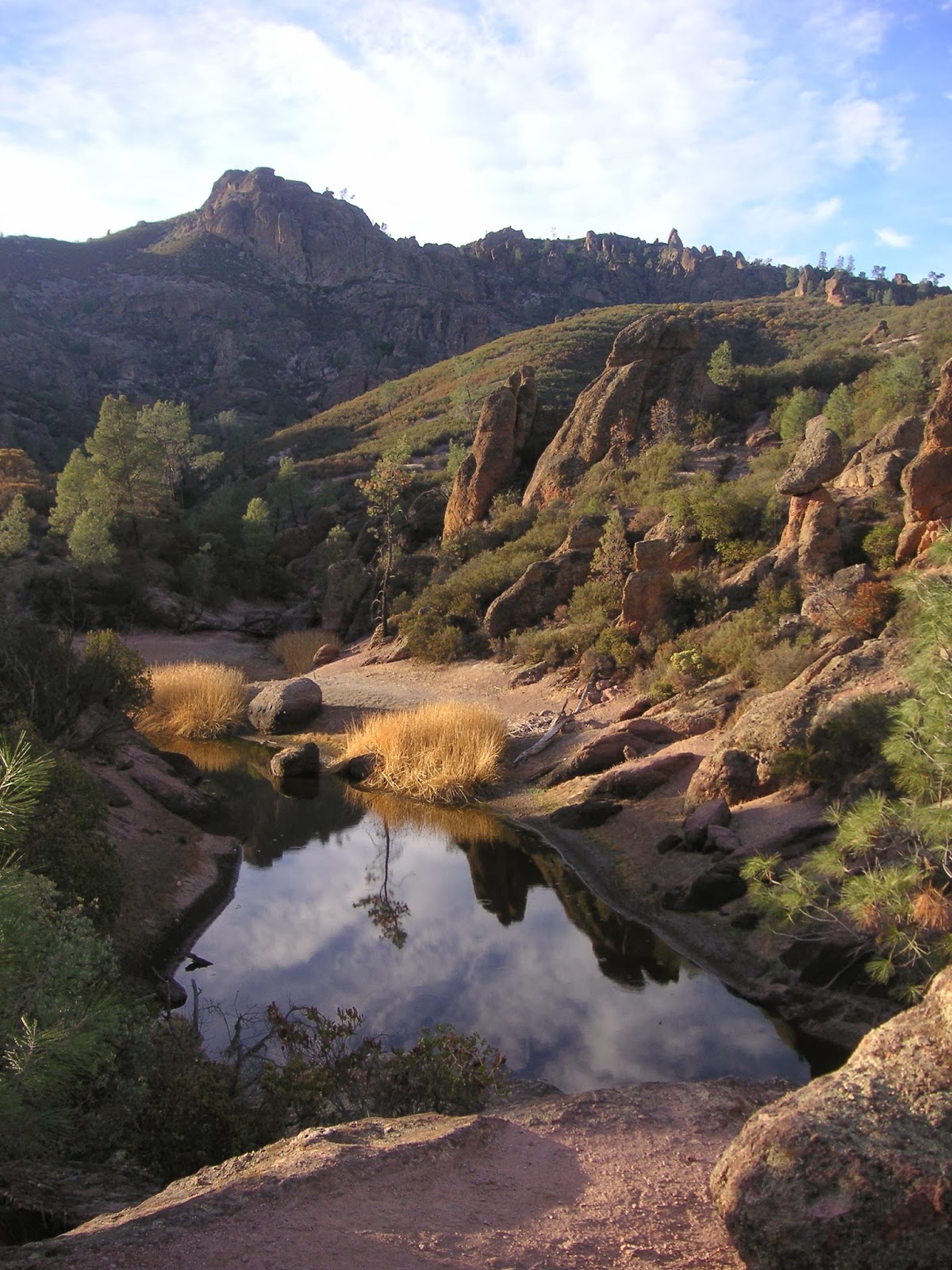
The obvious indicator that it's indeed December is the leaves are still turning colors and are still attached to the plants, especially the willows and blue oaks. The buckeyes turned back in July, and the numerous browned gray pines are ones that died this 3rd year drought. Curiously, I noticed this week that the blue oaks were mostly two stark contrasts (all green or all tan) after the recent rains (wind gusts < 17mph) and the knock-down of the remaining smattering of turned tan leaves, which began back in July (as a note, this visit was before the wind storm hit the next day, which maxed at a whopping 44mph). What's going on? Does SOD or similar affect blue oaks? Or, are all the tan blue oaks dead like the pines due to drought? Or, are there genetic variations to explain the differences?
Oops, oh dear, maybe they aren't all blue oaks? I did a cursory check to confirm blue oak, but I'll check again. And, even then, who knows about the genetics? Still, I double-check frequently, because my first impressions are not always correct and the repetition helps me learn. It's because of distinctive color changes that I was able to quickly distinguish between valley oak and black oak from a distance at my Monterey Co. site while looking for broadleaf mistletoes and great purple hairstreaks, but it wasn't until my second visit that I double-checked and realized what I had been told and had assumed to be correct the first visit was not the case. It really helps to see things through the seasons, because differences become obvious at different times. I've enjoyed discovering these little lessons as they come up from the first-hand doing, rather than from other people's accounts (which are not always correct, either, or may vary depending on location).
When writing up my Nature ID posts the past several years, I noticed I tend to make assumptions (often false) based on what I find during a single visit to any location. I suspect I am not the only one who does this. Problem is with random and sporadic visits, I don't often know what I'm not finding and in what context. Grunion Greeting taught me confirmed negative results provide just as valuable information as positive results. And, I've found context is often location specific beyond any general habitat label.
Through the course of going to Pinnacles every week, I've become more regimented in what I record in photos and notes. I'm improving my plant ID photos and making sure my step-back shots are actually informative of the immediate surroundings. I have the history, week by week. Sometimes I don't notice something until it becomes glaringly obvious, but if I look back through my sampling photos, I can often pinpoint the week the event started happening or clearly ended.
Timing. How do natural events time relative to each other? How do natural events time to weather events? How do natural events time over the course of years? Art has an easy to understand page about phenology and climate from a butterfly bent.
It was almost accidental that I even started going to Pinnacles every week Tuesday through the end of August, because after my April 8 visit, I returned 2 days later April 10 with a Santa Clara Valley CNPS group (they're awesome!) and 1 week later April 15 with Paul and his kids (they're awesome, too!). By the following week's April 22 Pinnacles visit, I started latching onto the idea of phenology.
So, then it became a choice of do I continue to go every week on the same day to try to standardize phenology observations, or do I follow typical butterfly monitoring protocols and go on the best predicted flight weather day (sunny, warm, not too windy) for each week? Or, do I go every 2 weeks, like Art does in order to fit in his numerous sites? Hey, back in April, I just wanted some regularity in my schedule to match Andy's school schedule. So, I picked Tuesdays, because there are few visitors to the National Park midweek (it can get crazy crowded on the weekends). Plus, Tuesdays are our local farmers' market night and it was lovely to meet Andy after school to get food-to-go when I was too tired to cook dinner after a long day of hiking in the heat (in all fairness, Andy cooks plenty). Whatever schedule I pick has to be pleasant enough to make me want to do it for the next 20-25 years, because money isn't my primary motivating factor for this project (it's still a factor, just not the primary one). Whether I actually make it that long is totally unknown, but if I don't set it up now in a way that works for me, I'll never make it.
I figured since this was my practice year, I could test out how variable weather affects my observations and going 1-2 times weekly provided more practice. Practice, practice, practice makes perfect. Little did I know at the time that it would not rain again for months. However on windy days, the butterflies tucked themselves down on the ground or clung for dear life to nectar sources. The wind and moving shadows seemed to serve as a sensory overload such that they mostly ignored my own moving shadow, which was great for getting auto-focused macro shots (like these from my Monterey Co. site). That was a nice discovery. On cloudier days, I focused more on learning the plants. And on super hot days, the butterflies generally disappeared for a siesta by 1:00pm, which made me want to follow suit, too. The hottest I stayed was a high of 106°F on September 12 at 2:45pm. Oof. I'm still amazed I acclimated so well to the heat, after almost passing out at only 82°F on March 19 when I went to the east side. A wet cover shirt, a better sunhat, lots of drinking water, and a lighter lunch than my usual hiking fare made it possible. And, I'm a bit more fit after all this hiking and healing time from my bike accident last year (carrying a backpack full of water and gear hurt my injured shoulder for days after, which makes me consider how I'll be in 20 years' time).
Actually, my initial butterfly plan was just to practice to the end of June, because quite honestly I didn't predict I could hack the heat in July and August. Paul told me the butterflies disappear in those months, even though he shows quite a few on his multi-year stacked Park checklist (zoom to > 200% to see the shading). I'm glad I continued to see what happens first-hand through the heat of the summer, like how the best way to spot territorial CA sisters high above is to look down on the ground for their shadows moving through the dappled oak shade, or like how the ringlets are smaller and lighter in color than earlier in the year (and even compared to my Monterey Co. site's late summer darker forms), or like my very first metalmark on August 19, which prompted me to continue visiting into autumn. It's funny, because I'm starting to miss the hot summer heat.
Now that the weather is seriously turning, I already know I don't want to be out in pouring rain, not so much for myself since I like playing in the rain, but to keep my electronic equipment dry enough (at least, that's what I like to tell myself as an excuse, because I'm not as tough as I'd like to believe I am). Plus, if the wind gets to be too much, that's just plain dangerous with falling trees, branches, and even hefty gray pine cones that could do serious bodily injury. Like I did with weather forecast for high temps and cloud cover, I'll have to correlate the trend of predictions vs. actual for wind gusts and set a limit for when not to go out (it was often hotter than predicted 3 days out). Despite the new cautions (summer snakes traded for falling pine cones), I'm now looking forward to winter at Pinnacles, which was never in my original butterfly plan.
After playing around with weekly timing starting in September, I suspect 7 days is too soon and 14 days is too long to really hit the best notching of the rate of change. I'm guessing around 10 days would be best, but that's impractical with days that would hit on the crowded weekends. Observing butterflies and having a lot of disturbance from passing hikers is not an easy combination. Variations in noted observations may be due to the distraction of human presence more than any changes in butterflies or plants, which is why I prefer not to have companions with me on my routes and I rarely engage anyone in conversation on the trails (I've overheard other hikers complain about me being so grumpy, ha!). One thing that did occur to me is that in 20 years there will be many more visitors to the relatively new Pinnacles National Park (think Yosemite). Paul helped out by pointing me to comparable canyons generally not accessed by the public, which in of itself could make an interesting study through time, less traveled vs. high traffic. Besides, 10 days is mentally hard to compute with our week-based, monthly calendar system. Real life limits my dream of a perfect data set.
What really surprised me this year is how Pinnacles goes through amazing color changes through the seasons, way more than I even suspected back in February 2012. It's not subtle, which is a bigger contrast for me because I'm accustomed to year-round evergreen Monterey pines and coast live oaks against a constant blue-gray backdrop on the coast. I've talked about the apparent seasonal nature of dominant flower colors before (here and here), and I think I can extend this concept to overall general color impression including the non-flower bits, too. I make a big point of color in my notes, and I'm wondering how I might be able to utilize this in my project. If I can consistently call it to code it, I can set it as a data point. No?
What inspired me to think about color was having gone out to Fort Ord with David Styer, a local botanist and phenologist in his own right. He's color blind, and I've been convinced this disability helps him distinguish plants better than most people (I just looked this up, and it's hinted at in the literature). I know I'm sensitive to certain colors, and my camera picks up other colors. Unfortunately, I don't have perfect color memory, so it could be a potential problem calling code when switching between lighting conditions and cameras, which may be necessary (equipment craps out, technology changes, etc.).
Speaking of cameras, I still haven't given up on Lytro, which is able to capture the entire light field and can be refocused after the fact. I'll have to check to see if they've improved their software for macro shots (click anywhere on the photo to change the focal point).
Until then, my thought is to generally use two pocket cameras, one for macro and one for max zoom, for photo sampling. I'm strictly thinking utilitarian, good enough to extract information. Remember, efficiency, and I'll need backup. I have to cover a lot of ground and can't spend 20 minutes getting the perfect photo, and if a battery or camera dies halfway in, then that's a problem for a visit's worth of data (it's analogous to when it rained part way through a night's light trapping for the long-term moth survey, but several moths were still caught - what do you do with the data? keep presence, ignore count and absence? how? throw it all out?)
I've also considered using a GoPro to record the drive down and back up the west side. I think it'd be unreasonable to save the entire video footage every week for years, but if I could pull out set frames, then I could have an easier time of roadside photo series in order to call color changes across an elevation gradient, which I've discovered is much easier to spot along the road and in a series through time. There's also the potential for photo recognition software. One thing I've noticed is the higher elevations on the road into the west side seem to run about 3-4 weeks ahead of down lower. And based on discussions with Paul, the east and west sides are not synchronized or evenly offset, something I'd like to take a closer look at. If nothing else, the weekly video could turn into an amazing art project of Pinnacles through the seasons.
I'm guessing it wouldn't be too difficult to index color to plant stage, particularly for obviously colorful plants like Pinnacles' prolific CA buckwheat. USA NPN has 7 questions with 7 levels each including the no response, which seems inordinately cumbersome to me for only a single monitored plant, and I'd have to have someone show me what's considered their standard flower and fruit differentiations and their leveling estimates. Oh, btw, their CA buckwheat description is incorrect (leaves 6 to 18 cm?). I think I might be able to do better. Maybe?
I'm hoping that after a couple years of doing this, I'll have grown an exhaustive list of markers to look for and have culled through them and picked ones of significance for long-term data collection. I'm trying to keep an open mind about it all, taking one step at a time, following the path at my feet. Sometimes when I hit a dead end, I need to backtrack and go down another path, which has been a challenge not to succumb to frustration and throw in the towel on the whole project.
The obvious indicator that it's indeed December is the leaves are still turning colors and are still attached to the plants, especially the willows and blue oaks. The buckeyes turned back in July, and the numerous browned gray pines are ones that died this 3rd year drought. Curiously, I noticed this week that the blue oaks were mostly two stark contrasts (all green or all tan) after the recent rains (wind gusts < 17mph) and the knock-down of the remaining smattering of turned tan leaves, which began back in July (as a note, this visit was before the wind storm hit the next day, which maxed at a whopping 44mph). What's going on? Does SOD or similar affect blue oaks? Or, are all the tan blue oaks dead like the pines due to drought? Or, are there genetic variations to explain the differences?
Oops, oh dear, maybe they aren't all blue oaks? I did a cursory check to confirm blue oak, but I'll check again. And, even then, who knows about the genetics? Still, I double-check frequently, because my first impressions are not always correct and the repetition helps me learn. It's because of distinctive color changes that I was able to quickly distinguish between valley oak and black oak from a distance at my Monterey Co. site while looking for broadleaf mistletoes and great purple hairstreaks, but it wasn't until my second visit that I double-checked and realized what I had been told and had assumed to be correct the first visit was not the case. It really helps to see things through the seasons, because differences become obvious at different times. I've enjoyed discovering these little lessons as they come up from the first-hand doing, rather than from other people's accounts (which are not always correct, either, or may vary depending on location).
When writing up my Nature ID posts the past several years, I noticed I tend to make assumptions (often false) based on what I find during a single visit to any location. I suspect I am not the only one who does this. Problem is with random and sporadic visits, I don't often know what I'm not finding and in what context. Grunion Greeting taught me confirmed negative results provide just as valuable information as positive results. And, I've found context is often location specific beyond any general habitat label.
Through the course of going to Pinnacles every week, I've become more regimented in what I record in photos and notes. I'm improving my plant ID photos and making sure my step-back shots are actually informative of the immediate surroundings. I have the history, week by week. Sometimes I don't notice something until it becomes glaringly obvious, but if I look back through my sampling photos, I can often pinpoint the week the event started happening or clearly ended.
Timing. How do natural events time relative to each other? How do natural events time to weather events? How do natural events time over the course of years? Art has an easy to understand page about phenology and climate from a butterfly bent.
It was almost accidental that I even started going to Pinnacles every week Tuesday through the end of August, because after my April 8 visit, I returned 2 days later April 10 with a Santa Clara Valley CNPS group (they're awesome!) and 1 week later April 15 with Paul and his kids (they're awesome, too!). By the following week's April 22 Pinnacles visit, I started latching onto the idea of phenology.
So, then it became a choice of do I continue to go every week on the same day to try to standardize phenology observations, or do I follow typical butterfly monitoring protocols and go on the best predicted flight weather day (sunny, warm, not too windy) for each week? Or, do I go every 2 weeks, like Art does in order to fit in his numerous sites? Hey, back in April, I just wanted some regularity in my schedule to match Andy's school schedule. So, I picked Tuesdays, because there are few visitors to the National Park midweek (it can get crazy crowded on the weekends). Plus, Tuesdays are our local farmers' market night and it was lovely to meet Andy after school to get food-to-go when I was too tired to cook dinner after a long day of hiking in the heat (in all fairness, Andy cooks plenty). Whatever schedule I pick has to be pleasant enough to make me want to do it for the next 20-25 years, because money isn't my primary motivating factor for this project (it's still a factor, just not the primary one). Whether I actually make it that long is totally unknown, but if I don't set it up now in a way that works for me, I'll never make it.
I figured since this was my practice year, I could test out how variable weather affects my observations and going 1-2 times weekly provided more practice. Practice, practice, practice makes perfect. Little did I know at the time that it would not rain again for months. However on windy days, the butterflies tucked themselves down on the ground or clung for dear life to nectar sources. The wind and moving shadows seemed to serve as a sensory overload such that they mostly ignored my own moving shadow, which was great for getting auto-focused macro shots (like these from my Monterey Co. site). That was a nice discovery. On cloudier days, I focused more on learning the plants. And on super hot days, the butterflies generally disappeared for a siesta by 1:00pm, which made me want to follow suit, too. The hottest I stayed was a high of 106°F on September 12 at 2:45pm. Oof. I'm still amazed I acclimated so well to the heat, after almost passing out at only 82°F on March 19 when I went to the east side. A wet cover shirt, a better sunhat, lots of drinking water, and a lighter lunch than my usual hiking fare made it possible. And, I'm a bit more fit after all this hiking and healing time from my bike accident last year (carrying a backpack full of water and gear hurt my injured shoulder for days after, which makes me consider how I'll be in 20 years' time).
Actually, my initial butterfly plan was just to practice to the end of June, because quite honestly I didn't predict I could hack the heat in July and August. Paul told me the butterflies disappear in those months, even though he shows quite a few on his multi-year stacked Park checklist (zoom to > 200% to see the shading). I'm glad I continued to see what happens first-hand through the heat of the summer, like how the best way to spot territorial CA sisters high above is to look down on the ground for their shadows moving through the dappled oak shade, or like how the ringlets are smaller and lighter in color than earlier in the year (and even compared to my Monterey Co. site's late summer darker forms), or like my very first metalmark on August 19, which prompted me to continue visiting into autumn. It's funny, because I'm starting to miss the hot summer heat.
Now that the weather is seriously turning, I already know I don't want to be out in pouring rain, not so much for myself since I like playing in the rain, but to keep my electronic equipment dry enough (at least, that's what I like to tell myself as an excuse, because I'm not as tough as I'd like to believe I am). Plus, if the wind gets to be too much, that's just plain dangerous with falling trees, branches, and even hefty gray pine cones that could do serious bodily injury. Like I did with weather forecast for high temps and cloud cover, I'll have to correlate the trend of predictions vs. actual for wind gusts and set a limit for when not to go out (it was often hotter than predicted 3 days out). Despite the new cautions (summer snakes traded for falling pine cones), I'm now looking forward to winter at Pinnacles, which was never in my original butterfly plan.
After playing around with weekly timing starting in September, I suspect 7 days is too soon and 14 days is too long to really hit the best notching of the rate of change. I'm guessing around 10 days would be best, but that's impractical with days that would hit on the crowded weekends. Observing butterflies and having a lot of disturbance from passing hikers is not an easy combination. Variations in noted observations may be due to the distraction of human presence more than any changes in butterflies or plants, which is why I prefer not to have companions with me on my routes and I rarely engage anyone in conversation on the trails (I've overheard other hikers complain about me being so grumpy, ha!). One thing that did occur to me is that in 20 years there will be many more visitors to the relatively new Pinnacles National Park (think Yosemite). Paul helped out by pointing me to comparable canyons generally not accessed by the public, which in of itself could make an interesting study through time, less traveled vs. high traffic. Besides, 10 days is mentally hard to compute with our week-based, monthly calendar system. Real life limits my dream of a perfect data set.
What really surprised me this year is how Pinnacles goes through amazing color changes through the seasons, way more than I even suspected back in February 2012. It's not subtle, which is a bigger contrast for me because I'm accustomed to year-round evergreen Monterey pines and coast live oaks against a constant blue-gray backdrop on the coast. I've talked about the apparent seasonal nature of dominant flower colors before (here and here), and I think I can extend this concept to overall general color impression including the non-flower bits, too. I make a big point of color in my notes, and I'm wondering how I might be able to utilize this in my project. If I can consistently call it to code it, I can set it as a data point. No?
What inspired me to think about color was having gone out to Fort Ord with David Styer, a local botanist and phenologist in his own right. He's color blind, and I've been convinced this disability helps him distinguish plants better than most people (I just looked this up, and it's hinted at in the literature). I know I'm sensitive to certain colors, and my camera picks up other colors. Unfortunately, I don't have perfect color memory, so it could be a potential problem calling code when switching between lighting conditions and cameras, which may be necessary (equipment craps out, technology changes, etc.).
Speaking of cameras, I still haven't given up on Lytro, which is able to capture the entire light field and can be refocused after the fact. I'll have to check to see if they've improved their software for macro shots (click anywhere on the photo to change the focal point).
Until then, my thought is to generally use two pocket cameras, one for macro and one for max zoom, for photo sampling. I'm strictly thinking utilitarian, good enough to extract information. Remember, efficiency, and I'll need backup. I have to cover a lot of ground and can't spend 20 minutes getting the perfect photo, and if a battery or camera dies halfway in, then that's a problem for a visit's worth of data (it's analogous to when it rained part way through a night's light trapping for the long-term moth survey, but several moths were still caught - what do you do with the data? keep presence, ignore count and absence? how? throw it all out?)
I've also considered using a GoPro to record the drive down and back up the west side. I think it'd be unreasonable to save the entire video footage every week for years, but if I could pull out set frames, then I could have an easier time of roadside photo series in order to call color changes across an elevation gradient, which I've discovered is much easier to spot along the road and in a series through time. There's also the potential for photo recognition software. One thing I've noticed is the higher elevations on the road into the west side seem to run about 3-4 weeks ahead of down lower. And based on discussions with Paul, the east and west sides are not synchronized or evenly offset, something I'd like to take a closer look at. If nothing else, the weekly video could turn into an amazing art project of Pinnacles through the seasons.
I'm guessing it wouldn't be too difficult to index color to plant stage, particularly for obviously colorful plants like Pinnacles' prolific CA buckwheat. USA NPN has 7 questions with 7 levels each including the no response, which seems inordinately cumbersome to me for only a single monitored plant, and I'd have to have someone show me what's considered their standard flower and fruit differentiations and their leveling estimates. Oh, btw, their CA buckwheat description is incorrect (leaves 6 to 18 cm?). I think I might be able to do better. Maybe?
I'm hoping that after a couple years of doing this, I'll have grown an exhaustive list of markers to look for and have culled through them and picked ones of significance for long-term data collection. I'm trying to keep an open mind about it all, taking one step at a time, following the path at my feet. Sometimes when I hit a dead end, I need to backtrack and go down another path, which has been a challenge not to succumb to frustration and throw in the towel on the whole project.
To be continued. Maybe?