Showing posts with label heath family. Show all posts

Tuesday, March 25, 2014

snow plant ~ 03/25/14 ~ Lewis Creek


posted 04/03/14 - Hey, here's something different!  I vaguely remember always seeing these coming up out of the snow back when I used to ski twenty years ago.  They made me think of Snow White's red lips.  The reported bloom time is May - July, even from local Yosemite Hikes site.  Hmm?  I guess these are early? Maybe plant people generally aren't out looking for blooms when there's enough snow on the ground for skiing?  In the week since I took these pictures, it snowed quite a bit in the area.  These were the only ones I found next to a slow moving side creek.  The middle picture is a snow plant seed stalk that was laying nearby.  I also spotted plenty of upright seed stalks, but I was mistaken and they ended up being the similarly odd-looking pine drops (Pterospora andromedea).  I keep wanting to call these snow drops, but that's not correct.  Snow plant, snow plant.  For more information on this flaming red parasitic plant, the USDA Forest Service and Botanical Society of America have good pages.

Sunday, March 4, 2012

CA huckleberry ~ 03/04/12 ~ SFB Morse Botanical Reserve

California huckleberry
Vaccinium ovatum
Ericaceae

I almost gave up on being able to ID this plant and was about to post it as a can you ID? It really had me stumped. Based on the bell-shaped flowers, I figured it must belong to the heath family. The leaves are serrated and shiny, so I didn't think it could be a manzanita. Then I looked at all 176 records in Calflora for Ericaceae. Just my luck, its scientific name starts with a 'v'. Sigh. When we were hiking Huckleberry Hill that last 2 years, I never did get around to looking up what a huckleberry plant actually looks like. Well, now I know.

Saturday, December 17, 2011

Monterey manzanita ~ 12/17/11 ~ Fort Ord

best guess Monterey manzanita
best guess Arctostaphylos montereyensis
CNPS 8th Edition Inventory
Ericaceae

I believe all of our local manzanitas start blooming in the winter. The above pictured plant is the first to bloom for the season that I've noticed at Fort Ord. According to Calflora, there are 120 spp./ssp. in CA, which makes ID rather challenging. This is my best guess based on the 7 recorded spp./ssp. at Fort Ord. I'd love to hear from anyone who knows how to distinguish between the different types of manzanitas.

Thursday, June 9, 2011

Wednesday, January 19, 2011


manzanita
Arctostaphylos sp.
Ericaceae

Before I started Nature ID, I pretty much ignored manzanitas. Hey, they're shrubs and I usually don't get too excited about shrubbery. However, I've since come to appreciate the varied beauty of manzanitas, from their amazingly artistic, maroon and grey bark to their delicate pink and white flowers. While there are 123 species records of Arctostaphylos listed on Calflora (click on the scientific name above to link to the database), I've narrowed down the species to just 7 possibilities at sandy Fort Ord. Perhaps, this year I'll look into how I can distinguish between the different species. Can anyone help me identify these rather cool shrubs?

Tuesday, December 21, 2010


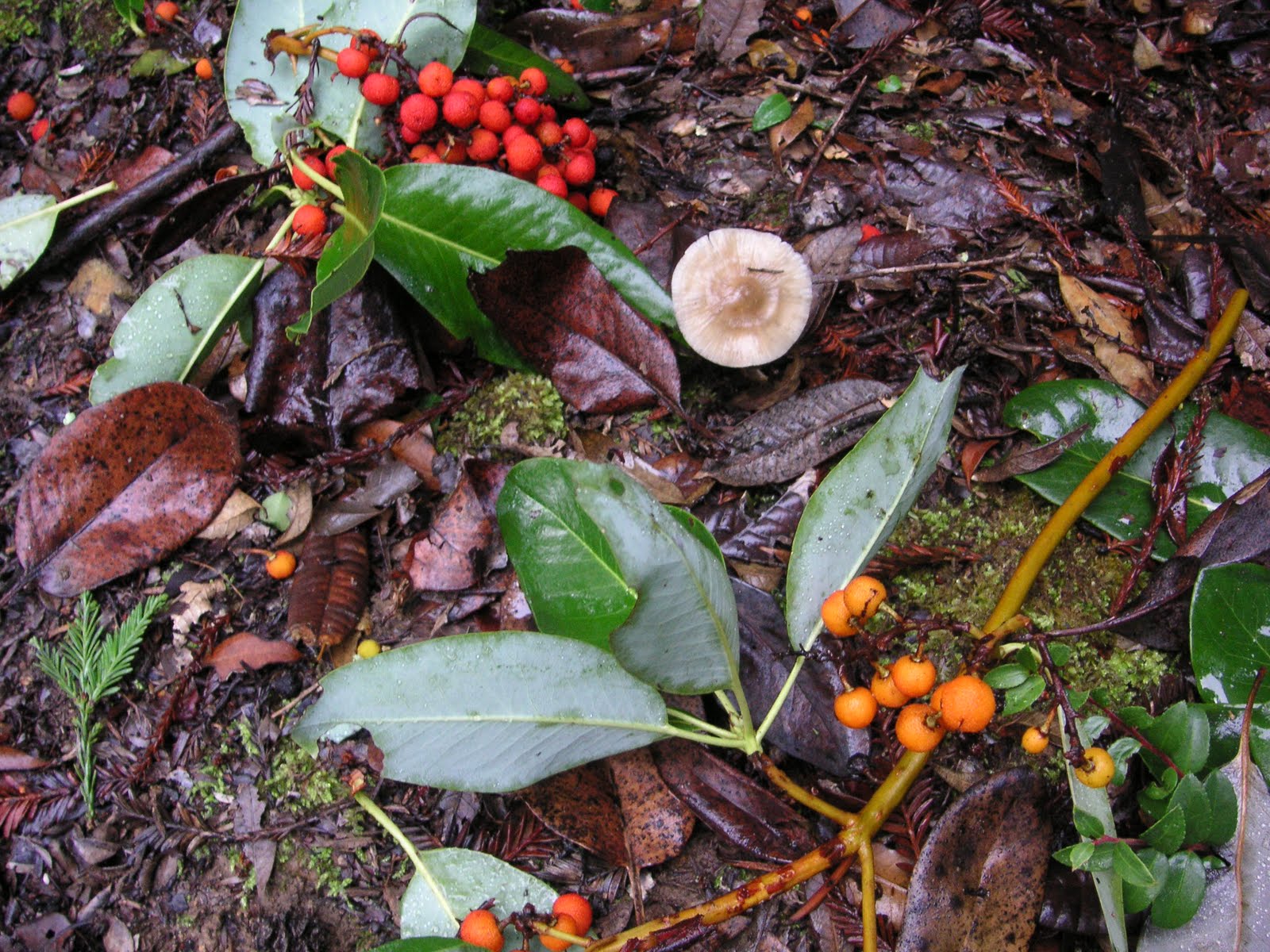
Pacific madrone
Arbutus menziesii
Ericaceae

This looks Christmas-y, right? I was amazed at how prolific the Pacific madrones were up on the mountain. Red, orange, and yellow berries were everywhere, in the trees and on the ground. I ate one just to try it out. Not too bad... it had the taste and texture of a not very sweet, ripe strawberry, but with a whole lot of seeds on the inside. I'm not going to become a madrone eating freak anytime soon, but it's good to know in case I ever need to "survive" out in the wild. Oh! There's an unidentified mushroom in the last pic, but I'll get to my numerous 'shroom pics after the holiday.

I hope everyone has a wonderful Christmas day, whether you celebrate it or not.

ps 12/24/10 - I'm not the only one who has tried the berries. See Rooted in California's foraging post. It seems many regionally local nature bloggers have noticed the profusion of madrone berries this year.

Sunday, July 25, 2010

Yadon's piperia ~ 07/25/10 ~ Manzanita Park


After 4 unsuccessful GPS coordinate attempts to find this rare orchid and finding other things instead, we finally hit pay dirt on our 5th try. The first photo above is unusually light colored compared to other Yadon's piperia that we saw this day. For a much better picture of this pale individual, check out Native Orchids on Flickr. The low growing shrub where this orchid is found is, I'm totally guessing, Hooker's manzanita and it's classified by CNPS as a 1B.2 rare, threatened, and endangered CA native.

ps 06/06/11 - As I was looking at my new labels for endangered and threatened species, I discovered Hooker's manzanita is considered endangered in the state of CA.

pss 10/23/11 - I'm going through and adding labels for endangered and threatened species for CA . I can't find this particular manzanita on the official California Department of Fish and Game's PDF list updated this month October 2011. I haven't figured out which is correct, the PDF or Elkhorn's site (embedded in the postscript above) is correct. And, I also have not figured out how to embed links to PDFs.

Sunday, June 20, 2010

strawberry tree ~ 06/20/10 ~ Rec Trail


strawberry tree
Arbutus unedo
Ericaceae

Well, color my bark red, this is a different species than our native madrones (A. menziesii) that I've seen at Los Padres Dam and Mt. Madonna County Park. This strawberry tree is very popular here in Monterey and can be found in many city-maintained areas. The fruits, which are so bright they appear to be fake, stain the sidewalks when they drop. I'm interested in how the pink flowers and orange and red fruits can all be on the same tree at the same time. It's native to Europe.

ps 12/07/11 - To see these trees in their native habitat, check out Cittaslow Botanik Park in Turkey. There they call it

Saturday, May 22, 2010

manzanitas ~ 05/22/10 ~ Fort Ord

manzanita
Arctostaphylos sp.
Ericaceae

If there was one plant that differentiated Fort Ord - BLM Creekside from my other local favorite hiking places, it would be the manzanita shrub. The last picture looks very similar to a previous manzanita posts, but what can I say, I adore the artsy look of the bare bark.

I have not been able to identify these to species, but I am now utilizing the Fort Ord plants list compiled by the CNPS. In fact, the 4 pictures above may very well be 4 different species. Here, with links to CalPhotos and CalFlora, are the species listed for Fort Ord:
~ Santa Cruz Mountains manzanita (A. crustacea ssp. crinita)
~ brittle-leaf manzanita (A. crustacea ssp. crustacea)
~ Hooker's manzanita (A. hookeri ssp. hookeri)
~ Monterey manzanita (A. montereyensis)
~ Pajaro manzanita (A. pajaroensis)
~ sandmat manzanita (A. pumila)
~ shaggy-barked manzanita (A. tomentosa ssp. tomentosa)
Can anyone give me hints as to how to differentiate between these?

Friday, June 19, 2009

manzanita
Arctostaphylos sp.
Ericaceae

This is not the exact same tree as from the May 23, 2009 hike at Fort Ord. I did find it interesting that the bark of many manzanitas had started peeling within a 4 week span.

Thursday, May 28, 2009

Pacific madrone ~ 05/28/09 ~ Los Padres Dam

Pacific madrone
Arbutus menziesii
Ericaceae

We always wondered what those small, colorful trees were that line several New Monterey streets off of Lighthouse Ave with bell-looking flowers and bright red, burry berries. It was hard to believe those landscape trees were the same as these very large beauties that grow out in the wild.

ps 06/22/10 - Well, I always try to learn something new. This wild species, A. menziesii, is native. The landscape trees in town are not and are a different species, A. unedo.

Saturday, May 23, 2009

manzanita ~ 05/23/09 ~ Fort Ord

manzanita
Arctostaphylos sp.
Ericaceae

There are at least 13 manzanitas listed on Calflora for the area. I don't think I could even begin to identify this to species.