Showing posts with label x: Fort Ord - BLM Creekside. Show all posts

Saturday, November 15, 2014

habitat ~ 11/15/14 ~ Fort Ord National Monument - Creekside

Fort Ord National Monument - Creekside entrance
November 15, 2014

It feels like forever since I've been out to Fort Ord, mainly because I've been focusing on my butterfly sites, which leaves me too exhausted to do more hiking elsewhere.  Plus, it's been unbearably dry.  Andy hasn't been trail running out here much this year, either.  We enjoyed the recent rains (last one on Thursday 11/13/14), and we were hoping to see our coastal version of early winter "spring green".  Sure enough, Creekside delivered in the form of freshly sprouted fiesta flower leaves under the oaks.  There's something so soothing and welcoming to see soft green again.  Yep, this is what November looks like here on the central coast of CA, and I'm very glad I'm not still living in the Midwest with their polar vortex

Things that caught my attention at Fort Ord...  There are a lot more people on the trails since Fort Ord became a National Monument.  They finished another parking area off Hwy 68, so there's better access.  Before it used to be primarily mountain bikers and retired folks with hiking poles; now there are more youth trail runners and families with little children.  I love their new "Play Nice" campaign, which covers horseback riders, dogs, bikers, and staying on designated trails.  I finally figured out I can use unused trailside-dispensered dog poop bags as trash pickup receptacles - the increased litter was bothering me, so I decided to do something about it.  The BLM replaced the old sign off Reservation Road, and the neighboring farmer switched from strawberry plasticulture to berry vine plasticulture.  The thought occurred to me that those plastic awnings would be the perfect cover to hide crops from DEA agents.  Eh-hem.  And, as always, there are reminders on the trails that this used to be an Army training area.

Saturday, December 7, 2013

habitat ~ 12/07/13 ~ Fort Ord - BLM Creekside

Fort Ord National Monument - Creekside entrance

We woke up around 3am to the rainstorm splattering our windows.  Yay!  This hike was pure bliss, partly because of the decent soaking everything got and partly because I haven't been out to Fort Ord in months.  While Andy ran away for 2 hours, I headed over to the old pre-Creekside parking route. The old Public Lands sign is still up, instead of the fancy new National Monument signs.  It was nice to see water in the Salinas River; I had heard a rumor that it had completely dried up. Apparently not. There were more people on the trails than I'm used to.  Andy thinks it's a combination of all the attention the National Monument designation got last year and this year yet another parking access opened along Hwy 68 next to the Toro Park housing development.  It's okay.  While I loved the complete solitude I used to find here, I'm open for sharing this pretty unique spot of land.

ps - If Pete is reading this, I looked for rain beetles since it was still early.  No luck.

ferns ~ 12/07/13 ~ Fort Ord

western bracken fern (and possibly coastal wood fern)
Pteridium aquilinum var. pubescens (and possibly Dryopteris arguta)
Dennstaedtiaceae (and possibly Dryopteridaceae)

Look how prolific the ferns were this year.  Oh my!  I haven't been out to Fort Ord since May, so this was a little bit of a surprise to me.  While I'm normally not a big fan of brown, I appreciated the subtle variation of shades from copper to rusty chocolate. Doh!  When I took these pictures, I had assumed they were all western bracken fern. However, as I was checking information, I discovered there's a similar looking coastal wood fern also reported at Fort Ord.  Even if I had gotten decent close-ups, I'm not sure I'd be able to tell them apart.  I generally try to avoid fern IDs, but they were impossible to ignore this time.

coast live oak ~ 12/07/13 ~ Fort Ord

Fagaceae

As we were driving out to the Creekside entrance on Hwy 68, I noticed most of the oaks had dead tips.  Speeding past, it looked like a deep green mosaic with scattered bits of tan.  I don't think this is sudden oak death, which is caused by a fungus-like pathogen.  I'm guessing it's caused by true fungal diseases, some of which apparently show themselves more when the oaks are drought-stressed, like this year.  I'm not quite sure how that works since fungi generally like moisture.  Right?  This looks very different from the swaths of entirely dead trees I saw last year at Toro Park, which is located right across the street of Hwy 68.  The U.S. Forest Service Pacific Southwest Research Station has an excellent technical report "A Field Guide to Insects and Diseases of California Oaks".  Maybe it's Diplodia quercina branch canker (pp. 88-89) or Cryptocline cinerescens twig blight (pp. 76-79)?  I really don't know.  I'm no tree doctor.  Half the time I can't even distinguish coast live oak from other Quercus spp.  In any case, this widespread dieback is interesting to note.

ps 03/12/14 - An intern from a local paper The Californian contacted me regarding this post.  She wants to use my pictures and information in an article she's writing.  This is the first time I've ever been contacted by a newspaper for Nature ID, so it was an interesting experience... I think for the both of us.  She was sweet but sounded a little nervous.  I gave my photos free of charge, because I didn't want the hassle of creating an invoice and dinging for payment (so many places conveniently "forget" to actually pay).  I'll link to the article once it comes out.  Cool beans.

telegraph weed ~ 12/07/13 ~ Fort Ord


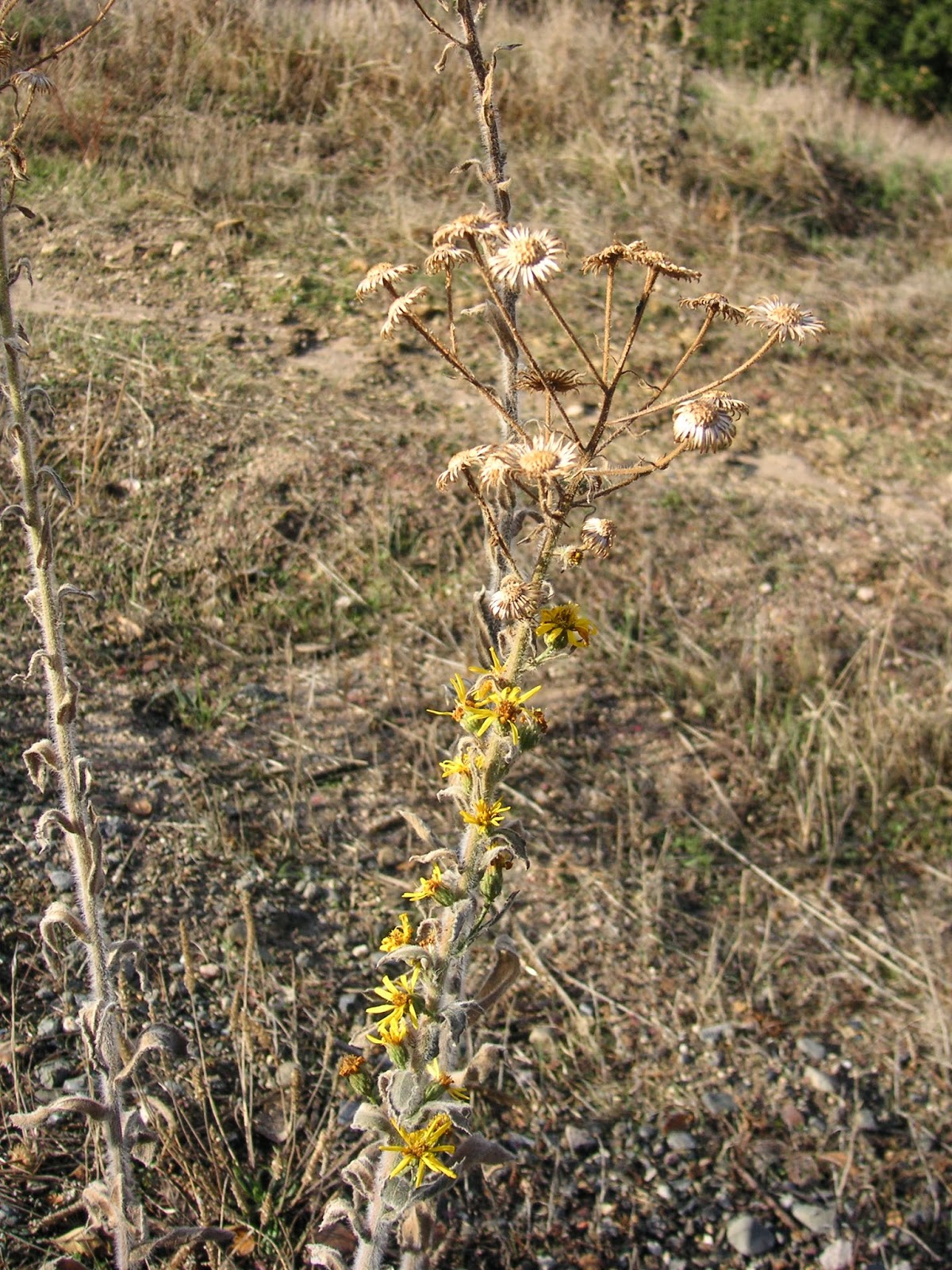
Wikipedia says this is a roadside weed.  No kidding.  In my tradition of trying to capture plants in various stages through the seasons, I came across this lovely, dried flower-looking thingie (yes, my terminology).  Thanks to an instructive set of photos by Zoya Akulova on CalPhotos, I now know those thingies are "receptacle and phyllaries after fruiting".  So, I'm wondering how to label this stage, because * fruits/seeds is not quite accurate.  Any suggestions?  While reading up, I found an excellent compilation of information at The Weed Society of Queensland, even though their descriptors like "infestation" and "unsightly" are not generally used here in its native CA.

toyon ~ 12/07/13 ~ Fort Ord

Rosaceae

I've featured toyon on Nature ID before, but I want to show how prolific and plump the berries can get, rather than the desiccated example found in February at Garland Ranch.  It could merely be what's catching my eye lately, but the toyon does seem to be going gangbusters this year.  There are splashes of red everywhere.  About 2 weeks ago I spotted a flock of cedar waxwings at one of the State Historic Parks downtown Monterey, and I'm hoping in the next few months I'll be able to photograph them systematically stripping a toyon of all its berries like I saw for the first time last winter.

pet peeves ~ 12/07/13 ~ Fort Ord

filled dog poop bag

I'm not sure this is any better than fuzzy, mold-covered, open-air poop that I used to see at Fort Ord.  Can anyone tell me why dog owners leave used poop bags on the trails?  This makes no sense to me.  The now-common dispensers at trailheads indicate these green bags are degradable.  Is that different from compostable?  I don't see how individual bags would degrade/compost properly.  Are the dog owners expecting someone else will come along, pick up all those randomly dropped filled bags, and properly compost them like they do in a State Park in Ithaca, NY?  My going assumption has been, if it's your dog, then you need to take care of it and pack it out. Erg.

ps 03/19/14 - OK, this is too funny.  Santa Cruz now has "There's No Poop Fairy" signs.

Friday, May 3, 2013

blow-wives ~ 05/03/13 ~ Fort Ord

 Asteraceae

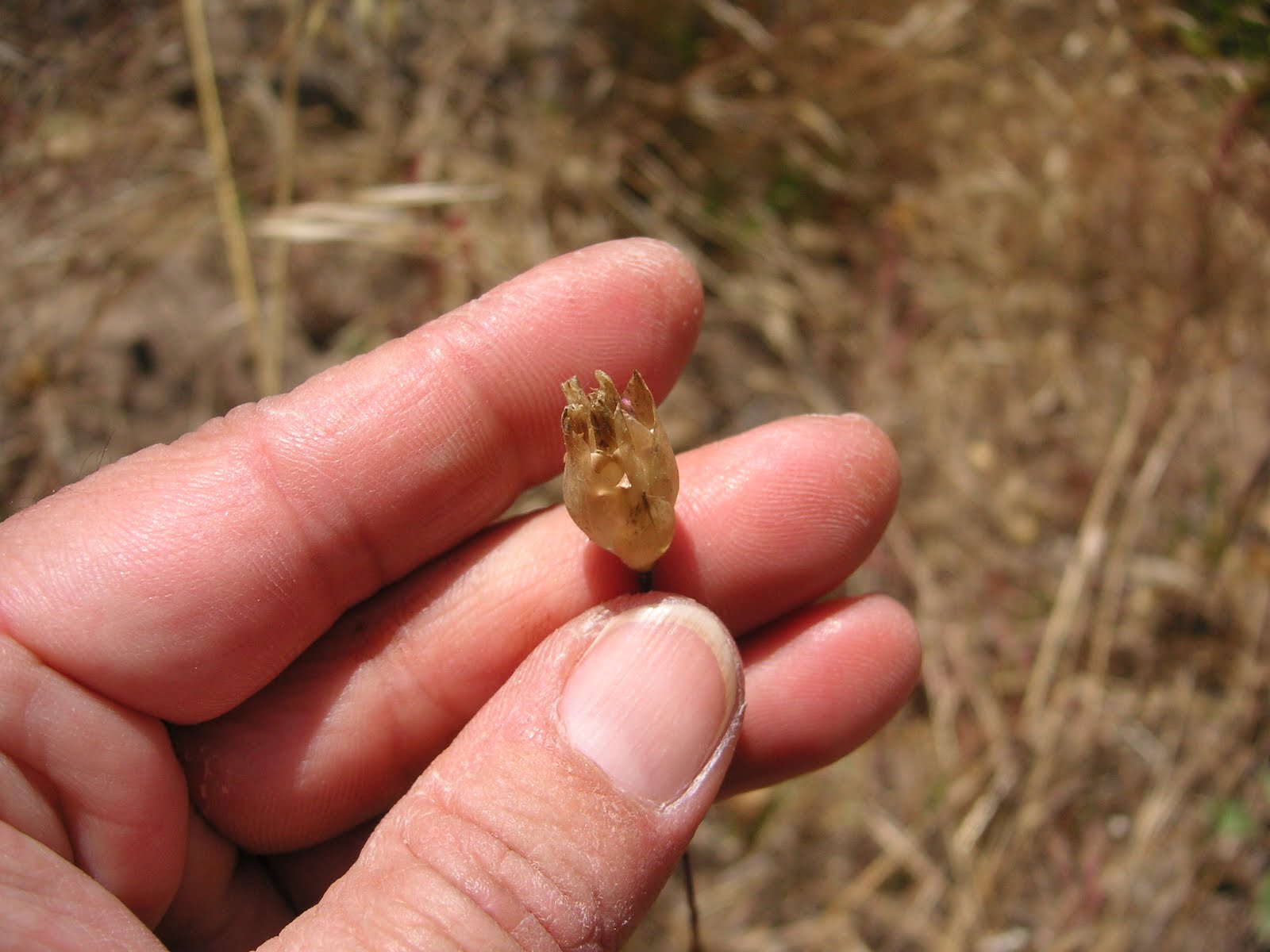
posted 05/22/13 - I've seen these before but simply had never bothered to look them up.  Look at what I've been missing.  What a peculiar common name!  I wonder what the story is, because it seems like it should be a good one.  Trying to google it returns some lewd results.  You'll notice I added the fruits/seeds label instead of the flower label. Apparently, the actual flower is a tiny yellow ray flower; it's a native version of the dandelion. I caught the flowering stage a little too late in the bottom center of the first photo. Still, cool beans.

I wanted to note this hike, because I met a local woman online and took her along with me.  She searched the internet for Yadon's piperia after seeing flags just like I did.  She found my images through flickr [I don't know what to make of their recent changes; it's flashier probably for high phone traffic.], which led to my Yadon's blog posts.  We exchanged a couple e-mails and set to meet up. Oddly enough, this is the second time I've actually had a face-to-face with someone I met online because of my Yadon's photos.  Has anyone else experienced that with a particular photo set?

ps - Here are links for later, comparing blow-wives with silverpuffs at Sierra Foothill Garden and the inaccurate picture on Wikipedia, which has unfortunately also populated iNaturalist.org and EOL.org. Editing Wikipedia is a bunch of mumbo jumbo to me, so I asked the iNat fellow to correct this in the interest of internet-kind.  Even, UCSC Natural Reserves has this incorrectly pictured.  Erg!

Monday, September 3, 2012

checkered white ~ 09/03/12 ~ Fort Ord

female checkered white (possibly western white)
female Pontia protodice (possibly Pontia occidentalis)
for more information click here and here

posted 09/18/12 - When I started Nature ID back in the spring of 2009, I simply wanted to learn more about local nature. I wasn't fully aware of the extent of challenges I would face creating a virtual collection. Sure, basing IDs solely on photographs, especially my typically crappy ones, has its limitations when experts often rely on actual collection of specimens, dissections, and scopes to distinguish species. But, I figured whatever I casually found during my hikes would be quite common and clearly represented online by people who know way more than I do. This has proven to not always be the case with some of my photographs being the first online of newly described species to the best represented of rare species to possible correction of collections from places like CalAcademy. For a new ID to me, I usually look at 3 to 20+ different sources from my own small collection of field guides, library books, and most often online, especially from reputable online ID resources I've discovered. While comparing several different sources side by side, outliers often become blatantly obvious. I hate to admit to it, but I've become something of an ID policewoman particularly on sites I know other people trust such as Wikipedia, CalPhotos, and BugGuide. In fact, I sent a correction in to a contributor to BugGuide while I was searching for this white butterfly ID.

In the embedded links in the ID under my photograph, I've linked to trusted sites Butterflies of America, Butterflies and Moths of North America (they've made vast improvements to their site in the past 3 years), and Art Shapiro's Butterfly Site. It looks to me like it's a western white based on the pattern and boldness of the markings. However for now, I'm going with a checkered white ID, because westerns have never been reported for Monterey County. As biologist and fellow blogger biobabbler has repeatedly cautioned me, I should not always rely on what other people have reported. I've sent e-mails to Paul Opler, Jim Brock, and Art Shapiro for their expert guidance. I've already heard back from Paul and Jim and will ask if I can quote them in this blog post. I have a feeling Art will have a more definitive answer for me. I'll update this post when I know more.

Btw, the Pontia I show is nectaring on telegraph weed (Heterotheca grandiflora), one of the few flowers I found blooming profusely at Fort Ord on this date.

ps 09/22/12 - Phew!  I've been in several e-mail correspondences regarding this post.  Mike Hoffman at BugGuide was surprisingly quick in getting the ID corrected, even though he's not an editor with access to move IDs.  The three experts I contacted each have authored books on butterflies (linked in their names below) and basically said the two Pontia spp. are difficult to tell apart.  Paul Opler, like me, thought it looks more like P. occidentalisJim Brock suggested I contact Art who is more familiar with butterflies in this region.

Art Shapiro ended up being a gold mine with more detail and PDFs of his scientific papers than I could fully wrap my head around (still trying to figure out how to post PDFs on my blog).  His area of extraordinary familiarity from the greater Sacramento area to the Sierras spans an impressive 40 years.  With his permission, here's what Art said, "I'm sure it's protodice. It's a very fresh, crisply-marked one, but it's still a female protodice. I've gotten nearly identical ones here and in Riverside County--and on the East Coast! Back in the 70s it was sometimes incredibly common in the Salinas Valley and nearby, and it generally peaks regionally in September. Occidentalis has never been reported reliably in the Coast Range south of the Bay, except for the two Doudoroff early-spring specimens from the Santa Cruz Mts. in the 1940s cited on p.106 of my book. (I wanted to ask him if he remembered anything about them, but he had died just a few weeks before I came upon the specimens at Berkeley!)"  M. Doudoroff actually collected these specimens in 1930, which are now housed at University of California, Berkeley's Essig Museum of Entomology and have not been catalogued yet.  Art goes on to state, "Occidentalis has indeed been expanding its range--eastward across Canada and along the US-Canada border, nowhere near here. It does show up very rarely on the floor of the Sacramento Valley (see attachments) in September-October. We don't really understand this. Monterey would be rather an incredible stretch. Nothing is impossible, of course. A P. beckeri was once caught (really) in Colusa County. I suspect the pupa came in on a camper or other vehicle..."  After some questioning on my part and an admission that I was hoping I had found a new Monterey Co. record for P. occidentalis, Art replied, "These two cause lots of confusion, and it doesn't help that where they are sympatric 1-2% may be hybrids. (Here is another old paper about their genetics. It goes back to the Miocene, before the polymerase chain reaction triggered the sequencing revolution. We probably should look at these two genomically as part of our overall hybridization research program. We're doing sulphurs right now.) The 'winter' phenotypes of both are VERY much darker beneath than the 'summer' ones and yes, it is easy to get confused with only singletons or a few specimens, rather than good series. In the 'recurrent enigma' paper, the occis are at the upper left in each group. No, that first record was not a hoax, but I had been cautioned by colleagues to refer to the possibility if only to discount it.  I have raised literally 1000s of these things in the course of research. I don't claim infallibility--only that I'm pretty good with them. Never take 'expert' stuff on faith. I've often been wrong, usually on Speyeria but hardly ever on Pontia or on skippers. But 'hardly ever' does not equal 'never.'"  Art finishes, "Butterfly people can be annoying in the same way as birders. If you can tell your Empidonax flycatchers you are up in the stratosphere with the anabolic-steroid users. Hang in there! Don't be intimidated by 'expertise.' As we age, it metamorphoses into senility."  Gotta love Art!  If anyone would like PDFs of his papers, feel free to contact me and I can forward them to you.

Monday, May 28, 2012

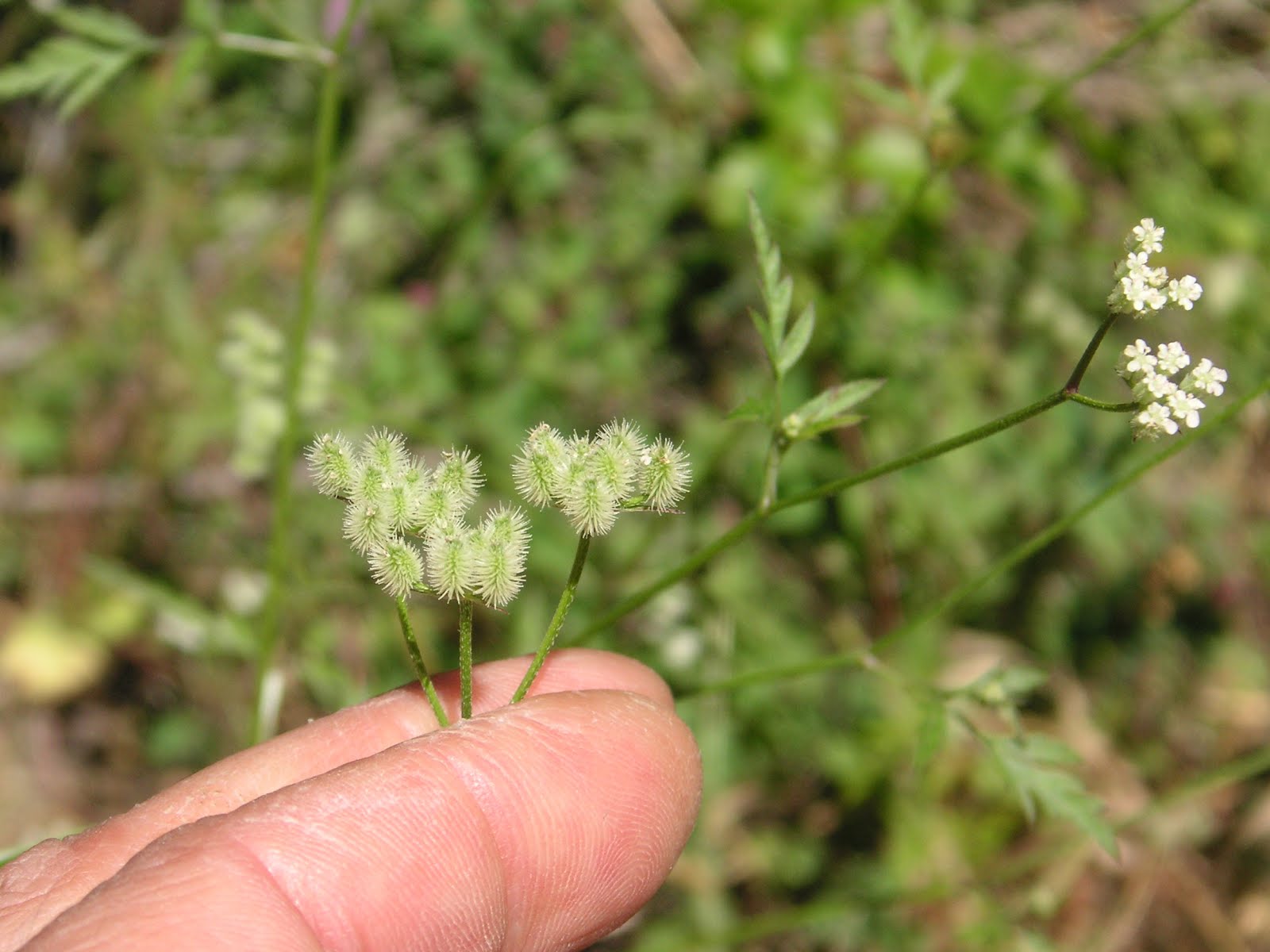
tall sock-destroyer ~ 05/28/12 ~ Fort Ord

Apiaceae

I'm loving the new common name given to this plant by Jepson eFlora. It's very apropos. To see a decent picture of why it could be called a sock-destroyer, check out this photo from CalPhotos.

After looking at numerous online photos of various hedge parsleys, I'm deciding against what David Styer suggested, even though he likely knows the plants of Fort Ord better than anyone else. He thought these were either knotted hedge parsley, aka short sock-destroyer (Torilis nodosa) or CA hedge parsley, aka false carrot (Yabea microcarpa). I compared online pictures with Jepson eFlora descriptions and decided on the tall sock-destroyer ID, because all the flowers and seeds we found here were at the terminal ends of stems (not along the stems like with T. nodosa) and with rays almost the same length (not unequal like with native Y. microcarpa). Since I needed a visual to decipher carrot family part names (like peduncle, ray, and pedicel), I found a great labeled photo of a carrot family member from UBC Biology 324 Blog.

Obviously, hedge parsleys are not the only plants with seeds that stick to fabrics like Velcro. I'm sure their real purpose is to stick to furry animals with equally annoying results to the carrier such that the seeds will be picked at repeatedly until they drop at a new location. David pointed out the similarly looking and closely related bur chervil (Anthriscus caucalis
) and how its seeds have a little pointy end.

creeping snowberry ~ 05/28/12 ~ Fort Ord

creeping snowberry / Southern California snowberry
Symphoricarpos mollis (formerly S. hesperius)
Caprifoliaceae

David Styer said he's never seen these bloom so profusely before. I believe he picked trail 49, because he thought it'd be interesting for me to see the variety of plants he found during his previous day's walk along this trail. Had he not named these pretty pink flowers for me, I would have had a difficult time IDing them. I'm still not sure if I could tell the difference between this sp. and the common snowberry (S. albus var. laevigatus). I had expected the creeping snowberry to be, well, more creeping along the ground. They were fairly short, though, maybe 18-24" tall at the most. I now wonder if my ID for the common snowberry at Garland Ranch back in November is correct. Depending on which name is accepted, various sites have different distribution information, like the USDA Plants Profile for S. mollis vs. its profile for S. hesperius.

hairy pink ~ 05/28/12 ~ Fort Ord

petrorhagia / hairy pink
Petrorhagia dubia
Caryophyllaceae

This flower has many common names. It's also known as windmill pink, which I think gets people confused since it's also known as wilding pink. For folks with hearing impairments like me, that could easily sound like windmill pink. Both Jane and David Styer pointed out the very large ovary on this flower from two different trips with each as my field guide. I think this must be important, because the MBC CNPS lists from 2010 matches David's list. However, it got changed back to childing pink (Petrorhagia prolifera) for the 2012 list. Which is correct? Or are both spp. growing in the same areas? It's unfortunate that people have taken up to calling this pink grass, which is also another common name for the 3 spp. of Petrorhagia in CA, all non-natives originating from the Mediterranean region.

Sunday, May 13, 2012

oneleaf onion ~ 05/13/12 ~ Fort Ord


oneleaf onion
Allium unifolium
Alliaceae (formerly Liliaceae)

posted 06/09/12 - I think this is one of the prettiest onions around. I particularly like the tapered shape of the filaments (structures that hold the light-yellow, pollen-bearing anthers) and the delicate pink color gradation. Because the flowers reminded me so much of superficial crosses between Triteleia, Brodiaea, and Toxicoscordion, all of which were also once placed in the lily family, I went on a futile search of Themidaceae and Melanthiaceae and totally ignored the onion-like appearance. The next time I'm crying my eyes out as I'm cutting up a cooking onion, I'll try to remember how beautiful the flowers can be.

coast dandelion ~ 05/13/12 ~ Fort Ord

Asteraceae

posted 06/09/12 - I don't have an absolutely positive ID on this dandelion, since it was not from one of my three May guided tours of Fort Ord (easy-peasy for IDs) but rather through Andy, my anywhere running cam (as one kind blog reader called him). There are 4 spp./var. of Agoseris listed for Fort Ord, which on the surface look quite similar. The tricky part is the wide, large, serrated, and deeply lobed leaves in the center of the second pic do not belong to the flowers. If you follow the stems down from the flowers, there are small clumps of thin, lobed leaves, hence how I went about this ID.

Friday, May 11, 2012

fritillary ~ 05/11/12 ~ Fort Ord

possible new to science fritillary
Fritillaria sp.
Liliaceae

Master's Student Sean Ryan from California State University, San Diego (aka San Diego State University) believes this may be an undescribed species of Fritillaria. Checker lily (Fritillaria affinis), which I've only seen once at Garland Ranch, tends to have wider leaves and is the only Fritillaria currently recorded from Fort Ord. I received Sean's permission to post these pictures online just in case it does end up being a new species. He said something about this fritillary being dispersed through bulblets, but then my notes got iffy as I was focusing more on taking pictures. Sean took the seed pod back to SDSU for study. I believe he attended this field trip since he did his undergraduate work at Cal Poly SLO and is still in contact with his former professors. I'll be curious to hear back from him with his findings.

Saturday, December 17, 2011

habitat ~ 12/17/11 ~ Fort Ord - BLM Creekside

Fort Ord Public Lands - Creekside entrance
December 17, 2011

Truth be told, we didn't actually park at the Creekside entrance for this evening hike. We used the old dirt pull-off on Reservation Rd., which we once used regularly before the BLM built a fancy parking lot with pit toilets on Creekside Terrace, shown in the 3rd photo above.

Speaking of the 3rd photo and 4th photo, that's not the pretty shimmer of water in the distance; it's the extensive plastic that farmers use to cultivate strawberries. Strawberries have been Monterey County's most valuable crop for the past 3 years. I had a friend who recently worked at a small organic farm. Even though they didn't use methyl bromide or methyl iodide, they used several hundred pounds of plastic every year. It was a huge expense for them to dump the plastic at the local waste management, but it was "better" than burning all those plastic chemicals to be released into the atmosphere, which according to my organic farmer friend so many other farmers choose to do to save on costs of dumping plastic. There seems to be something inherently wrong with plasticulture. Needless to say, I've long ago not purchased strawberries, be it cheap supermarket, on the side of the road, or expensive organic farmers' market. I believe the environmental costs are too great for such a small fruit. However, I will eat them if they're offered to me. Hmm, maybe I'll try growing strawberries in my mini-balcony greenhouse... which, guess what, is covered in reused greenhouse plastic?

Monterey manzanita ~ 12/17/11 ~ Fort Ord

best guess Monterey manzanita
best guess Arctostaphylos montereyensis
CNPS 8th Edition Inventory
Ericaceae

I believe all of our local manzanitas start blooming in the winter. The above pictured plant is the first to bloom for the season that I've noticed at Fort Ord. According to Calflora, there are 120 spp./ssp. in CA, which makes ID rather challenging. This is my best guess based on the 7 recorded spp./ssp. at Fort Ord. I'd love to hear from anyone who knows how to distinguish between the different types of manzanitas.