Showing posts with label * anniversary hike. Show all posts

Sunday, April 6, 2014

woodland star ~ 04/06/14 ~ Garland Ranch

Saxifragaceae

Thanks to Wildflowers of Garland Ranch by Michael Mitchell and Rod M. Yeager, I knew both hill star and woodland star occur here.  It's been a very handy go-to guide for local plants.  Three years ago I photographed the square-calyxed L. heterophyllum, and I've been on the search for this v-shaped L. affine ever since.  Note the pretty red stem.

ps 04/22/14 - I discovered there are other Lithophragma found in our area.  I just noticed the 3-lobed petals shown above have notches, whereas the green one I photographed at Pinnacles does not.  I don't know if that's a common variation of L. affine.  There is a possibility this is a smallflower woodland star (Lithophragma parviflorum var. parviflorum), but I don't know the difference. 

wedding tree ~ 04/06/14 ~ Garland Ranch


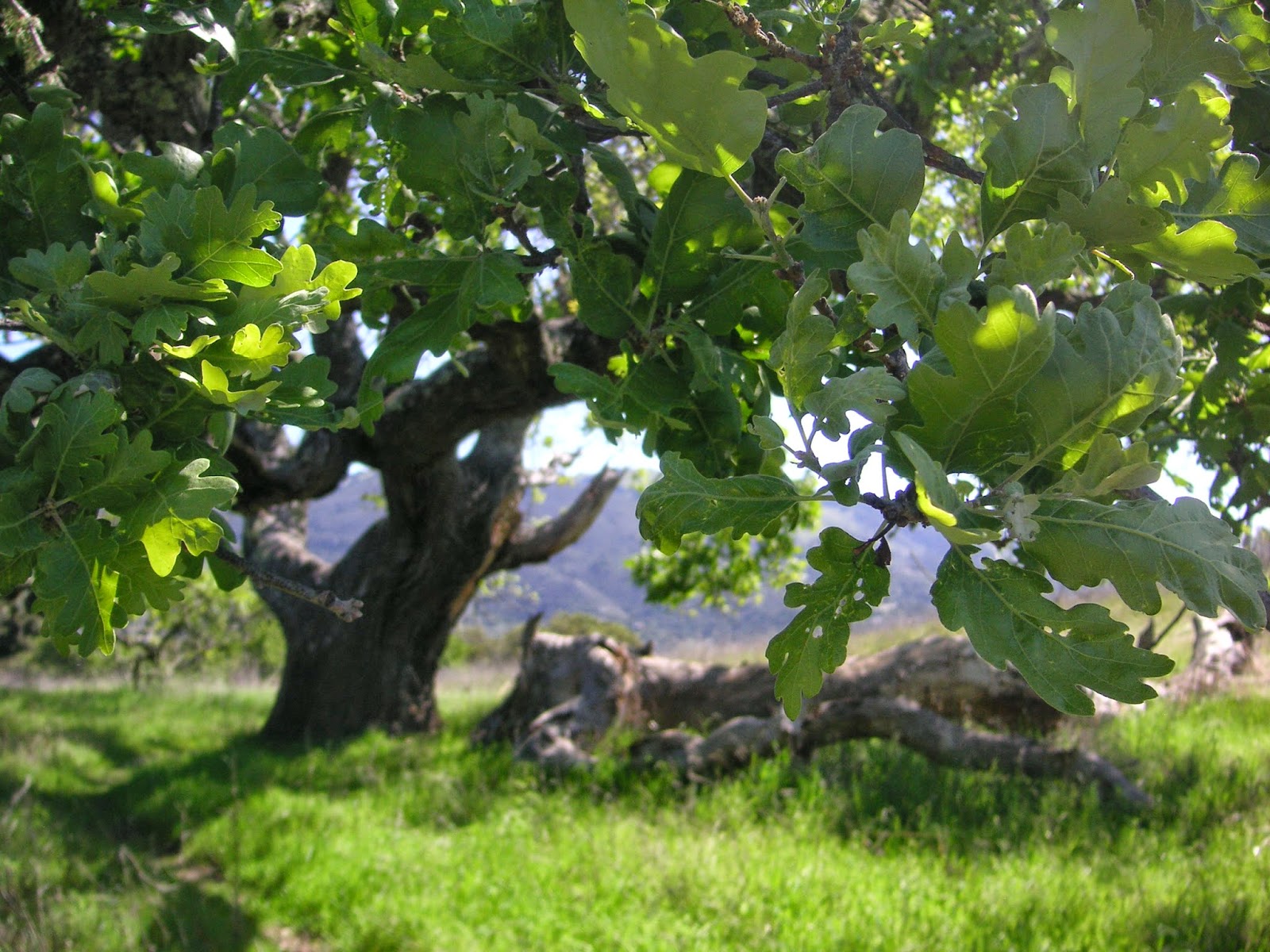
I think it's cool that Andy and I have made it a tradition to hike to our wedding tree on or around our anniversary.  It's not like we don't visit any other time of year, e.g., last November when it was dry, dry, dry or in February before the leaves come out.  It's been particularly interesting to look at my photos of this tree on an annual basis, showing variations in the timing of spring leaf-out and subtler, annual changes as the tree ages, not to mention the weather (it snowed on us in 2011!).  This year, the leaves were fairly progressed; some had already toughened up and were very shiny like typical summer leaves.  The last time it was anywhere near this leafy on our anniversary was back in 2010 when the catkins were still hanging on.  I don't know what's going on with the swath of no leaves in the last photo.  There's a patch of lace lichen there that hasn't spread much over the years, and supposedly it doesn't hurt the tree.  Also, notice how much greener the grass is in the shade of the tree versus out on the sunny hilltop?  What's that phenomena called?  It's as if mature oaks create their own personal water cache through their own shade.  Since we share this tree with other visitors to Garland, we also take note when other people leave their mark, in this case, a heart painted with... chocolate and vanilla pudding?  Cheers!

Sunday, April 7, 2013

margined white ~ 04/07/13 ~ Garland Ranch

female  margined white / grey-veined white
female Pieris marginalis venosa (aka Pieris napi venosa)

edited 05/11/13 - Phew!  After a failed quick search of my go-to favorites for butterfly IDs, I cheated and asked Dr. Art Shapiro from UC Davis.  Once you know the spring generation has dark veins and the summer generation is almost all white, this is a fairly easy butterfly to distinguish.  Then, tracking down its currently correct name is a bugger. I'm using Butterflies of America in the first scientific name link above, because they seem the most anal about names. However, Art does not believe most of the CA populations are conspecific with P. marginalis and maintains the P. napi complex (mustard whites) remains uncertain.

Years ago, I was fortunate enough to have been a museum intern and later a research assistant for Dr. Sonja Teraguchi in the first establishment years of Ohio's Long-term Monitoring of Butterflies.  My fondest memories of Ohio are from butterfly outings and workshops with Sonja, various museum volunteers, and The Ohio Lepidopterists. That experience helped create and shape Nature ID. I was aware the program was partially based on the Illinois Butterfly Monitoring Network, but until I started this blog, I didn't know Art has been doing it since 1972. As an ulterior motive for contacting Dr. Shapiro, I've been wanting to go out with him during one of his butterfly walks for the past handful of years. I've dropped the ball, repeatedly... but not this year. Now, we're tentatively set to go to his Washington site in Nevada County next Tuesday.  I'm looking forward to meeting him and learning from a butterfly master.

checker lily ~ 04/07/13 ~ Garland Ranch

 Liliaceae

posted 05/05/12 - The only time I have ever found this lily before was during our wedding tree hike in 2009.  I'm posting these photos, because they're a vast improvement from my original entry.  The checker lily is generally not considered a rare plant, but it's rare to me.  Based on this sighting, I told the president of our local CNPS chapter that I predicted this year was going to be a great flower year for our annual wildflower show.  He was more concerned with how dry some areas of the county were.  Turns out we had an unofficial species count of 715 blooming flowers, the second highest count in the 50+ years our wildflower show has been held.  And, if my memory is correct, I believe 2009 was the highest count on record with over 735 spp.  To put this into perspective, we usually have maybe 625-675 spp. in the show, and many other regional wildflower shows may have 100-400 spp. at the most.

Skilton's skink ~ 04/07/13 ~ Garland Ranch


Swoon.  Bright blue is my favorite color. The juveniles and young adults have blue tails, and when they're ready for some lovin' they turn flushy orange. They're remarkably shiny. I've seen western skinks many times before, but this was the first time I could capture a couple on camera.  I was surprised to see one retreating to a hole.  I usually don't think of lizards as being burrowing animals.

wedding tree ~ 04/07/13 ~ Garland Ranch


Hey yo, long time, no?  Has it really been almost 4 months since I last posted to Nature ID?  It's interesting how time seems to become more condensed as I get older.  No offense to anyone but I have a theory as to why elderly folk drive so slow, if an hour feels like half an hour, then going 30 miles per hour feels more like 60 miles per hour.  Whoa.  Time and the unspoken commitments we all make to each other have been looming large in my brain space lately.  I had meant for Nature ID to chronicle nature.  Now I realize it's helped me chronicle the seasons of my life... and I miss the act of recording.  Anniversary.  We did our annual hike a day early with concerns over having enough daylight after school and the possibility that I might be traveling. Imagine our surprise when we found our wedding tree trail closed for rehabilitation.  Fortunately other trails to the tree remain open for now.

Sunday, April 8, 2012

wedding tree ~ 04/08/12 ~ Garland Ranch


How often will our wedding anniversary land on Easter? While extending our regrets for leaving the Highlands shin-dig early, a sentimental fellow best known as "Boo" suggested we take Easter egg offerings for our wedding tree. That's exactly what we did! Once the kids' egg and adults' beer hunts were finished, we found cracked eggs we liked and wrapped them up for our hike up to the mesa. It was great fun selecting our own hiding spots on our tree. Notice the ant on mine? Many ants came to check it out. Andy hid his high in a nook. The vernal greenery on this deciduous oak was notably varied this year with clusters of tight buds to soft unfurled leaves. Click to see this tree on April 8 in 2006, 2008, 2009, 2010, and 2011.

ps 04/12/12 - I looked for fairy fingers and could not find them.

Friday, April 8, 2011

habitat ~ 04/08/11 ~ Garland Ranch Regional Park


posted 04/20/11 - As is my custom on Nature ID, I'm posting a final habitat entry to mark the end of this day's hike of IDs. These photos are a bit dark. Have I mentioned it snowed on us during this hike? Snow in April, or anytime, is extremely unusual around these parts. It's been an unusually wacky spring in 2011. There are other IDs I'd like to show from Garland, but I'm behind on my blog posts; I have several newer photos and places in the queue that are already more than a week old.

The last pic above is looking down on Laureles Grade and Bernardus Lodge. It's so fancy and spendy at the lodge that I've only ever been there once for a work meeting. It was very nice, but I think I would have liked it better had I been for pleasure (especially the spa), rather than business.

fringepod ~ 04/08/11 ~ Garland Ranch

best guess hairy fringepod or narrowleaf fringepod
best guess Thysanocarpus curvipes or T. laciniatus
Brassicaceae

The seed pods are quite stylish; they remind me of the 70's fashionable wallpaper that has now cycled around to be hip again. If I had to take a guess between the two species found at Garland Ranch, this would be the hairy fringepod (T. curvipes), mainly because these were found on the sandy floodplain of the Carmel River and not up on the hilly and rocky slopes. Even after looking up the keys in Jepson (its regular usage of "±" wacks me out as it's not informative at all), I still have no idea about the difference. I am uncomfortable making a positive ID.

Such as it is, I've never looked at fringepods this closely. In a similar train of thought to my past comment about how Monet and other Impressionist painters must have been myopic, I'm starting to really appreciate macro photography (not mine, but others, which show better). Eh, my new eye doc says I need "reading" glasses simply because I'm getting older. I don't have an issue wearing glasses as I've needed them to see distance ever since the 6th grade when Mrs. Harris went out of her way to notice and comment to my folks that I could not see the Five-A-Day math quiz on the chalkboard. However, I'm wondering about the quality of the new eye doc's corrective examination as I can read clearer without contacts, or glass at all, and through my old glasses from 6 years ago, all compared with this new prescription. Erga.

hill star ~ 04/08/11 ~ Garland Ranch


hill star
Lithophragma heterophyllum
Saxifragaceae

Oy! It's taken me a while to figure out which species this is as several Lithophragma flowers look exactly alike with small, white, fringy flowers on long stalks. A few years ago, I even wondered if the color of the stalk, green or red, had anything to do with the different species. Nope.

Thanks to multiple sources, there are only two species recorded for Garland Ranch, L. heterophyllum and L. affine (commonly known as woodland star; please note other species are also called this). At our recent wildflower show, a very friendly volunteer overheard my conversation with my companion as I was describing my confusion between the two. She pointed out differences in the leaves, with one being roundish and the other being deeply lobed to the point of looking spindly. I thought, "Aha!" Again, nope. As you can see from my 2nd and 3rd pictures above, there's a variety of leaf shapes found on the same plant.

However, after researching this, including looking up Jepson's descriptions, I would have assumed the plant samples were inadvertently switched, except that my pictures from the wildflower event clearly show what I now consider a more reliable distinction: L. heterophyllum has a squarish calyx base (bell-shaped or U-shaped), whereas L. affine has a tapered calyx (obconic or V-shaped).

Are you confused, yet? I am and may have to review/edit this later and make sure I got it correct.

best guess zigzag larkspur
best guess Delphinium patens ssp. patens
Ranunculaceae

Here's my heart photo (in response to a comment made by Jeannette of Bread on the Water)... The first time I heard the word Delphinium was several years ago when a good friend from college asked me to do her summer wedding flowers. I am by no means a florist, gardener, or an expert in anything botanical, but she gave me a wonderful gift of special memories. We poured over flower books for months beforehand, calling and e-mailing, picking good color combinations and shapes of flower arrangements. The day before her wedding we visited the Columbus, OH morning flower market to haul buckets and buckets of flowers home. I spent an exhausting 28 hours straight prepping and arranging roses, delphiniums, bells of Ireland, and numerous other flowers in the cool of her basement. However, she insisted on making her own wedding bouquet. After I noticed she was too busy accommodating her guests, I made a bouquet for her as a just-in-case and hid it in the fridge. She was in tears as she was desperately trying to get ready for her wedding ceremony and never got around to making her own bouquet. I said, "Never fear, my dear." Then, I showed her what I made for her all wrapped up neatly in a large satin ribbon. She burst into more tears. While I understood her appreciation, I hadn't meant to cause her more tears... plus, her eyes would be puffy for photographs. That moment was one of my favorite memories of a friend, gifts to each other of the heart. Thank you, Paula.

So, onto the ID stuff... This is my best guess. The other possibility is the Parry's Larkspur (Delphinium parryi ssp. parryi). Delphiniums are nowhere to be found on the 2006 CNPS plant list for Garland Ranch. It's thanks to my handy-dandy, brand new Wildflowers of Garland Ranch - a field guide by Michael Mitchell and Rod M. Yeager that I could even begin to narrow down the 57 species and subspecies of Delphiniums found in CA and 22 found in Monterey County alone. It's not a terribly uncommon flower at Garland as I have photos of this beautiful purple from past anniversary hikes, unfortunately not posted on Nature ID. I usually associate delphiniums with Pinnacles National Monument where some years they grow in impressive patches along the little creek. I was surprised to discover this flower is related to the buttercups.


Castilleja attenuata
Orobanchaceae (formerly Scrophulariaceae)

posted 04/16/11 - I'm very pleased with this find as I was attempting to get pictures of another flower at the time. I would have walked right past it since it's so small and inconspicuous, especially among the grasses.

I learned of this ID during a visit to our town's Good Old Days last weekend. One of the regular booths at this annual street fair is hosted by the Monterey Penninsula Regional Park District. They had a copy of the newly released book Wildflowers of Garland Ranch - a field guide by Michael Mitchell and Rod M. Yeager, which I was very excited about. Unfortunately, they were not selling the book at their stall. As it so happens, the following weekend (i.e., currently as I post this blog entry) is the 50th Annual Wildflower Show hosted at the Pacific Grove Museum of Natural History and run by a small group of dedicated volunteers from the local Monterey Bay Chapter of the California Native Plant Society. While I didn't have enough cash on me to purchase the book (no credit cards accepted), I did return later yesterday with cash in hand.

I'd like to give public kudos to Carol and Brian LeNeve, who are always so kind and informative and tirelessly do the brunt work of the wildflower show.

ps 06/01/11 - This ID of C. attenuata was confirmed by Mark Eggar on Flickr. He's a public school science teacher up in Seattle, WA, and I consider him one of the most accessible Castilleja experts around. Check out Eggar's impressive Castilleja photo collection.

black cottonwood ~ 04/08/11 ~ Garland Ranch


I usually limit my ID posts to 3 pics at the most, but I really liked these pictures of the black cottonwood. Garland Ranch is the only local place I know where if you hike in the springtime, little fluffs of cotton float around in the air. It's like a dreamy snow globe on the floodplain of the Carmel River. Little did we know that it would actually get cold and snow on us an hour later up on the Mesa.

California goldfields
Lasthenia californica
Asteraceae

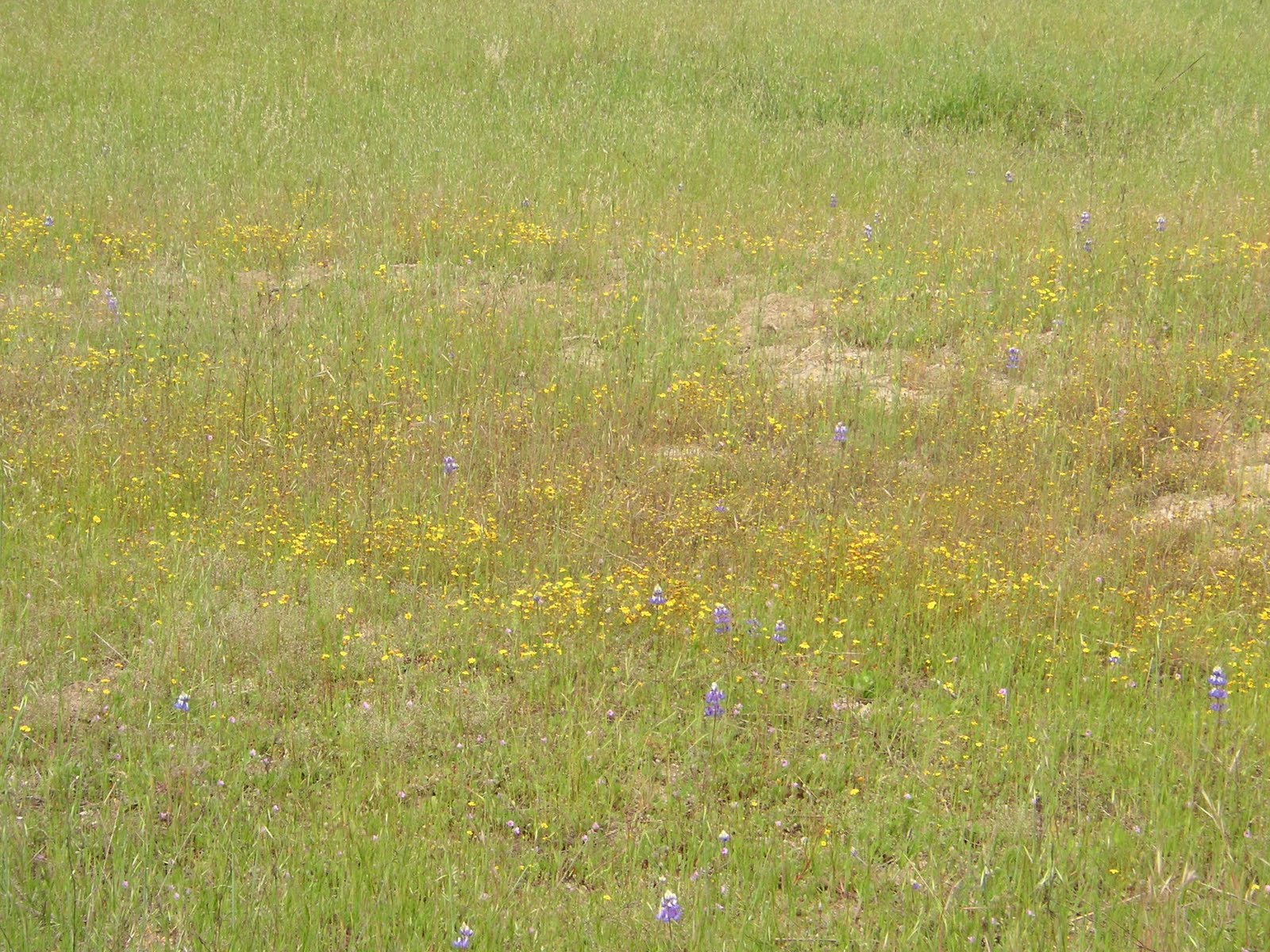
It's still a little early for an impressive showing of goldfields, but this is the closest I've been able to get a picture. If and when I see them, it's usually from a distance during our annual drive out Carmel Valley Road, pouring down hills in rivers of gold from mid to late April. The sky lupine (Lupinus nanus) is just starting to show itself (there are a handful in the second picture above). The two often bloom together here in Monterey County in great swaths of purple and gold.

ps 04/14/11 - I was wracking my brain trying to figure out where I gained the term "rivers of gold" and then it struck me that I got it from fellow blogger Chris Grinter of The Skeptical Moth. Click on his blog name to link to more illustrative photos of what these flowers can look like from a distance. He took his pictures March 27-28, 2010 in San Luis Obispo County. I've been very interested in the timing of flowers. It seems to me that much of it has to do with how far south and how far inland one is. Of course, we've had unusual weather this year with temps in the mid-70's in January and no rain for a month and a half, then snow here on the coast in March and April. I'm curious to see how the natural wildflower "shows" progress this spring.

slim solomon ~ 04/08/11 ~ Garland Ranch


OK, folks, I'm starting to get extremely irritated by all these naming changes. I thought this would be a simple post to quickly pump out this morning with perhaps a mention of the biblical reference in the common name, but, oh no, there's been a massive reclassification - not only family (x2!), but genus, species, and common names as well. Now, I'm wondering if the collective is actually talking about the same plant, since some of the photos available online do not look like each other, with one being upright and stiff and the other being loungy and relaxed (as shown in my pics above). I can understand how the official written descriptions can apply to both. Here's where I think actual photographs help clarify where words and archaic terminology can be interpreted differently. Erg. This lovely moist hillside find is often published in a variety of books as Smilacina stellata under the family Liliaceae; good luck if you can find it in an index with all its various names.

ps 07/17/11 - I edited the names and embedded links above, because even I was starting to confuse myself. For a closely related plant, see my fat Solomon post.
As an added note, the green berries of the slim Solomon have 3 dark stripes.

I was really pleased at how well this photo turned out with the little faces (click on the picture to see a larger image), considering I took only one shot in a hurry as the wind was picking up right before it began to snow. To confirm this ID, I compared this with the purple owl's-clover (C. exserta ssp. exserta), which is also present at Garland Ranch and has a hooked, hairy beak, versus the exserted stigma of C. densiflora (seems contrary to the scientific names, eh?). If I had my druthers, I'd call all owl's-clovers CA quail's-clovers due to the little "plume" (hooked, hairy, exserted, or otherwise) above the face.

ps 06/01/11 - This ID of C. densiflora var. densiflora was confirmed by Mark Eggar on Flickr. He's a public school science teacher up in Seattle, WA, and I consider him one of the most accessible Castilleja experts around. Check out Eggar's impressive Castilleja photo collection.

wedding tree ~ 04/08/11 ~ Garland Ranch

wedding tree
Fagaceae

It's amazing to me how 5 years goes by in the blink of an eye. For those new to my blog, this is the tree Andy and I married under, erm, before that huge branch broke off. We've made it a tradition to visit our tree on our anniversary. It's not always easy to schedule this hike, and Andy made extraordinary efforts this year so that he could be available. The day, like our marriage, started off warm and sunny, experienced a little stormy weather with snow during our hike, and ended sunny with a lovely dinner.

I guess I should mention that this is a California white oak (Quercus lobata). From a previous post before the leaves came out, Cindy from Dipper Ranch was correct in saying this tree is still alive. Thank you, Cindy.

ps 04/10/11 - Thank you, commenters, for your well wishes! Apologies again for those subscribed to comments for my deletion and extended reply. I figured people might want to read my answers to Cindy's questions. Also, I've found other blogs (not Dipper Ranch) sometimes delete posts or close their blogs altogether. Being a person who likes to keep records, I thought it best to "host" my recommendations.

Thursday, April 8, 2010

about habitats label


Garland Ranch Regional Park
April 8, 2010

With these scenery shots, I hope to convey in pictures (more than I can state in words) what the local Central Coast of CA is like from location to location and seasonally from year to year - labeled as habitats. Maybe as I continue with this blog and learn specific IDs, I'll feel more comfortable writing about ecology, geology, hydrology, etc...