Wednesday, September 10, 2014

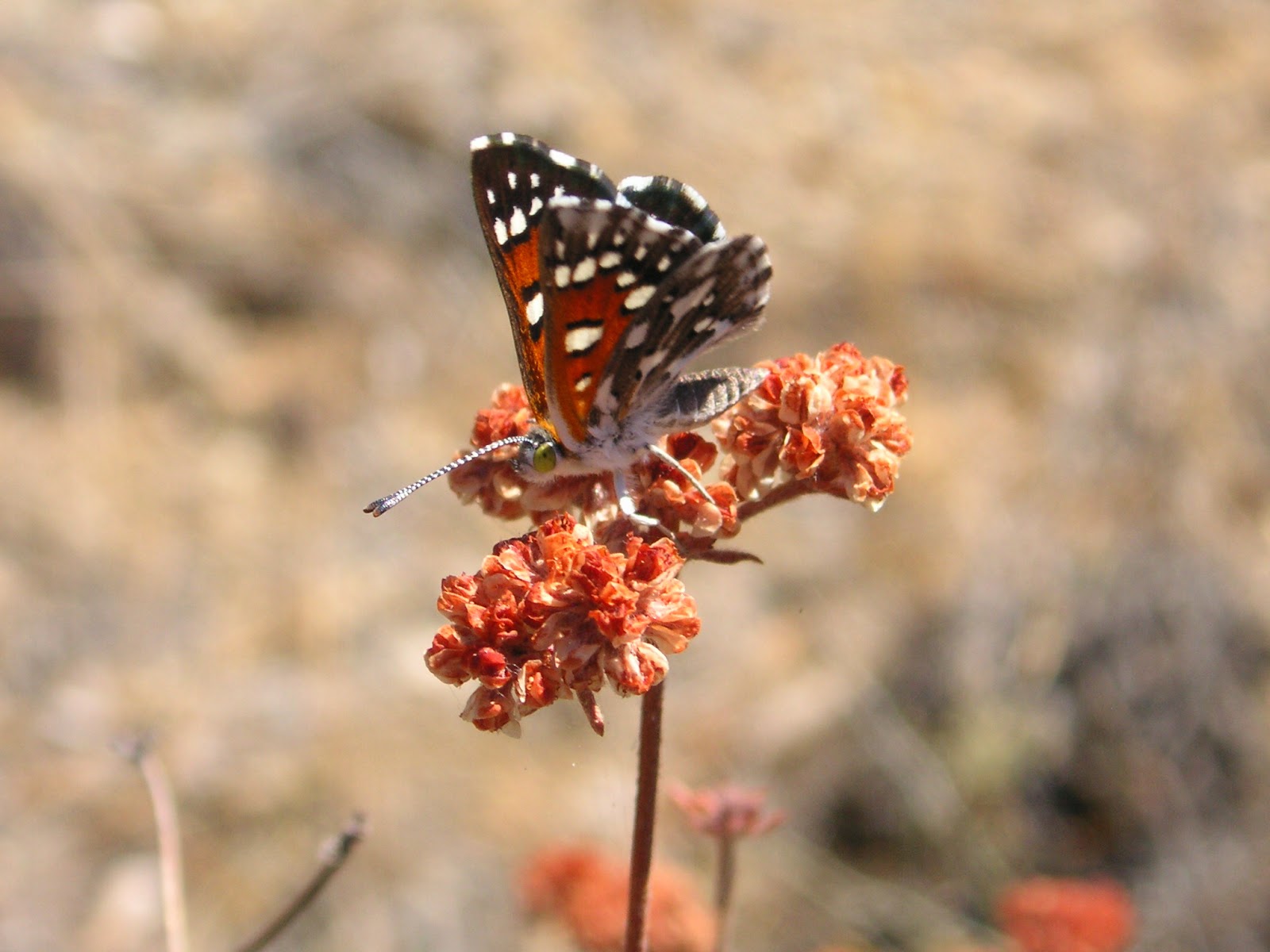
acmon blue on naked buckwheat ~ 09/10/14 ~ Podere di Farfalla

mating acmon blue (male top, browner female bottom) on naked buckwheat
mating Icaricia acmon (aka Plebejus acmon) on Eriogonum nudum var. auriculatum
Polygonaceae

I mentioned in a previous mating acmon post on seacliff buckwheat from mid-July about how host plant associations cannot be assumed.  I'm trying to do a better job at documenting the butterfly, the plant, and the activity.  Here I found them on another type of buckwheat (one that was not evident to me back in July).  I was able to get a series of mating photos that made for a surprisingly graphic gif.  Unfortunately, after succumbing to a fit of giggles, I decided other people may not appreciate my crass animal p0rn humor (or it might get stolen and put on a site I would be embarrassed to show my grandmother, if you know what I mean).  And so, it's not included on Nature ID.  However, it was eye-opening to see how butterfly sexy parts actually fit together.  I never took such a close look before.

acmon blue laying egg on naked buckwheat
Icaricia acmon laying egg on Eriogonum nudum var. auriculatum

This is the true money shot for me.  Laying an egg on an identified host plant.  Although, as I witnessed this spring, females sometimes get their host plants mixed up.  No kidding.  It's apparently how insects regularly adapt to using introduced plants.  It's evolution in action.  At the time, I was encouraged to find the egg of my unusual sighting.  Ha!  I tried, I really did.  It's very much like looking for a needle in a haystack.  Miniaturized.  What's not always obvious from photos is exactly how small all of this is.  I seriously doubt I'll be able to get a clear picture of something as tiny as an acmon egg out in the wild, on a cliff, in bright sun, and the ever-present wind.  With my relatively recent need for reading glasses, I couldn't even see what the egg here looked like after the female did her quick drop off.  I'm starting to view television nature shows in an entirely different light now and not in a good way.  Instead of oohing and awing over nature, I'm wondering how the heck they managed to film whatever it is that they did.  Seriously.  Eh, I like my easy crappy photos.  So, on to the plant...

Polygonaceae

While I already suspected which buckwheat this was, I used the plant list for Podere di Farfalla to narrow down the possibilities of buckwheats, from 256 spp./var. found in all of CA to just 6, plus 4 more from nearby Garland Ranch.  I looked at all the possibilities, and more, just to make sure it wasn't something I hadn't heard of before.

oblong leaves along lower part of stem, wavy margin, spider webby on top, 
and solidly fuzzy below
(my descriptive words, nothing to do with plant keys)

The official CNPS list for Garland Ranch shows another of the 14 var. of naked buckwheat (geez, there's a lot), sometimes called hairy flowered buckwheat or Fremont's wild buckwheat (E. nudum var. pubiflorum).  I took a close look at the few available photos online, and I think the leaves here look more like auriculatum than pubiflorum.  Leaf shape more determinate over level of fuzz on top?  It's a close call, and I could be wrong.  If anyone knows better, please tell me!

a step-back view 
(See?  Crappy.  Bright butterfly sun and waving plants in the wind do not mix.)

Thursday, September 4, 2014

Mormon metalmark ~ 09/04/14 ~ Pinnacles

Polygonaceae

Spotting a metalmark in flight out of the corner of my eye really gives the impression of a small grey butterfly, and I wondered at first if it was a blue or a copper.  However, the bright white spots are glaringly obvious once I can get a good line of sight on them.  I don't think there's anything else that looks remotely like them here.  They'll zip around the same area for a minute or two, briefly landing at different spots, before completely disappearing.  I even saw several pairs swirling in what seemed to be territorial chases, with one always quickly exiting.  I found one significantly larger metalmark, and based on published information, I'm assuming it was a female.  And therefore, I'm assuming the above smaller version is a male.  I could be wrong.

I'm thrilled to have gotten a halfway decent picture of this zippy little butterfly.  It's gorgeous (and surprisingly well-camouflaged - see below)!  I believe I saw my first metalmark two weeks ago on August 19, but I missed getting a better look as an off-duty ranger and his wife caught up with me on the trail and started a conversation.  I do much better tracking butterflies if I'm alone and without other trail travelers.  I have to laugh, because I recently overheard another hiker comment about how grouchy I was to her companion after they had passed me.  Sound really carries in the canyons.  Oh dear.

I found several Mormon metalmarks this day around separate CA buckwheat patches.  However, nude buckwheat (Eriogonum nudum) is the reported host plant for this region, so I'm not sure what it's doing on dried CA buckwheat (Eriogonum fasciculatum) flower stalks.  Certainly the nectar has all dried up.  There are a couple other buckwheats just starting to show buds in other locations, but I haven't ID'd them yet.  As a note for me later, I'm still not sure of the difference between the two reported CA buckwheat vars. in the area, polifolium or foliolosum.  I'm checking into it...

Find the Mormon metalmark among the CA buckwheat.

ps 09/10/14 - I've changed the ID above to foliolosum, even though I believe the hairier and grayer polifolium is also found in the area.

Tuesday, August 26, 2014

photo series ~ 04/08-08/26/14 ~ Pinnacles National Park - west

April 8, 2014 to August 26, 2014
Pinnacles National Park - west entrance

posted 09/02/14 - My weekly Tuesday Pinnacles practice visits have come to an end.  It's been quite a journey and an utterly unique experience that began essentially 6 months ago when I visited Pinnacles on February 25, 2014.  This vantage point from the westside parking lot doesn't highlight the seasonal changes as dramatically as some of my other photo series (posted here or in my archives), however it is the longest continuous run I have at 21 weeks.  They were not my primary purpose, but it was easy to do and I liked seeing the changes over time.  It never rained on me once in this record-breaking drought year.  I surprised my finicky self, so dedicated to this project that I even went out hiking in 105°F weather.  Good golly, that was hot, hot, hot!  Now that it's done, maybe I'll get around to backposting more of my photos?  

CA striped racer ~ 08/26/14 ~ Pinnacles


While I don't go out of my way looking for snakes, I get a thrill when I do find them.  This is only my second time knowingly spotting a striped racer; the last time was at Fort Ord over 3 years ago!  True to its name, it quickly skedaddled when I attempted to get a closer picture.  And, yes, my location label below is correct for the east side of Pinnacles.  This was the first time since camping back in 2011 that I've hiked from one side of the park to the other.  I'll admit, I'm a bit of a hiking wimp, especially in the heat on hills.  It was worth the trek.