Showing posts with label buck brushes. Show all posts

Monday, March 24, 2014

western brown elfin on ceanothus ~ 03/24/14 ~ Bass Lake

western brown elfin on ceanothus

As I was trying to get pictures of the unusual-to-me ceanothus, she flew right into focus and sat there.  No nectaring, no laying eggs.  Guess she wanted her picture taken.  So I did.

Rhamnaceae

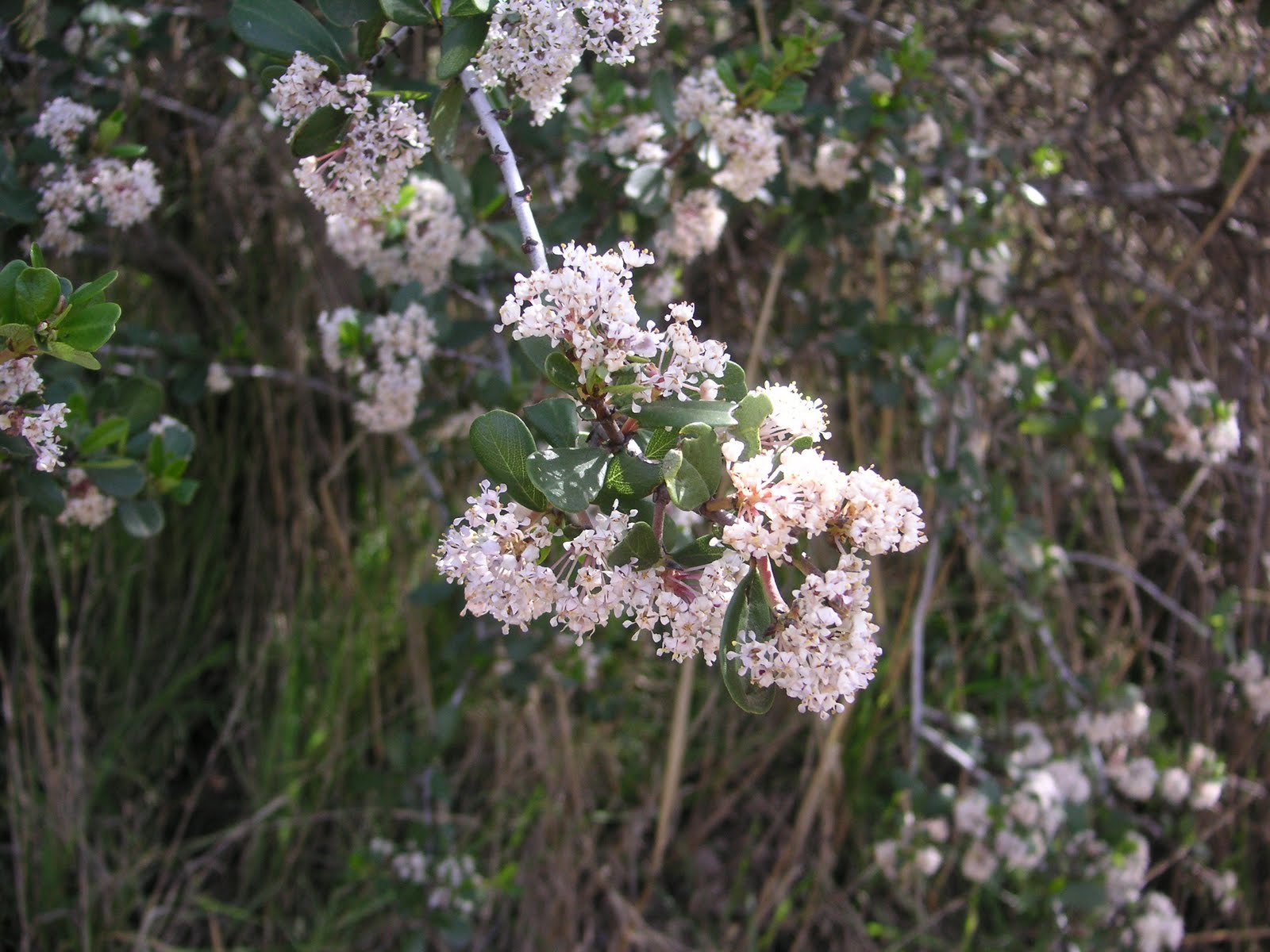
Now, back to the ceanothus.  Grrr.  I'm most familiar with the buck brush found at Pinnacles in San Benito Co., and it happens to be the last place I saw a western brown elfin.  C. cuneatus is the only sp. on their plant list, which seems odd to me considering Calflora has 82 records of native Ceanothus spp./var. (some are outdated, but still!).  At Pinnacles, the flowers are whiter, the leaves are shinier, and the stems are browner... and there's quite a bit of variation as I just noticed.  I think lots of people are confused about Ceanothus ID, myself included, and many online pictures are too inconsistent to be helpful.

OK, I'll admit, there's a part of me just wishing this to be a different sp.  I did drive over 3 hours, up the hills, suppressing awful memories of childhood car sickness every single time we visited the Sierras (ah, now I remember why I generally avoid the area like the plague).  I want to find something different, dang it!  I tried to convince myself that this is mountain whitethorn (Ceanothus cordulatus). However, it didn't particularly have any thorns, the bushes were taller than me (Jepson eFlora states C. cordulatus is generally < 1.5m), and the leaves are not 3-ribbed from base.  Anyone have a better guess?  Big bushes like these were blooming everywhere in open sunny areas.  It was really stunning.

Thursday, June 9, 2011

hedgerow hairstreak ~ 06/09/11 ~ Pinnacles


Satyrium saepium on Ceanothus cuneatus var. cuneatus
for more information click here , here, and here
Rhamnaceae

Often when I'm able to capture photos of butterflies, I get them on perches, mud-puddling, or nectaring. For whatever reason, I rarely get them on their reported host plant as shown above. I love the iridescence of the wings and the orange knobs at the end of the antennae.

Friday, March 4, 2011

buck brush ~ 03/04/11 ~ Pinnacles


buck brush
Ceanothus cuneatus var. cuneatus
Rhamnaceae

These white to lavender blooms were everywhere and smelled amazing. What a treat to be hiking through wafts of pleasant floral perfumes. However, I was surprised to see so few bees visiting the flowers. Even though it was fairly warm the day we visited, it snowed just the previous Saturday and perhaps the freezing temps affected the native bees. There are close to 400 species of bees at Pinnacles, which according to their website is "the highest known bee diversity per unit area of any place on earth." Impressive.

ps - Given the comments already posted below, I should also mention Ceanothus spp. are frequently, generically called wild lilac. Here in California, there are around 90 species and subspecies of native Ceanothus. It's no wonder I usually have such a difficult time identifying these lovely bushes. Many Ceanothus closer to home, both out in the wild and in gardens, have been blooming since mid-January this year.

Thursday, May 6, 2010

CA sister ~ 05/06/10 ~ Pinnacles

California sister perched on buck brush
Adelpha californica (formerly Adelpha bredowii) perched on Ceanothus cuneatus var. cuneatus
Rhamnaceae

Didn't I say I hope my pictures will improve in a year? And, yes, I'm using the same ol' Konica Minolta DiMAGE X50. I'm just pausing a little longer and being patient.

I often get California sisters confused with Lorquin's admiral (Limenitis lorquini) from the top view and on the wing. The way I remember it now is "Lorquin's lacks the black" margin around the orange tips. From the underside, each is very different.

Notice it appears like there are only 4 legs? There really are 6, the front two are tucked in, which is typical of the Nymphalidae family, also known as brushfoots. What I don't understand is Glassberg, p.134 says the forelegs are reduced in males. Does this mean they are not reduced in females? I can't find anything online confirming this, but I do find it interesting that most pictures online are of males.

To see a fantastic picture of the California sister caterpillar, see Butterflies of America's site.

ps 07/02/11 - I should note that buck brush is not the host plant of CA sister. This butterfly's caterpillars reportedly eat oaks. As I watched the individual above, it seemed to be territorial of a particular open air space created by the nearby stream; it repeatedly perched on the same branch of buck brush, after chasing other butterflies.

ps - 06/01/13 - I've updated the butterfly name change and embedded links.