Saturday, October 30, 2010


yellow sand verbena
Abronia latifolia
Nyctaginaceae

This is a cheery little sand dune plant. It's a welcome sight in an area overrun by the hottentot fig, an iceplant. As I was looking this up, I was surprised to find it's in the same family as the bougainvillea. I read somewhere this is the only yellow colored sand verbena; based on a search of Calflora, this looks like it might be true as the others range in color from white to pink to purple.

ps 11/04/10 - Could someone do me a favor and click on the embedded link above to Calflora? I'd like to know whether what I see as a registered user is what the public can access. Thanks!

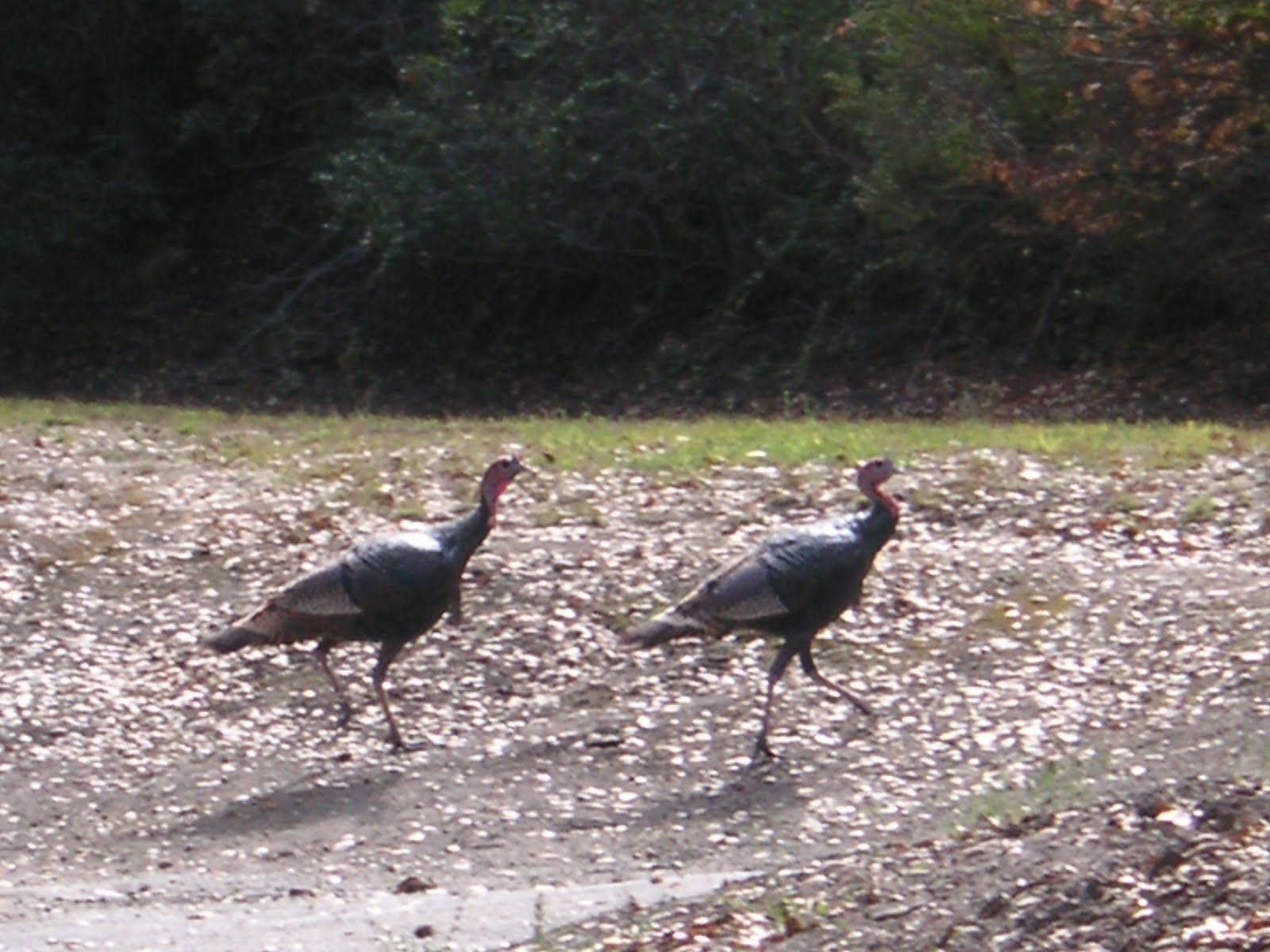
turkey ~ 10/30/10 ~ Corral de Tierra

wild turkey
Meleagris gallopavo

Are you ready for the next holiday? It always seems to be autumn before I see turkeys out and about. I'm not sure exactly why, but our local turkeys appear skinnier than most online pics. Of course, I've seen the males puff up into their trademark Thanksgiving pose, but otherwise they look kind of prehistoric. It's a bit shocking to witness these huge birds take flight. I don't have much to say about wild turkeys, except that I know the domesticated ones found frozen and wrapped in plastic at the grocery are the same species.

Warning: if you're squeamish and prefer your food sanitized in plastic, then stop reading!
Years ago I was fortunate enough to meet a college classmate who was also a commercial turkey farmer returning to school with hopes to get out of the business. He invited us to his family’s annual Wednesday-before-Thanksgiving tradition of prepping the next day’s meal. He let us take a pick of his turkeys. We chose a "small" one at a live weight of around 36 lbs. and 28 lbs. fully plucked and gutted...
Thankfully, his teenage son did the kill and spill (lots of blood). He used a baseball bat to knock it out and then a sharp knife to cut its throat. After the blood let, we dunked the body into a huge cauldron of boiling water over a wood fire, by holding onto its legs. It was heavy. I enjoyed plucking the feathers, but I was surprised at how warm the body and guts still were when I reached in to pull out the innards.
In their backyard, they had a deep, dug-out pit with a metal barrel inserted, with the top lid flush with the ground, next to the cauldron fire. I think someone added coals to the pit throughout the night to slow-cook their turkeys… and it’s no wonder! We had to keep our prepped turkey wrapped in a garbage bag outside until the next morning, since we couldn’t fit it in our fridge. I ended up squeezing it into our oven at 6am to start the roasting in time for dinner.
It was the best turkey I ever ate! I liken the freshness to just-caught fish or just-cut vegetables. I find most elaborate recipes (including brining, save for religious purposes) are designed for the sole purpose to mask the “old” flavor of long-stored/frozen meats and vegetables.
What are you eating for Thanksgiving? I think I'm going to cook ham.

tarantula ~ 10/30/10 ~ Corral de Tierra


Just in time for Halloween! This tarantula was crossing the road and of course we stopped. I'm fairly sure it's a male, because some of my numerous pictures clearly show spurs on the underside of the front "knees." As big as he seemed, his cephalothorax was not much bigger than a dime. When I touched his back legs, he'd arch his abdomen up and spread out his spinnerets. He was very camera friendly and would walk toward me when I got down on the ground to take pictures. We tried to herd him to the side of the road, but he seemed to prefer roaming around on the road... which was terribly unfortunate. As we were leaving him to his thing, he got squished by a passing car. I almost cried.

While I believe this is an Aphonopelma eutylenum, I've e-mailed Brent Hendrixson at The American Tarantula Society to confirm and will update this post when I hear back. For more photos, see my Flickr set.

ps 11/01/10 - For other regionally local tarantula sightings, check out Idora Design, Nature Visions, and Dipper Ranch.

pss 11/12/10 - Again, another tarantula post, not necessarily local, Weird Bug Lady's blog post.

pss 11/15/10 - I heard back from Brent after sending a second e-mail without a photo attachment. With his permission, here's what he said, "This is a tough group of spiders. The species belongs to what we call the "Aphonopelma eutylenum" species complex, a group of several closely related species whose identities remain elusive because they are difficult to distinguish (in fact, I think they're more than likely all the same species). I know this isn't terribly helpful, but that's where we're at with this group right now." Thank you, Dr. Hendrixson!

Thursday, October 28, 2010

black-tailed deer ~ 10/28/10 ~ at home

Columbian black-tailed deer
Odocoileus hemionus columbianus

It seems that all the fashionable nature blogs are featuring deer this fall season, so I thought I'd join in on the game.

Does and fawns are regular visitors, but this is the first time we've ever seen a full-grown buck on our side of the Monterey Peninsula, let alone in our driveway in the 4 1/2 years we've lived here. The horned fellas usually seem to stay on the ocean side around Asilomar and Del Monte Forest, where there are reports of a pet-eating mountain lion every few years. In fact, some people put up posters in their yard saying, "Go away, mountain lion!" as if the big cat could read sharpie and crayola home-made signs. OK, I live in a funny, little town.

This guy looks kind of young, no? The sun was just coming up, so my pics are a bit dark. Plus, I wasn't too eager to head down the stairs to get a closer look and collect greens for my caterpillars, as I've heard the bucks can attack women unprovoked. It's probably local lore, yet I wasn't about to take my chances.

I believe I have finally correctly ID'd this local deer down to subspecies. According to the USGS, there are 11 subspecies of Odocoileus hemionus. For a nice summary of black-tailed deer by Keith Smith, click on the scientific name above. There's much debate about names and subspecies. Mule deer seems to be a generally accepted common name for O. hemionus. I still don't quite understand the antler descriptions between the species/subspecies, but I picked pics to show off this fella's antler shape and huge ears. Interesting to note for those of you not from around here, the common North American white-tailed deer (Odocoileus virginianus) is apparently not found in California. I'd appreciate hearing if anyone knows of better information.

ps 11/21/10 - For more information on male mule deer, check out this blog post from It's Time to Live. They definitely look different than what's around here.