Showing posts with label * ant's eye view. Show all posts

Thursday, October 13, 2011

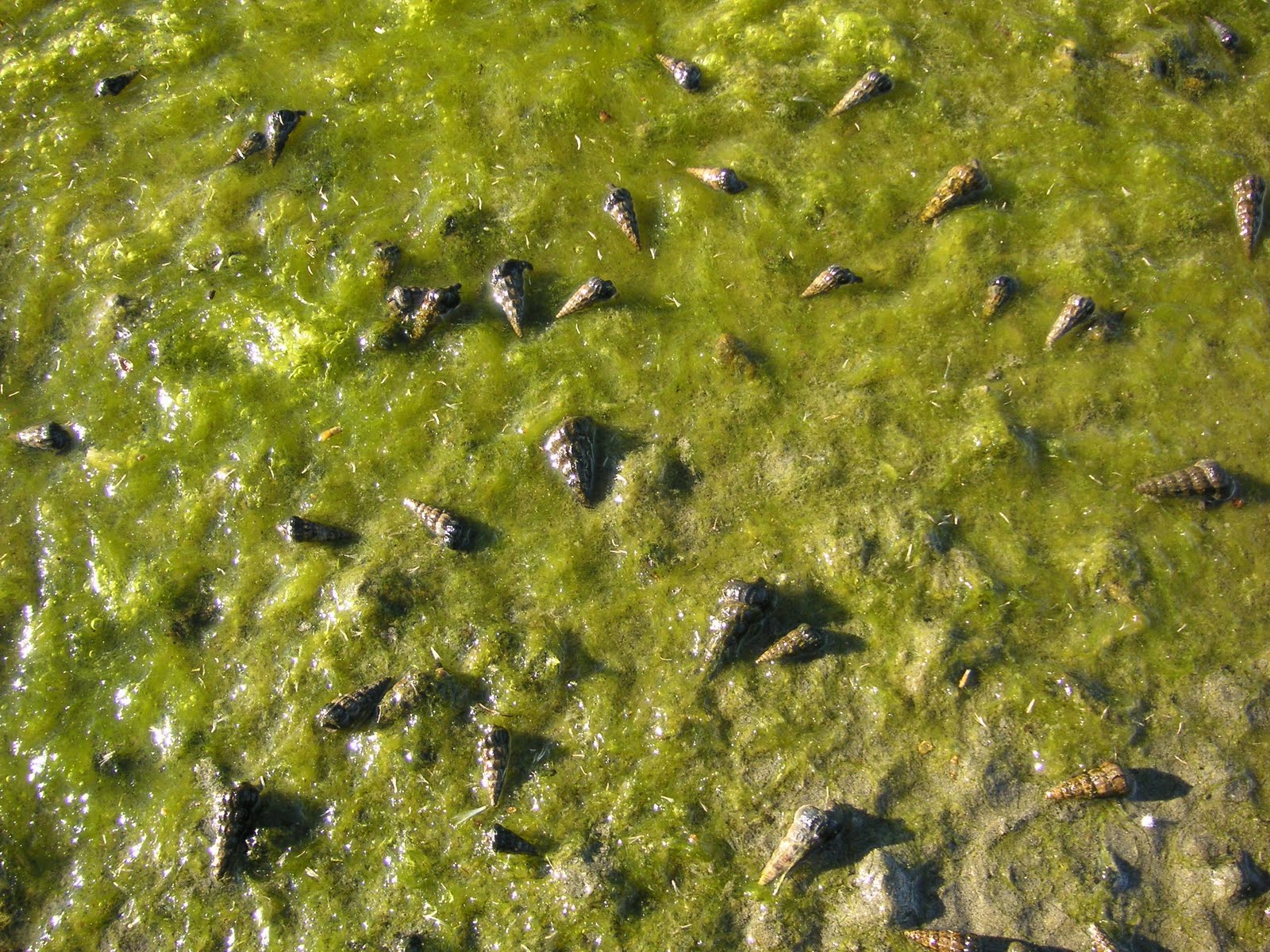
CA horn snail ~ 10/13/11 ~ Morro Bay


posted 11/03/11 - I wanted to revisit this ID with fresh pictures and conduct another online ID search. What I noticed this visit was that all the snails on the path were dead with their openings facing down in the mud. I thought this was peculiar and probably not random. For the second picture above, I turned one over and cleaned the opening to show the shape of aperture. I reached into the green gunk to take a closer look at an actual live snail. The one I'm holding is about medium sized compared to the larger empty shells.

Walla Walla University still has the best somewhat-local ID comparative description I've found under Batillaria attramentaria (one of two Japanese false cerith snails, with the other being Batillaria zonalis, if indeed it is a distinct species). Plus, this time around I noticed Conchology, Inc. has at least two errors on their Potamididae family page; Batillaria spp. belong to the Batillariidae family page. So, this got me thinking about looking at other similar looking marine snails. WoRMS is great for listing the names of other Cerithioidea families. I looked through the Natural History Museum Rotterdam's site and came up with the following families that have similar looking shells: Batillariidae, Cerithiidae, Dialidae, Potamididae, Scaliolidae, Thiaridae, and Turritellidae. I checked the EOL for the locations of some of the snails, but none are recorded anywhere near central California's coast, except C. californica and B. attramentaria. Nature's variations amaze me.

I don't often post so many pictures for a single ID, but this was a personal quest after my minor hubbub around a permissions request and withdrawal from my first post of CA horn snails. It caused me to go into major blogging existential contemplation, which I wrote about in am I doing the right thing with this blog?

Saturday, September 17, 2011

common buckeye ~ 09/17/11 ~ Wilder Ranch

common buckeye / northern buckeye
Junonia coenia grisea

Buckeye the tree or buckeye the butterfly? As with the tree, CA has a different kind than is found east of here. The CA buckeye tree is Aesculus californica and the American buckeye tree is Aesculus glabra. The buckeye butterfly found in CA is Junonia coenia grisea and elsewhere it is known as Junonia coenia coenia or other Junonia spp. entirely (according to Butterflies of America, a particularly anal-in-a-good-way butterfly site if you really, really want to know your butterfly species). As far as I know the buckeye butterfly caterpillars do not feed on buckeye trees.
Buckeye butterflies are bold-eyed, medium-sized butterflies that I often encounter sunning themselves in the middle of paths. This is my first entry on Nature ID of this familiar and easily approachable butterfly, because I regularly forget to post common finds. It was pretty easy getting a clear picture as this individual was mud-puddling near a creek. I was hoping to get a ground level shot to show its proboscis stuck in the wet goop, but it suddenly got shy and lowered its wings. Then, it had enough of its candid photo session and flew away.

ps - Cool! Google's blogspot/blogger has a new photo feature if you click on any picture. Check it out... Oh man, my photos are really going to show how poor quality they are now. In that case, never mind.

pss 09/20/11 - For more colorful posts of those other buckeye butterflies from across the continent, check out ohio birds and biodiversity or the garden-roof coop.

pss 09/23/11 - Well, that didn't last very long. Google switched back its new cool feature of gallery-like photo displays. Quite frankly, I don't care enough to check out the discussion boards as to why this was reversed.

Thursday, June 30, 2011

smooth harvester ant ~ 06/30/11 ~ Fort Ord

best guess smooth harvester ant
best guess Messor andrei

This is my best guess, seeing as how my attempt to get a close-up shot resulted in an ant's eye view and not much detail. Another possibility would be the rough harvester ant (Pogonomyrmex rugosus). These ants serve as a major food source for the coast horned lizard. While searching for information, I found these two blogs to have great information: Myremecos "North American Ants" and Wild About Ants "Objects on Harvester Ant Mounds".

Thursday, June 9, 2011

bernardino dotted blue ~ 06/09/11 ~ Pinnacles


bernardino dotted blue
Euphilotes bernardino
for more information click here and here

This little butterfly was mud-puddling with several others of its kind in a small area where water was seeping from the ground. As I was attempting to get pictures for a clear ID, I wiped my hand across my forehead to collect sweat and reached down for the butterfly to walk onto it. It stayed there for about 10 minutes with its proboscis probing around my finger as I clumsily tried to take pictures with my other hand. The result was a crappy photo of the butterfly and a lovely shot of a rock that looks like Jabba the Hutt.

Sunday, March 20, 2011


sun cup / golden egg
Camissonia ovata
Onagraceae

Sun cups were without a doubt the most numerous blooming plant I noticed during this hike at Fort Ord. While I've posted sun cups from the InterGarrison entrance before, I want to log the March date of blooming and show a diversity of photo angles. Lately, whenever I can I try to show a close-up shot or detail of some sort, a medium range shot, and a step-back shot.

Saturday, October 30, 2010

tarantula ~ 10/30/10 ~ Corral de Tierra


Just in time for Halloween! This tarantula was crossing the road and of course we stopped. I'm fairly sure it's a male, because some of my numerous pictures clearly show spurs on the underside of the front "knees." As big as he seemed, his cephalothorax was not much bigger than a dime. When I touched his back legs, he'd arch his abdomen up and spread out his spinnerets. He was very camera friendly and would walk toward me when I got down on the ground to take pictures. We tried to herd him to the side of the road, but he seemed to prefer roaming around on the road... which was terribly unfortunate. As we were leaving him to his thing, he got squished by a passing car. I almost cried.

While I believe this is an Aphonopelma eutylenum, I've e-mailed Brent Hendrixson at The American Tarantula Society to confirm and will update this post when I hear back. For more photos, see my Flickr set.

ps 11/01/10 - For other regionally local tarantula sightings, check out Idora Design, Nature Visions, and Dipper Ranch.

pss 11/12/10 - Again, another tarantula post, not necessarily local, Weird Bug Lady's blog post.

pss 11/15/10 - I heard back from Brent after sending a second e-mail without a photo attachment. With his permission, here's what he said, "This is a tough group of spiders. The species belongs to what we call the "Aphonopelma eutylenum" species complex, a group of several closely related species whose identities remain elusive because they are difficult to distinguish (in fact, I think they're more than likely all the same species). I know this isn't terribly helpful, but that's where we're at with this group right now." Thank you, Dr. Hendrixson!

Thursday, May 6, 2010

armored darkling beetle
Eleodes armatus
Tenebrionidae

Let's everyone stand on their heads! Okay, I give in, there's a link to BugGuide.net above. It's surprisingly difficult to find online information of CA beetles. I added a link to the CA Beetle Project under recommended ID links. So, is it E. armatus or E. armata? I'm not absolutely positive this is an E. armatus, because its elytra were incredibly smooth without dimples. I need to start carrying around a little ruler to measure these suckers.

I was so proud of my photo and the different camera angle... until I found several hundred online just like it. Growing up in the Central Valley, I often poked and prodded a larger and less tapered-butt Eleodes. They're fun beetles. Touch them and they do a headstand for you. I am apparently fortunate enough to have never experienced the noxious spray of the stink beetle. Haha, I've actually poked many stink beetles hoping to witness this reported spray, but I've never seen it.

ps - I've been putting off posting additional pics of beetles until I got the Field Guide to Beetles of California. In all honesty, it's not what I had hoped it'd be for a field guide; it reads more like a textbook summary for people who're already familiar with the beetles in question. Yet, it's the best CA beetle book I've found, so I'm keeping it. Maybe with time I'll become more comfortable using it and will appreciate all the information. With so many beetles everywhere, I can see why there are so few ID books.