Friday, March 4, 2011

lichen and moss ~ 03/04/11 ~ Pinnacles


Oooh, look at the pretty rocks! That's the best ID you're going to get out of me. I thought I'd try my hand at lichen ID this morning (posted 03/12/11). Ha! No way, José! If anyone can tell me the visual difference between Caloplaca ignea and Xanthoria elegans, please, please comment. There are an estimated 300+ species of lichens at Pinnacles. In the second photo above, I count at least 6 different kinds of lichen in about one square meter of rock. Seriously, who took the time to inventory all the lichen? If you're interested in lichen, I recommend these two great lichen sites: Lichens of North America (thanks to Ted at Beetles in the Bush from a comment made on Squirrel's View) and The California Lichen Society.

ps 09/08/11 - Thanks to help on my Flickr photo, the moss shown above may not actually be moss, but spike-moss, a totally different kind of plant. Who knew?


Here's one shrub that if it weren't blooming, I'd have no idea what it is based on the leaves. I think I've mentioned before that I generally ignore bushes. Maybe I've gotten used to seeing shrubs pruned to an inch of their life and not looking very natural in gardens and public spaces. They generally don't excite me. However, it is fun to see the bright yellow of this bush poppy on hillsides.

ps - For those who follow my blog through readers, you may have noticed an odd testing post yesterday. I'm trying to figure out a better way to manage my numerous labels. It used to be fairly easy when I only had 4 label groups: flowers, insects, birds, and location labels. I want to easily find past posts of specific groups, like poppies, without having to scroll down from here to eternity in the widgets on the right side of this blog, or having to continually, manually maintain the lists. I've found google's search widget to not be very effective for my own blog or other blogs. Right now I have 4 groups of lists for plants: ferns, flowers (garden flowers, native wildflowers, and non-native wildflowers), plant families, and trees & shrubs. I don't particularly like the idea of adding additional pages to the top of my blog, because personally I rarely click on those unless it's an "about." Does anyone have any ideas?

pss 07/21/11 - I've changed labels around for plants. To see lists of all plant labels see plant families and plants.

bordered plant bug
Largus californicus

We saw quite a few of these true bugs in the middle of the Juniper Canyon, Tunnel, and High Peaks trails. Usually, we spotted them on or near seedy scat. The second picture above was of two that seemed to be fighting over the remains of a spider. It was fascinating to watch as one would chase the other away and quickly return to its capture.

This didn't make sense to me since they supposedly feed on lupine, hence the name plant bug. I found an online abstract written by Carey L. Booth that mentions they will supplement their diet with feces and carrion. So, a question remains for me, if you have a piercing-sucking mouth part, as all true bugs do, how do you eat dried feces and carrion? In any case, for whatever reason, it's always reassuring when my own observations mesh with what's published.

Click on the common name above and scroll down the page to see some cool pictures of the unusual looking nymphs and last instar molt. While University of California, Irvine is quite a bit south from us in Orange County, I've really enjoyed Dr. Peter Bryant's Arthropod web pages as a reliable resource for this blog.

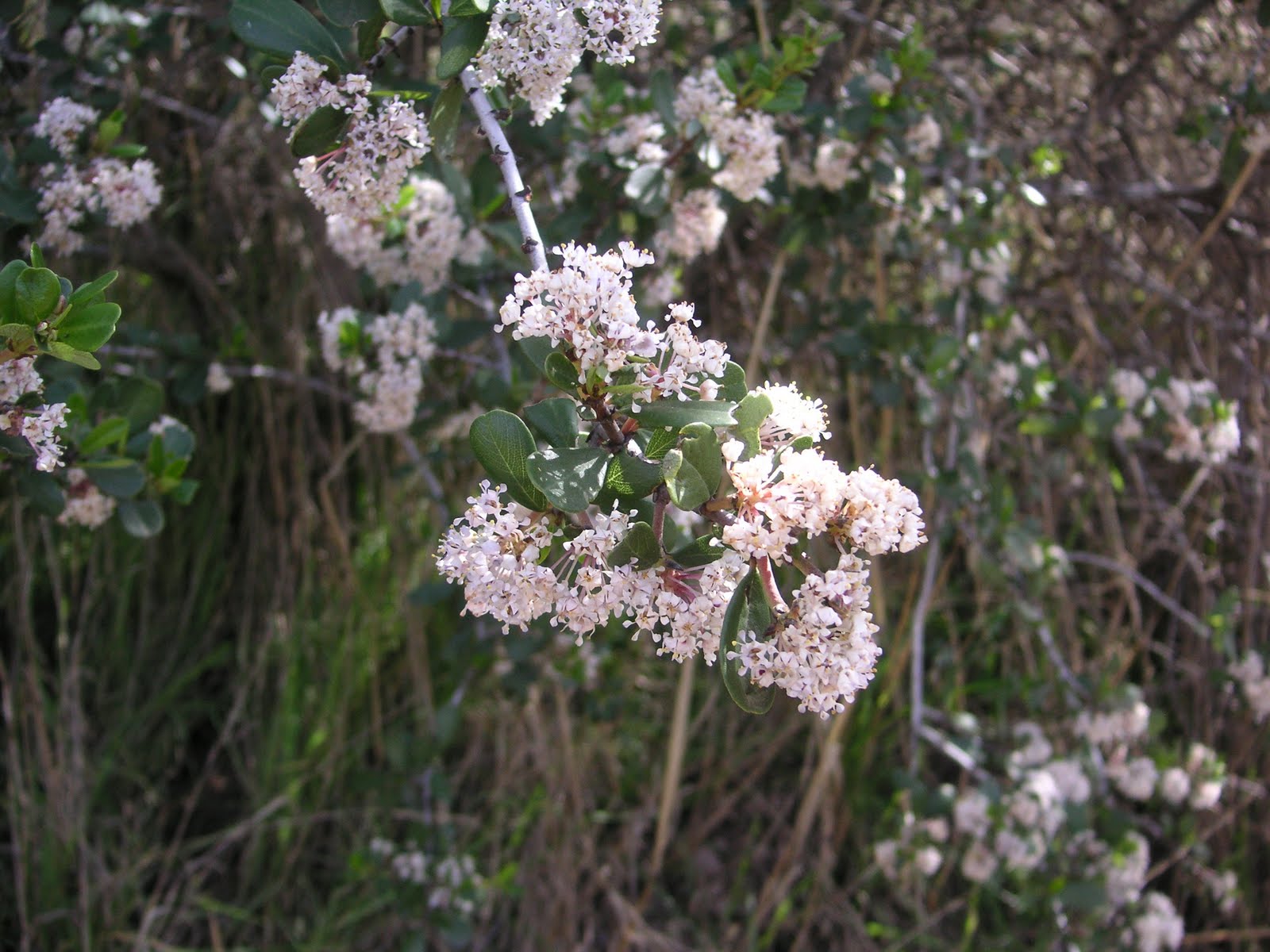
buck brush ~ 03/04/11 ~ Pinnacles


buck brush
Ceanothus cuneatus var. cuneatus
Rhamnaceae

These white to lavender blooms were everywhere and smelled amazing. What a treat to be hiking through wafts of pleasant floral perfumes. However, I was surprised to see so few bees visiting the flowers. Even though it was fairly warm the day we visited, it snowed just the previous Saturday and perhaps the freezing temps affected the native bees. There are close to 400 species of bees at Pinnacles, which according to their website is "the highest known bee diversity per unit area of any place on earth." Impressive.

ps - Given the comments already posted below, I should also mention Ceanothus spp. are frequently, generically called wild lilac. Here in California, there are around 90 species and subspecies of native Ceanothus. It's no wonder I usually have such a difficult time identifying these lovely bushes. Many Ceanothus closer to home, both out in the wild and in gardens, have been blooming since mid-January this year.