Showing posts with label lungless salamander family. Show all posts

Monday, March 10, 2014

arboreal salamander ~ 03/10/14 ~ Midpen Preserve


I should note that we did not happen across this arboreal salamander resting on top of the log as pictured. I think Ken found it under some bark, but that makes it difficult to photograph. Normally, I don't go actively hunting for herps, but I'm also not documenting spp. for a preserve. This individual is not as spotty as the one-eyed arboreal salamander Andy found near home 4 years ago. I can't believe how gushy I was with my first find.  I think I appreciate the random encounters a little more, but this was definitely eye-opening as to how much is hidden just out of sight.

Monday, March 3, 2014

CA slender salamander ~ 03/03/14 ~ Purisima Creek


Cutie.  This is a fairly small salamander, thinner than the width of a pencil.  It looks pretty much like the Santa Lucia Mountains slender salamander (B. luciae) that I found April 29, 2012 as I was digging around at home.  Well, okay, this one is not covered in dirt and has a longer tail.  Field markings are almost no help for several look-alikes, because they appear to have just as much variation within as between spp.  Thanks to the expert ID I received from Gary Nafis @ California Herps and John Sullivan @ Wild Herps for my B. luciae, I understand the currently acceptable way to distinguish slender salamanders is to pinpoint location found.  Here's a map of Batrachoseps spp. distribution.  It doesn't seem very intuitive, but whatever, I'll go with it.  I kinda wish I had retaken molecular genetics back when I transferred to a larger (read: better funded) university, because I might have appreciated what the PCR craze is all about.  As it is, the statistical models, like Tajima’s D and Fu’s Fs, sound like rap names to me.  Eh, I guess I'm getting old and staid.

Sunday, April 29, 2012

Santa Lucia Mountains slender salamander ~ 04/29/12 ~ at home

Santa Lucia Mountains slender salamander
Batrachoseps luciae
(map of distribution)
Plethodontidae

I ran out of potting soil, my compost isn't ready, and my favorite commercial soil mix is out of stock for a week. Sigh. So, I decided to pull out some of the prolific Vinca major under the douglas-fir and collect what turned out to be very rich soil. As I was sifting the soil for rocks and debris, I found what I figured was an earthworm. "Oh, good!", I thought, because I've been adding earthworms to my largest container with nasturtiums. Hmm... but hey, this little one has short legs and the cutest toes that put me over the edge of aww!

Oh man, I have had such a difficult time figuring out which species this slender salamander is. According to different sources, in CA there are anywhere from 19, 20, to 21 species of Batrachoseps. AmphibiaWeb shows an old map of relictual slender salamander (B. relictus) as being in this area; whereas California Herps shows both Gabilan Mountains slender salamander (B. gavilanensis with map) and Santa Lucia Mountains slender salamander (B. luciae). However, I wonder if it might be a California slender salamander (B. attenuatus with more information). I'm sending e-mails to some experts to help me, but if you know, please comment. Don Roberson of Creagus has an excellent site on slender salamanders.

ps 05/04/12 - I heard back from Gary at California Herps; he's continually creating the best CA herp site I've found. With his permission, here's what he said, "Fortunately there is only one species of slender salamander in that area [at my home] - the Santa Lucia Mountains Slender Salamander. Since all of the species look the same, you need to go by the range in order to identify most slender salamanders. Old books call it the relictual slender salamander, but that name was changed around 10 years ago. The Gabilan Mountains Slender Salamander does get up to Monterey Bay, but only north of the Monterey peninsula up near the Elkhorn Slough area. The California slender salamander is found north of there. You are welcome to quote me, but I wouldn't call myself an expert." Ha! Thank you very much, Mr. Nafis, aka Mr. Herp King.

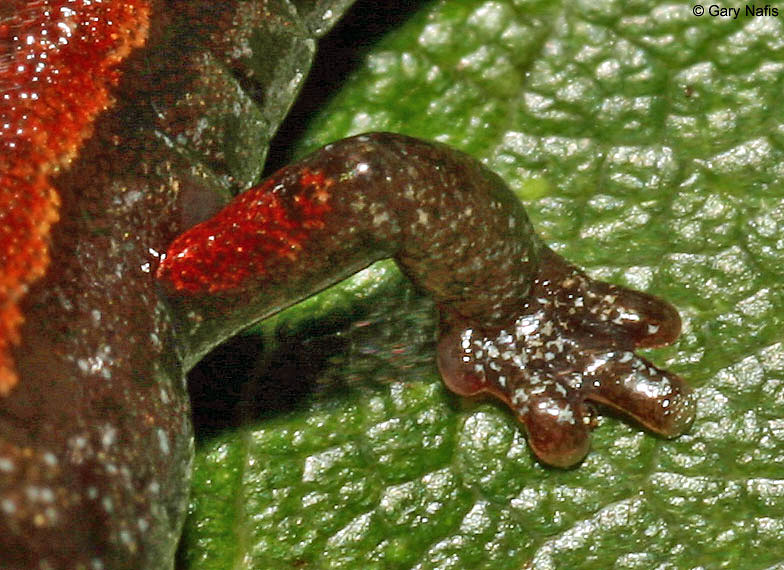
Oh, I want to mention that I believe Batrachoseps spp. are the only genus of salamanders with 4 toes on their hind feet; all other salamanders have 5 toes on their hind feet along with the always 4 front toes. Cool!  Right?

pss 05/07/12 - I also heard back from John at Wild Herps. I forgot to provide him specific location information. With his permission, here's what he said, "Your salamander is a Batrachoseps (slender salamander) species. Exactly which Batrachoseps species can probably be determined only by where you found it, as there are a bunch of nearly identical species in California. If it was in Monterey or Pacific Grove then it would be Batrachoseps luciae. Check out the range maps at <http://californiaherps.com/salamanders/salamandersmaps.html>." Thank you, John! Hope your trip was amazing.

pss 06/05/12 - I found another slender salamander in soil I had collected several weeks ago in a bucket and just now got around to sifting through it. It looked different than the one above by not having the reddish back. I wonder if there are loads of slender salamanders hidden among the Vinca major.

Tuesday, December 21, 2010

yellow-eyed Ensatina ~ 12/21/10 ~ Mt. Madonna

Plethodontidae

posted 12/31/10 - For my last post made in 2010, I really wanted to have something with a face. Seeing a salamander out in the wild was one of my goals this year and voilĂ ! Actually, Andy found this salamander after he rolled over a log and called me over to take pictures - gotta love the fella for supporting me in my quirky nature obsession. For more information on this very cool Ensatina with yellow spots in the top half of its eyes, make sure to click on the embedded links above.

I was amazed at the color and diversity we found during our hikes in the rain and at the end of December. And to think, I almost canceled our reservations to "camp" in a yurt on Mt. Madonna due to fierce winter storm forecasts. It was a bit cold and very wet, but we had an incredible time. Sometimes you just have to go for the experience and hope for the best.

Wishing all my blog readers the best for 2011. May it be a new year filled with love, laughter, and the making of fond memories!

ps 01/06/11 - For a much more informative blog post than mine, check out Curbstone Valley Farm.

ps 03/16/14 - I edited the text, because now I know this was not a newt, rather a lungless salamander in the Plethodontidae family.


Sunday, February 21, 2010

arboreal salamander ~ 02/21/10 ~ Pacific Grove


arboreal salamander
Aneides lugubris
more information
Plethodontidae


My husband came home from an evening walk and announced he saw what might have been a dead lizard, newt, or salamander on the corner. I tossed on my shoes and ran back out with him to see what he found in the dark.

I was happy to discover this live salamander! My pictures were a bit fuzzy, so I brought him home to take a closer look. The salamander was surprisingly quick and agile.

I'm not 100% positive about my ID here, especially considering that before we looked it up online, I was trying to remember back to my basic biology class in college - something about 4 or 5 toes (lizards, btw!) and what was the difference between newts and salamanders. Haha! I did find this great herp site and from a fellow Pacific Grove resident to boot!

I fell in love with his sets of four moist toes and briefly considered keeping him as a pet. After repeatedly exclaiming how cute he was, even with his missing eye, we let him loose in the park below our balcony by the big oak tree instead of back on the street corner. I likened it to being picked up by a giant and plopped down in Nevada, but I figured he'd be much safer away from cars and evening dog walkers.

May you live long, my cute, one-eyed arboreal salamander!

ps 03/30/14 - After looking at my pictures of another arboreal salamander, I think the toe count is supposed to be 4 in the front and 5 in the back.  This individual is missing more than an eye, as its toe count is off.  I believe the slender salamanders (Batrachoseps spp.) are the only group with a max of 4 toes in the back.  Right?