Showing posts with label x: Mt. Madonna County Park. Show all posts

Thursday, July 19, 2012

fallow deer ~ 07/19/12 ~ Mt. Madonna


Hey, I thought these deer were separated to prevent breeding. The perimeter fencing is impossibly tall topped with electric wires to keep mountain lions out, but the gate separating the males from the females is not as tall and potentially jumpable. We only spotted one male's large horns in the distance, but in the past we've seen at least a couple young males. I wonder if the County Parks moves males around to keep the herd going for display. These two fawns were not twins and followed different mothers.

royal rein orchid ~ 07/19/12 ~ Mt. Madonna


If I hadn't wanted to take a break in the shade while hiking back up the mountain, I doubt we would have spotted this diminutive 8 inch tall orchid. This was the only individual we found during our entire camping trip, even though it's the time of year for other rein orchids to start blooming. While looking at other Piperia for this ID, I realized I may have made a couple errors in past posts and am waiting to hear back from an expert. The face and long spur look somewhat similar to elegant rein orchid (P. elegans) or dense flowered rein orchid (P. elongata) to me, but the spur is definitely transverse/flat/perpendicular to the axis of the stem versus pointing downward.

Wednesday, July 18, 2012

tanbark oak ~ 07/18/12 ~ Mt. Madonna

posted 08/03/12 - When we last camped at Mt. Madonna in December 2010 I noticed great swaths of tanbark oaks had been recently chopped down. At the time I wasn't positive about the ID of this tree, nor did I hazard a guess as to why so many of these trees had been cut. Thanks to Randy at Way Points I learned more about Sudden Oak Death, which can affect tanbark oaks and Quercus spp. I suspected the clearing had to do with this disease, but I was wrong. As I looked into Santa Clara County Parks for this blog post, I discovered their best management practices included monitoring for pathogens such as Armillaria oak root rot fungi and others. What? It never occurred to me that mushrooms could kill trees. Clustered fruits, such as honey mushrooms (Armillaria mellea), may indicate the presence of deadly diseases. I now wonder about the ID of the possible sulfur tufts I found. Hmm, always learning something new.

Friday, February 3, 2012

habitat ~ 02/03/12 ~ Mt. Madonna County Park

Mount Madonna County Park
February 3, 2012

This was an unusual hike in that I rarely go out looking for a specific flower. The last time I did this was July 19, 2010 and July 25, 2010 when we went on hunts for the federally endangered Yadon's piperia. See my fetid adder's tongue post for the cool lily that brought us out to this remote spot at Mt. Madonna.

I wanted redwoods. Andy is much better at maps and GPS coordinates than I am since he's an avid trail runner. We initially hiked up the Ridge Rd. trail because of the Calflora report. There were plenty of oaks and CA bays. After a bit, I didn't think we'd find any FATs, so we backtracked and went on the Sprig trail where there were plenty of redwoods. Bingo! The last picture above is supposedly of Sprig Lake. It looks like a small creek to me, but with the lack of rain we've had this year, it's no wonder. The creek-side willows were just starting to show their fuzzy buds.

Sigh... I have to state that I don't feel comfortable hiking this side of Mt. Madonna by myself. This mountain is known for its drug activity. When we came across a couple eating an orange on the redwood trail, I excitedly asked them if they were into plants. They said, "Sure!" I promptly pulled out my camera to show them my pics of FATs. Their expressions changed. I don't think my plants were the ones they wanted. Recently in the news there was a big pot growing bust with DEA helicopters landing near the Dama dama pens. And thanks to our friendly ranger the first time we camped up here, we know there are also meth labs around. Because I'm nosey and generally inquisitive, I haven't yet decided if I am unobtrusive enough to hike safely through these kinds of areas. This is one of the reasons why I don't hike down in the Big Sur area by myself.

CA bay ~ 02/03/12 ~ Mt. Madonna

California bay / Oregon myrtle
Umbellularia californica
Lauraceae

I simply want to document the seasonal changes of the CA bay and show the yellow umbels of this native evergreen tree. To read about my experience of eating ripe bay nuts off the tree, click here. To see all 3 posts about CA bay through the year, click the ca bay label. It's hard for me to believe now, but I never noticed this common tree until I started blogging. Nature ID has served me well for learning about and paying better attention to the local natural world.

fetid adder's tongue ~ 02/03/12 ~ Mt. Madonna

fetid adder's tongue / slink pod
Scoliopus bigelovii
for more information click here and here
Liliaceae

Yay! Yay! Yay! It's been a while since I've been this excited about finding a plant in bloom. One of the very cool aspects about following other nature bloggers, especially fairly local ones, is I get turned onto new discoveries. Many thanks to John Wall for his recent post alerting me that fetid adder's tongues are blooming now. In fact, it was one of John's posts this time last year that the name fetid adder's tongue caught my attention for the first time. Then I started seeing other bloggers post about this stunning little lily, and I made a list o' links for my online archive. So, I've been waiting a whole year to see FAT blooms in person. To actually read anything informative about FAT, such as flower parts and its relatively limited distribution, check out the two links in the ID section above "for more information."

I'll continue this post later, but right now I want to get outside to enjoy the beautiful, sunny 64°F!

ps 02/05/11 - For the record, the temperature in Monterey reached 72.3°F on Saturday. I spent most of yesterday morning researching FATs and ran out of time to finish this post. I usually give myself a time limit for creating a post, which hopefully explains why I often feel the need to edit and postscript my crappy writing. However, this time, I got a bit obsessive with finding my own information. I looked at over 240 online pictures (from flickr and CalPhotos, both linked in the common names above). I even created a spreadsheet of the photographic collection data, excluding those without flowers, without location information or specific dates, repeats from the same trip from the same person or from the same hiking group, cultivated plants, and misidentified and potentially incorrectly dated photos. Yep, that's definitely obsessive, and no, I rarely do this for any post on Nature ID.

Perhaps, I should have looked into FATs a little more before heading to Mt. Madonna with the belief that if I didn't get out last week, I would miss my opportunity to see this lily bloom for another year. I truly felt a sense of urgency to get my butt and camera to the nearest redwood grove ASAP. I'm not sure how I got that impression. Come to find out the earliest published record of FAT blooming is December 15 from A California Flora and supplement 1959 & 1973 by Philip A. Munz and David D. Keck. Since I don't have that book as a reference, I found something even better (for me anyways), a flickr photo by G. Dan Mitchell dated December 18, 2009. The latest believable seasonal online reference I found is a flickr photo by Michael Graupe dated March 29, 2008, even though I also found a few photos claiming they were taken at the end of April, May, and even August. While published bloom times vary from January to February or February to March, I found this information to be too vague. From my own photographic survey, I figure the peak bloom period occurs from the last 10 days of January through February and into the first 10 days of March. Well, gee, I guess I didn't need to be in such a rush after all.

For some miscellany...

Several online blogs, photos, and sites commonly state one has to get down on hands and knees to spot this 2" tall lily. Bah! The ones shown in my photos above were easily 6" tall from ground to sepals, with some in the area even taller. I was actually quite surprised by how big they were.

We were undecided between going to Mt. Madonna (Santa Clara Co.) or Nisene Marks (Santa Cruz Co.) for the nearest redwood groves, so I looked at Calflora before we left and discovered they've added a cool new location closeup feature to their site. While redwood forests are the most common habitat, they can also be found in chaparral and other areas, as Katie from PhyteClub shows.

Oh, I included the pic of the banana slug munching on a seed pod above, because I had a good laugh when I found a gardening site state the seed pods are "virtual gastropodic picnic baskets." Unfortunately, I was unable to capture a picture of a tiny fly that checked out several flowers. It didn't look like any of the fungus gnats I've found referenced as pollinators, but it did look like it fit perfectly in the center grooves of the sepals with its head positioned under the anthers. And, no I didn't catch any fetid whiff while I was so close observing the fly.

Tuesday, December 21, 2010

habitat ~ 12/21/10 ~ Mt. Madonna County Park


Mount Madonna County Park
December 21, 2010

posted 01/04/11 - Here's my typical final take-a-step-back-and-look-around habitats post, even though I have several other pics to ID from this excursion, which I may backdate at a later time. Visiting friends and family over the holidays took precedence over keeping up with blogging, as it should be. I haven't even gotten to my cool pics in San Francisco on Christmas Day.

I've said it numerous times before how I almost canceled this trip due to severe winter weather forecasts (i.e., on the CA coast, this term means heavy rain and lots of wind). I am so glad Andy talked me into keeping our yurt reservations. Despite the potential cold, a part of me hoped to have some snow before Christmas, since Mt. Madonna gets a decent dusting a couple times a winter. No luck on that front. After expressing concerns about keeping warm and dry, a friend showed up the night before our trip with a huge pile of dry wood and an axe to make kindling. Thank you, Steve!!! Having a campfire is one of my favorite things and the rain cooperated just enough so that I could make several decent fires to cook and warm ourselves. And, yes, we had 2 camping stoves as backup and more sandwich material than I'd like to eat again anytime soon. The hiking in the rain was incredible! As evidenced in my previous posts for this day, I saw life I've never seen before.

I guess I should mention the broken, moss covered steps in the first picture above were once the grand entrance to Henry Miller's summer home. Without his family's sale of the land to Santa Clara County, Mount Madonna County Park would not exist. The red ground is due to dead redwood needles. The last picture shows the view northwest towards Santa Cruz from near the entrance to the park at Hecker Pass.

many-headed slime ~ 12/21/10 ~ Mt. Madonna

many-headed slime
Physarum polycephalum

I have absolutely no idea what group this would even belong. Fungus? Lichen? The yellow venation pattern is visually reminiscent of fall ginko leaves. Does anyone have any clue as to what this is?

ps 01/05/11 and edited 08/18/11 - I originally had this posted as an unknown. It's a slime mold! Who knew this was in the kingdom of protista? Much of its taxonomy is debated beyond my comprehension, but one thing that most agree is that it is not a fungus. And apparently many slime molds move! Thanks to those who have commented, I believe I have a fairly accurate ID of this slime mold.

pss 01/13/11 - Very cool! I had a student from Liverpool John Moores University contact me to ask for permission to use my slime mold picture in her final year project presentation.

pss 08/18/11 - For other blogs posts of slime molds, check out Martin's Moths, Cabinet of Curiosities, and Curbstone Valley Farm. I'm fascinated those in the UK are just now seeing them in late-July to mid-August.

pss 10/09/11 - For an excellent explanation of slime molds with plenty of good links, check out The Biology Refugia.

pss 01/30/12 - Wow, this picture is popular on the internet. I received another permissions request from Mirian Tsuchiya Jerep, a TA for the Biodiversity course at George Mason University. With her OK, here's her request, "I am writing to know if you would allow me to use your slime mold picture in my class. Your picture is so pretty, and it shows where this type of organism is found on the real world, outside the lab. One of my main goals is to make the students connect what they see in the lab with their lives, and that picture is a great example. Of course, I would reference you and your blog as the source. Generally, I post my slides for the students, but if you prefer, I can remove your picture before doing that." Very cool, times two!

pss 11/22/13 - Apparently, this is a popular internet picture.  I received yet another request, this time from Dr. Peer Seipold from the Technical University of Hamburg-Harburg, Institute for Transport Planning and Logistics.  He's going to be presenting a talk about biomimicry and logisitcs (huh?  really? how?) at Magdeburg 2013: Green Innovations.  Amazing.

pss 05/10/16 - My photo above continues to be of interest, despite there being a virtual explosion of Physarum polycephalum photos in situ online compared to the paucity available back in 2010.  A couple days ago, I received yet another request for use of this photo from a blogger in France who is reporting on incredible recent research of the many-headed slime.  Please check out PK Read's Fast Learners.

yellow-eyed Ensatina ~ 12/21/10 ~ Mt. Madonna

Plethodontidae

posted 12/31/10 - For my last post made in 2010, I really wanted to have something with a face. Seeing a salamander out in the wild was one of my goals this year and voilà! Actually, Andy found this salamander after he rolled over a log and called me over to take pictures - gotta love the fella for supporting me in my quirky nature obsession. For more information on this very cool Ensatina with yellow spots in the top half of its eyes, make sure to click on the embedded links above.

I was amazed at the color and diversity we found during our hikes in the rain and at the end of December. And to think, I almost canceled our reservations to "camp" in a yurt on Mt. Madonna due to fierce winter storm forecasts. It was a bit cold and very wet, but we had an incredible time. Sometimes you just have to go for the experience and hope for the best.

Wishing all my blog readers the best for 2011. May it be a new year filled with love, laughter, and the making of fond memories!

ps 01/06/11 - For a much more informative blog post than mine, check out Curbstone Valley Farm.

ps 03/16/14 - I edited the text, because now I know this was not a newt, rather a lungless salamander in the Plethodontidae family.


sulfur tuft ~ 12/21/10 ~ Mt. Madonna

sulfur tuft
Hypholoma fasciculare
more information

ps 09/03/11 - I originally posted this in another initial post. Thanks to a Flickr ID from John Wall, I was able to ID this.

pss 08/03/12 - I now wonder if this might be honey mushrooms (Armillaria mellea). See this tanbark oak post as to the reason why I suspect this.

false turkey tail ~ 12/21/10 ~ Mt. Madonna

false turkey tail with lanky moss/Pacific forest moss/goose neck moss
Stereum hirsutum with Rhytidiadelphus loreus
more information
Hylocomiaceae

ps 09/03/11 - I originally posted this in another initial post. I'm making a general guess as to the moss species. For a cool Norwegian moss ID site, check out Kristins Lav Og Moser. Also, check out California State University, Northridge's CA bryophytes page.

western grisette ~ 12/21/10 ~ Mt. Madonna

western grisette
Amanita pachycolea
more information

ps 09/03/11 - I originally posted this in another initial post.

witch's butter ~ 12/21/10 ~ Mt. Madonna

witch's butter parasitizing false turkey tail
Tremella aurantia parasitizing Stereum hirsutum
for more information click here and here

ps 09/03/11 - I originally posted this in another initial post and split all the fungi out into separate IDs.

pss 02/09/12 - Oh dear. I see John at Sinbad and I on the Loose has linked to my 2 witch's butter posts, so I feel I should offer a little more information considering I sent him an e-mail IDing his very cool jelly fungi (for more information click here and here). John has much better pictures than mine, btw. For North America (I can't really say for the rest of the world, you know?), I'm only aware of 3 species of witch's butter: Tremella aurantia (as linked above), Tremella mesenterica (confused superficially, but most easily differentiated by different fungal hosts), and Dacrymyces palmatus, which (not witch) Wikipedia says is now named Dacrymyces chrysospermus.

mycenoid mushroom ~ 12/21/10 ~ Mt. Madonna

mycenoid mushroom in lanky moss/Pacific forest moss/goose neck moss
Mycena sp. in Rhytidiadelphus loreus
more information
Hylocomiaceae

ps 09/03/11 - I originally posted this in another initial post. I'm making a general guess as to the moss species. For a cool Norwegian moss ID site, check out Kristins Lav Og Moser. Also, check out California State University, Northridge's CA bryophytes page.

oyster mushroom ~ 12/21/10 ~ Mt. Madonna

oyster mushroom
Pleurotus ostreatus
more information

ps 09/03/11 - I originally posted this as an unknown mushroom, but thanks to John Wall's comment on the initial post, I've corrected the ID above.

red-capped russula ~ 12/21/10 ~ Mt. Madonna

red-capped russula with golden chinquapin bur
Russula sp. with Chrysolepis chrysophylla
more information
Fagaceae

ps 09/03/11 - I originally posted this as a fly agaric, but thanks to John Wall's comment on the initial post, I've corrected the ID above.

turkey tails ~ 12/21/10 ~ Mt. Madonna

turkey tails with banana slug
Trametes versicolor with Ariolimax sp.
more information

ps 09/03/11 - I originally posted this in another initial post.

waxy cap ~ 12/21/10 ~ Mt. Madonna


waxy cap with coast redwood needles
Hygrocybe sp. with Sequoia sempervirens needles
more information
Cupressaceae

Oh my goodness, this was one of the most challenging posts on Nature ID! I know next to nothing about fungi, except that I like eating those button mushrooms from the grocer when sauteed in butter. Funny enough, I had a sudden craving for mushroom soup, similar to whenever I spy a crab and have a hunkering to eat crab.

It's taken me a couple days to sort through my hundreds of fuzzy fungi pics. Rain, dark forest lighting, and not being as steady as I could be after hiking up and down hills, versus a leisurely stroll, made for poor quality photos. I picked the best pics to post here.

I'd certainly appreciate any ID help from anyone out there. Whenever I could, I've embedded links above to the 3 best online fungi ID sites I've found so far: Mushroom Hobby, The Fungi of California, and Mushroom Expert. For additional pictures, I'm also posting to Flickr.

ps 01/01/11 - Thanks to John Wall, I've edited, corrected, and added to the above IDs. He has an incredible photo set on Flickr called the Mt. Tam Mushroom Project. Mt. Tam is a couple hours further northwest than Mt. Madonna, but both places seem to have similar habitats.

ps 09/03/11 - I'm separating out these pictures, so each fungus has its own entry. They can be seen in newer entries to this one from this hiking date, or check out * all fungi.
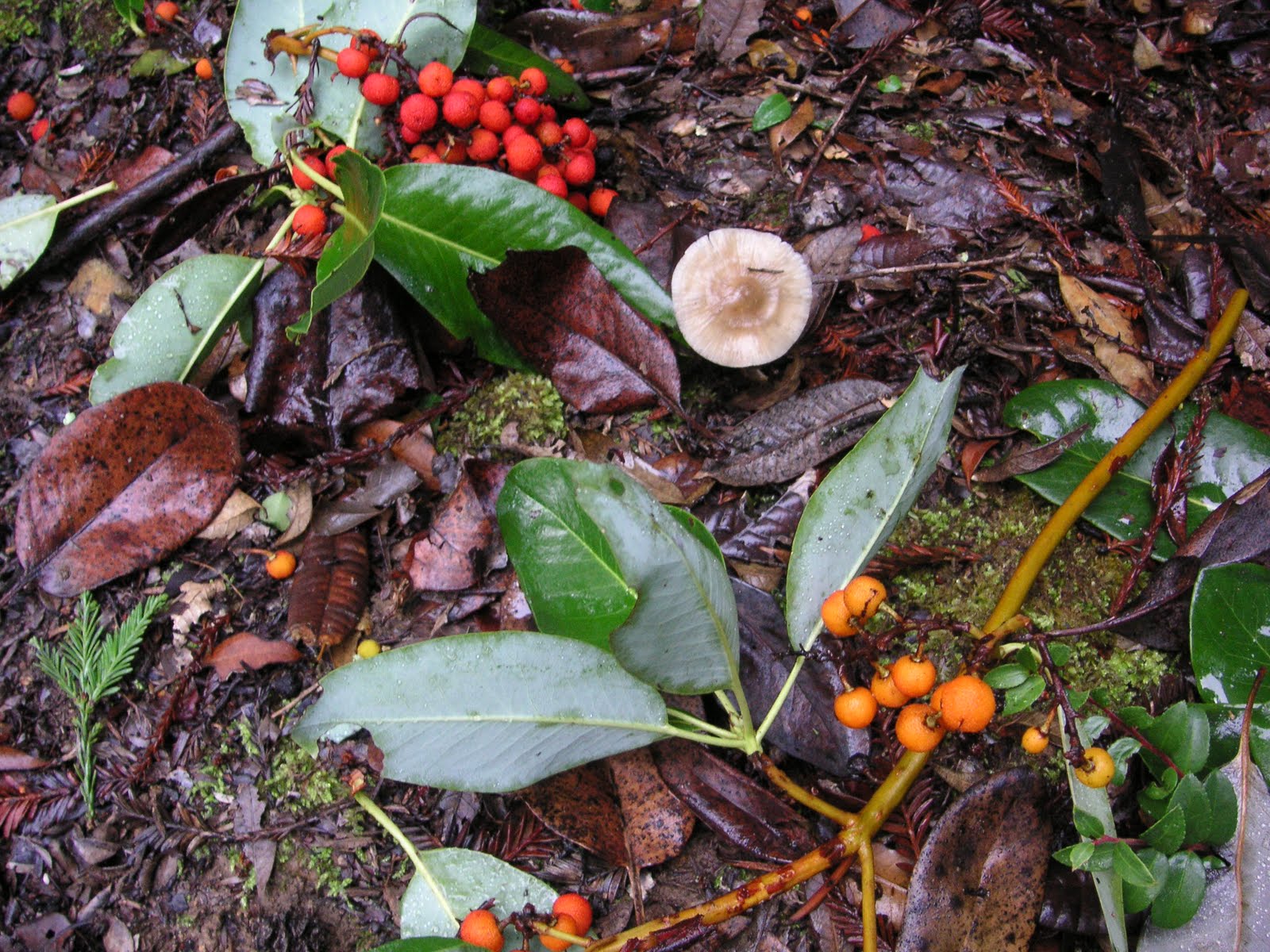

Pacific madrone
Arbutus menziesii
Ericaceae

This looks Christmas-y, right? I was amazed at how prolific the Pacific madrones were up on the mountain. Red, orange, and yellow berries were everywhere, in the trees and on the ground. I ate one just to try it out. Not too bad... it had the taste and texture of a not very sweet, ripe strawberry, but with a whole lot of seeds on the inside. I'm not going to become a madrone eating freak anytime soon, but it's good to know in case I ever need to "survive" out in the wild. Oh! There's an unidentified mushroom in the last pic, but I'll get to my numerous 'shroom pics after the holiday.

I hope everyone has a wonderful Christmas day, whether you celebrate it or not.

ps 12/24/10 - I'm not the only one who has tried the berries. See Rooted in California's foraging post. It seems many regionally local nature bloggers have noticed the profusion of madrone berries this year.

banana slug ~ 12/21/10 ~ Mt. Madonna


banana slug
Ariolimax sp.

It was total slugville underneath the redwoods and madrones at Mt. Madonna in the gentle rain. I easily lost count of how many native banana slugs we spotted during our hikes. True to my blog rules, all of these unedited pictures were taken on 12/21/10. They're fairly camera shy and quickly retracted their optical and sensory tentacles as we walked up to them. It took more patience than I generally have while waiting for the tentacles to reappear for the first photo above. Many of the banana slugs were longer than the span of my hand, from thumb to pinky, i.e., > 7". Most appeared to have egg masses sticking to their tail ends. Or it could have been the mucous/slime plug I've read about?

I was hoping to be able to ID the banana slug to species, but my numerous internet searches didn't offer any information on how to distinguish between Ariolimax columbianus (Pacific banana slug), A. dolichophallus (slender banana slug), and A. californicus (California banana slug). Color does not seem to be an identifying trait as they can be white, black, brown, or varying shades of yellow, all with or without spots. Not even my Field Guide to the Slug had any identifying information within the Ariolimax genus. However, I did find more sites about slug sex than I ever wanted to know.

For more information, click on any of the embedded links above, or check out a favorite local blogger's very nice summary of banana slugs at Curbstone Valley Farm. If anyone has better information, I'd love to hear from you.