Showing posts with label x: Morro Bay State Park. Show all posts

Sunday, January 19, 2014

habitat ~ 01/19/14 ~ Morro Bay State Park - Black Hill

Morro Bay State Park - Black Hill
January 19, 2014

This was purely a social visit, so we barely got out on a short section to Black Hill before the football games started.  The road access is located above the Morro Bay Golf Course, a San Luis Obispo County Parks on CA State Parks land.  Confused?  Yeah, me, too.  It looks like they've been cutting back on watering the greens, because there was quite a bit of yellow.  Good.  I think golf is a gross misuse of precious water for an exclusive recreation.

I love the 360° views from on top this volcanic peak and am sorry my uncle didn't join us.  Every visit I worry may be the last time I see him or my aunt, so I try to make the most of our time together.  Even though he still hikes like a mountain goat for short periods of time, he wasn't really aware of the trails here.  I'm not surprised, because for all the years I've been going to Morro Bay, too, it took Andy's wandering trail running ways to discover this little gem a few years back.  

It wasn't until I started Nature ID that I wanted to learn more about Morro Bay, which I discovered is actually part of the larger Estero Bay.  I appreciate the estuary more than ever now, but finding information online has been challenging, especially 5 years ago when I started this blog.  I don't know if google has customized my search properties and/or if the sites have just gotten better.  Two that I like are Morro Bay National Estuary Program and grad student Eric Mohler's Morro Bay Watershed site.

January 17-20, 2014

Oh, while we were there, this was going on.  Everywhere we went there were folks with good sun hats, binoculars, and cameras so big that I'm surprised they didn't walk all hunched over from the weight around their necks.  The festival was completely not on my radar, so I was not prepared.  Still, I'm not sure I would have participated anyways.  Every time I stopped an obvious birder to ask them what something was, they weren't very helpful or accurate.  Avid birders are a strange bunch.  Talk about another exclusive recreation, which reminds me of the topic of lack of minorities in birding. While I can't say I feel uncomfortable among affluent, retirement-aged, Caucasian nature folks, after all my uncle and aunt fit quite neatly in that category, I am aware I am "other" or the designated minority friend in most groups.  Hmm, maybe that's why I tend not to join things?  My favorite bird blogger is Steve of Bourbon, Bastards, and Birds.  He crushes birder stereotypes.

ps 02/13/20 - I removed several embedded links thanks to Ryan Blundell at Tideschart.  Here's his tidechart for Morro Bay: https://www.tideschart.com/United-States/California/San-Luis-Obispo-County/Morro-Beach.

hairy woodpecker ~ 01/19/14 ~ Black Hill


Ta-da!  This has got to be one of the crappiest pics posted to Nature ID.  I digitally enhanced it as much as possible, too, which is something I rarely do.  Oh well, I think it's good enough to make a positive ID.  It's another new-to-me sp.

The first thing that caught our attention was the tree seemed to be dropping bits and pieces.  What the hey?  Turns out this woodpecker was pulling bits of bark off the tree trunk in between brief bouts of drilling.  Well, that's different.  Hey, where's the red head?  Usually, whenever I notice woodpeckers (rarely), they almost always have a red head, which I assume (probably inaccurately) are the clown-like acorn woodpeckers.  The last thing I noticed was that long white stripe.  Visually it didn't make sense to me that it was located in the middle of the back, because I kept wanting to believe it was on the edge of the wing, like with the sapsuckers.  It really confused me until I looked at my pictures and read up on an ID.  Turns out there's a smaller, cuter look-alike called the downy woodpecker (P. pubescens).  I liked the description on Cornell's site that said the larger hairy woodpecker has a "somewhat soldierly look".  True, true.  Oh, and that pulling bits of bark is to find tasty insects.  They're apparently pretty decent at pest management.  Btw, males do have a small patch of red on the back of the head.

Cool.  Slowly expanding my bird awareness...

spotted towhee ~ 01/19/14 ~ Black Hill


Considering I still have my bird books out, I might as well continue with the crappy bird photos... hop, hop, hop, nah, nah, nah, you can't get a good shot.  This is a new sp. to Nature ID.  Except for its shape, it looks nothing like the related California towhee.  I like this striking bird, which reminds me more of a bolder and more colorful dark-eyed "Oregon" junco.  What would be the evolutionary advantage of the dark executioner's hood that many birds seem to have?

Thursday, July 18, 2013

habitat ~ 07/18/13 ~ Morro Bay State Park

July 18, 2013

Wanting a shower, we headed over to the main Morro Bay State Park camping area to use their facilities (this access is included with a stay at the Strand).  While Andy went for a pre-shower run, I strolled around to see what was new.  It's weird to think of my life in decades, but I've been coming to this spot for close to 4 decades.  The very first time, I remember coming home from Morro Bay and not understanding why we were returning to our old house after vacation.  I thought we had moved!

Despite all the financial difficulties the CA State Parks have faced in the last many years, I've been impressed with the improvements they've managed to implement here.  The housing for employees is very nice, with one growing native plants in the backyard for what I assume will be park landscaping.  I sometimes fantasize working at a state or national park with housing provided in the actual park would be awesome, but then you've got to be careful what you ask for.  Like health insurance for many out there, if you lose your job, you end up loosing way more than a paycheck. Maybe when we retire, we'll try the whole camp host thing.  The groomed trails around Black Hill didn't exist when I was a kid; there used to be only an exercise loop with stations and a painted pole-style frisbee golf course. There's also a new boardwalk along the estuary. It's artistically laid out, zigzagging through the muddy parts, but it'll mean no more looking for native horn snails for me.  I have mixed feelings about that.  On one hand I know things need to be protected, fenced, signed, etc., but it comes at the cost of us humans not allowed to get in touch with nature.  In the act of saving, it's also distancing from raw human experience, which is ironic.  Hey, lady, put that shell down and step away!

And, finally, I included the eucalyptus tree above, because I wanted to ask my nature-loving blog readers... have any of you ever heard of hummingbirds clustering in 1 or 2 trees?  I could not believe the loud chatter coming from this tree, and I figured there had to be several dozen hummingbirds, if not a hundred.  It was really wild.

Thursday, October 13, 2011

CA sea-lavender ~ 10/13/11 ~ Morro Bay


posted 11/04/11 - Too bad these flowers are past their prime. I've been wanting to get pictures of our native sea-lavender ever since our last visit to Morro Bay on October 31, 2010 when I spotted the purple flowers but failed to photograph them. Interesting to note, even though we visited a couple weeks earlier compared to last year, the purple flowers had already dried up. I like seeing how plants bloom at slightly different times every year.

This is the only native Limonium found in CA, and one of only 3 species native to North America, with the other two being L. carolinianum and L. limbatum. Thanks to the Morro Bay National Estuary Program site, I learned that the non-native Algerian sea-lavender (L. ramosissimum) has recently been found in Morro Bay. Most folks around the world likely know Limonium spp. as statice.

ps - Lavender is spelled with an -er, not -ar, of which the above named plants are not actually related.

CA horn snail ~ 10/13/11 ~ Morro Bay


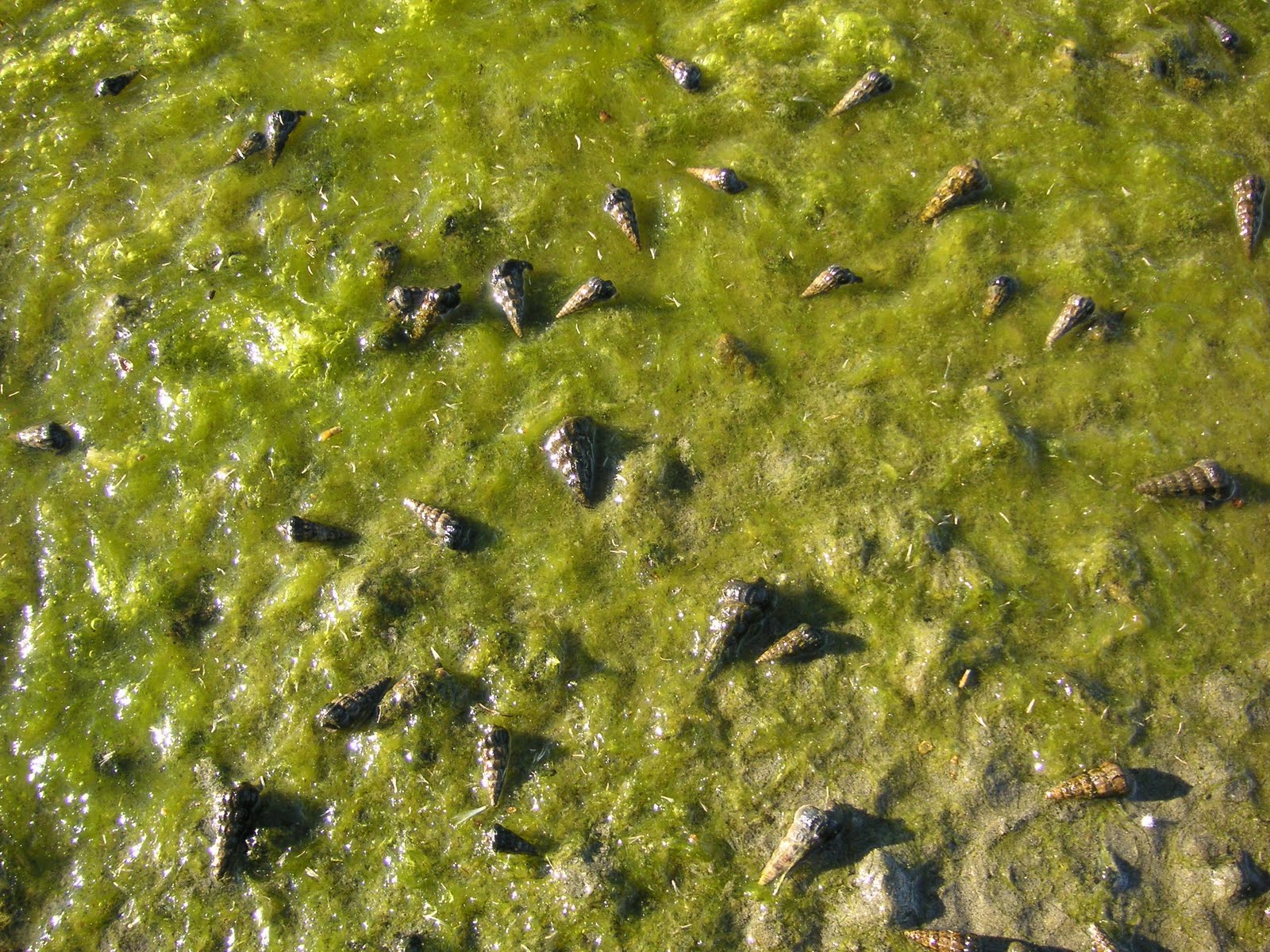
posted 11/03/11 - I wanted to revisit this ID with fresh pictures and conduct another online ID search. What I noticed this visit was that all the snails on the path were dead with their openings facing down in the mud. I thought this was peculiar and probably not random. For the second picture above, I turned one over and cleaned the opening to show the shape of aperture. I reached into the green gunk to take a closer look at an actual live snail. The one I'm holding is about medium sized compared to the larger empty shells.

Walla Walla University still has the best somewhat-local ID comparative description I've found under Batillaria attramentaria (one of two Japanese false cerith snails, with the other being Batillaria zonalis, if indeed it is a distinct species). Plus, this time around I noticed Conchology, Inc. has at least two errors on their Potamididae family page; Batillaria spp. belong to the Batillariidae family page. So, this got me thinking about looking at other similar looking marine snails. WoRMS is great for listing the names of other Cerithioidea families. I looked through the Natural History Museum Rotterdam's site and came up with the following families that have similar looking shells: Batillariidae, Cerithiidae, Dialidae, Potamididae, Scaliolidae, Thiaridae, and Turritellidae. I checked the EOL for the locations of some of the snails, but none are recorded anywhere near central California's coast, except C. californica and B. attramentaria. Nature's variations amaze me.

I don't often post so many pictures for a single ID, but this was a personal quest after my minor hubbub around a permissions request and withdrawal from my first post of CA horn snails. It caused me to go into major blogging existential contemplation, which I wrote about in am I doing the right thing with this blog?

Sunday, October 31, 2010

monarchs ~ 10/31/10 ~ Morro Bay

monarch butterfly
Danaus plexippus

I can't say this picture of clustered monarchs is any better than last year when we visited Morro Bay. We laughed over the fact we drove 150 miles south and then looked for monarchs, when just down the street from where we live in Pacific Grove we have our own Monarch Grove Sanctuary. Silly, really. I still haven't made a visit to the local sanctuary yet this season to see their newly purchased eucalyptus trees... that may be a story for another time.

From a purely casual observation standpoint, there didn't seem to be very many monarchs this year, perhaps, even less than last year. I got a crick in my neck from looking up for so long in the very tall eucalyptus. I didn't include any links in the common and scientific names above, because I figure anyone can find information online about monarchs. More than half of what's available online doesn't go beyond a 1st grade level of understanding, anyways.

I want to give a shout out to Chris Grinter at The Skeptical Moth for being, well, skeptical.

ps 11/23/10 - I've been sent an e-mail asking about monarch numbers this year in Pacific Grove. I'm not associated with any of the following groups, disagree with some of what they say, and generally prefer to stay out of what is increasingly becoming a political fray... but thought I'd make a list o' links for reference:
Arizona Monarchs
Butterfly Digest
Monarch Alert
Monarch Grove Sanctuary January 2009
Monarch Watch Forum
Pacific Grove Message Board
Ventana Wildlife Society
Western Monarch Discussion Group
Xerces Society
sea otter
Enhydra lutris

Ah, now I remember why I don't post many pictures of sea otters... in my measly photos, they look more like big turds floating in water than anything identifiable.

CA horn snail ~ 10/31/10 ~ Morro Bay


California horn snail
Cerithidea californica

These shells are kinda of pretty with the blue on the fat end. It's somewhat odd to me that I found these in a town that I visited for many, many years for holidays where we always went to The Shell Shop. They sold the prettiest, polished shells from around the world for pennies. My mother liked keeping an abalone shell filled with various other shells as decoration on our main bathroom counter. Maybe it was a sign of the times. I don't know. I do remember not being particularly keen on cleaning them when they got covered in household dust during my weekly bathroom chores. Now, I feel a little repulsed by any collection of animal parts on display as art or decoration, without any knowledge of what they are. "Pretty" just doesn't do it for me anymore.

With a quick search online, I didn't find a decent site describing C. californica, but I'm fairly sure of this ID. Several sites mention the CA horn snail is similar looking to the introduced Asian horn snail (Batillaria attramentaria), which I've posted about before. However, when considering the location, relative density of the horn snails, and looking at pictures of each without being completely covered in mud, the visual cues seem fairly obvious. Despite my hesitation to promote online commercial interests, I found Conchology, Inc. to have an excellent pictorial comparison of snails in the Potamididae family.

ps 10/01/11 - I was asked this week for permission to use my photos of CA horn snails by a journalist from Pour la Science (apparently the French version of Scientific American). I was pretty chuffed that someone from France found my pictures and wanted to use them in a respectable publication, online and in print. During our e-mail communications, I pointed out that I am not a malacologist and that my IDs are my amateur best guesses. Hey, I really do try to be honest and up front. I'm not sure how that translated into French, but she ended up declining use and thanked me for my time. I remember how long it took me to make this Cerithidea californica ID, and I'm 95% sure I got it correct. Before granting permission, I admit to holding concerns about knowing exactly what the article was supposed to be about and whether to charge $ for use (more for those bloggers who use their blogs as a way to advertise their own professional photography; personally, I don't have much interest in that kind of thing). I did not ask pay for use, but I did ask to quote her e-mail request. She didn't respond specifically, so I don't have it available here. I was a bit disappointed my photos are not being used, and my ego got bruised. In any case, her article is already out: http://www.pourlascience.fr/ewb_pages/a/actualite-escargots-volants-28027.php. I assume she received permission from Conchology, which I embedded in my original post above, but she also got the credits incorrect - I seriously doubt Haderman had access to e-photography back in 1840. I think it'd be a tough job being a journalist and writing about things you know very little about.

pss 11/03/11 - I visited this place again to get better pictures and to double-check my ID. Please see my new post on CA horn snails.

white pelican ~ 10/31/10 ~ Morro Bay


American white pelican
Pelecanus erythrorhynchos

I'm still attempting to get a closer picture of the American white pelican; certainly, this is much better than what I've posted previously. They're huge! Maybe it's the bright white that makes them seem so much larger, but their 9 ft. wingspan is only half a foot longer than the brown pelican. Depending on the information source, American white pelicans can weigh as much as 2 times the size as brown pelicans. Seriously, how do those things fly?

Sunday, October 25, 2009

monarchs ~ 10/25/09 ~ Morro Bay


monarch butterfly
Danaus plexippus

For all those years I camped in Morro Bay State Park as a kid during the summers, I never knew there was a significant monarch overwintering site just behind the campgrounds. It was great to see them for my first time. The overwintering numbers are far fewer than in Mexico, so it's not an obvious tourist attraction. They really are difficult to spot in the eucalyptus trees, but once you know they're there... WOW!