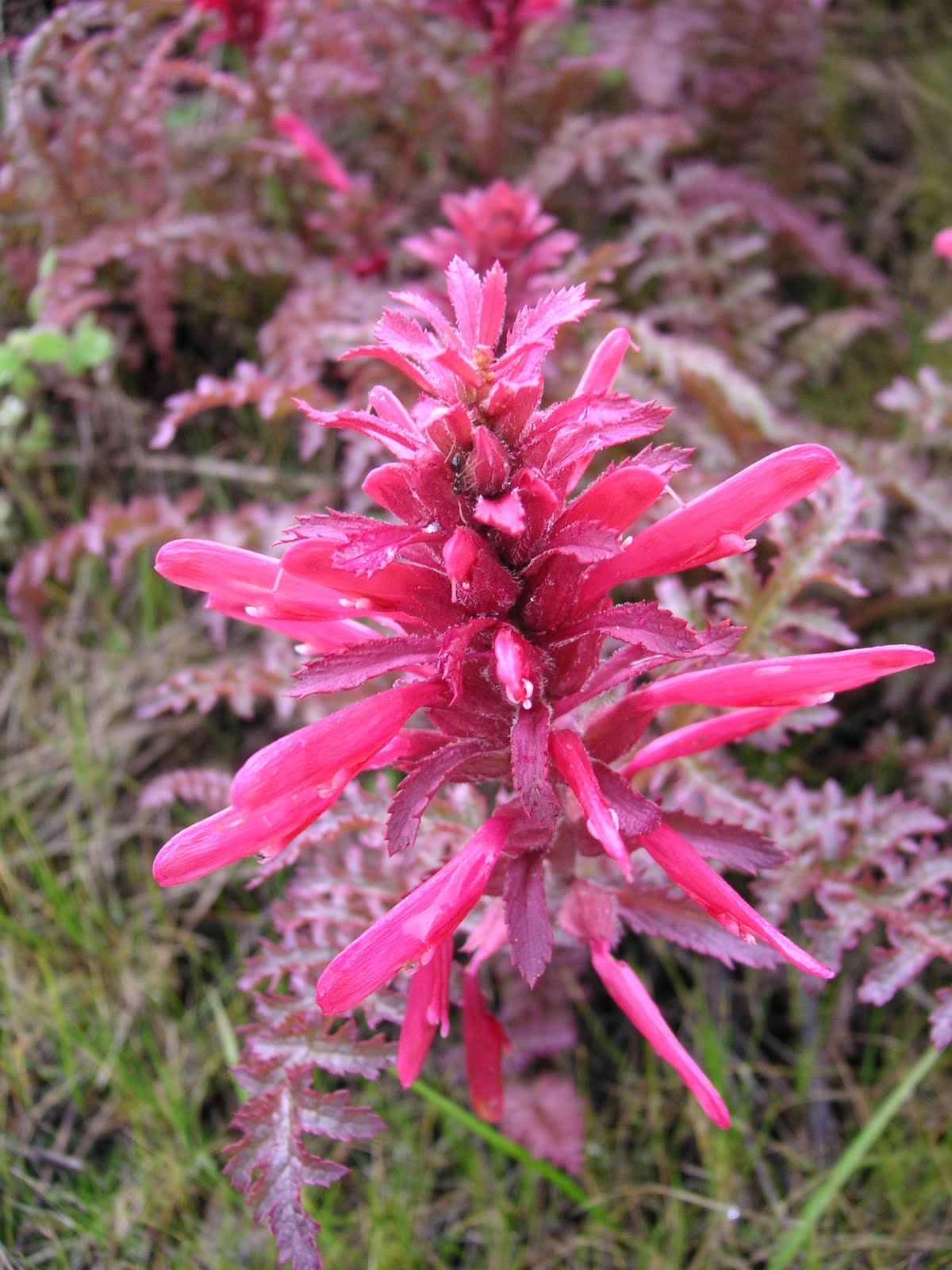
This is the best showing of Indian warriors I've ever seen. Wikipedia says this is a root parasite of plants like manzanitas. Until I read this, I didn't actually notice the low growing manzanitas, during our hike nor in my pictures, along the trail where we found these. My eyes gravitate toward the bright and colorful. To be politically correct, Jepson's recommends the following common names: dense-flowered pedicularis, dense-flowered lousewort, red warrior, or warrior's plume. However, I doubt anyone who's familiar with these plants would know what I'm referencing if I called it a lousewort, so called because there was apparently a belief that a lice infestation would occur if livestock fed on these plants. I was amazed at the variation of Indian warriors we saw within one stretch of trail, from light salmon colored flowers to deep purple leaves; for additional pictures, check out my Flickr set.
Sunday, March 20, 2011
Tuesday, March 15, 2011
silver-spotted tiger moth ~ 03/15/11 ~ Carmel Highlands
silver-spotted tiger moth (or nameless arctiid moth) feeding on California lilac
Lophocampa argentata (or Lophocampa sobrina) feeding on Ceanothus sp.
Rhamnaceae
Lophocampa argentata (or Lophocampa sobrina) feeding on Ceanothus sp.
Rhamnaceae
It's always a thrill for me when I find a striking caterpillar or two. I'd even say these are pretty. These pictures were taken in a friend's expansive yard just south of Point Lobos, so I can't be sure if the Ceanothus is native or a garden variety. The visual addition of periwinkle and pride of Madeira made for an awesome sight of intense purples and greens. It's too bad I didn't get a step-back habitat photo.
As for the ID of the moth, I am sure it's a Lophocampa sp., but I'm not absolutely positive it's a silver-spotted tiger moth. Based on their size, I suspect these have another instar or two before they're ready to pupate into adult moths. Almost a year ago, bb of biobabbler, Chris Grinter of The Skeptical Moth, and I had a discussion of L. argentata on her blog post of a mystery caterpillar. Most of the L. argentata caterpillar pictures found online are tannish-orange in overall color. In my defense, there are whiter versions like mine (and, no, it's not due to a flash) that have been found at Point Lobos: BugGuide and CalPhotos. Additionally, the literature states the silver-spotted tiger moth feeds on conifers, particularly Douglas-firs. As shown above, they're definitely feeding on Ceanothus blooms. I wonder if location or food preference has anything to do with the color variation of the caterpillars... or if these locals are possibly a different species.
ps 03/23/11 - I originally posted this as silver-spotted tiger moth (Lophocampa argentata). Thanks to Chris Grinter of The Skeptical Moth, I queried Jerry Powell, professor at UC Berkeley and co-author of Moths of Western North America. The three of us had a brief e-mail exchange. Jerry seems to be unsure whether L. argentata and L. sobrina are indeed distinct species, contrary to what his co-author Paul Opler thought. The photo they used in their book of L. sobrina was feeding on blackberry and alder. With Chris's permission to quote him on my blog, here's what he e-mailed, "Yea I think there are deeper problems than just the identification. Only L. sobrina is known from the Monterey area - and identifications of L. argentata from that are are incorrect IF sobrina is a true species. Putting them side by side I do see differences, but they are incredibly superficially similar. I haven't taken a close enough look at the morphology or DNA to actually make a real call. This is a project for another day - but caterpillars of Lophocampa from that area would also be sobrina. The problem with caterpillars is that they are even more variable than adults..." Chris goes on, "I'd say sobrina is the name applied to that population right now. Who knows how long that will stick around for though, there are a few other Arctiinae species in coastal california that share this same problem." Thank you, Chris and Jerry! Who knows, I may have the very first pictures of L. sobrina correctly identified on the internet. Maybe Chris will get BugGuide and Calphotos to correct their pictures?
pss 03/27/11 - I've also contacted Paul Opler who advised me to try to rear these so that I can know for sure which species it is. Hmph! I think I'll do that.
pss 04/20/11 - I realized I haven't posted an update with pictures of this caterpillar. I ended up collecting one on 03/31/11 along with another all black caterpillar from the Highlands. As it so happens, today I spotted something fuzzy on the balcony and thought the one I had collected had somehow escaped. Nope. Now I have two of these caterpillars that seem to like feeding on fresh oak leaves.
As for the ID of the moth, I am sure it's a Lophocampa sp., but I'm not absolutely positive it's a silver-spotted tiger moth. Based on their size, I suspect these have another instar or two before they're ready to pupate into adult moths. Almost a year ago, bb of biobabbler, Chris Grinter of The Skeptical Moth, and I had a discussion of L. argentata on her blog post of a mystery caterpillar. Most of the L. argentata caterpillar pictures found online are tannish-orange in overall color. In my defense, there are whiter versions like mine (and, no, it's not due to a flash) that have been found at Point Lobos: BugGuide and CalPhotos. Additionally, the literature states the silver-spotted tiger moth feeds on conifers, particularly Douglas-firs. As shown above, they're definitely feeding on Ceanothus blooms. I wonder if location or food preference has anything to do with the color variation of the caterpillars... or if these locals are possibly a different species.
ps 03/23/11 - I originally posted this as silver-spotted tiger moth (Lophocampa argentata). Thanks to Chris Grinter of The Skeptical Moth, I queried Jerry Powell, professor at UC Berkeley and co-author of Moths of Western North America. The three of us had a brief e-mail exchange. Jerry seems to be unsure whether L. argentata and L. sobrina are indeed distinct species, contrary to what his co-author Paul Opler thought. The photo they used in their book of L. sobrina was feeding on blackberry and alder. With Chris's permission to quote him on my blog, here's what he e-mailed, "Yea I think there are deeper problems than just the identification. Only L. sobrina is known from the Monterey area - and identifications of L. argentata from that are are incorrect IF sobrina is a true species. Putting them side by side I do see differences, but they are incredibly superficially similar. I haven't taken a close enough look at the morphology or DNA to actually make a real call. This is a project for another day - but caterpillars of Lophocampa from that area would also be sobrina. The problem with caterpillars is that they are even more variable than adults..." Chris goes on, "I'd say sobrina is the name applied to that population right now. Who knows how long that will stick around for though, there are a few other Arctiinae species in coastal california that share this same problem." Thank you, Chris and Jerry! Who knows, I may have the very first pictures of L. sobrina correctly identified on the internet. Maybe Chris will get BugGuide and Calphotos to correct their pictures?
pss 03/27/11 - I've also contacted Paul Opler who advised me to try to rear these so that I can know for sure which species it is. Hmph! I think I'll do that.
pss 04/20/11 - I realized I haven't posted an update with pictures of this caterpillar. I ended up collecting one on 03/31/11 along with another all black caterpillar from the Highlands. As it so happens, today I spotted something fuzzy on the balcony and thought the one I had collected had somehow escaped. Nope. Now I have two of these caterpillars that seem to like feeding on fresh oak leaves.
Friday, March 4, 2011
habitat ~ 03/04/11 ~ Pinnacles National Monument - west
March 4, 2011
This is the earliest in the year we've ever visited Pinnacles, a truly unique geological oddity. Driving to the park was enjoyable with rolling hills of green... the green only existing a couple months out of the entire year around here. I've heard the "golden" of "golden California" has less to do with the discovery of gold in the late 1840's (or the blond locks of Hollywood babes), than with the prevalent golden color of dried grasses across much of the state. Within the park, it seemed like spring was just beginning. My usual favorites of CA poppies, clarkia, and Chinese houses were not out yet. There was definitely a different mix of Lepidoptera compared to what I usually see in April and May (2010 and 2009). And, as usual, we spotted numerous turkey vultures but no condors. Afterward, we did our traditional stop in tiny Soledad at La Fuente for yummy CA-Mex food, which was originally recommended by one of the rangers at Pinnacles a couple years ago. For other blog posts about Pinnacles, here's my virtual collection: kt's Nature ID companion.
Douglas' wallflower ~ 03/04/11 ~ Pinnacles
posted 03/15/11 - Apologies for the third post this morning. Simply trying to knock out a few IDs from our March 4, 2011 hike at Pinnacles. I have to say this is one of the prettier mustards around.