Showing posts with label x: Fort Ord - BLM InterGarrison. Show all posts

Thursday, April 3, 2014

Indian warrior ~ 04/03/14 ~ Fort Ord

Indian warrior among host plant manzanita
Pedicularis densiflora among host plant Arctostaphylos spp.
Orobanchaceae (formerly Scrophulariaceae)

I generally tend not to hike towards the sound of chainsaws and weed wackers, but the main reason I wanted to get out to Fort Ord was to see the progress of a particularly prolific patch of Indian warriors.  I didn't get out last year, but I have some spectacular photos from April 1, 2012 and March 20, 2011.  Eh, there's an average showing here and there, but the spot, the exact spot I really wanted to check out in detail was being weed wacked by a team in bright orange.  I was informed by their supervisor to not take pictures of them.  Too late, because I had no clue. Now that I know, I won't post them online out of respect.  I'd like to think I'm colorblind and had a funny interaction with a fellow who asked if I was an environmentalist.  It wasn't until I looked at my photos that I noticed a disturbing pattern, which reminded me of a couple recent award-winning movies that I haven't seen.  It makes me sad, but it's not my story to tell.  These guys can't be too dangerous if they're being given weed wackers and chain saws.  Right?  At least they're being exposed to nature, a soothing salve for whatever troubles a person internally.  This reminds me of the Sustainability in Prisons Project I found while I was searching lomatium recently.  I plan on revisiting this spot again at the end of the month to see how things have progressed, given the drought and mid-season manzanita cutting.

Saturday, February 22, 2014

habitat ~ 02/22/14 ~ Fort Ord - BLM InterGarrison

 Fort Ord National Monument - InterGarrison entrance

Andy wanted to run some trails, and I tagged along for the ride.  I don't enjoy running like he does, so we often do our own thing.  We've gotten pretty good at setting a time limit and meeting up at the end.  He only wanted to do an 1 1/2 hour run, but I asked to push it to 2 hours (he's so accommodating to my whims) because I thought I'd have plenty of early spring sightings to keep me busy.  Nope.  Oh sure, under the oaks there's a gorgeous flush of green grasses and poison oak, as expected, but out in the wide open spaces...  

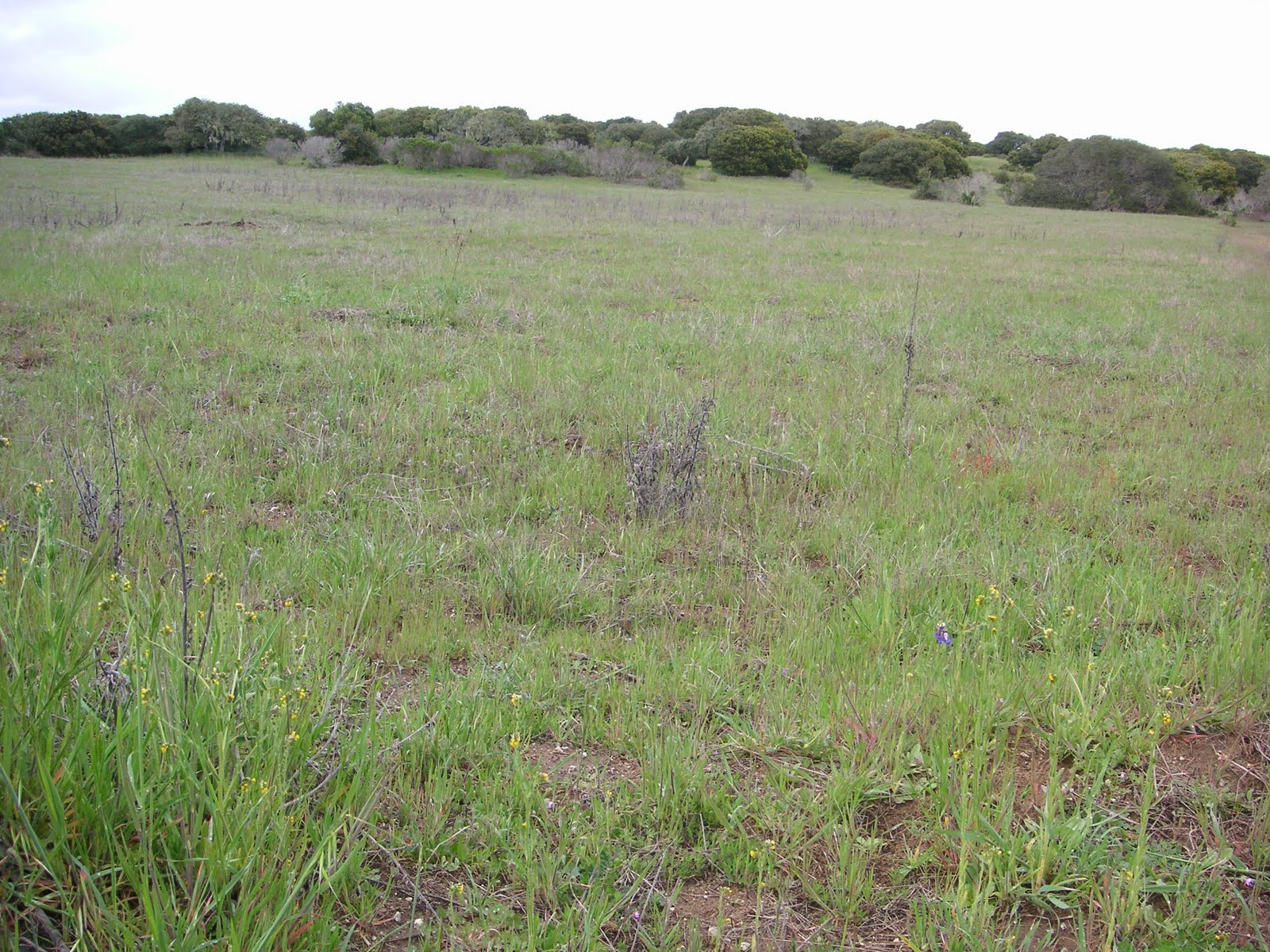
... grey, dried, dead.  This year's record-breaking drought has bleached the landscape into a flat monotone wash.  It doesn't even pretend to have the usual golden winter tinge.  Shown here is one of the larger vernal pool sites at Fort Ord.  Um, nope.  To compare how wet this spot can be, check out the 2nd picture from my habitat post taken March 20, 2011.

I headed directly to a road lined with large lilac trees (Ceanothus sp.), because I was hoping to see blooms considering the Ceanothus in gardens around town are going gangbusters right now.  Um, nope, again.  Grey.  Dried.  Dead?  In my head, I rationalized the moderate amount of rain 2 weeks ago was enough to kick things into gear.  It looks like it's going to take a lot more rain to catch up to what I expect.  I'm hoping this is not becoming the new normal.

So, I'll admit I've been in a bit of a foul mood lately, which may just be an annual February thing, but... Argh!  Seriously?  Once again there are new closed trail signs, this time "No Trespassing", and once again they're being promptly vandalized.  Many of the metal signs were completely ripped off their hefty posts and tossed into the poison oak.  In the summer of 2009, the BLM first started adding "closed trail" stickers to their brown trail markers, which were ripped out by May 2010.  Then sometime during the winter of 2011-2012, somebody added new "area closed" red markers, which were defaced immediately by February 2012.  I say "somebody", because I'm not sure if it was the BLM or the owners of the neighboring private property, who apparently host bicycling races as I discovered this day with all the traffic.  Was there a transfer of land somewhere in the last 5 years?  I don't know.  You gotta figure the signs are spendy to make and install, and I just don't see how vandalizing them is productive in any way. There's obviously a kerfuffle going on.  Look at the tire tracks behind the sign.  There you go.

coast live oak ~ 02/22/14 ~ Fort Ord

Fagaceae

I don't know why I keep getting tripped up on coast live oaks, as is evidenced by my past posts March 20, 2011 and March 11, 2012.  In the comments section, Cindy @ Dipper Ranch has provided quick tips on oaks, but my mental block around trees keeps me from remembering most of it.  I now know to look for "underarm hair" on the underside of leaves.  It seems to me that our CA native oaks have a greater degree of variation within spp. than between spp.  Every time I think I've found a different sp. of evergreen oak, it ends up being a coast live oak.  Ugh.  These two sets of photos are two trees growing about 20 feet apart.


Underarm hair?  Check.  But, look how smooth the trunk is, akin to how smooth the leaves are with very few points on the leaf margin.  I know the number of points can be variable, but the trunk, too?  Can anyone confirm for me that this is coast live oak?  Cindy?

For my future reference, and maybe yours, too:
California Oak Identification @ University of California Hastings Reserve
California Native Oaks @ Las Pilitas Nursery 
Oak Identification @ University of California Cooperative Extension, Marin County

Sunday, April 1, 2012

Indian warrior ~ 04/01/12 ~ Fort Ord

Indian warrior
Pedicularis densiflora
Orobanchaceae (formerly Scrophulariaceae)

It's a tough call to say these were more prolific than last year's batch.  I would say yes.  There was a definite lushness around what we saw.  The host plant manzanitas look like they've grown some, but not as much as I would have guessed from clearing this fire road two years ago in 2010.

Saturday, February 18, 2012

habitat ~ 02/18/12 ~ Fort Ord - BLM InterGarrison

Fort Ord Public Lands - InterGarrison entrance
February 18, 2012

Lately, I've been trying to focus on the positive on Nature ID and was hoping if I waited a few days to post about this excursion, my grumpy attitude would mellow out. Unfortunately, I still have pet peeves to report from this hike, and those pet peeves are more hot to me than describing my other photos.

Right as we pulled into the very limited sandy parking at InterGarrison, we met a couple of dogs off leash. As soon as I got out of the car, one promptly stuck its slobbery nose up where it didn't belong, and the other pooped not more than a few feet away in the sand (I was very careful not to step in the steaming pile of poo). I don't blame the dogs. I blame the dogs' owner. The regulation of having a dog under voice command does not mean a verbal remonstration after the fact of "Bad Barkie, leave the nice lady alone!" Plus, the owner made no movements to pick up after his other pet. (Oh, did I mention he was a mountain biker? I'll get to that in a mo'.) At the very least, I'm glad none of the dogs jumped into my car, which Andy experienced a little more than a year ago. When Andy tried to get Lola out of his car, he ended up with his 3rd worst poison-oak rash ever. His arms oozed for weeks thanks to a careless dog owner who couldn't find her way on the trails, let alone find her own dog. Given my last several encounters with dogs on trails (muddy footprints all over me, scaring me during my first ever bobcat encounter, pooping not 3 feet away in the ocean waves from my friend's toddler, and other incidents), really, I do like dogs... just not run amok where common courtesy seems to be forgotten.

There was a ton of poop on the trails. With minimal rain this season, poop seems to be holding its shape pretty well with fuzzy mold. Some were obviously from wild animals with bits of red berries in them, but I'm guessing most were from dogs. Does anyone know how to tell dog and coyote poop apart? Several bikers had dogs with them, and I can't imagine that they would stop their bike to pick up after their pet. As the biker in the parking area demonstrated, he wasn't the least bit concerned about cleaning up after his dog. All that dog poop has got to have a negative impact on the wildlife and the environment.

So, speaking of bicyclists, check out the bright red trail marker above. Can you also see the clear bike tire treads? These trail markers are new within the past couple of months. It's supposed to say "Area Closed," but it's already been defaced. These trails were closed 2 1/2 years ago, and even then the markers were promptly defaced or ripped out of the ground completely. Oh, did I mention? I witnessed the same dog/bike loving fellow promptly go down a brightly marked red trail to enjoy the beauty that is Fort Ord. If he and his cohorts continue, the place may not be so beautiful in the coming years. Considering there are still UXOs being found on previously opened trails, this could be really dangerous. Andy and I don't understand this behavior. We consider it a privilege, not a right, to have access to these lands.

edited 02/25/12 - Now that my rant is done, I've added descriptions for the rest of the photos:

vernal pool

There's a new definition of dry this year. I passed 3 vernal pools during my hike, and they were all this brown without a lick of water. Even on August 4, 2010 there was more green here. To see how filled with water the vernal pools can be, check out my March 20, 2011 post. Let's do a rain dance to get a flood of rain in March and April. Interestingly, I heard several frogs during this hike. I don't know where they'll lay eggs if there isn't some rain soon.


green grass under coast live oak

For how dry it was, I was impressed there were areas of new green under the tree canopies. The tree provides shade and extra moisture collection from fog and rain to the understory. I've asked this before, but what's the term for this natural occurrence? Is it a combination of throughfall and fog interception?


rototilled ground

While there are skunks and badgers at Fort Ord, I think the likely candidate that did this were wild California pigs (Sus scrofa), an odd cross between feral domestic pigs and Eurasian wild boar. They've only been seen at Fort Ord since 2004, and more than a hundred have been trapped since 2006. While I've never seen them, Andy has seen several during his many trail runs at Fort Ord.


dusky-footed woodrat house
Neotoma fuscipes

Normally, I'd have this as its own post, but now I'm starting to see dusky-footed woodrat houses as indicators of certain habitats. I most often see them in heavily forested coast live oak areas. I rarely see just one house, and more often than not there's a whole complex of multiple houses. The king of woodrat blogging is Nature of a Man. Check out his blog!


Fort Ord Army Lands

This picture was taken very near where I saw an incredible display of Indian warriors on March 20, 2011. There's a new Fort Ord map as of last September, but we believe it's already out of date. They've done quite a bit of new trail building that will make it easier to get from the BLM InterGarrison side through open Army Lands to the BLM Creekside entrance. I'm not quite sure what this corridor was since it's not a trail; I suspect it was a temporary road that was used for equipment to build the new trails. It's been exciting to see all the work being done to convert Fort Ord into a public access space. I just hope people can respect the land, the life, and the rules so that everyone can enjoy it for years to come.

ps 02/28/12 - Given my pet peeves above, particularly pets on public lands, Shaina of Middle of Everywhere has a decent post about where this might head.

pss 03/14/12 - Well, here's a different idea - just throw the poo into the bushes according to Rambling on...

kestrel ~ 02/18/12 ~ Fort Ord

male American kestrel
Falco sparverius

Yup, I've reached a new low (or is that high?) for crappy photos, especially of birds. Never mind the massive early-blooming silver bush lupine, the coyote brush, the coast live oak, or the dried bit of telegraph weed, there is a kestrel in this pic. Can you find it? Perched on the coyote brush?

When we went to Palo Corona back on January 2, 2012, I spotted several kestrels and was unable to capture any pictures of them. I love how brightly colored the males are with their light-colored breast, slate grey wings, and brown backs. The mere fact that I can actually recognize them is because I've flipped through every single page of the handful of bird books I now have in my possession (some are on permanent loan from a dear friend). It's a sharp learning curve for me to ID birds, but it's been fun.

fuchsia-flowered gooseberry ~ 02/18/12 ~ Fort Ord

fuchsia-flowered gooseberry
Ribes speciosum
Grossulariaceae

We seem to see fuchsia-flowered gooseberries at all of our favorite spots, from sandy Fort Ord to the inland hills of Garland Ranch. It's an extraordinarily spiny plant and best avoided while hiking. The bright red flowers remind me of Asian lanterns. There are 52 native spp./ssp. of Ribes in CA. The gooseberry and currant flowers can be quite showy and beautiful. I want to start recognizing some of the other spp., like R. californicum (CA gooseberry), but I suspect whenever I've seen them I may have figured they were garden escapees and simply ignored them.

Monday, July 18, 2011

habitat ~ 07/18/11 ~ Fort Ord - BLM InterGarrison

Fort Ord Public Lands - InterGarrison entrance
July 18, 2011

posted 09/10/11 - Yep, I'm still backposting from this summer, filling in blank spots I skipped in order to write about more current encounters, like red abalone, before I forget the details.

My habitat posts seem to be the least popular and rarely get comments. Basically, they're a step back and look around at the place where I'm hiking. Photos seem to do more justice about the type and seasonal changes than I can possibly describe in words. I often don't have much to write about habitats, because I've yet to really look into the basics of habitats. I'm still focusing on IDs of specific plants, animals, and other.

Everyone seems to have different names for particular habitats and frequently a location has legitimate numerous descriptions. The University of California, Santa Cruz's Fort Ord Natural Reserve, a place I have not hiked and is adjacent to my Fort Ord locations, describes Fort Ord as "maritime chaparral." The U.S. Department of the Interior Bureau of Land Management (BLM) describes Fort Ord variously as "riparian forest, perennial grasslands and vernal pools."

From the very beginning of Nature ID, I felt it was important to include the wider picture, so to speak. Because I'm limited as to what blogspot can do and my own ability to code, I rely heavily on labels and archives (masquerading as hiking/observation dates). A nifty trick is to go to the sidebar, look at the current blog entry you're looking at and click on the specific date under hiking/observation dates. Then you'll be able to see all the posts for that particular hiking excursion. For this date, I only have a Spiranthes orchid. For dates like June 10, 2011 at Pinnacles, there's much to be seen.

Blogging is merely a hobby I have enjoyed. I know if I set up my own domain or switch to WordPress I may have more flexibility in how I present information. I'm not ready to go down that path quite yet.

hooded ladies' tresses ~ 07/18/11 ~ Fort Ord


It's that time of year again - orchids! Posting this reminds me we should go look for some other orchids around town. Piperia anyone?

Often when I repeat previous identifications, I do a cursory look to make sure I have past posts correct, in this case another hooded ladies' tresses at Fort Ord on August 4, 2010. The CNPS plant list for Fort Ord shows this species as "Spiranthes porrifolia/romanzoffiana – Western/Hooded ladies' tresses", which is unusual having a slashed ID on one of their lists. Maybe they weren't sure? I cheated last year by simply going with what Native Orchids on Flickr told me.

This time I looked at Jepson for both S. porrifolia and S. romanzoffiana, but relative proportions of fused upper sepal with lateral petals sounds variable and somewhat subjective. Besides, most flower descriptions don't make much sense to me unless I compare pictures. The two best CalPhotos' for comparison purposes are these close-ups of western and hooded. I've come up with my own non-scientific metaphor on how to tell these two ladies' tresses apart: western has a long straight tongue (lower petal/lip) sticking out over wide lower lips (sepals), whereas hooded has an arrow-shaped tongue sticking out over missing lower lips.

Thursday, June 30, 2011

habitat ~ 06/30/11 ~ Fort Ord - BLM InterGarrison

Fort Ord Public Lands - InterGarrison entrance
June 30, 2011

As dry as it appears from a distance, I am always a little surprised at how green it can be under the oak trees... granted most of the green comes from posion-oak. The second picture is looking northeast across Salinas towards Fremont Peak. The third picture is looking southeast towards Mt. Toro, which funnily enough is not located in Toro County Park. Finally, in the last picture is an ever-present reminder along the trails of how this land was once used.

CA oak moth ~ 06/30/11 ~ Fort Ord

California oak moth on coast live oak
Phryganidia californica on Quercus agrifolia var. agrifolia
Fagaceae

The populations of the CA oak moth are known to fluctuate dramatically over the years in an apparent cycle. I tend to forget about them until I start seeing swarms of moths around oak trees on warm June or September/October afternoons. It's really quite an amazing sight. In places of heavy outbreaks, people who normally don't pay attention to such things definitely notice massive numbers of caterpillars swinging on lines of silk from defoliated oak trees and climbing everywhere to pupate, from tree trunks to buildings and cars. I've read the population cycle runs anywhere from 5 to 10 years. It seems to me this would be a difficult thing to monitor, particularly the relative numbers, length of time, and locations. What I recall is that one year it could be heavy out in Carmel Valley and three years later it could be heavy up in Aptos. I've even seen one oak completely defoliated and the oak right next to it not even touched. I wish I had taken notes and photos of my observations through the years.

Many people seem to get alarmed when their precious oak tree in their yard gets defoliated. They call out pest management companies to spray and inject pesticides. I think this is a waste of time and money. I also believe this is harmful to the tree, the fauna that depends on the tree, and surrounding wildlife, including birds that collect the acorns and other moths that don't even eat oaks. Some reputable companies will clearly state oak moth infestations generally only last 2 years at most and they will treat in the second year. Huh? Well, if you wait to the third year without doing anything, the moths mysteriously disappear anyways. Plus, the live oak usually recovers with vigorous new growth, which is not an annual thing for this evergreen oak. It's cost-free pruning with an added benefit of natural fertilizer from the frass. I've seen this first-hand in the oak trees next to our driveway; I actually think they look healthier now than a few years ago before defoliation from the oak moths.

I believe these regular population crashes are density dependent. My theory is that when you intervene in the natural cycle and artificially suppress the peak population size, you prolong the higher than average population numbers. Again just my theory, the reason for this is that parasitoids (tachinids and ichneumonids), viruses, fungi, other diseases, and predators that normally keep the oak moth population in check aren't allowed to do their job as effectively. You end up with a bedraggled oak (think how your hair looks without a hair cut for a long time) and the potential to prolong the stress of repeated partial defoliation, which could in the long-run do more harm to your oak tree.

Okay, I'll get off my soap box. For decent links with better information, check out Elkhorn Slough.org, University of California Hastings Reserve, Pests of Landscape Trees and Shrubs, and Tree Solutions (yes, a pest management company with well-written information).

ps 10/09/11 - The oak moths have started swirling around our oak tree en masse. Interesting to note, the tree itself does not look defoliated like I've seen other trees around town.

statice ~ 06/30/11 ~ Fort Ord


I usually think of statice as the standard cheap grocery store bouquet filler. I prefer seeing small patches of it growing out in the wild. It's considered a garden escapee, which is a funny term. One can envision little plants waiting until nightfall to execute their break over the fence from manicured life. No one seems to agree on its origins, from the Canary Islands, the Mediterranean, Europe, and/or Asia. This plant is also called sea-lavender, but I'd prefer to reserve that name for the native Limonium californicum, which I've seen blooming down in Morro Bay (sorry, no pics, yet).

CA cudweed ~ 06/30/11 ~ Fort Ord

best guess California cudweed / California everlasting
best guess Gnaphalium californicum (aka Pseudognaphalium californicum)
Asteraceae

I'm starting to like cudweeds despite my not being too fond of crispy, dried flowers. They remind me of the dead flower bouquets my mother used to keep in waterless vases or baskets about the house. I think the main flower was strawflower, which must have had their peak of popularity as craft fair staples in the 1970's since I don't see them around anymore. One of my assigned chores was to dust weekly and those bouquets were impossible to clean without breaking off petals. I despise dusting, which may explain why I have so few knickknacks in my own home.

I'm pretty sure of this ID. I've seen CA cudweed before at a different Fort Ord location when it was very green. However, with a touch of white fuzz on the stems, I wonder if it might be slender everlasting (Psudognaphalium thermale), although Calflora.org and Jepson disagree over its distribution. What made searching for possible IDs challenging is Gnaphalium cudweeds/everlastings are variously aka Pseudognaphalium, Euchiton, and Gamochaeta.

wavyleaf soap plant ~ 06/30/11 ~ Fort Ord

Chlorogalum pomeridianum var. pomeridianum
Agavaceae

Finally I have some pictures of this plant's flowers. They're only open in the late afternoon through one night (hence pomeridianum from post meridium, aka p.m.), a time of day when we don't usually hike. Shown in the second picture at the base of the green flower stalk are the dried leaves, although I don't think they always dry up by the time this plant blooms. True to the common name, when the rosette leaves are green, they can have a distinctive wavy margin. Also, it's named soap plant for a reason. The best site I've found that talks about its many historical uses is Wayne's Word.

STRONG WORDS OF CAUTION: As Wayne points out, make sure you're positive of the ID before using soap plant. You'd think no one would mistake death camas for soap plant, but many do, including myself in retrospect. I've seen both plants growing within a couple feet of each other (Jack's Peak death camas / soap plant, Wilder Ranch death camas / soap plant, and Rocky Creek death camas), and the leaves can look somewhat similar when the variation and extent of waviness is in question. This can be an issue if you dig up the bulb in winter when only the green leaves are visible. As I was looking up information for this post, I found a couple blogs and professional-looking sites with incorrect photo IDs, e.g., Plants of California, a Guide to Useful, Edible and Medicinal Plants shows death camas flowers, not soap plant! This is why I try to be as diligent as possible when posting IDs, because I know Nature ID gets picked up by search engines. While I do make mistakes, I also do not claim to be an expert, especially on edible or medicinal plants. It basically comes down to being smart about what we read online.

As a last note, I should mention the lush green stuff in the background is poison-oak. Funnily enough one of the reported uses of soap plant is to treat poison-oak rash. While there are many generic "obviously copied from somewhere else" notations of this online, I discovered Plants for a Future actually includes original references.

ps 01/23/12 - For a soap plant recipe, check out the comments on this tulipsinthewoods.com blog post.

coast pretty face ~ 06/30/11 ~ Fort Ord

coast pretty face / golden brodiaea
Triteleia ixioides ssp. ixioides

Themidaceae (aka Asparagaceae and formerly Liliaceae)

This pretty face is locally common and looks similar to the related goldenstar I found inland at Pinnacles. There are 5 subspecies of golden brodiaea (T. ixioides), and I used the Fort Ord plant list to narrow this down. For some reason I started calling this "yellow dick" a couple years back, perhaps because it's also related to the blue dick. It's my own made-up name. To read a better blog post of golden brodiaea, check out Sierra Foothill Garden.

smooth harvester ant ~ 06/30/11 ~ Fort Ord

best guess smooth harvester ant
best guess Messor andrei

This is my best guess, seeing as how my attempt to get a close-up shot resulted in an ant's eye view and not much detail. Another possibility would be the rough harvester ant (Pogonomyrmex rugosus). These ants serve as a major food source for the coast horned lizard. While searching for information, I found these two blogs to have great information: Myremecos "North American Ants" and Wild About Ants "Objects on Harvester Ant Mounds".

Sunday, March 20, 2011

habitat ~ 03/20/11 ~ Fort Ord - BLM InterGarrison

Fort Ord Public Lands - InterGarrison entrance
March 20, 2011

Considering it had been raining for a solid week before this hike, and indeed during our hike, all the vernal pools we passed were filled. They look like lakes, but most of them do dry up by the end of summer. Many rare plants can be found around the vernal pools, including Hickman's popcorn flower, which we found completely submerged by the recent rains.


This is quite possibly the largest vernal pool at Fort Ord. It extends to about twice as wide as shown in the picture. The InterGarrison parking area, consisting of a sand lot with no facilities, is located straight as the crow flies to the left of the water tower and a bit beyond.


I took this photo to show how this particular meadow looks before the sky lupine really gets going. There is only one lone lupine blooming now with some fiddlenecks. For a comparison photo taken from almost the exact same spot, see my May 8, 2010 lupine post.


This photo is looking southeast over towards the Creekside entrance where the trails are a bit more established and erm, less dangerous...


And the last photo is a reminder that the BLM lands were once an Army training site. I didn't get a great shot of the sign, because I was more interested in the brush clearing they were doing of a trail that had been previously open. The sign says, "Danger. Do not enter. This area is being investigated for ordinance and explosives." I got on my soapbox and mentioned this in my star tulip post from this hike.

While I don't particularly like hiking in the rain, Andy convinced me to get out there with hopes to see the bobcat he spotted the day before during a trail run. We only saw some bobcat poop in the usual places. I have to say, I think Fort Ord is becoming my favorite local place to hike, even more than Garland Ranch Regional Park.

ps 05/12/12 - At the end of April, I was contacted by a California Stare University, San Jose student who is working on a group project regarding California coastal wetlands. Apparently, Fort Ord vernal pools was his assignment for a presentation. Since his photos from a March 8 personal tour were of very dry vernal pool areas, he used and credited my first 2 pictures above to show vernal pools at Fort Ord with actual water in them. It pleases me that students and university professors are finding my blog for first-hand accounts, which are not simply repeated blurbs found on so many sites.

blue dick ~ 03/20/11 ~ Fort Ord

blue dick
Dichelostemma capitatum ssp. capitatum
Themidaceae (aka Asparagaceae and formerly Liliaceae)

It always amazes me how one or two colors of wildflowers seem to dominate at a time. During this particular hike at Fort Ord, lilacs (blue dicks, ceanothus, fiesta flowers, star tulips, yerba santas) and bright yellows (buttercups, footsteps of spring, oak catkins, sun cups) were everywhere. It's as if Mother Nature only had two tubes of flower paint and also consulted a color wheel.

CA yerba santa ~ 03/20/11 ~ Fort Ord


California yerba santa
Eriodictyon californicum
Boraginaceae (formerly Hydrophyllaceae)

I've hiked past these always wondering what they are, most notably for the black fungus covering most of the leaves. You can see some black leaves in both pictures above. Wikipedia says this fungus is called Heterosporium californicum, but I can't find any online information other than this sooty fungus is common on this plant. This is the first time I've seen these shrubs blooming. It's really hard for me to believe that these are in the same Eriodictyon genus as the woolly yerba santa I spotted at Pinnacles recently. Erg. Once again this plant has changed families from the waterleaf family Hydrophyllaceae to the borage family. These family changes are harder to track than women who change their surnames due to marriage and/or divorce.