Showing posts with label figwort family. Show all posts

Thursday, April 3, 2014

Indian warrior ~ 04/03/14 ~ Fort Ord

Indian warrior among host plant manzanita
Pedicularis densiflora among host plant Arctostaphylos spp.
Orobanchaceae (formerly Scrophulariaceae)

I generally tend not to hike towards the sound of chainsaws and weed wackers, but the main reason I wanted to get out to Fort Ord was to see the progress of a particularly prolific patch of Indian warriors.  I didn't get out last year, but I have some spectacular photos from April 1, 2012 and March 20, 2011.  Eh, there's an average showing here and there, but the spot, the exact spot I really wanted to check out in detail was being weed wacked by a team in bright orange.  I was informed by their supervisor to not take pictures of them.  Too late, because I had no clue. Now that I know, I won't post them online out of respect.  I'd like to think I'm colorblind and had a funny interaction with a fellow who asked if I was an environmentalist.  It wasn't until I looked at my photos that I noticed a disturbing pattern, which reminded me of a couple recent award-winning movies that I haven't seen.  It makes me sad, but it's not my story to tell.  These guys can't be too dangerous if they're being given weed wackers and chain saws.  Right?  At least they're being exposed to nature, a soothing salve for whatever troubles a person internally.  This reminds me of the Sustainability in Prisons Project I found while I was searching lomatium recently.  I plan on revisiting this spot again at the end of the month to see how things have progressed, given the drought and mid-season manzanita cutting.

Sunday, April 1, 2012

Indian warrior ~ 04/01/12 ~ Fort Ord

Indian warrior
Pedicularis densiflora
Orobanchaceae (formerly Scrophulariaceae)

It's a tough call to say these were more prolific than last year's batch.  I would say yes.  There was a definite lushness around what we saw.  The host plant manzanitas look like they've grown some, but not as much as I would have guessed from clearing this fire road two years ago in 2010.

Monday, January 2, 2012

monkeyflower ~ 01/02/12 ~ Palo Corona

monkeyflower
Mimulus sp. (aka Diplacus sp.)
Phrymaceae (formerly Scrophulariaceae)

Andy and I joke with each other regularly about how we're getting old. Despite his increasing amount of grey in his beard (and ear tufts... snicker) and my having gained a few extra pounds, we're mostly referring to our older mindset. I'm feeling more and more fixed in my opinions. This monkeyflower reminds me of this. I've never seen one so reddish-orange, and it was obviously purposely planted near the interpretive signs. The wild growing monkeyflowers on this same hike were the typical buttery orange color of Mimulus aurantiacus that I've come to expect to be blooming somewhere near here all year round.

I have some issue with planting "natives" when, in fact, they may not actually be native to a specific area. Town Mouse and Country Mouse had an interesting post recently making the distinction between native plants and native garden hybrids. With native planting so popular here in CA, I've often wondered how "native" is defined, especially when I spot plants in gardens that are obviously from SoCal (Santa Barbara south to San Diego), several hundred miles south of where I live. It might as well be in a different country, but we all know political and natural boundaries do not coincide.

I've tried my best to ID this particular plant and I'm at a loss, partially due to botanical names being changed left and right. I had to laugh when Las Pilitas Nursery stated, "The botanists over the years have called it all sorts of names, with no cross references, very confusing. Botanists need to get a life!" My best guess is that this is a cultivated hybrid. The closest visual matches I've found have been: CalPhotos 1 (most significant for the local cultivated description), CalPhotos 2 (showing how the experts can't seem to agree), San Diego Sunrise from Las Pilitas, and Sunset Monkeyflower from Camissonia's Corner (a garden blogger from SoCal).

Thursday, July 14, 2011

Chinese houses ~ 07/14/11 ~ Garland Ranch

Chinese houses
Collinsia heterophylla
Plantaginaceae (formerly Scrophulariaceae)

I usually think of Chinese houses as a spring bloomer. I was surprised to see this in mid-July. The older reddish leaves look like they're on their last legs, but there are new shoots and blooms (ooh, 3 uses of th'air). It has been such an unusual weather year with rain as late as June, so I suspect the flowers are a bit confused.

sticky snapdragon ~ 07/14/11 ~ Garland Ranch

sticky snapdragon / withered snapdragon / Sierra snapdragon
Antirrhinum multiflorum (aka Sairocarpus multiflorus)
Plantaginaceae (formerly Scrophulariaceae)

Now, I figured this was a garden escapee, because it's big and colorful. Nope. It's native to Monterey County. As I was trying to get clean close-up shots with the breeze, I held the plant and discovered it is indeed sticky. This is the only spot we found this plant through our hike.

Thursday, June 9, 2011

sticky monkeyflower ~ 06/09/11 ~ Pinnacles


sticky monkeyflower / bush monkeyflower
Mimulus aurantiacus
Phrymaceae (formerly Scrophulariaceae)

I'm surprised I haven't posted this plant on Nature ID before now. It is one of the most common flowers we see seemingly all year-round on the coast - I'll make a point to verify that it indeed blooms in the winter months. Here is one plant where the common name(s) may be better used than the scientific name. Some place this plant in a different genus, Diplacus. Others include separate species as synonyms, e.g., Diplacus grandiflorus, aka Mimulus bifidus, aka Mimulus aurantiacus. It's really quite confusing. And this doesn't even cover its new family inclusion. It's like keeping track of Hollywood celebrities and their kids who divorce, remarry, and have stage names - names and family relations are constantly changing.

ps 12/24/11 - John Wall recently captured pictures of sticky monkeyflower blooming in December.

woolly Indian paintbrush ~ 06/09/11 ~ Pinnacles


woolly Indian paintbrush
Castilleja foliolosa
Orobanchaceae (formerly Scrophulariaceae)

This is a new paintbrush species for Nature ID. As the name suggests this differs from the regular flavor Indian paintbrush (C. affinis) by having a fine felt covering of hairs and can be more shrub-like. Both species are found at Pinnacles.

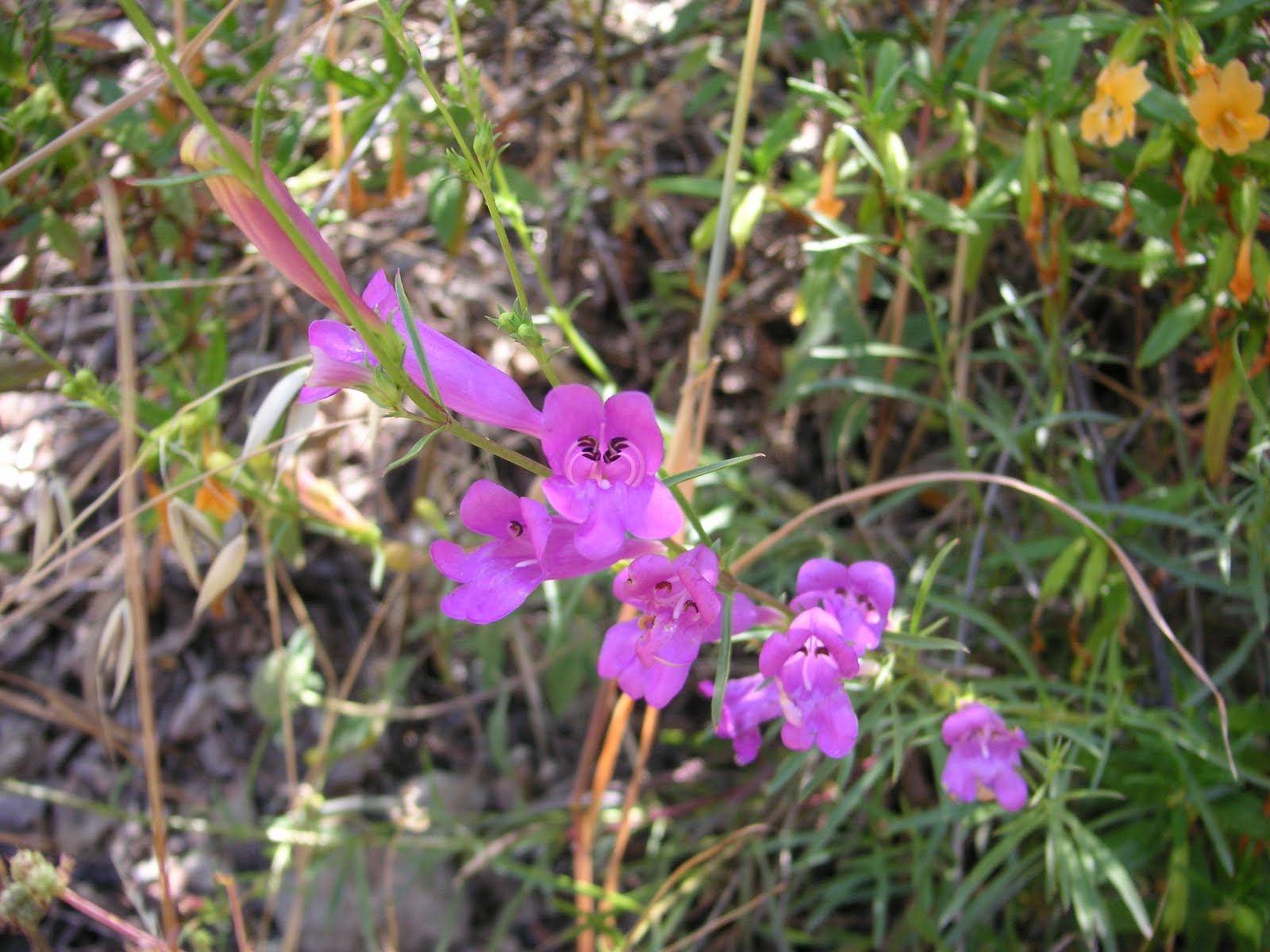
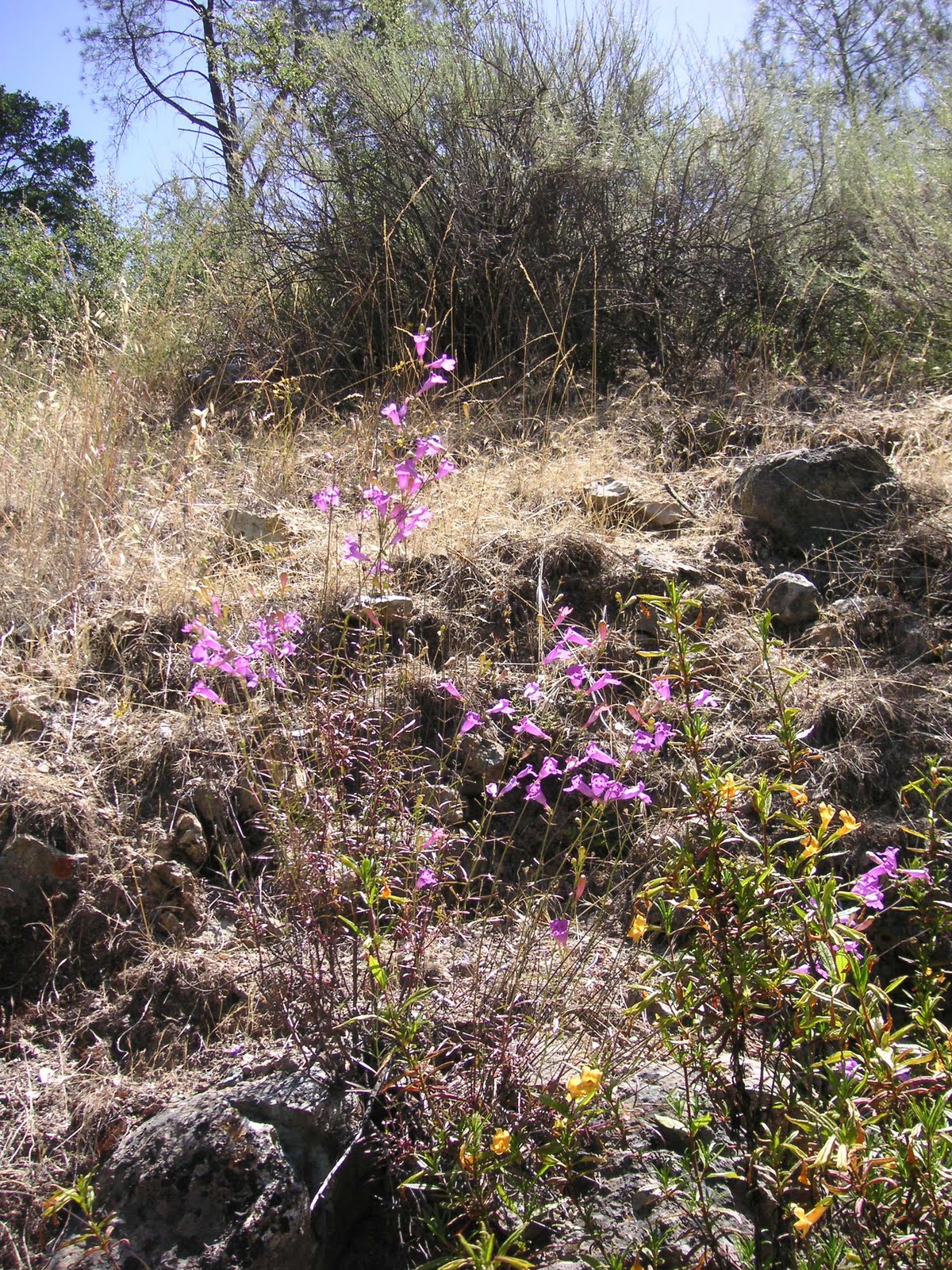
foothill penstemon ~ 06/09/11 ~ Pinnacles


foothill penstemon
Penstemon heterophyllus var. heterophyllus
Plantaginaceae (formerly Scrophulariaceae)

The detail of this flower with its curved stamens is amazing. It's like a 4 gun salute to the army of bees found at Pinnacles. Interesting to note, the buds are yellow, which I barely captured in the first pic (click on it to see a larger version). While this species is common throughout the state (with 3 subspecies), this is the first time I've noticed this plant.

Saturday, May 14, 2011

seaside bird's-beak ~ 05/14/11 ~ Fort Ord

One of our guides Chris tried to point this small plant out to me a couple times during our walk. She said to look for the "little red, 6 inch tall, Charlie Brown Christmas tree." I totally missed seeing it, until she tossed a little rock to the base of the plant. She felt this younger stage of its growth was its cutest. There are very few pictures online of this particular subspecies. It is listed in the state of California as endangered. I believe this was found in an area that was burned in 2003.

Sunday, April 24, 2011

seaside painted cup ~ 04/24/11 ~ Carmel Highlands


Monterey paintbrush / seaside painted cup
Castilleja latifolia
CNPS 8th Edition Inventory
Orobanchaceae (formerly Scrophulariaceae)

Have you missed my posts? This is the first day that I've felt somewhat better in 3 weeks (posted 05/10/11). Hooray! This is a new species of paintbrush for Nature ID. Isn't it pretty? I can't believe I haven't posted a picture of it before now. It's a rare plant found only here in CA along the coast. Vern Yadon states in Wildflowers of Monterey County that the seaside painted cup is semi-parasitic on beach sagewort (Artemisia pycnocephala) and the colors can vary from orange, yellow, white, and red. Check out the embedded links in the ID below the pictures above.

Friday, April 8, 2011


Castilleja attenuata
Orobanchaceae (formerly Scrophulariaceae)

posted 04/16/11 - I'm very pleased with this find as I was attempting to get pictures of another flower at the time. I would have walked right past it since it's so small and inconspicuous, especially among the grasses.

I learned of this ID during a visit to our town's Good Old Days last weekend. One of the regular booths at this annual street fair is hosted by the Monterey Penninsula Regional Park District. They had a copy of the newly released book Wildflowers of Garland Ranch - a field guide by Michael Mitchell and Rod M. Yeager, which I was very excited about. Unfortunately, they were not selling the book at their stall. As it so happens, the following weekend (i.e., currently as I post this blog entry) is the 50th Annual Wildflower Show hosted at the Pacific Grove Museum of Natural History and run by a small group of dedicated volunteers from the local Monterey Bay Chapter of the California Native Plant Society. While I didn't have enough cash on me to purchase the book (no credit cards accepted), I did return later yesterday with cash in hand.

I'd like to give public kudos to Carol and Brian LeNeve, who are always so kind and informative and tirelessly do the brunt work of the wildflower show.

ps 06/01/11 - This ID of C. attenuata was confirmed by Mark Eggar on Flickr. He's a public school science teacher up in Seattle, WA, and I consider him one of the most accessible Castilleja experts around. Check out Eggar's impressive Castilleja photo collection.

I was really pleased at how well this photo turned out with the little faces (click on the picture to see a larger image), considering I took only one shot in a hurry as the wind was picking up right before it began to snow. To confirm this ID, I compared this with the purple owl's-clover (C. exserta ssp. exserta), which is also present at Garland Ranch and has a hooked, hairy beak, versus the exserted stigma of C. densiflora (seems contrary to the scientific names, eh?). If I had my druthers, I'd call all owl's-clovers CA quail's-clovers due to the little "plume" (hooked, hairy, exserted, or otherwise) above the face.

ps 06/01/11 - This ID of C. densiflora var. densiflora was confirmed by Mark Eggar on Flickr. He's a public school science teacher up in Seattle, WA, and I consider him one of the most accessible Castilleja experts around. Check out Eggar's impressive Castilleja photo collection.

Sunday, March 20, 2011

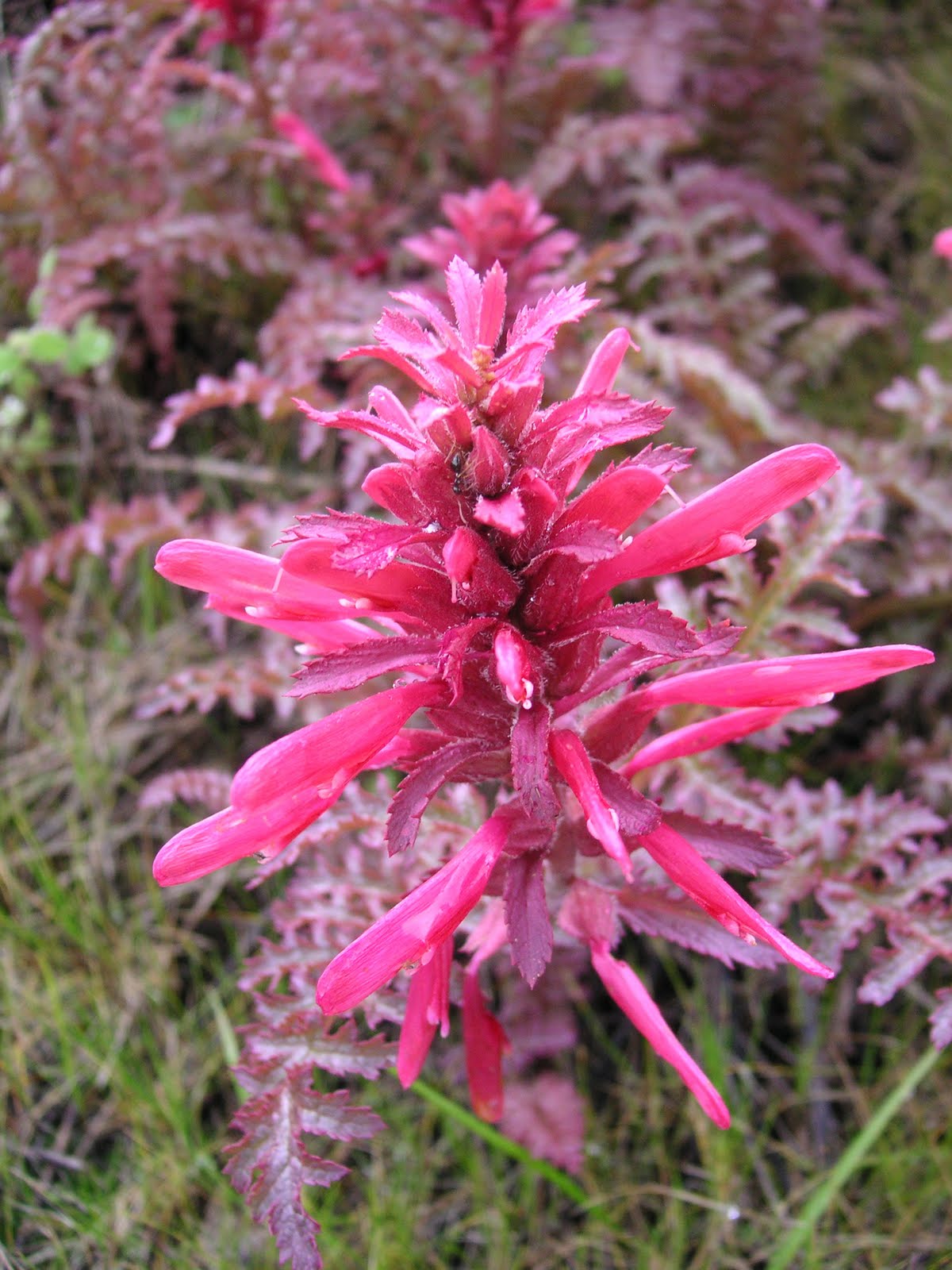
Indian warrior ~ 03/20/11 ~ Fort Ord


Indian warrior
Pedicularis densiflora
Orobanchaceae (formerly Scrophulariaceae)

This is the best showing of Indian warriors I've ever seen. Wikipedia says this is a root parasite of plants like manzanitas. Until I read this, I didn't actually notice the low growing manzanitas, during our hike nor in my pictures, along the trail where we found these. My eyes gravitate toward the bright and colorful. To be politically correct, Jepson's recommends the following common names: dense-flowered pedicularis, dense-flowered lousewort, red warrior, or warrior's plume. However, I doubt anyone who's familiar with these plants would know what I'm referencing if I called it a lousewort, so called because there was apparently a belief that a lice infestation would occur if livestock fed on these plants. I was amazed at the variation of Indian warriors we saw within one stretch of trail, from light salmon colored flowers to deep purple leaves; for additional pictures, check out my Flickr set.

Wednesday, June 9, 2010


purple foxglove
Digitalis pupurea
Plantaginaceae (formerly Scrophulariaceae)

While this is an introduced species, I still love seeing it out in the woods... often where nothing else is blooming. It's native to Europe.

Sunday, May 23, 2010

Indian paintbrush ~ 05/23/10 ~ Jacks Peak

(pale form, most likely)

(pale form, most likely)

(normal color)

(note the very red stem is somewhat unusual)

Indian paintbrush
Castilleja affinis

Orobanchaceae (formerly Scrophulariaceae)

Given my current confusion over the Castilleja genus, I'm going to leave these mostly unidentified. I suspect I have 3-4 species shown above. The first two pics were the first time I noticed the hemiparasitic nature of paintbrushes as they were well off the ground and growing on top of the unknown shrub. If you look closely at the second picture, there's an immature katydid (and, no, I didn't do it!). Maybe if I'm really nice, I can get Mark Egger to look at my collection of paintbrush pictures.

ps 07/09/10 - After opening a Flickr account, Mark Egger took a look at my request and helped me with the IDs several weeks ago. He believes they're all the same species. I'm still finding it hard to accept, but I trust his expert opinion. Really, what do I know about paintbrushes, other than they're pretty? I've separated out paintbrushes and what I'd consider owl's clovers, in my labels below and in the side bar, despite the common names. Oh, Calflora's lists Castilleja under Scrophulariaceae, but I'm moving them to the Orobanchaceae family. Also, it seems Jepson's online objects to the term "Indian paintbrush," but I don't see anyone knowing what I'm talking about if I say "Lay and Collie's paintbrush." As always, thank you, Mark Egger!

Saturday, May 8, 2010

purple owl's-clover
Castilleja exserta var. latifolia
Orobanchaceae (formerly Scrophulariaceae)


purple owl's-clover
Castilleja exserta var. latifolia
Orobanchaceae (formerly Scrophulariaceae)


an "odd form" of johnny nip
Castilleja ambigua var. ambigua
Orobanchaceae (formerly Scrophulariaceae)

Alrighty, this post on owl's clovers just about made me throw in the towel on continuing with this blog. Oh my goodness, I couldn't find decent IDs on any of these. What I provided above are my best guesses after looking over hundreds of pictures. I make no allusions that I key plants... or any of the IDs on my blog. I've heard remarks this method is not very scientific. Yeah, well, I'm not claiming to be scientific, but I do like to know what I'm looking at. In any case, I suspect there needs quite a bit of work done to straighten out this genus Castilleja. I'm seeking some help from someone I found online, so maybe I can reconcile these IDs.

ps 05/16/10 - I've already heard back from Mark Egger who is a CalPhotos contributor and specializes in Castilleja. I've made the corrections above according to his expert IDs. I'm also taking his cue by using variety and not subspecies in the scientific names. With big thanks to Mark Egger!!! I've added his Flickr stream under recommended ID links for Castilleja. If anyone can get Castilleja sorted out, he can.

LOL, my 3 guesses for the last photo of johnny nip were: Castilleja attenuata, C. densiflora ssp. obispoensis, C. lineariloba. Oh well...

common coast paintbrush
Castilleja affinis ssp. affinis
Orobanchaceae (formerly Scrophulariaceae)

Last year I was too intimidated to ID the paintbrushes. There are 71 records in Calflora for the genus Castilleja. Oy! For this reason, I've held off posting my pics of them. Thanks to actually using a plant list for Fort Ord, I was able to narrow down my search for this paintbrush ID. My second best guess C. wightii ended up being the old name for C. affinis ssp. affinis.

They really are striking, and, no, I did not enhance the color of these pics at all (oh yep, I tried, but the red turns kinda funky with the enhance feature of iPhoto). These pictures were taken under the oak trees, about a 5 minute walk away from the lupine. Fort Ord really is an amazing place! And to think there used to be soldiers in training trampling through all of this, shooting at stuff left and right. We still find lots of empty bullet casings on the paths. I wonder how many of the soldiers got poison oak rashes?

Thursday, April 8, 2010

dense-flowered owl's-clover
Castilleja densiflora ssp. densiflora
Orobanchaceae (formerly Scrophulariaceae)

Despite the common name of owl's-clover, this plant is in the Castilleja genus (family Scrophulariaceae) along with paintbrushes, not Trifolium (family Fabaceae) with other true clovers. For a fabulous picture of why this is called owl's clover, look at Doreen Smith's photo and imagine little owls sitting there.

I'm fairly positive about this ID. There are a couple of other similar looking species: C. brevistyla (short style owl's-clover) - it's difficult to find ID info on this and is not listed for Garland Ranch; and C. exserta ssp. exserta (purple owl's clover) - however, mine doesn't have hooked, hairy beaks.

Note: I did not link to Calflora & CNPLX's C. brevistyla entries because they are still showing a misidentified photo as corrected to C. densiflora by Jeffrey Greenhouse.

ps 04/13/10 - I rewrote this post because I mixed up my links. It's really easy to make mistakes. I can't imagine tackling something as impressive as CalPhotos.

Thursday, May 28, 2009

cutpetal bush monkeyflower ~ 05/28/09 ~ Los Padres Dam


cutpetal bush monkeyflower
Mimulus bifidus
Phrymaceae (formerly Scrophulariaceae)

Now, I'm not positive about the ID to species (M. aurantiacus?), but I'm sure it's a Mimulus. Los Padres has the prettiest monkeyflowers I have ever seen! The incredible color reminded us of the color of creamsicles. Wow! I only wish my camera could focus up close (hint, hint).

ps 07/10/11 - It looks like this flower is aka Diplacus grandiflorus. Also, it has been moved to the lopseed family, which I have corrected above.

Thursday, April 16, 2009

Edith's checkerspot caterpillar ~ 04/16/09 ~ Pinnacles

Edith's checkerspot caterpillar feeding on Indian warrior
Euphydryas editha feeding on Pedicularis densiflora
Orobanchaceae (formerly Scrophulariaceae)

Edited 05/24/14 - I originally posted this as variable checkerspot caterpillar (Euphydryas chalcedona).  When we went back 3 weeks later (from the westside on May 8, 2009, not the eastside as shown here), adult variable checkerspots were everywhere on flowers and mud puddles!  

Then, last year I went out with our local Monterey butterfly guy Chris Tenney, and he recalled Paul Johnson had told him Edith's feeds on Indian warrior, whereas variable is actually variable in its host preferences.  I have since confirmed directly with Paul that he has observed this host difference between these two look-alike local checkerspots. He's quite good at distinguishing adult Edith's from variable on the wing.  I changed the ID above from variable to Edith's.  Plus, I've seen first-hand both spp. flying together, so that May 2009 visit may very well have both on the wing.  Thanks, Paul!