Showing posts with label carrot family. Show all posts

Sunday, March 9, 2014

bramble hairstreak ~ 03/09/14 ~ Pinnacles

Apiaceae

posted 03/18/14 - I should have posted this yesterday, but it slipped my mind that it was St. Patty's Day until I saw all the school children wearing green on the Rec Trail as they headed to the Aquarium.  The way the kids float in and around each other reminded me of butterflies, hence this post.  I've got butterflies on the brain.  Last year I noticed the populations of bramble hairstreaks seemed to be booming everywhere I went.  I'll be curious to see how they show this dry year.

I half joked with Art Shapiro that the common names of butterflies are becoming more reliable than the scientific names.  He agreed with me.  I tend to lean old school, like him.  Oy vey!  It looks like there's quite a heated debate around the taxonomy of this common butterfly, as is evidenced by this BugGuide entry under lotus hairstreak.  I've also read a couple mentions for C. viridis for the coastal version.  Local lep people, including at Pinnacles, seem to prefer C. perplexa.

I think, for a descriptive and recognizable name, I'm just going to call them bramble hairstreaks.  They're the only solid green butterfly reported in this area.  However, the juniper hairstreak (Callophrys gryneus) might be mistaken for a bramble if one doesn't look close enough, and there are very few reports of junipers.  I should note the bramble topside is actually solid brown for both males and females, and it's a flash of green and brown when they fly by.  When all is said and done, I'm charmed by this sweet little green butterfly.

ps - As I was researching links (all the highlighted words above) to embed in this post, I found this odd page for lomatium @ Sustainability in Prisons Project in conjunction with Evergreen State College.  Huh?  Yes, correctional facilities.  I heard Evergreen folks were a little wacky.  Their project is fascinating.

pss 03/21/14 - Ken-ichi Ueda on Flickr came up with a similarly tangled name search.  I'm glad I'm not the only one who finds this confusing to track.

Monday, May 28, 2012

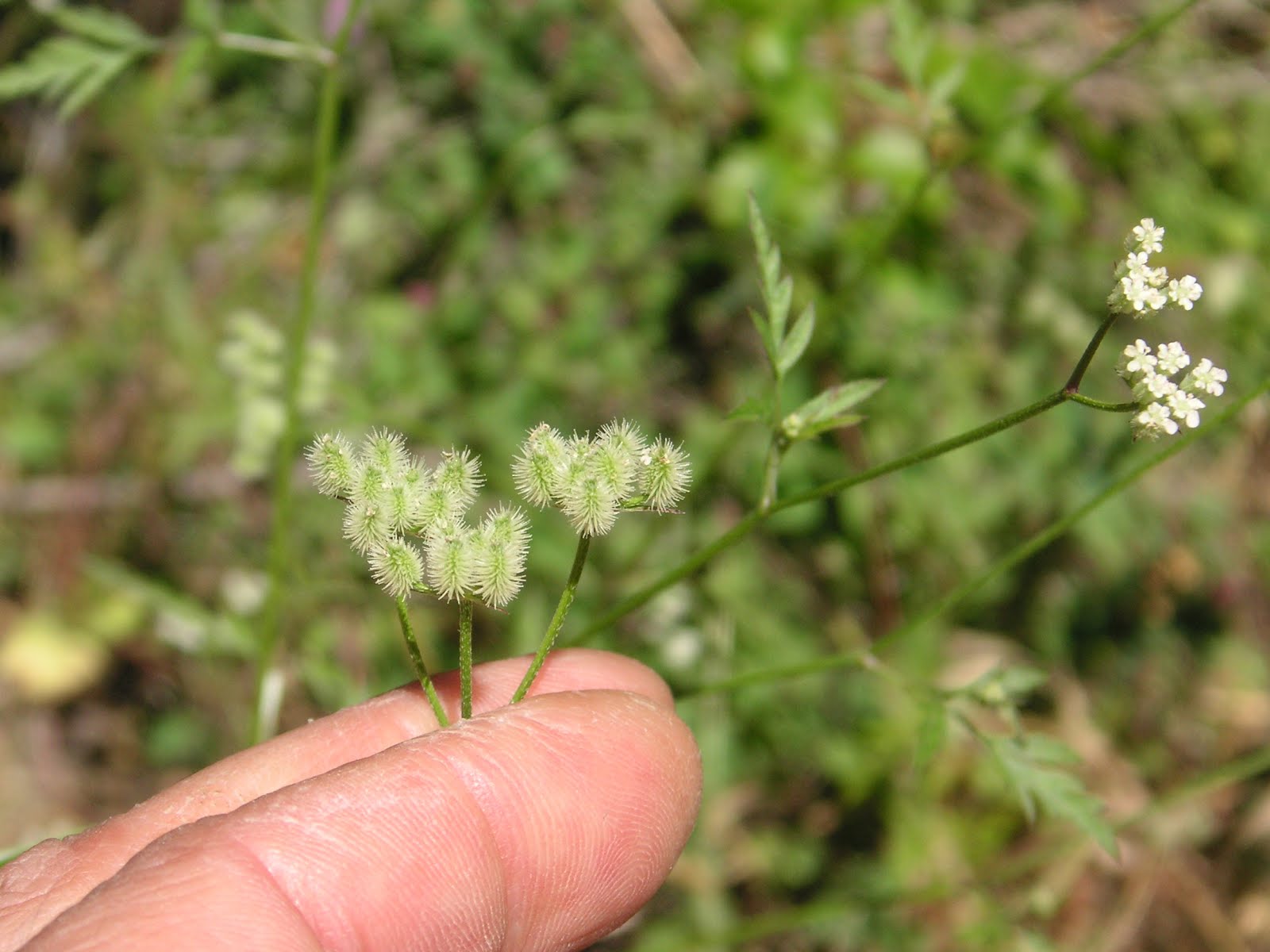
tall sock-destroyer ~ 05/28/12 ~ Fort Ord

Apiaceae

I'm loving the new common name given to this plant by Jepson eFlora. It's very apropos. To see a decent picture of why it could be called a sock-destroyer, check out this photo from CalPhotos.

After looking at numerous online photos of various hedge parsleys, I'm deciding against what David Styer suggested, even though he likely knows the plants of Fort Ord better than anyone else. He thought these were either knotted hedge parsley, aka short sock-destroyer (Torilis nodosa) or CA hedge parsley, aka false carrot (Yabea microcarpa). I compared online pictures with Jepson eFlora descriptions and decided on the tall sock-destroyer ID, because all the flowers and seeds we found here were at the terminal ends of stems (not along the stems like with T. nodosa) and with rays almost the same length (not unequal like with native Y. microcarpa). Since I needed a visual to decipher carrot family part names (like peduncle, ray, and pedicel), I found a great labeled photo of a carrot family member from UBC Biology 324 Blog.

Obviously, hedge parsleys are not the only plants with seeds that stick to fabrics like Velcro. I'm sure their real purpose is to stick to furry animals with equally annoying results to the carrier such that the seeds will be picked at repeatedly until they drop at a new location. David pointed out the similarly looking and closely related bur chervil (Anthriscus caucalis
) and how its seeds have a little pointy end.

Saturday, November 12, 2011

poison hemlock ~ 11/12/11 ~ Elkhorn Slough


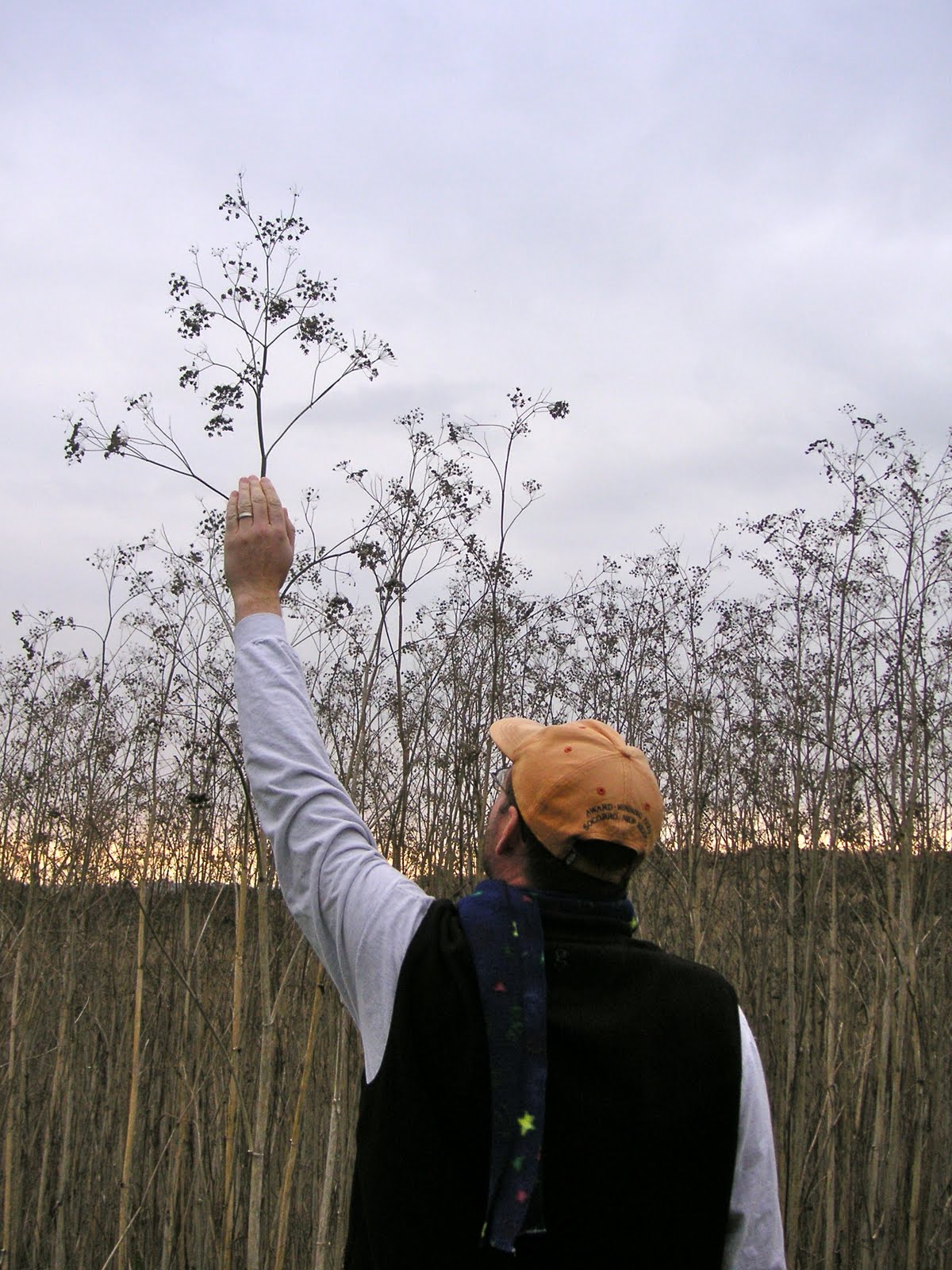
While poison hemlock gets very little mention on the recently revised official Elkhorn Slough site, in my humble opinion, it is the single most dominating weedy species on their coastal, publicly-accessed grasslands. There are massive stands of it, not only in the expansive area it encompasses but also in height. Andy was kind enough to provide a size comparison for me to show it readily grows to 8 feet tall at Elkhorn.

Per my m.o. for Nature ID, all these photos were taken on November 12, 2011. This means the typical blurb repeated everywhere from books to online that C. maculatum flowers from April to July is not entirely correct. It's obviously flowering here in November, so it's no wonder it's such a productive plant. The flowers and leaves remind me very much of Queen Anne's lace and garden carrots.

I was sorry to see Land Steward ceased blogging about Elkhorn Slough. In fact, I discovered several blogs that featured Elkhorn Slough have stopped abruptly in the past two years, which makes me wonder if all the staff and volunteers were asked to stop blogging about their experiences. I now receive weekly, glossy, sugar-coated e-mail updates on what is going on there. It's too bad; I preferred the nitty-gritty and personal perspective of the reality of land management.

Did you notice the other unwanted resident in the first photo, a cucumber beetle?

Oop, I guess I should also note that there are other hemlocks out there besides the ones in the Apiaceae, aka carrot family, such as those in the pine family like Tsuga spp.

Wednesday, January 19, 2011

If it weren't for the neon yellow color, I'd have a hard time identifying this low-growing plant in the carrot family. Vern Yadon states, "Think of someone walking across a dark carpet with bleach on their shoes and you will visualize these chartreuse green flowers in a dark green field." I only spotted a few patches of footsteps during this hike. If my notes from past years are correct, they should last until about mid-March. This is the earliest I've seen them; of course, we've had an incredibly mild and warm January this year.

Saturday, March 14, 2009

footsteps of spring
Sanicula arctopoides
Apiaceae

Aptly named! Neon yellow-green splotches in the bright-green grasses of spring alongside many trails. Interestingly, they're in the same family as carrots, anise, and hemlock.

By the time we went hiking out at Fort Ord again (from Inter-Garrison on March 28, not Creekside as shown here), most of the footsteps were fading and withering, replaced by a superficially similar, ground-hugging yellow flower, the coastal sun cup.

ps 01/27/11 - Cool! I can link to the entire month of March 2009 from my blog.