Showing posts with label * all plants (non-native). Show all posts

Sunday, September 14, 2014

hooded owlet ~ 09/14/14 ~ at home

hooded owlet moth caterpillar prolegs (+ aphids)
Cucullia sp.

Yesterday, we walked down Oceanview above the Rec Trail with hopes to spot and cheer on my cousin Bob while he ran the last leg of the PG Triathlon.  We found Bob in the race... and a couple brightly-colored caterpillars on the same tall stalk of roadside weed.

Cats were fresh on my mind, because I had just received an e-mail from Gordon Pratt explaining his techniques for raising tiny blue butterflies and essentially encouraging me to do the same.  Eh, I make for a rather lazy lepidopterist and generally only raise whatever I can easily find (read: large enough to spot from 5 ft. away!) and if I'm in the mood.  It's been a while since I've reared anything, the last ones being Genista broom moths as a pest management favor for J.  I've had moderate luck with larger leps in our relatively cool coastal climate (e.g., Lophocampa success and unidentified woollybear failure), but I haven't reared anything as small as blues (except for the accidental poop-shooting orange tortrix relative).  So, while I figure out the logistics for raising tiny cats (and whether I have the patience for such endeavors), I'm dusting off my rearing containers for a bit of practice with yet another larger caterpillar.

À la Gary Larson, here are the newest additions to our family (note: he/she designations are purely random)...

Charlotte
Those are her gorgeous black prolegs in the first picture above.  She was voracious and slightly smaller than her companion.

George
Slightly larger, less hungry, and definitely more mobile.  Go, George, go!  I quickly stuffed a cotton ball into the vase, so roaming George wouldn't drown.

I didn't measure either one (remember, lazy), but they were maybe 2 inches long.  They seemed to prefer medium-sized leaves off stems that could support their hefty stature.  Within a day, the single stalk I found them on was stripped bare, except for side supporting stems and wispy flower-bud tips, whereupon I ran down the street and collected 2 more stalks for food.  Oy!  I inadvertently brought home lots of other insects from the clippings (aphids, ants, an inchworm, and a syrphid fly larva).

Until I see their adult form, I can't really say which Cucullia sp. these are.  My ID search started with googling images of "zebra striped caterpillar".  No kidding.  Yep, super-scientific.  Not!  But, it works.  That took me to the zebra caterpillar (Melanchra picta), which gave me Hodges number 10293 and a decent starting point.  Btw, Moth Photographer's Group has a excellent series of caterpillar plates for North America.

Cucullia speyeri (Hodges 10190) looks like a superficial match, but Robert W. Poole indicates C. speyeri is not found anywhere near here.  I think he's the same fellow who wrote a Noctuid catalog, so he would know (but I'm not positive).  There are certainly enough look-alikes, here (various), here (thin yellow stripe on side w/ white prolegs and white bindi), here (Hodges 10191), and here (wide yellow stripe on side w/ facial freckles and white bindi, not laetifica), so it's hard to say if this one from San Diego on CalPhotos is correct.  The Cucullia adults are not much easier to tell apart.

Asteraceae

It's because of the reported native host plant for C. speyeri, horseweed (Erigeron canadensis, aka Conyza canadensis), that I was able to track down the ID of this non-native < 4 ft. tall relative.  I checked the few flowers in bloom, and they definitely look like bonariensis, not canadensis, to me.  I'll try to take pictures of this plant in situ, as the one I have here was otherwise stripped of its leaves and didn't look like it normally would.  More to come...

Tuesday, August 26, 2014

yellow star-thistle ~ 08/26/14 ~ Wishing Well

Asteraceae

This cheery yellow flower is easily in my top 5 most despised plants in the state of CA, which gained a foothold here sometime before 1869 and hails from southern Europe and western Eurasia.  It's super pokey and stops me in my tracks while out hiking.  I realized recently that I may have been mistaking another star-thistle tocalote for this yellow star-thistle, so I made a point to find it on the road outside the west entrance to Pinnacles National Park to take a closer look and these pictures.  If only it weren't such a great reported butterfly nectar source...

Tuesday, August 12, 2014

tocalote ~ 08/12/14 ~ Pinnacles

Asteraceae

This is the plant that while it was blooming, I had mistaken for yellow star-thistle.  There are large patches of tocalote inside the National Park and almost no yellow star-thistle (thanks to an aggressive targeted weed management program).  What made me realize I had been mistaking this ID is that while I was hiking past it, it dawned on me that it didn't hurt as much as I thought it should if it were yellow star-thistle.  No kidding.  I'm apparently not the only one who mistakes the two related plants, because Anna Bennett did a nice job comparing the two on CalPhotos: here, here, and here.

Friday, July 25, 2014

Mylitta crescent ~ 07/25/14 ~ Sierra Valley

female Mylitta crescent nectaring on Canada thistle
female Phyciodes mylitta mylitta nectaring on Cirsium arvense
Asteraceae

Note the stronger contrast of the female underside (ventral) markings compared to the male Mylitta crescent.  The same can be said above (dorsal), too - see below.

female (brighter, ~middle of pic), male (more solid in color and at the bottom of the pic)
Mylitta crescent

ox-eyed satyr ~ 07/25/14 ~ Sierra Valley

female ox-eyed satyr nectaring on Canada thistle
Asteraceae

Like so many of Art's Sierra Nevada butterflies, I would have never gotten this ID without his patient help.  This ox-eyed satyr is one of at least 25 subspecies of the common wood-nymph!  Here I am just trying to figure out the difference between the common and the Great Basin wood-nymph (Cercyonis sthenele).  Gah!  Additional posts to come...

Thursday, July 17, 2014

CA dogface ~ 07/17/14 ~ Podere di Farfalla

male California dogface nectaring on bull thistle
male Zerene eurydice nectaring on Cirsium vulgare
Asteraceae

Despite the fact our official state insect seems to fly practically all year around here (Monterey Co. and Pinnacles), I've only ever spotted this yellow butterfly a couple times.  It's frequently reported that its only larval host plant is false indigo (Amorpha californica).  Either that's not entirely correct, or plant folks generally don't bother looking for this native shrub.  I say this because the plant checklists for Podere di Farfalla and San Benito County strikingly do not include false indigo, notwithstanding the reported 10-month flight period of the CA dogface in these same areas.

As a note to myself, I want to be sure to not mistake the CA dogface for the superficially similar orange sulphur (Colias eurytheme), another butterfly I don't often see and have yet to photograph.

Thursday, July 10, 2014

Mylitta crescent ~ 07/10/14 ~ Podere di Farfalla

male Mylitta crescent nectaring on tocalote
male Phyciodes mylitta mylitta nectaring on Centaurea melitensis
for more information, click here and here
Asteraceae

The first crescent butterfly I became familiar with was in Ohio, the pearl crescent (Phyciodes tharos).  It became my mental model of what a crescent should look like on the top, something I liken to a grandmother's lace doily (don't ask me why, it just worked for me).  It was such an immediate ID clue for me that I don't think I ever really bothered to look at the underside (ventral) of the wings.  It wasn't until I recently picked up Art Shapiro's Field Guide to Butterflies of the San Francisco Bay and Sacramento Valley Regions that it finally dawned on me why crescents are named such.  Just look at that white crescent shape, along the margin in the middle of the ventral hindwing!  Cool.  Note: not all crescents have such strongly marked crescents.  Also to note:  female Mylitta often have more strongly marked topside (dorsal) patterns.  Ah, I'm slowly getting the hang of local IDs...

acmon blue ~ 07/10/14 ~ Podere di Farfalla

acmon blue (blue male top, brown female below) nectaring on tocalote
Asteraceae

Thursday, May 1, 2014

changing forget-me-not ~ 05/01/14 ~ Fort Ord

Boraginaceae

Gush.  This is my favorite new flower.  I don't care that it's non-native.  I love the three colors of blooms on one flower stalk.  The yellow petals turn blue and other parts turn red as they age.  I don't know how they explain the white.  The freshest bloom?  It's really tiny and so sweet.  It looks like it belongs on something girly, like old-fashioned stationery.

Tuesday, April 15, 2014

white-lined sphinx ~ 04/15/14 ~ Pinnacles

Lamiaceae

Well, I won't win any photography awards for these photos, but it's good enough to show how impressively long its proboscis is and for an ID.  I've been casually calling these hummingbird moths.  Problem is no one knows what I'm talking about.  In my defense, I spotted what I believe was a Hyles lineata during a break in the rain at SFB Morse Botanical Reserve on February 28, which happened to be around the time when I also started seeing rufous hummingbirds on migration.  On an overcast day, the overall coloring for both the hefty moth and the tan bird are remarkably similar, and the name stuck in my head.  I have Paul to thank for correcting me when we saw another white-lined sphinx along the butterfly highway. 

Thanks to the blurring of memory through time, I had forgotten all about the clearwings (hey, if you don't use it, you lose it).  Back when I lived in OH, I was familiar with the hummingbird clearwing (Hemaris thysbe), which can have the more traditional green and red coloring of hummingbirds.  They were popular subjects of insect question calls to the museum and were frequently described as hovering like a hummingbird with a lobster tail.  Pinnacles has a different clearwing, the bumble bee moth (Hemaris thetis), formerly classified under the eastern snowberry clearwing sphinx (Hemaris diffinis).  I plan on keeping my eye out for them, because day-flying sphinx moths are fun to watch.

Wednesday, March 26, 2014

giraffe's head ~ 03/26/14 ~ Ahwahnee Hills

Lamiaceae

Like with owl's-clovers, it doesn't take a big stretch of the imagination to see why the CA locals call this giraffe's head.  They're often featured as a plant in bloom at the Garland Ranch visitor's center, yet after years of looking, I've never seen it growing there myself.  So, I was a little surprised to find out this is not a native plant.  It hails from Europe, Asia, and Africa, if Wikipedia is correct.  For some reason the flowers remind me of CA hedgenettle, even though the leaves are totally different.

Friday, February 21, 2014

Victorian box ~ 02/21/14 ~ Hatton Canyon


I've seen this large shrub at different locations and wondered what it was.  My first thought when seeing it is coffeeberry.  Nope.  When it's in bloom, it reminds me of an orange tree.  And, I've tasted the bright red seeds.  Blech!  After several half-hearted attempts at IDing old photos, I finally resorted to a google image search for "orange berry tree wide wavy leaves".  Ta-da!  (Goodness, what did I do before google?  Anyone remember the World Book encyclopedia?)  I liked Trees of Santa Cruz County's blog post on Victorian box.  This garden escapee hails from eastern coastal Australia and has been locally reported at Jacks Peak and the Frog Pond.

Sunday, October 21, 2012

arum ~ 10/21/12 ~ Elkhorn Slough


I've wondered what these are for quite a while, ever since I first saw them in a corner of the Memory Garden behind the Pacific House in Monterey.  Lately I've seen them more and more in yards here in town.  I attribute their recent proliferation to Trader Joe's offering cheap, decorative potted plants. Unfortunately, while you shop for pseudo-organic, cleverly packaged food products, many of their potted plants only include generic care instructions for water and sunlight without any identifying label.  This is the first time I've seen these growing in the "wild" outside of a tended garden.  Given Elkhorn Slough's history as a farm and the proximity of this bunch under an oak tree next to one of the barns, I suspect this is a waif from the past.

Without seeing the leaves or flowers, I can't easily tell which of the 25 spp. of Arum this is.  Calflora and Jepson eFlora list only Italian lords and ladies (A. italicum) and black calla (A. palaestinum, A. palestinum seems to be a misspelling) as occurring in CA.  The ones in the Memory Garden have a striking deep purple spathe, like the black calla, aka Solomon's lily, but several Arum spp. are also black.  If I had ignored the bright orange color of the fruit, I may have been able to figure out this was related to the locally prolific calla lilies (which surprisingly I don't have as a featured ID yet).  Oddly enough Arum and calla lilies are in the same Araceae family as duckweed.  Weird.

ps 08/19/13 - For a fun post on the related cuckoo pint (A. maculatum), check out Cabinet of Curiosities.

Monday, May 28, 2012

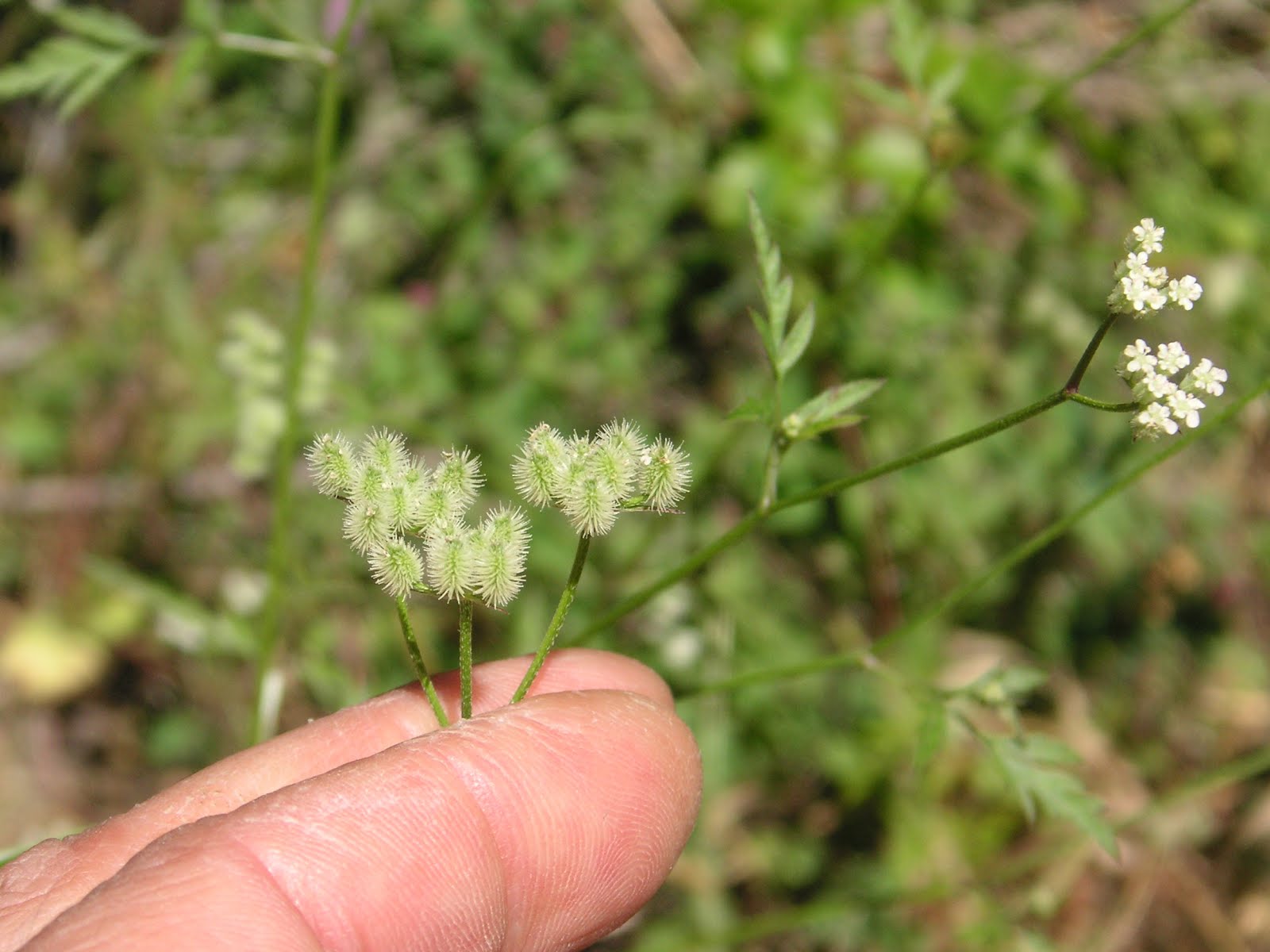
tall sock-destroyer ~ 05/28/12 ~ Fort Ord

Apiaceae

I'm loving the new common name given to this plant by Jepson eFlora. It's very apropos. To see a decent picture of why it could be called a sock-destroyer, check out this photo from CalPhotos.

After looking at numerous online photos of various hedge parsleys, I'm deciding against what David Styer suggested, even though he likely knows the plants of Fort Ord better than anyone else. He thought these were either knotted hedge parsley, aka short sock-destroyer (Torilis nodosa) or CA hedge parsley, aka false carrot (Yabea microcarpa). I compared online pictures with Jepson eFlora descriptions and decided on the tall sock-destroyer ID, because all the flowers and seeds we found here were at the terminal ends of stems (not along the stems like with T. nodosa) and with rays almost the same length (not unequal like with native Y. microcarpa). Since I needed a visual to decipher carrot family part names (like peduncle, ray, and pedicel), I found a great labeled photo of a carrot family member from UBC Biology 324 Blog.

Obviously, hedge parsleys are not the only plants with seeds that stick to fabrics like Velcro. I'm sure their real purpose is to stick to furry animals with equally annoying results to the carrier such that the seeds will be picked at repeatedly until they drop at a new location. David pointed out the similarly looking and closely related bur chervil (Anthriscus caucalis
) and how its seeds have a little pointy end.

hairy pink ~ 05/28/12 ~ Fort Ord

petrorhagia / hairy pink
Petrorhagia dubia
Caryophyllaceae

This flower has many common names. It's also known as windmill pink, which I think gets people confused since it's also known as wilding pink. For folks with hearing impairments like me, that could easily sound like windmill pink. Both Jane and David Styer pointed out the very large ovary on this flower from two different trips with each as my field guide. I think this must be important, because the MBC CNPS lists from 2010 matches David's list. However, it got changed back to childing pink (Petrorhagia prolifera) for the 2012 list. Which is correct? Or are both spp. growing in the same areas? It's unfortunate that people have taken up to calling this pink grass, which is also another common name for the 3 spp. of Petrorhagia in CA, all non-natives originating from the Mediterranean region.

Saturday, May 19, 2012

windmill pink ~ 05/19/12 ~ Fort Ord


Jane pointed out how the petals look like little windmills, hence the name. I hope I'm not showing off my ignorance too much, but I wonder if those round structures on the stem below the flowers are buds or seeds. Which direction do these flowers bloom? From the bottom up, or from the top down? My orchids bloom from the bottom up, and my columbine blooms from the top down - two very different kinds of plants. Caryophyllaceae is a new family on Nature ID. Jepson's calls it the pink family, but the Styers refer to it as the carnation family.

Wednesday, April 25, 2012

cheeseweed ~ 04/25/12 ~ Frog Pond


Did you ever wonder how a plant got its common name? Cheeseweed, really? This non-native from Northern Africa, Europe, and Asia supposedly has fruiting heads that look like little wheels of cheese. I wonder if cheese fanatic Wallace of Wallace and Gromit was the one who named this plant. It should be noted that this individual was the only one I found at the Frog Pond and is not listed on either the old or the new 2012 CNPS plant list for the Frog Pond Wetland Preserve, Del Rey Oaks.

ps 05/06/12 - I did wonder if this was bull mallow (Malva nicaeensis), but according to Jepson, bull mallow should be trailing along the ground and not erect as shown.

Sunday, March 4, 2012

acacias ~ 03/04/12 ~ SFB Morse Botanical Reserve

prickly Moses / star acacia
Acacia verticillata
Fabaceae

prickly Moses (left shrub) and golden wattle (right tree)

everblooming acacia
Acacia retinodes
Fabaceae

Wow, I didn't know there was such a variety of acacias. Usually when I see the prolific bright yellow blooms, I'm speeding down a highway, like Hwy 1 from Watsonville to Santa Cruz and Hwy 68 from Monterey to Salinas. During this hike, I noticed the leaves and blooms were very different shapes, so I took pictures. All these trees and shrubs featured here are native to Australia.

When I saw my doctor last month for a check-up, he blamed the acacia trees for my runny nose. I'm not sure that's entirely correct, since right along the coast where we spend most of our time, there are no acacias that we've seen. The nearest one is at the Pacific Grove Golf Course a mile away. I'm guessing my and Andy's late January to early March allergies are due to the Monterey pine.

Monday, February 20, 2012

curly dock ~ 02/20/12 ~ Pinnacles


I was a little disappointed to see this weed at Pinnacles, a place I consider relatively pristine. To my knowledge, Pinnacles has never been farmed or used for any other purpose than pure enjoyment. I wonder how much hikers inadvertently bring in weedy seeds or spores on their shoes, clothing, and camping gear.

At the research reserve in Elkhorn Slough, they require every visitor to step into bleach water with hopes to keep out Sudden Oak Death (SOD). I don't mind at all. Hehe, this reminds me of the time our camping gear was held for several days at the Auckland airport upon arrival in New Zealand. Andy didn't have a lick of spare clothing, and we were in Tairua by the time an airport shuttle finally delivered his backpack. It wasn't all bad; he got a now-favorite holiday shirt from a second-hand store along with some swim trunks, and we stayed in a lovely cabin since we couldn't camp.

ps 09/13/14 - It's been interesting reading through my older posts.  I have to say, now that I know the lovely great copper butterfly uses dock as a host plant,  I very much like seeing this very distinctive reddish plant around.  I'm amazed at how I was getting caught up in the biological xenophobia that's been going around.  I don't want to be in the mind frame that it's okay to kill things and be super distructo simply because, today, I deem it somehow to be bad.  Tomorrow, I may change my mind and deem it be good (as shown here), but then it's too late.  And, also during a recent visit to the Park, I talked with a couple historical researchers who told me that a part of the property was once a copper mine claim.  They'll have that information available in the next year on the website.  Cool.  Also, I'm trying to make it a habit to clean my hiking shoes and gear before I leave a place, so that I can minimize anything I might potentially spread at my next hiking destination.

Saturday, November 12, 2011

wild radish ~ 11/12/11 ~ Elkhorn Slough

Well, knock my socks off! Hello? I had no idea the wild radish I frequently see around here is the same species as the radish I buy at farmers' markets and the grocery store. Did you know that? I even grew one this summer in my mini-greenhouse after a stocky sprout came up from my too-soon-to-use compost. I'm laughing, because the whole time I was perplexed thinking, "Hey, this looks exactly like what I see growing out in the wild." I should note, there is another species of radish that grows wild at Elkhorn and is aka wild radish / jointed charlock (Raphanus raphanistrum).

The second photo above is the exact area where last year I noticed a heavy dose of herbicide to knock down the poison hemlock. I'm sorry to say that at the time I was very critical of the reserve's generous use of herbicides. I had quickly edited the post, which now doesn't reflect what I was reading at the time. I'll admit to being ignorant of lots of things. Through following blogs, my opinions about land management practices have been changing. Bree at the now defunct Land Steward had two really good posts, what restoration means to me and weeds. I still think the marketing departments at major pesticide manufacturers do too good of a job at pulling the wool over people's eyes, ears, and mouths. However, given the choice between invasives versus reintroduced natives... well, I do like seeing native flowers... but at what costs?