Showing posts with label x: Chews Ridge. Show all posts

Sunday, June 22, 2014

unidentified Satyrium hairstreak ~ 06/22/14 ~ Chews Ridge

unidentified male Satyrium hairstreak

posted 10/11/14 - This ID has had me stumped ever since June.  Both photo series are of the same individual as I turned around to capture different lighting angles.  It would have been great to get a photo of the topside (dorsal) wing color and abdomen to help ID, but that didn't happen.  As I was asking Chris his thoughts as to what it was, he forgot it was simply sitting on my finger and it promptly flew away into the sun when he made a sudden movement.  That's the handicap I've given myself this year by not collecting specimens.  Honestly, I didn't want to deal with lugging around a net and killing jar, pinning and spreading, and not to mention permit paperwork.  I think scrutinizing photos has been a good learning tool for me, but as evidenced here, it's not perfect.

I sent one of the lighter-colored pics around to my trusted butterfly posse (I hope they don't mind me calling them that), and I received a surprising variety of answers.  Their suggestions for ID are as follows (links open in new windows for photo comparisons):
gold-hunter's hairstreak (Satyrium auretorum) - BOA, BugGuide, Flickr
mountain mahogany hairstreak (Satyrium tetra) - BOA, BugGuide, Flickr
hedgerow hairstreak, aka sepia hairstreak (Satyrium saepium) - BOA, BugGuide, Flickr

I also trust Butterflies of America (BOA) more than self-reported ID sites like BugGuide and Flickr, which both have a few ID errors.  Even UC Irvine's Butterflies of Orange County has what I believe is a gold-hunter's in the middle of hedgerows.  These look-alike spp. are not well-illustrated in my field guides, so we're not alone in our uncertainty.  Can you ID?

ps - After initially insisting it was a mt. mahogany because of how dark it was, I'm now leaning towards a hedgerow hairstreak, mainly because of the tailend patterning.  There's a notable lack of any orange near the tails, which even if worn would have been an indication for gold-hunter's.  Besides, the tails are too long to be a male gold-hunter's, I think.  Oh, how do I know it's a male?  The relief of the teardrop-shaped scent gland (stigma) can be seen in the middle of the hindwing in the shadowier photos.

Thursday, June 5, 2014

Gorgon copper ~ 06/05/14 ~ Chews Ridge


They're all look-alikes!  Heavy sigh.  At first, I confused the female Boisduval's blue with the Gorgon copper with that split orange couplet dotting towards the butt when their wings are held at rest above their body.  Now that I'm looking at this picture, there's a definite chalky white that I've also noticed in the great copper and is totally absent in all the blues I've seen so far.  Also, I think I might get the topside female with its golden-hued window panes mixed up with the similarly looking tailed-copper.  I have yet to get a good look at females topside in-person, because I didn't bother this one too much except to take its picture.  She looks heavy with eggs and lots of fat.  In flight, the boys flash a beautiful alternating leathery brown with white, only a couple feet off the ground.  They're quite distinctive.

Boisduval's blue ~ 06/05/14 ~ Chews Ridge


Now, here's a butterfly with a fancy French name!  Jean Baptiste Boisduval was a famous lepidopterist, among other things, and I often see his name associated with the naming of numerous butterflies.  Chris Tenney introduced me to Boisduval's on my first ever visit to Chews Ridge back April 17, 2014.  It looked so similar to the silvery blue I saw the previous week on April 8 at Pinnacles, that I spent some time really comparing the two and even consulting with Art Shapiro.  I have netted pics of a couple extremely worn Boisduval's from a May 2 visit to Chews Ridge, which I haven't posted yet.  So, I'm guessing these here are the 2nd generation this year.  

Since I rarely get pics of the full-on topside, I've had to rely on the underside markings.  See the white-outlined, curvy row of black spots and then the black spots closer towards the wing edge (submarginal) on both the fore and hindwings (particularly in the middle picture above)?  Well, Boisduval's will always have a hint of those submarginal black spots, even when really worn, and silvery never does.  

The real point of this post is that I know the bottom picture is absolutely a female with a brown topside and hints of orange on the hindwing underside with an extra row of dots (Good grief, it looks just like a Gorgon copper from the underside!), but I can't really say for the first set.  Another form of female?  Or is it a boy?  Does anyone know?  Erg.  I should mention that green sheen in the first photo is not always evident.  Usually, it just looks black.

Friday, May 2, 2014

goosefoot violet seeds ~ 05/02/14 ~ Chews Ridge

goosefoot violet seeds and seed capsule
Viola purpurea ssp. quercetorum seeds and seed capsule

Chris Tenney has kindly been my local butterfly mentor as I seriously pursue butterflies again.  This week he wanted to introduce me to a couple of butterfly researchers out of the University of the Pacific in Stockton, CA.  He's been helping them study the unsilvered fritillary (Speyeria adiaste). Sure!  I'm just following the path laid out at my feet here, and don't think I haven't considered graduate school.  However, I have my own questions I'd like to pursue, not someone else's.  If a professor out there wants to sponsor me while I do my thing, then all the better.  Eh-hem...

Dr. Ryan Hill and his soon-to-defend Master's student Khuram Zaman met us in the middle of nowhere.  They pulled up in Khuram's flashy black BMW sedan with vanity plates.  Haha!  I had to laugh, because only in CA would serious field researchers drive a fancy-schmancy car.  The reason for their 3-hour drive down was to collect goosefoot violet plants and seeds, and census the violet population.  You see, before you can raise butterflies, you first have to raise and propagate their natural host plant.  It sounds easier than it really is.

Before my mentor Sonja died, she was figuring out how to reintroduce the extirpated regal fritillary (Speyeria idalia) to Ohio.  She used a grant to purchase a large incubator with timers, lights, and heat.  It looked like a fridge, but was the exact opposite.  She had me practice rearing leps in the incubator, first with cabbage butterflies.  It ended horribly when we ran out of cabbage from her garden, bought some from Whole Foods, washed it twice in huge tubs knowing there'd be Btk residue, and it still killed all my stock.  I cried, because all my babies died and it was a month's worth of work down the drain.  Remember, organic does not mean pesticide free.  In any case, she didn't get very far with the regals, because she couldn't find a violet she could successfully grow and that they'd eat.  So, I totally feel for Dr. Hill's predicament.  

If anyone has a source for native Viola purpurea ssp. quercetorum, please contact Dr. Hill!

Violaceae

locally known as Johnny jump up
Viola pedunculata (most likely)
Violaceae

When studying butterflies, it's helpful to know your plants, because they can be incredibly picky about which foods they eat.  Ryan and Chris have been working on verifying that V. pedunculata also grew on the hill. Growing on a dry southwest facing slope was a group of plants that seemed to intermingle with V. purpurea.  Chris suggested they were V. pedunculata.  Ryan couldn't confirm this from specimens collected last year and wanted to study them more.  Two weeks ago, Chris asked what I thought about the different violets, and we discussed it.  Ryan was finally convinced on this trip by the golden yellow petals of V. pedunculata (vs. lemon yellow), the more heavily marked nectar guides in V. pedunculata, the large root mass complex with many rhizomes in V. pedunculata (vs. simple in V. purpurea) and the relatively large and glabrous capsule of V. pedunculata (vs. smaller and pubescent in V. purpurea).  Funny enough, none of Ryan's plant keys mention the nectar guides that I use to distinguish V. pedunculata from other native violets.  To me, they're very distinctive with the bold, forks/splits/frayed on each side of the center guide, regardless of what the leaves look like.  I actually don't know if that's a reliable diagnostic, but that is what I use to distinguish what's found locally.  Of course, this doesn't help if the flower is not in bloom.  Ha!

tea-bagged violet seed capsules
tea-bagged Viola purpurea ssp. quercetorum seed capsules

This was Ryan's method to bag the seed capsules for collection after they've ripened and popped.  I think he said violet seeds can fling themselves out of the capsules by 6 ft. or so.  I like the high-tech use of emptied tea bags and a stapler.  He'll return later to collect the dried seeds.  Very cool stuff.

view from Chews Ridge

I always like taking a step-back look, because over time with all the close-up shots, I tend to forget what it really looked like.  This day will forever remain in my memory as a good day.

ps -  Please note, I allowed Dr. Hill to edit this blog post for factual accuracy, and I found some of his edits rather humorous.  It wasn't his car!  Hehe.  Plus, he added additional usage of the scientific names, more than what I would typically use for Nature ID.  That's fine, he writes for a different audience in peer-reviewed papers.  I try to be casual, accurate, and first-hand so that anyone can understand.  Have I ever mentioned it's because of my hearing impairment that I prefer common names?

Thursday, April 17, 2014

habitat ~ 04/17/14 ~ Chews Ridge in the Ventana Wilderness


Chris Tenney took me up to the Chews Ridge Lookout to find hilltopping duskywings and a couple blues.  He's been monitoring this site for butterflies for a number of years.  The weather wasn't ideal with a high cloud haze, which we had hoped would have burned off by noon this far inland from the ocean.  We still had some measure of success when the clouds uncovered the sun for brief bouts.  I'm now confident I can identify a Boisduval's blue (Plebejus icarioides), even though I didn't manage a picture of the numerous ones flying knee high above a grassy slope.  We also saw a handful of Columbian skippers (Hesperia columbia), but I'd have a hard time distinguishing them from other local Hesperiinae.

It's really beautiful up there and completely unfamiliar to me.  The variety of pines and oaks are new to me.  There's also the MIRA Oliver Observing Station down the ridge and plenty of charred evidence from the massive 2008 Basin Complex Fire.

I don't have a local's perspective of the area at all, despite having lived in neighboring Monterey for the past 11 years.  The Ventana Wilderness of the Los Padres National Forest is a place I tend to avoid, except for the trailhead at Los Padres Dam.  The scary fire danger and hidden pot farms make me nervous.  It's rugged with long, curvy, dirt roads as the only way in.  I was thankful Chris was driving and knew where to go.  Although, we did get lost on the way back.  How the land in the Santa Lucis Mountains is divvied up is a complete mystery to me.  I have a feeling if I keep going out with Chris to look for butterflies, I will become better acquainted with this remote and unique area.  I think he's an explorer at heart.  I feel like I should brush up on CPR and reevaluate my standard take-alongs, because places like this require preparedness.

goosefoot violet ~ 04/17/14 ~ Chews Ridge

Violaceae

Note the chew marks on the flower petals above.  Violets are well-known caterpillar hosts for all Speyeria spp. butterflies.  Usually the leaves are the reported food source, but I wonder if the tender petals could be easier to eat for the first few instars.  Chris has found callipe fritillary (Speyeria callippe comstocki), coronis fritillary (Speyeria coronis), and unsilvered fritillary (Speyeria adiaste) at Chews Ridge.  True to its name, the unsilvered fritillary lacks the flashy white spots on the underside of the hindwing that many other CA Speyeria spp. have.  I'm hoping to return with him in the next couple months to see these gorgeously large butterflies on the wing.


I never really appreciated the variety of wild violets there are before this year of numerous spring outings.  Calflora lists 46 Viola spp./ssp.  Many of them are yellow, not violet.  We also found yellow violets that had rounder, shinier leaves, which I suspect was V. pupurea spp. purpurea.

ps 05/05/14 - I added callipe fritillary above after Ryan Hill reminded me.  Many people have only heard of the callipe in terms of the subspecies S. callipe callipe because of it's federally endangered status.  There are several recognized ssp. of S. callipe.

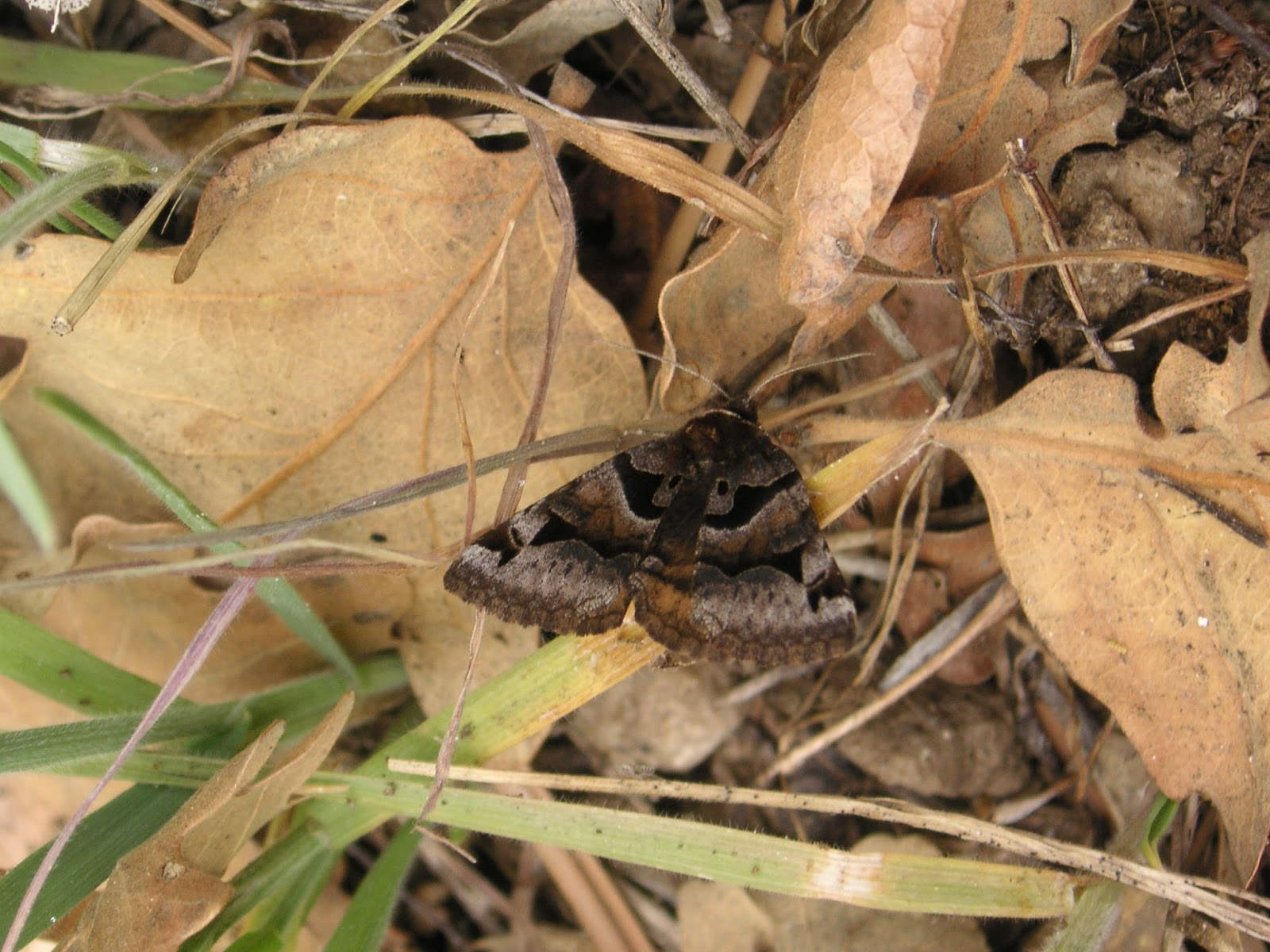
duskywing moth ~ 04/17/14 ~ Chews Ridge


Considering we were keeping our eyes out for medium-small dark duskywings, it's no surprise I spotted this subtly decorated day-flying moth.  It has no official common name, but I've heard Jerry Powell calls it the duskywing moth.  Then, I thought about what I'd name it.  I see a face in the wings.  In some pictures, it looks like a winged mouse or an elephant.  It's like that game of seeing shapes in clouds.  Is that a type of pareidolia?  I'm drawing a blank as to a fun common name.  Duskywing moth works just fine for me.

duskywings ~ 04/17/14 ~ Chews Ridge


I find many skippers (Hesperiidae), including the dark duskywings (Erynnis spp.), extremely difficult to tell apart.  I'm conferring with Chris Tenney before I finish placing embedded IDs on these pictures.  More to come...

ps 04/21/14 - Chris confirmed my IDs.  He said we also saw pacuvius duskywing (Erynnis pacuvius callidus, Shapiro, Tenney), but I probably mistook them for the similarly dark sleepy duskywing since ours in CA don't have the white fringe.  These are all hilltoppers for the most part, and we found them either right at the top at the base of the lookout or in a fairly limited radius around the summit.  I don't have any helpful ID notes to offer, because Chris basically pointed them all out to me.

Coulter pine ~ 04/17/14 ~ Chews Ridge

Pinus

These pine cones are gigantic.  Holy cow!  Reminds me of the time I regretted driving over a gray pine cone.  So, I wondered about the relative sizes of Coulter vs. gray pine cones, even though Wikipedia says, "Coulter pines produce the largest cones of any pine tree species."  I found this handy pine cone comparison on Tree Identification blog.  It looks like Coulter is longer, while gray is wider, and both are huge and heavy.  Chris told me he had a Coulter pine drop on his shoulder once.  He said it beat him up pretty badly.  Ouch.