Showing posts with label owlet moths. Show all posts

Thursday, September 18, 2014

hooded owlet ~ 09/18/14 ~ at home

Cucullia sp. (Hodges 10180-10214)

I have to say, Andy is incredibly accommodating to my insect-rearing whims.  Twenty years ago, my ex threw a hissy fit after I mentioned I wanted to bring home a couple silk moth caterpillars from class.  I never did.  I should have known right then that it wasn't going to work out.  Ha!  Anyways, Andy got home before I did and even though he was pressed for time to get to an evening meeting, he discovered Charlotte went on her walkabout and he went searching for her around the living room.  Oh my goodness.  He's seen me make these containers enough times that once he found Charlotte tucked under a cotton rug, he knew what to do.  Admittedly, he used an old gym sock instead of nylon (I changed it out before this pic), but he got the gist.  He said she held still for about 3 minutes and then in 30 seconds she was completely under.  That was way quicker than George's 10-15 minutes.  Plus, Andy added a little blue tab to show me exactly where Charlotte had dug herself in.  Good man.  In a few days, I may gently dig up George (on the left) just to document his turd shape with photos, and then return him to the soil.  I'll be setting these containers with papae outside for the winter so they'll develop naturally without the artificial influence of indoor warmth.  I just have to make sure to check on them come spring.  Sometimes I forget I even have them.  Oops.

ps 01/18/16 - Last year I dug up George and inadvertently tossed him over the balcony believing he was a compost chunk.  It wasn't until Charlotte emerged as an adult that I realized what I had done.  George and Charlotte were not smooth, turd-shaped pupae, as I had assumed they'd be.  Charlotte was a fuzzy, pill-shaped object.  As for George, I hope he ended up well.  I have pictures of the adult Charlotte and cannot determine the exact Cucullia sp.

Tuesday, September 16, 2014

hooded owlet ~ 09/16/14 ~ at home


That's George above.  I introduced him in a post from 2 days ago.  I mentioned he was mobile. Very mobile.  I provided him and his cohort Charlotte rather tall flax-leaved horseweed (Erigeron bonariensis) stalks (the same kind I brought them home on), because I was hoping to avoid the daily chore of obtaining smaller, quick-to-wilt clippings from down the street.  This is all to say, I did not have them in a container.  I simply stuck the trimmed stalks in a heavy-bottomed vase with water and a cotton topper to prevent accidental drowning.  Yep, the larvae were loose and fancy free at home, in my home.

And, George made a run for it today.  Twice.  Argh!  At first, I thought he was just searching for fresher food.  He somehow managed to get off the table and onto the floor, but that was about as far as he got.  The second time he disappeared, with a plethora of just-the-right-sized leaves to munch on, it dawned on me he must be looking for a cozy place to pupate.  It took me an hour of carefully searching every nook and cranny (man, I have some serious dust bunnies behind the furniture) until I finally found him nestled in a silty groove of our sliding glass door rail.  Phew!  I worried that if he had found a way to get into my houseplant containers, he'd be lost for good.  Plus, I had vivid images of settling in on the couch to discover something smooshy stuck to my bottom.  Yuck.  Good thing I found George.

If I hadn't dug up the large yellow underwing pupa in my compost a few years back, I don't think I would have known to simply provide a little loose dirt.  I quickly cleaned out a couple containers (another for Charlotte) and dumped in a couple inches of slightly moist compost.  I inserted a crawling stick for later and then set George down on top of the dirt.  After a few minutes of playing dead from the traumatic handling, he started wiggling himself in short spurts and then pauses, head first into the soil.  Shown above was about halfway through.  Within 10-15 minutes, he had dug himself completely under.  I was kinda surprised at how quick he was, because I had never witnessed how this happens before.

While the colors are a bit washed out in my photo, George had already started changing colors, loosing the bright yellow center dorsal stripe and gaining a reddish-brown tailend that looks a lot like a sclerotized head.  Doesn't he look a bit like a millipede here?  Very cool.

Sunday, September 14, 2014

hooded owlet ~ 09/14/14 ~ at home

hooded owlet moth caterpillar prolegs (+ aphids)
Cucullia sp.

Yesterday, we walked down Oceanview above the Rec Trail with hopes to spot and cheer on my cousin Bob while he ran the last leg of the PG Triathlon.  We found Bob in the race... and a couple brightly-colored caterpillars on the same tall stalk of roadside weed.

Cats were fresh on my mind, because I had just received an e-mail from Gordon Pratt explaining his techniques for raising tiny blue butterflies and essentially encouraging me to do the same.  Eh, I make for a rather lazy lepidopterist and generally only raise whatever I can easily find (read: large enough to spot from 5 ft. away!) and if I'm in the mood.  It's been a while since I've reared anything, the last ones being Genista broom moths as a pest management favor for J.  I've had moderate luck with larger leps in our relatively cool coastal climate (e.g., Lophocampa success and unidentified woollybear failure), but I haven't reared anything as small as blues (except for the accidental poop-shooting orange tortrix relative).  So, while I figure out the logistics for raising tiny cats (and whether I have the patience for such endeavors), I'm dusting off my rearing containers for a bit of practice with yet another larger caterpillar.

À la Gary Larson, here are the newest additions to our family (note: he/she designations are purely random)...

Charlotte
Those are her gorgeous black prolegs in the first picture above.  She was voracious and slightly smaller than her companion.

George
Slightly larger, less hungry, and definitely more mobile.  Go, George, go!  I quickly stuffed a cotton ball into the vase, so roaming George wouldn't drown.

I didn't measure either one (remember, lazy), but they were maybe 2 inches long.  They seemed to prefer medium-sized leaves off stems that could support their hefty stature.  Within a day, the single stalk I found them on was stripped bare, except for side supporting stems and wispy flower-bud tips, whereupon I ran down the street and collected 2 more stalks for food.  Oy!  I inadvertently brought home lots of other insects from the clippings (aphids, ants, an inchworm, and a syrphid fly larva).

Until I see their adult form, I can't really say which Cucullia sp. these are.  My ID search started with googling images of "zebra striped caterpillar".  No kidding.  Yep, super-scientific.  Not!  But, it works.  That took me to the zebra caterpillar (Melanchra picta), which gave me Hodges number 10293 and a decent starting point.  Btw, Moth Photographer's Group has a excellent series of caterpillar plates for North America.

Cucullia speyeri (Hodges 10190) looks like a superficial match, but Robert W. Poole indicates C. speyeri is not found anywhere near here.  I think he's the same fellow who wrote a Noctuid catalog, so he would know (but I'm not positive).  There are certainly enough look-alikes, here (various), here (thin yellow stripe on side w/ white prolegs and white bindi), here (Hodges 10191), and here (wide yellow stripe on side w/ facial freckles and white bindi, not laetifica), so it's hard to say if this one from San Diego on CalPhotos is correct.  The Cucullia adults are not much easier to tell apart.

Asteraceae

It's because of the reported native host plant for C. speyeri, horseweed (Erigeron canadensis, aka Conyza canadensis), that I was able to track down the ID of this non-native < 4 ft. tall relative.  I checked the few flowers in bloom, and they definitely look like bonariensis, not canadensis, to me.  I'll try to take pictures of this plant in situ, as the one I have here was otherwise stripped of its leaves and didn't look like it normally would.  More to come...

Thursday, April 17, 2014

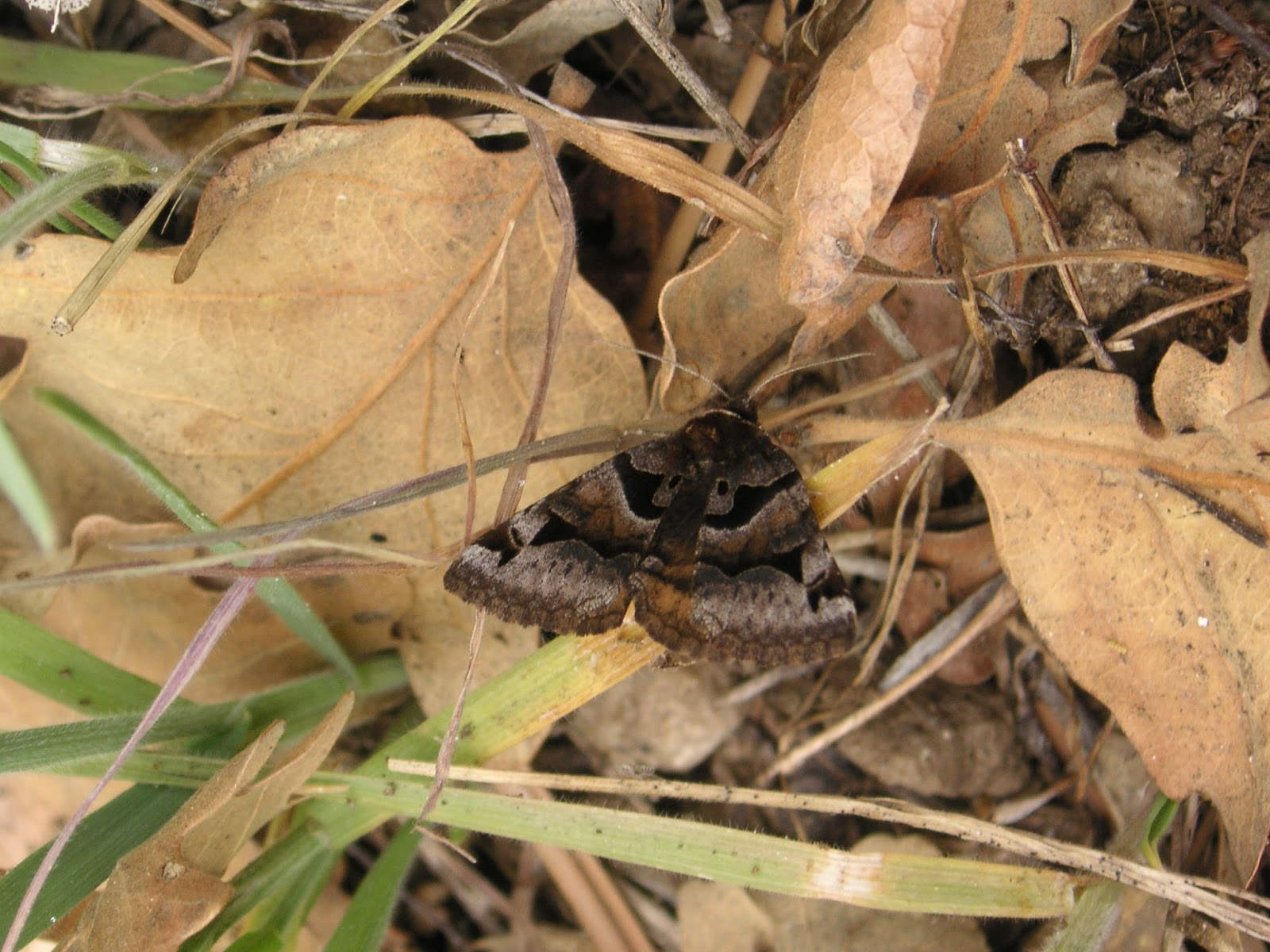
duskywing moth ~ 04/17/14 ~ Chews Ridge


Considering we were keeping our eyes out for medium-small dark duskywings, it's no surprise I spotted this subtly decorated day-flying moth.  It has no official common name, but I've heard Jerry Powell calls it the duskywing moth.  Then, I thought about what I'd name it.  I see a face in the wings.  In some pictures, it looks like a winged mouse or an elephant.  It's like that game of seeing shapes in clouds.  Is that a type of pareidolia?  I'm drawing a blank as to a fun common name.  Duskywing moth works just fine for me.

Wednesday, March 19, 2014

Annaphila decia ~ 03/19/14 ~ Pinnacles


More dead animals.  Hey, don't laugh at my photos, okay?  I should have asked for better lighting; the busy office was incredibly dark.  Getting decent pics is a crapshoot for me, as is evidenced by my crappy photos label.  I have zero interest in photography itself.  However, looking at my photo set compared to the standard is making me feel a bit embarrassed that I didn't take the time to line them up perfectly, properly sized, lighted, etc.  Eh, as it was, it took me a good 2-hour visit to take photos of a few trays' worth of Paul Johnson's Annaphila specimens, some from the Pinnacles National Park collection and some from his personal collection.  Thank you for your time and attention, Paul!

While I prefer alive and natural, over dead and spread, collections do have their uses.  My photos of a live Annaphila from March 9, 2014 match Paul's 4 A. decia specimens, especially compared to the series (scroll down for Annaphila spp.).  There's a distinctive, cartoony sideview of a boy's face on the hindwing, too.  The collection dates were 03/12/02, 03/18/07, and 2x 04/13/06 (yes, yes, I use mm/dd/yy).  That's good enough for me, even though I still don't think they're well represented online and barely match old hand-drawn plates (Hampson Species Index, figs. 7 & 8).  I did find it interesting that a couple more photos were uploaded to BugGuide in the days since my live post.  It's natural, since they're on the wing now.  And, I also located this gorgeous live shot, despite its misspelling (a challenge of online searching).

Alright, I'll admit I was jumping the gun the other day, fantasizing about how I may have accidentally found a previously undescribed species.  It's funny; I'm not ashamed.  Regardless, it reminded me of an item on my bucket list.  I'm not ready to go down that path now, anyways. Someday, right?  

Annaphila decia head on view

I should mention, it's really difficult to spread tiny moths this well.  Spreading takes good dexterity, talent, patience, and desire.  I have none of those qualities.  It's cool how those upright scales (that looked like jumping spider eyes) are still preserved in the spread body.  Now, all I need to do is find me some jumping spiders...

ps 03/27/14 - I am still researching this and may end up personally comparing with U.C. Berkeley's Essig Museum of Entomology original paratypes, which are accurately identified.  There is a potential that my photos, Paul's specimens, BugGuide, and Flickr are all the same, just not A. decia. Crazy, huh?  Go museums!

Sunday, March 9, 2014

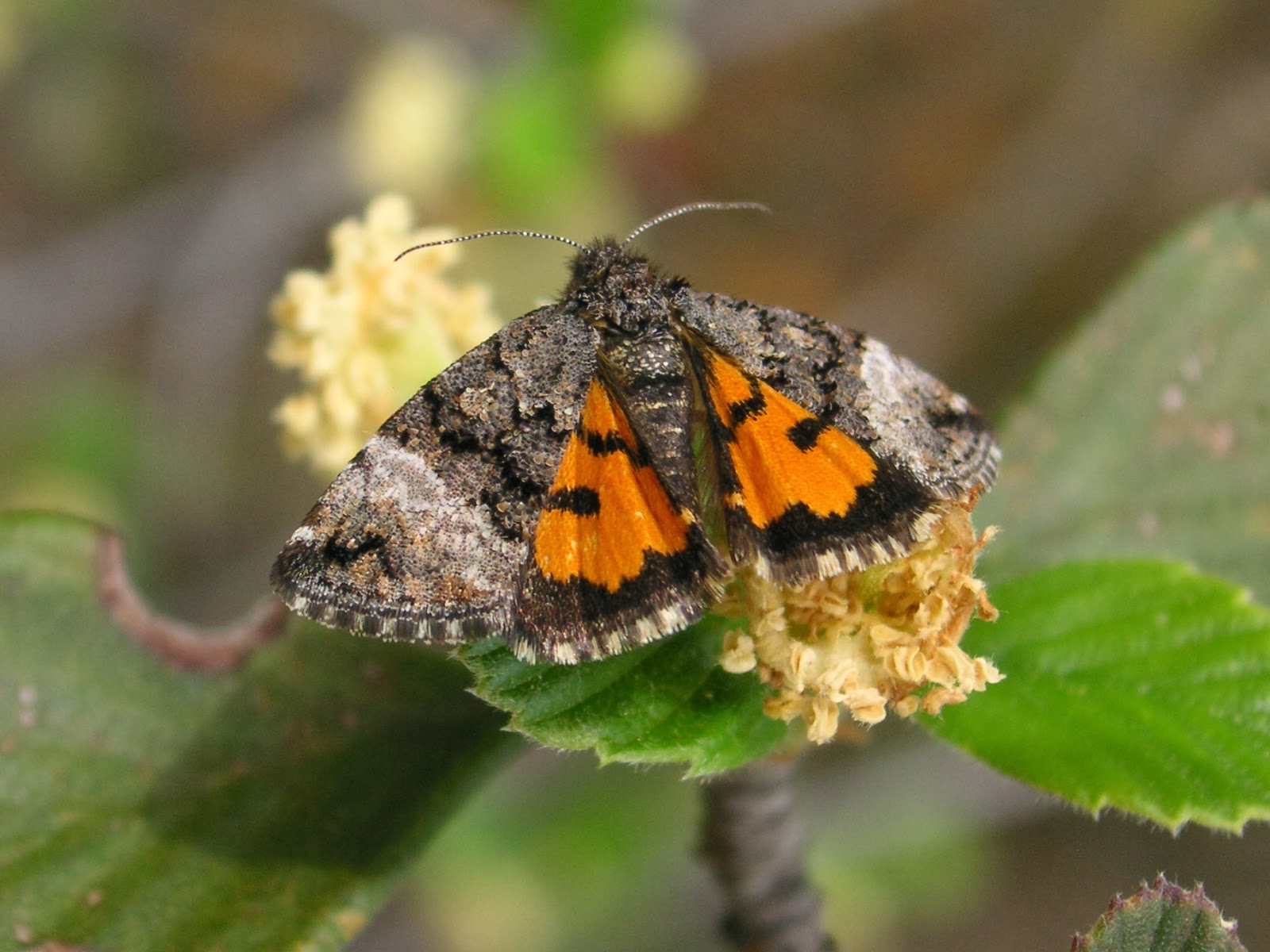
Annaphila decia ~ 03/09/14 ~ Pinnacles

Annaphila day-flying moth nectaring on birch-leaf mountain mahogany
Annaphila decia nectaring on Cercocarpus betuloides
Rosaceae

I think I've fallen in love.  This Annaphila is small, maybe 2/3 the size of its larger A. depicta sibling.  In fact, that's how I was introduced to the genus 3 years ago by Chris Grinter.  Its lines are gorgeous.  Look how they line up exactly on both the top and bottom wings, in its natural pose.  Even from the underside, there's full-on orange.  Be still my heart.

Unfortunately, I'm uncertain of its ID.  I queried Paul Johnson from Pinnacles, and we agreed it isn't well represented online.  Come on, look at this horrid picture.  He thinks it's A. decia. Both Moth Photographers Group and Pacific Northwest Moths have spread photos that don't quite match in my eyes.  I used to be quite familiar with Hodges, and I believe it's possible this is a yet undescribed Annaphila species (Hodges 9850-9872), the same as Hartmut Wisch's photos on BugGuide.  I'm asking Jerry Powell and Paul Opler for their opinions, hence why I'm including extra photos in this post.  Then, for Jeffrey Caldwell, yes, I do have additional pictorial evidence of proboscis use on the Cercocarpus betuloides flowers.

Holy cow, btw!  This bush was literally buzzing, which is so strange, because nothing else around it had that kind of activity, not even neighboring mountain mahoganies.  The leaf chews were kind of cute.  Leafcutter bees?

Annaphila decia looking very much like a jumping spider

And finally, you read it here first on Nature ID.  Paul Johnson suggested I could get an Annaphila paper out of the uncanny resemblance to jumping spiders that I noticed in this photo, right down to their striped legs.  The black scales on its shoulders and scruff of the neck look a lot like eyes, don't they?  Of course, I'd need to look at Paul's PNP specimens, observe more, take a lot more photos including local jumping spiders.  Apparently, our crappy 10-year-old point-and-shoot isn't so crappy, since it gets images when Paul's fancier DSLRs scare away the subjects.  Mmm, maybe, I should take on this pet project?  That is, if I don't lose interest first; I am prone to infatuations, after all (don't get me started on salamanders).  At the very least, I should figure out a way to get gas and food supplemented for these kinds of efforts.  For astonishingly hilarious jumping spider videos from down under, check out Jürgen Otto's peacock spiders.  Ha!  LiveScience has an excellent interview with Jürgen of how he came to do this.

ps 03/16/14 - I'm worried I might be a little crazy to believe I may have found a "new to science" moth.  In my defense, I've seen it happen twice for plants at Fort Ord within the last 2 years.  For some wacky reason, land life has not been as well-documented for the greater Monterey area compared to just north by 2 hours.  I think everyone is focused on the ocean life here, instead.

Then the thought process continues to something on my bucket list.  I want to be the person to name and describe a new species.  Crazy, huh?  I already know I would name it after Chris Grinter @ The Skeptical Moth, because of all the help he's provided me with moth IDs since I started my blog 5 years ago.

I've heard back from everyone I've queried.  I feel like I've found my fold with their various personalities.  There was a suggestion that this was A. divinula, which has only a single online reference on the Moth Photographers Group.  Nope.  Yes, yes, I already have in mind to personally check out 5 collections that would most likely have comparable specimens.  And so, my journey continues...

ps 03/21/14 - I've made a firm ID above (until I find out otherwise) and provided an update with comparison to Pinnacles specimens.

Tuesday, February 25, 2014

Annaphila depicta ~ 02/25/14 ~ Pinnacles

Annaphila day-flying moth nectaring on California milkmaids
Annaphila depicta nectaring on Cardamine californica
Brassicaceae

This is the same sp. moth I photographed on March 4, 2011, but these new macro shots are much clearer.  Three years ago, I had alerted Paul Johnson, Wildlife Biologist for Pinnacles, that it was on the wing.  A couple days later he was able to net a specimen for the Park's collections.  It was a new sp. for him, and he has since confirmed its ID.  Now, he's asked my permission to store my top photo in their wildlife observation files for interpretive/educational use.  Cool.  Not bad for my 10-year-old point-and-shoot.  Paul says his DSLR makes too much noise (slap of a mirror?), which scares off this beautiful moth in a blur.  Fancy-schmancy doesn't always get the goods.  Hehe.

There's also a fabulous fly in the second photo, but I'm ID'd out.  Can you ID?

ps 03/13/14 - I noticed the first set of Hodges 9866 photos in the Moth Photographer's Group by John Davis are misidentified.  I think BugGuide got it right, and they're A. macfarlandi and should be moved to Hodges 9867.  I don't know what happened to MPG, but they don't seem to be curating their collection as well as they used to.  It happens.

Saturday, September 28, 2013

moths ~ 09/28/13 ~ Rocky Creek


Here are all the moths from night 2 of white sheet lighting.  Again, I'll add the moth IDs at a later time.  I welcome anyone who wants to help me ID these coastal moths in the comments.

I'm surprised at how sentimental I became while sorting through these moth photos.  The feeling reminds me of "The Road Not Taken" by Robert Frost.  My only published papers were 6 checklists of moths with Sonja Teraguchi.  I googled to see if it's out there on the internet, since the pubication predates Y2K.  Hey, it's on eBay.  Cool.  I think?  It's also referenced in a paper by Roy Rings in The Great Lakes Entomologist.  Very cool.

Friday, September 27, 2013

moths ~ 09/27/13 ~ Rocky Creek


I'll add the moth IDs at a later time.  Thanks to Pete at Essig, I borrowed Moths of Western North America by Jerry Powell and Paul Opler.  It's a spendy tome at $100 a pop, so I wanted to take a good look before I purchased.  I haven't had the patience to sit down with the hefty book, yet.  If anyone would like to help get the ID ball rolling, please comment.

Friday, May 13, 2011

large yellow underwing ~ 05/13/11 ~ at home


large yellow underwing moth / European yellow underwing
Noctua pronuba

Well, as I've said before, I'm not always spot on in my IDs and will correct myself whenever I can. On March 22, 2011, I found a pupa while turning soil in one of my compost containers (click the embedded link to read that particular post). You can see the split, empty pupal casing in the second picture above. I had hoped the pupa was a painted tiger moth (Arachnis picta), considering I released my 2nd instar caterpillars in that open container 4 months before. Nope, I was wrong. Jennifer, a regular commenter on Nature ID and local friend, was correct in guessing it was a cutworm, as the caterpillar stage of this moth is also commonly known as a winter cutworm, an introduced species to North America from Europe and elsewhere. The morning I took this picture on 05/13/11 (I'm backposting on 05/25/11), it was lethargic, yet walking around a bit, so I'm guessing it must have just emerged. The next day, I tried to get a picture of its beautiful yellow hindwings, but it flew off in a flurry toward the sun.

ps - Again, many thanks to Chris Grinter of The Skeptical Moth for identifying several moths for me from e-mailed photos during my illness. While I'm feeling much better now, I'm desperately trying to catch up with work and regular life stuff. For those who have commented or e-mailed me, it may take a while before I can get around to replying.

Tuesday, March 22, 2011

large yellow underwing ~ 03/22/11 ~ at home


large yellow underwing moth pupa
Noctua pronuba

While I was turning one of my compost bins last week (posted 03/27/11, pics taken 03/22/11), lo and behold I found a little surprise. And, no, it is not a turd. Good thing I didn't slice it with my trowel! Considering I released several dozen caterpillars in this compost bin last fall, I'm fairly sure this is a painted tiger moth pupa. I know, I know, I said I wasn't going to disturb this bin until October or November of 2011. However, the prolific weed of hairy bittercress set seed a month ago in this bin, and I pulled them all out. The pupa measures about 26mm in length and wiggled furiously when I laid a cold plastic ruler next to it. I've since placed the pupa in its own container with soil and pantyhose on top to await to see what emerges. I'm keeping the container outside so as not to falsely speed up the development of this pupa with the warmth of our home. The timing of my observations so far does not match the literature, e.g., W.E. Conner's Tiger Moths and Woolly Bears.

For those new to my blog, here's a timeline of past tiger moth posts with embedded links:
October 17, 2010 - found an adult female laying eggs next to our front door
October 26, 2010 - eggs hatched and I collected the caterpillars
November 6, 2010 - released 2nd instar caterpillars in compost bin

Here are couple things to note: 1) I frequently call caterpillars "cats." Even though I've loved up to 3 kitty cats at one time, usually I'm referencing the insect. 2) I'm actually raising several different Lepidoptera on my balcony right now.

ps 05/25/11 - I posted this originally as a painted tiger moth pupa and now that it emerged on 05/13/11, I have corrected the ID above. To read the new post on this large yellow underwing moth, click here.

Friday, March 4, 2011

Annaphila depicta ~ 03/04/11 ~ Pinnacles


a day-flying moth nectaring on California milkmaids
Annaphila depicta ssp. morula nectaring on Cardamine californica
Brassicaceae

When the first few Lepidoptera flew by me with their flashes of orange, I got excited believing I was seeing my first copper butterflies since returning to CA. Nope. It's a day flying moth! The official Pinnacles National Monument website is now including moths, instead of just butterflies. Great... except, as the PDF states, it's a work in progress. The only Annaphila they list is A. decia.

Here's a dirty little secret from my past life, I suck at identifying moths without a reference collection. So, I sent a picture to Chris Grinter of The Skeptical Moth this morning around 6:30am - gotta appreciate fellow bloggers who are up before the sun comes up. He promptly replied the following, "Love to see the moth photos. This is absolutely in the genus Annaphila (Noctuidae), and I'm comfortable calling it A. depicta. I could even take a stab at this being the subspecies 'morula' based on that pronounced brown bar on the forewing!" After comparing the very few photographs available online of Annaphila, I agree with his expert ID. Thank you, Chris!

I should mention these small moths were relatively abundant in what I affectionately term the "butterfly highway" at Pinnacles.

Plus, milkmaids were definitely the predominant blooming herbaceous perennials everywhere we hiked. Some looked more mustardy than milky. It looks like there are two varieties of C. californica (var. californica and var. cuneata) recorded from Pinnacles, but I wouldn't be able to tell you which is which or the difference.

ps - If you look closely at the second picture, there's a cute little beetle. Based on my other pictures of milkmaids, these beetles are quite abundant on this flower. However, I'm done with IDs for today.

pss 04/06/11 - Before I forget, Chris encouraged me to contact Paul Johnson of NPS. Paul and I had a couple of e-mail exchanges between March 6-9, 2011. He says he has 3 or 4 Annaphila on his Pinnacles moth list, but it's not updated and available to the public. Whether due to my e-mails or not, he did manage to catch a moth similar to the one shown above on March 7, 2011.

Saturday, June 19, 2010

moths ~ 06/19/10 ~ at home

Oidaematophorus sp.?

ceanothus nola moth
Nola minna

These pics are for Chris Grinter of The Skeptical Moth blog. He works at Cal Academy and is a smart, young lepidopterist. His description of spreading microlepidoptera is impressive and would be a handy addition to any basic entomology textbook. It takes talent, patience, just the right amount of blow, and a steady hand to create beautifully pinned specimens.

Chris was kind enough to include a link to a post of mine on a blog carnival he hosted called The Moth and Me # 12. For The Moth and Me carnivals #s 1-11, check out North American Moths.

What? You don't know about blog carnivals? Me neither. I still don't really understand them. I thought I'd have to do something elaborate or fabulous, but, no, I just had to say "okay" and there you go.

My moth pics are nothing to brag about. Squirrel's View blogger has posted amazing pictures of a rosy maple moth and a giant leopard moth. Incredible!

ps 06/21/10 - I initially posted these as unidentified moths. Thanks to Chris, I've added the IDs with links above.

Friday, May 8, 2009

smoky arches moth ~ 05/08/09 ~ Pinnacles

smoky arches moth
Drasteria fumosa
8629


It sure is pretty! Noctuidae? It makes for an awesome Rorschach test. I see a horse's head like Chauvet Cave drawings in the dark part.

ps 10/14/10 -In the neighborhood of Hodges 8640?

pss 04/06/11 - This was one of first 5 posts on Nature ID. I originally posted it as an unknown moth. Thanks to the help of Chris Grinter of the Skeptical Moth, I now have corrected the ID above with embedded links.

CA forester ~ 05/08/09 ~ Pinnacles

Lepidoptera > Noctuidae > Agaristinae
(larva feed on elegant clarkia)

This initially stumped me. Since it was flying during the day and mud-puddling, I assumed it was a spread-winged skipper. Unfortunately, my pic isn't clear enough to show the antennal structure. I couldn't find it in my newly purchased Butterflies through Binoculars: The West by Jeffrey Glassberg (c) 2001. However, it looked so familiar to me that I pulled out all of my insect books and flipped through the plates. I finally found it in my 1908 edition of The Moth Book by W. J. Holland (c) 1903.

ps 05/23/14 - I'm giving my copy of The Moth Book to Paul Johnson at Pinnacles for all his help during my 2014 Prep Year LTBM Pinnacles project.