Showing posts with label day-flying moths. Show all posts

Tuesday, August 5, 2014

CA clearwing ~ 08/05/14 ~ Pinnacles


posted 08/15/14 - I've tried numerous times from late July to mid-August to get a clear picture of this fun bee mimic that hovers like a hummingbird.  Unfortunately, the CA clearwing moth usually finishes feeding at a flower the split second before my auto-focus sets, to then move around to the privacy of a bloom opposite the stalk to me.  It then becomes a game of ring around the odoriferous vinegar weed.  Sigh.  I end up smelling vinegar weed for the rest of my hike, too often from a carelessly dangled camera strap.  Ah, good times.  Smelly.  But, good.

For those not hip to the taxonomic tricks (like me), western Hemaris thetis was split off from eastern Hemaris diffinis (7855) in 2009.

Thursday, April 17, 2014

duskywing moth ~ 04/17/14 ~ Chews Ridge


Considering we were keeping our eyes out for medium-small dark duskywings, it's no surprise I spotted this subtly decorated day-flying moth.  It has no official common name, but I've heard Jerry Powell calls it the duskywing moth.  Then, I thought about what I'd name it.  I see a face in the wings.  In some pictures, it looks like a winged mouse or an elephant.  It's like that game of seeing shapes in clouds.  Is that a type of pareidolia?  I'm drawing a blank as to a fun common name.  Duskywing moth works just fine for me.

Tuesday, April 15, 2014

white-lined sphinx ~ 04/15/14 ~ Pinnacles

Lamiaceae

Well, I won't win any photography awards for these photos, but it's good enough to show how impressively long its proboscis is and for an ID.  I've been casually calling these hummingbird moths.  Problem is no one knows what I'm talking about.  In my defense, I spotted what I believe was a Hyles lineata during a break in the rain at SFB Morse Botanical Reserve on February 28, which happened to be around the time when I also started seeing rufous hummingbirds on migration.  On an overcast day, the overall coloring for both the hefty moth and the tan bird are remarkably similar, and the name stuck in my head.  I have Paul to thank for correcting me when we saw another white-lined sphinx along the butterfly highway. 

Thanks to the blurring of memory through time, I had forgotten all about the clearwings (hey, if you don't use it, you lose it).  Back when I lived in OH, I was familiar with the hummingbird clearwing (Hemaris thysbe), which can have the more traditional green and red coloring of hummingbirds.  They were popular subjects of insect question calls to the museum and were frequently described as hovering like a hummingbird with a lobster tail.  Pinnacles has a different clearwing, the bumble bee moth (Hemaris thetis), formerly classified under the eastern snowberry clearwing sphinx (Hemaris diffinis).  I plan on keeping my eye out for them, because day-flying sphinx moths are fun to watch.

Greya moth ~ 04/15/14 ~ Pinnacles

Saxifragaceae

Paul showed me this tiny moth nectaring on a woodland star.  In the sunlight, it has a lovely pearly sheen.  He said they can also be found with their butts stuck in there.  Some Greya spp. are known to lay eggs in the calyx, which also serves as an effective means of pollination for the flower.  Reportedly, the larvae feed on the developing seed, although later instars and other Greya spp. can also mine leaves. The Thompson Lab at UC Santa Cruz has been looking into the coevolutionary relationship between Greya moths and their host plants across western North America, including at Pinnacles.  The two reported spp. for Pinnacles are G. obscura (more info) and G. politella (more info).  Paul and I have been going back and forth over the ID of this particular individual.  My vote is G. obscura, but if questioned enough, I'll double-check ad nauseam.  I've asked opinions from others, and everyone has their own preferred way at arriving at an ID possibility:  wing pattern and size, behavior on specific host or nectar sources, dissection of genitalia, DNA analysis.

red-winged wave ~ 04/15/14 ~ Pinnacles


Paul had just finished telling me about another day-flying moth that looks like an x-large Annaphila, when one kindly obliged and landed in front of us.  It was roughly the size between crescents and coppers, which also look superficially similar.  The Annaphila I've seen recently are at least half the size of this.

Wednesday, March 19, 2014

Annaphila decia ~ 03/19/14 ~ Pinnacles


More dead animals.  Hey, don't laugh at my photos, okay?  I should have asked for better lighting; the busy office was incredibly dark.  Getting decent pics is a crapshoot for me, as is evidenced by my crappy photos label.  I have zero interest in photography itself.  However, looking at my photo set compared to the standard is making me feel a bit embarrassed that I didn't take the time to line them up perfectly, properly sized, lighted, etc.  Eh, as it was, it took me a good 2-hour visit to take photos of a few trays' worth of Paul Johnson's Annaphila specimens, some from the Pinnacles National Park collection and some from his personal collection.  Thank you for your time and attention, Paul!

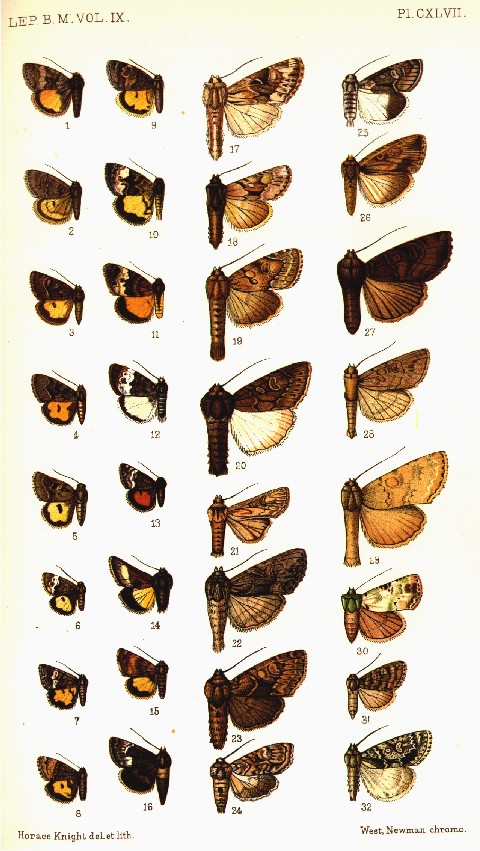
While I prefer alive and natural, over dead and spread, collections do have their uses.  My photos of a live Annaphila from March 9, 2014 match Paul's 4 A. decia specimens, especially compared to the series (scroll down for Annaphila spp.).  There's a distinctive, cartoony sideview of a boy's face on the hindwing, too.  The collection dates were 03/12/02, 03/18/07, and 2x 04/13/06 (yes, yes, I use mm/dd/yy).  That's good enough for me, even though I still don't think they're well represented online and barely match old hand-drawn plates (Hampson Species Index, figs. 7 & 8).  I did find it interesting that a couple more photos were uploaded to BugGuide in the days since my live post.  It's natural, since they're on the wing now.  And, I also located this gorgeous live shot, despite its misspelling (a challenge of online searching).

Alright, I'll admit I was jumping the gun the other day, fantasizing about how I may have accidentally found a previously undescribed species.  It's funny; I'm not ashamed.  Regardless, it reminded me of an item on my bucket list.  I'm not ready to go down that path now, anyways. Someday, right?  

Annaphila decia head on view

I should mention, it's really difficult to spread tiny moths this well.  Spreading takes good dexterity, talent, patience, and desire.  I have none of those qualities.  It's cool how those upright scales (that looked like jumping spider eyes) are still preserved in the spread body.  Now, all I need to do is find me some jumping spiders...

ps 03/27/14 - I am still researching this and may end up personally comparing with U.C. Berkeley's Essig Museum of Entomology original paratypes, which are accurately identified.  There is a potential that my photos, Paul's specimens, BugGuide, and Flickr are all the same, just not A. decia. Crazy, huh?  Go museums!

Sunday, March 9, 2014

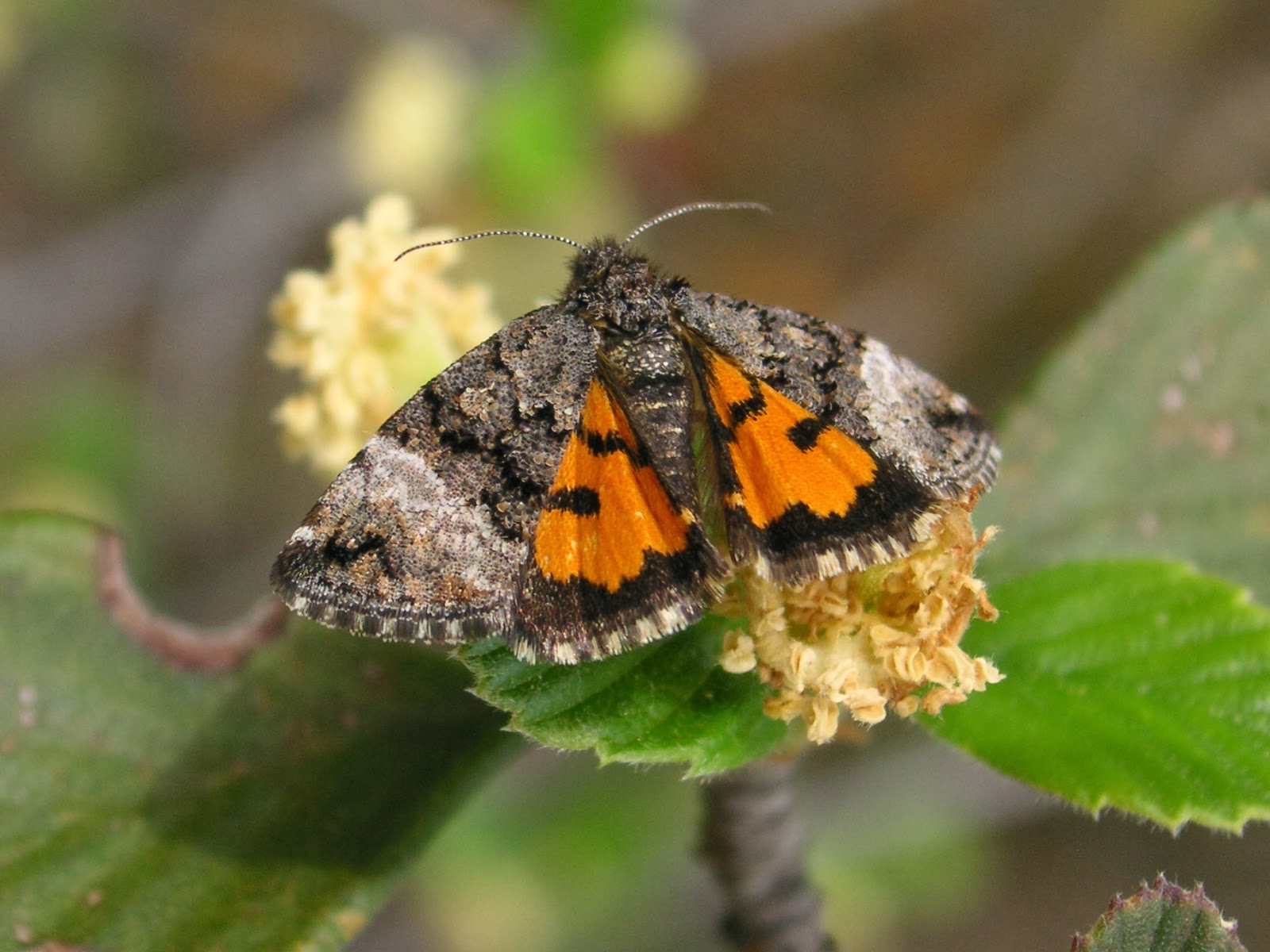
Annaphila decia ~ 03/09/14 ~ Pinnacles

Annaphila day-flying moth nectaring on birch-leaf mountain mahogany
Annaphila decia nectaring on Cercocarpus betuloides
Rosaceae

I think I've fallen in love.  This Annaphila is small, maybe 2/3 the size of its larger A. depicta sibling.  In fact, that's how I was introduced to the genus 3 years ago by Chris Grinter.  Its lines are gorgeous.  Look how they line up exactly on both the top and bottom wings, in its natural pose.  Even from the underside, there's full-on orange.  Be still my heart.

Unfortunately, I'm uncertain of its ID.  I queried Paul Johnson from Pinnacles, and we agreed it isn't well represented online.  Come on, look at this horrid picture.  He thinks it's A. decia. Both Moth Photographers Group and Pacific Northwest Moths have spread photos that don't quite match in my eyes.  I used to be quite familiar with Hodges, and I believe it's possible this is a yet undescribed Annaphila species (Hodges 9850-9872), the same as Hartmut Wisch's photos on BugGuide.  I'm asking Jerry Powell and Paul Opler for their opinions, hence why I'm including extra photos in this post.  Then, for Jeffrey Caldwell, yes, I do have additional pictorial evidence of proboscis use on the Cercocarpus betuloides flowers.

Holy cow, btw!  This bush was literally buzzing, which is so strange, because nothing else around it had that kind of activity, not even neighboring mountain mahoganies.  The leaf chews were kind of cute.  Leafcutter bees?

Annaphila decia looking very much like a jumping spider

And finally, you read it here first on Nature ID.  Paul Johnson suggested I could get an Annaphila paper out of the uncanny resemblance to jumping spiders that I noticed in this photo, right down to their striped legs.  The black scales on its shoulders and scruff of the neck look a lot like eyes, don't they?  Of course, I'd need to look at Paul's PNP specimens, observe more, take a lot more photos including local jumping spiders.  Apparently, our crappy 10-year-old point-and-shoot isn't so crappy, since it gets images when Paul's fancier DSLRs scare away the subjects.  Mmm, maybe, I should take on this pet project?  That is, if I don't lose interest first; I am prone to infatuations, after all (don't get me started on salamanders).  At the very least, I should figure out a way to get gas and food supplemented for these kinds of efforts.  For astonishingly hilarious jumping spider videos from down under, check out Jürgen Otto's peacock spiders.  Ha!  LiveScience has an excellent interview with Jürgen of how he came to do this.

ps 03/16/14 - I'm worried I might be a little crazy to believe I may have found a "new to science" moth.  In my defense, I've seen it happen twice for plants at Fort Ord within the last 2 years.  For some wacky reason, land life has not been as well-documented for the greater Monterey area compared to just north by 2 hours.  I think everyone is focused on the ocean life here, instead.

Then the thought process continues to something on my bucket list.  I want to be the person to name and describe a new species.  Crazy, huh?  I already know I would name it after Chris Grinter @ The Skeptical Moth, because of all the help he's provided me with moth IDs since I started my blog 5 years ago.

I've heard back from everyone I've queried.  I feel like I've found my fold with their various personalities.  There was a suggestion that this was A. divinula, which has only a single online reference on the Moth Photographers Group.  Nope.  Yes, yes, I already have in mind to personally check out 5 collections that would most likely have comparable specimens.  And so, my journey continues...

ps 03/21/14 - I've made a firm ID above (until I find out otherwise) and provided an update with comparison to Pinnacles specimens.

Tuesday, February 25, 2014

Annaphila depicta ~ 02/25/14 ~ Pinnacles

Annaphila day-flying moth nectaring on California milkmaids
Annaphila depicta nectaring on Cardamine californica
Brassicaceae

This is the same sp. moth I photographed on March 4, 2011, but these new macro shots are much clearer.  Three years ago, I had alerted Paul Johnson, Wildlife Biologist for Pinnacles, that it was on the wing.  A couple days later he was able to net a specimen for the Park's collections.  It was a new sp. for him, and he has since confirmed its ID.  Now, he's asked my permission to store my top photo in their wildlife observation files for interpretive/educational use.  Cool.  Not bad for my 10-year-old point-and-shoot.  Paul says his DSLR makes too much noise (slap of a mirror?), which scares off this beautiful moth in a blur.  Fancy-schmancy doesn't always get the goods.  Hehe.

There's also a fabulous fly in the second photo, but I'm ID'd out.  Can you ID?

ps 03/13/14 - I noticed the first set of Hodges 9866 photos in the Moth Photographer's Group by John Davis are misidentified.  I think BugGuide got it right, and they're A. macfarlandi and should be moved to Hodges 9867.  I don't know what happened to MPG, but they don't seem to be curating their collection as well as they used to.  It happens.

Friday, March 4, 2011

Annaphila depicta ~ 03/04/11 ~ Pinnacles


a day-flying moth nectaring on California milkmaids
Annaphila depicta ssp. morula nectaring on Cardamine californica
Brassicaceae

When the first few Lepidoptera flew by me with their flashes of orange, I got excited believing I was seeing my first copper butterflies since returning to CA. Nope. It's a day flying moth! The official Pinnacles National Monument website is now including moths, instead of just butterflies. Great... except, as the PDF states, it's a work in progress. The only Annaphila they list is A. decia.

Here's a dirty little secret from my past life, I suck at identifying moths without a reference collection. So, I sent a picture to Chris Grinter of The Skeptical Moth this morning around 6:30am - gotta appreciate fellow bloggers who are up before the sun comes up. He promptly replied the following, "Love to see the moth photos. This is absolutely in the genus Annaphila (Noctuidae), and I'm comfortable calling it A. depicta. I could even take a stab at this being the subspecies 'morula' based on that pronounced brown bar on the forewing!" After comparing the very few photographs available online of Annaphila, I agree with his expert ID. Thank you, Chris!

I should mention these small moths were relatively abundant in what I affectionately term the "butterfly highway" at Pinnacles.

Plus, milkmaids were definitely the predominant blooming herbaceous perennials everywhere we hiked. Some looked more mustardy than milky. It looks like there are two varieties of C. californica (var. californica and var. cuneata) recorded from Pinnacles, but I wouldn't be able to tell you which is which or the difference.

ps - If you look closely at the second picture, there's a cute little beetle. Based on my other pictures of milkmaids, these beetles are quite abundant on this flower. However, I'm done with IDs for today.

pss 04/06/11 - Before I forget, Chris encouraged me to contact Paul Johnson of NPS. Paul and I had a couple of e-mail exchanges between March 6-9, 2011. He says he has 3 or 4 Annaphila on his Pinnacles moth list, but it's not updated and available to the public. Whether due to my e-mails or not, he did manage to catch a moth similar to the one shown above on March 7, 2011.

Friday, May 8, 2009

CA forester ~ 05/08/09 ~ Pinnacles

Lepidoptera > Noctuidae > Agaristinae
(larva feed on elegant clarkia)

This initially stumped me. Since it was flying during the day and mud-puddling, I assumed it was a spread-winged skipper. Unfortunately, my pic isn't clear enough to show the antennal structure. I couldn't find it in my newly purchased Butterflies through Binoculars: The West by Jeffrey Glassberg (c) 2001. However, it looked so familiar to me that I pulled out all of my insect books and flipped through the plates. I finally found it in my 1908 edition of The Moth Book by W. J. Holland (c) 1903.

ps 05/23/14 - I'm giving my copy of The Moth Book to Paul Johnson at Pinnacles for all his help during my 2014 Prep Year LTBM Pinnacles project.