Showing posts with label x: Los Padres Dam. Show all posts

Sunday, February 16, 2014

habitat ~ 02/16/14 ~ Los Padres Dam

Los Padres Dam

The Los Padres Dam along the Carmel River is owned by California American Water (CalAm) and is one of several trailheads to the Ventana Wilderness of the Los Padres National Forest.  While it's a popular backpacking destination, I don't particularly have any desire to go myself: it's drier than I prefer; there are way too many mosquitoes, ticks, and poison oak; and quite frankly, some of the die-hard Big Sur folks make me a little nervous.  We've only ever done the Carmel River Trail for very enjoyable short day hikes.  I'll admit I'm woefully ignorant of the heated water politics surrounding the Carmel River, and it's always in the local news.  CalAm is currently removing the San Clemente Dam located downstream.

ps - Does anyone know what causes the orange colored seepage?  Iron bacteria?

margined white ~ 02/16/14 ~ Los Padres Dam

female margined white / grey-veined white
female Pieris marginalis venosa (aka Pieris napi venosa)

nectaring on Cardamine californica
Brassicaceae

Check out the cool yellow "shoulder" in the first pic above.  I'm so glad we finally found the macro setting on our ol' camera!  A small patch of milkmaids near the water was a very popular nectaring spot, being visited by butterflies, bee flies, and honey bees. There's not much in bloom, so it's worth noting that just down the way the patch of western coltsfoot had no visitors.

I also spotted margined whites at Stevens Creek last week, which at first sight I knew were related to cabbage whites (look at that dot on the male), but second guessed myself when I went to look for an ID.  I've totally missed the margined white ID before based on the fact I rely heavily on two quick references which omit entirely or misrepresent the early spring, first brood, bold version that I find in the area.  The summer brood is apparently almost all white.  It doesn't help that there doesn't seem to be much consensus on the Pieris "napi" complex.  I need to add notations to my field guides, so I can remember this for next time.

bald eagle ~ 02/16/14 ~ Los Padres Dam


What a nice surprise!  I almost didn't believe it.  This bird was massive with an all white head and all white tail.  I didn't even know we could find bald eagles in Monterey County, because I usually associate them being further north starting near Oregon. Now, I wonder how many I may have seen in the distance riding air currents and mistook for turkey vultures.  I'm almost ashamed to admit how little I know about the bald eagle story here on the Central Coast.  This blog post is as good of an excuse as any to read up on this delisted federally endangered and currently state endangered national symbol.  It's interesting how the bald eagle was extirpated from the county back in 1934 and reintroduced by the Ventana Wildlife Society starting in 1986. Monterey Birds 2d ed. by Don Roberson has an excellent accounting of bald eagles and their nesting history in the county.  Don confirmed to me that they are indeed rare at this location.

western coltsfoot ~ 02/16/14 ~ Los Padres Dam

Asteraceae

Not much was in bloom, just a couple small patches of white flowers: milkmaids, miner's lettuce, and this.  On first glance I thought it was cowparsnip (Heracleum maximum), but the flowers didn't look quite right to me and there weren't any leaves. After I got home, I flipped through my Wildflowers of Garland Ranch by Michael Mitchell and Rod M. Yeager, my personal favorite local flower guide.  I double-checked online (see embedded links in the ID above).  Michael and Rod also do an impressive online MontereyWildflowers site that I tend to forget exists.  It looks like they've made a lot of improvements in the past few years.

CA newt ~ 02/16/14 ~ Los Padres Dam

Taricha torosa
Salamandridae

Well, color me orange!  More newts!  This seems to happen to me all the time; once I see something and learn to recognize it, I tend to notice a lot more of them.  We found a couple dozen, and in much drier areas than I would ever expect to see them.  Click on the picture above to take a closer look at the amazing newt iris.  Very cool.

possible rough-skinned newt intergrade?
possible Taricha granulosa intergrade?

Supposedly, rough-skinned newts have not been found in this area before, but I'm still closely examining my photos with Gary Nafis' Taricha spp. comparison.  I dunno, do the eyes "extend past the margin of the head"?  Would it help if I said the lower eyelids on this individual were ambiguously dark?  Erg.  Erg.  Erg.  I may have to throw in the towel on being able to separate the 2 spp.


How many newts?

Answer: 2.  It could well have been the different lighting and moisture level (sunny vs. the overcast skies under tree cover at Stevens Creek from last week), but it seemed to me the newts here at Los Padres Dam have more of a reddish coloring on top.  In fact, I'd say their red was almost a perfect match with the madrone bark.

in the Carmel River

Good-bye, newts.  See you next time.  Have a lot of love and lay a lot of eggs.

Sara orangetip ~ 02/16/14 ~ Los Padres Dam

Brassicaceae

Saturday, December 10, 2011

habitat ~ 12/10/11 ~ Los Padres Dam

Los Padres Dam

This hike was all about contrasts. The reservoir seemed fairly full, but the spillway was bone dry and the Carmel River was very low. Once past the dam, the Carmel River Trail hugs the hills, from sunny to shady, repeatedly. There were dry areas still recovering from the 2008 Basin Complex Fire and other areas which seemed extra lush and green for this time of year. One side of the trail could have chaparral yuccas, chamise, and dried grasses, while the other side could have newly sprouted fiesta flowers, ferns, grasses, and mushrooms. We went through stands of trees to open meadows. Evergreen oaks, madrones, CA bays, and toyon were mixed in with deciduous oaks, CA buckeyes, bigleaf maples, and CA sycamores. Buckwheats, CA fuchsias, CA goldenrods, cudweeds, telegraph weeds, and a variety of other Asteraceae were setting seed and showing fresh blooms. I saw very few insects or hummingbirds that could pollinate the flowers, but I did spot a couple bumblebees, a honkin' huge tachinid fly, other smaller flies, damselflies, and dragonflies. We thoroughly enjoyed being outdoors in December.

I may want visit Los Padres Dam again in January or February. We don't often go there, because it can get blazing hot by May (although the numerous river crossings are refreshing), the trails are not well maintained further in (with loads of poison-oak), and it takes an hour to travel the 25 miles inland (which is almost beyond my patience to drive for a hike). I've found very few nature-related sites about the Los Padres Dam area. It's a very popular access point for the northern area of the Los Padres National Forest, so most of my search results have been from hard-core hiking sites. To see what backpacking is like in the area, check out this fellow Tony's pictures.

stinging lupine ~ 12/10/11 ~ Los Padres Dam

stinging lupine
Lupinus hirsutissimus
Fabaceae

My brain has totally taken a holiday. When I'm usually working on this blog early in the morning, it's now dark out, and I've been feeling like I would rather be back in bed. But, that's just a lame excuse... For the life of me, I couldn't figure out what this plant was and posted it on Flickr seeking ID help. Doh! I should have known it was a lupine of some sort based on the leaf shape, yet I was more focused on the prickly parts. True to its name, they do give a mild sting when touched, like a poke with a small needle that stays stuck. Andy and I both discovered this when we took a closer look and feel of the plant. While I suspect this plant would normally grow where I found it, Wikipedia states these grow in places that were recently burned. I wonder how much the 2008 Basin Complex Fire on this trail encouraged the presence of this particular patch of stinging lupine.

CA buckeye ~ 12/10/11 ~ Los Padres Dam

California buckeye
Aesculus californica
more information
Sapindaceae (formerly Hippocastanaceae)

I wanted to show how big our CA buckeye seeds get, much larger than the native buckeyes (A. glabra and A. flava) and introduced horse chestnut (A. hippocastanum) seeds I found when I lived in Ohio. During our hike, we had a fun time rolling the prolific seeds down the ravines to see how far they would go; it was like rolling bocce jacks over a rough terrain.

I'm surprised I don't have additional seasonal posts of the CA buckeye, considering it's noticeably one of the first trees to sprout leaves in late winter and one of the first trees to drop leaves in late summer, which I read somewhere was due to lack of water. I'll have to rectify this posting deficiency. For much better information than I could ever provide, check out Clare's buckeye post at Curbstone Valley Farm.

CA goldenrod ~ 12/10/11 ~ Los Padres Dam


During this hike, I felt like I was in some kind of seasonal time warp. It is December after all. Here's another cheery flower that really should have finished blooming by now. Calflora shows there are 16 spp./ssp. of Solidago in CA. However, I'm fairly confident of this ID based on the leaf shape and the way the flowers are clustered on one side of the stem.

green lynx spider ~ 12/10/11 ~ Los Padres Dam

western variation female green lynx spider on cudweed
Peucetia viridans on Pseudognaphalium sp.
Asteraceae

That's quite a large egg sac she's protecting! She's about 1" or more in size but not very green, eh? While searching for an ID, I looked at other Oxyopidae, and none seemed to match as well as P. viridans. It helped to read that this spider can change color depending on the season or surroundings. As I was getting in close to take pictures, I got a whiff of the lovely scent from the cudweed. Green lynx spiders are not the only things that utilize cudweed blooms; Cindy at Dipper Ranch found American lady caterpillars tucked into her cudweed.

CA fuchsia ~ 12/10/11 ~ Los Padres Dam

California fuchsia / hummingbird trumpet
Epilobium canum (formerly Zauschneria californica)
Onagraceae

I was pleased to find CA fuchsia blooming out in the wild in December. It's a cheery Christmassy color. I didn't know the seeds would be fluffy. Actually, I rarely find it growing wild because of my hiking location choices and time of year I most often hike (spring). I doubt I'd recognize this plant if it weren't in bloom. I should have taken better pictures of its leaves. The CA fuchsia is a very popular native plant with gardeners these days, and I often see it used in landscaping around town and on CA garden blogs, like Camissonia's Corner and Sierra Foothill Garden. I didn't see any hummingbirds feeding on it, but I know they're around. I should point out the CA fuchsia is not a real fuchsia; it's a willowherb.

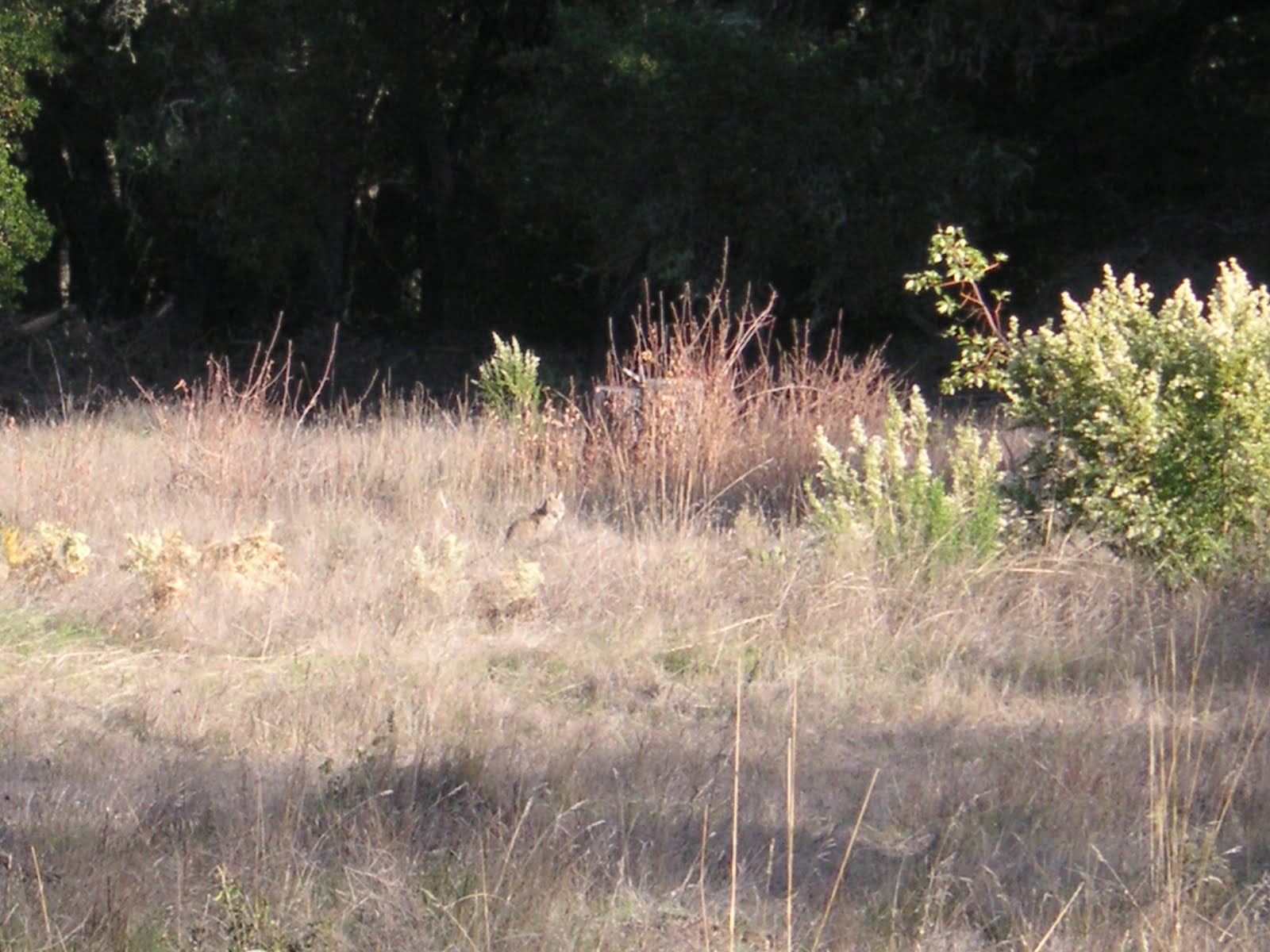
bobcat ~ 12/10/11 ~ Los Padres Dam

Do you see it!?!
(click any Nature ID pic for a larger screen view)


Let's zoom in a little closer.


Oho! Very exciting! Finally! Today I saw my first wild bobcat... and got some crappy photos of it. It's too bad that moments after we decided the log tucked in among the tall dried grasses had moved and really was a bobcat, a large dog came bounding down the trail towards us. During a 4-hour hike, we only met one other group of hikers. Per our typical trail luck, this 2nd group was loudly chatty to each other and oblivious with a loose dog that I was somewhat concerned would bite me before I could continue taking crappy photos.

This bobcat didn't seem too disturbed by their barking dog, nor did it seem to be in much of a hurry to depart the scene. After we pointed out to the other hikers the presence of the bobcat, we took a side trail to see if we could follow it. We didn't find it again, although we spotted an agitated CA gray squirrel high in a tree chirping out a high-pitched alarm call that seemed to spread through the trees.

For much better pictures of local subspecies of bobcats, check out other CA nature bloggers John Wall and Nature of a Man. I've been so keen on seeing a bobcat out in the wild that I've even collected a list o' links from various other bloggers on bobcats. I feel like I could easily retire this ol' blog with a sense of completion. It's as if Christmas came early for me this year.

common yarrow ~ 12/10/11 ~ Los Padres Dam


posted 12/29/11 - When I started this blog 2 1/2 years ago, I focused on colorful, sunny flowers and animals that were already familiar to me. It's been a real joy learning more about my local natural world. My learning curve was a sharp incline at first and then it flattened out, partially due to blogging fatigue and partially due to my hesitancy to show off how much I don't know.

Without flowers, I'm often at a loss as to what a plant is. It's time for me to start looking at leaves. Once again, thanks to Flickr and Nature of a Man blogger randomtruth, I received help for the ID of this very common plant.

The white blooms in the last picture might be a type of naked buckwheat (Eriogonum nudum), but really I have no idea. I had several pictures of this buckwheat, but none of them turned out very well since my point-and-shoot couldn't find a focal point. Once again, I should have looked for the leaves to be able to make a better determination.