Showing posts with label sunflower family. Show all posts

Sunday, September 14, 2014

hooded owlet ~ 09/14/14 ~ at home

hooded owlet moth caterpillar prolegs (+ aphids)
Cucullia sp.

Yesterday, we walked down Oceanview above the Rec Trail with hopes to spot and cheer on my cousin Bob while he ran the last leg of the PG Triathlon.  We found Bob in the race... and a couple brightly-colored caterpillars on the same tall stalk of roadside weed.

Cats were fresh on my mind, because I had just received an e-mail from Gordon Pratt explaining his techniques for raising tiny blue butterflies and essentially encouraging me to do the same.  Eh, I make for a rather lazy lepidopterist and generally only raise whatever I can easily find (read: large enough to spot from 5 ft. away!) and if I'm in the mood.  It's been a while since I've reared anything, the last ones being Genista broom moths as a pest management favor for J.  I've had moderate luck with larger leps in our relatively cool coastal climate (e.g., Lophocampa success and unidentified woollybear failure), but I haven't reared anything as small as blues (except for the accidental poop-shooting orange tortrix relative).  So, while I figure out the logistics for raising tiny cats (and whether I have the patience for such endeavors), I'm dusting off my rearing containers for a bit of practice with yet another larger caterpillar.

À la Gary Larson, here are the newest additions to our family (note: he/she designations are purely random)...

Charlotte
Those are her gorgeous black prolegs in the first picture above.  She was voracious and slightly smaller than her companion.

George
Slightly larger, less hungry, and definitely more mobile.  Go, George, go!  I quickly stuffed a cotton ball into the vase, so roaming George wouldn't drown.

I didn't measure either one (remember, lazy), but they were maybe 2 inches long.  They seemed to prefer medium-sized leaves off stems that could support their hefty stature.  Within a day, the single stalk I found them on was stripped bare, except for side supporting stems and wispy flower-bud tips, whereupon I ran down the street and collected 2 more stalks for food.  Oy!  I inadvertently brought home lots of other insects from the clippings (aphids, ants, an inchworm, and a syrphid fly larva).

Until I see their adult form, I can't really say which Cucullia sp. these are.  My ID search started with googling images of "zebra striped caterpillar".  No kidding.  Yep, super-scientific.  Not!  But, it works.  That took me to the zebra caterpillar (Melanchra picta), which gave me Hodges number 10293 and a decent starting point.  Btw, Moth Photographer's Group has a excellent series of caterpillar plates for North America.

Cucullia speyeri (Hodges 10190) looks like a superficial match, but Robert W. Poole indicates C. speyeri is not found anywhere near here.  I think he's the same fellow who wrote a Noctuid catalog, so he would know (but I'm not positive).  There are certainly enough look-alikes, here (various), here (thin yellow stripe on side w/ white prolegs and white bindi), here (Hodges 10191), and here (wide yellow stripe on side w/ facial freckles and white bindi, not laetifica), so it's hard to say if this one from San Diego on CalPhotos is correct.  The Cucullia adults are not much easier to tell apart.

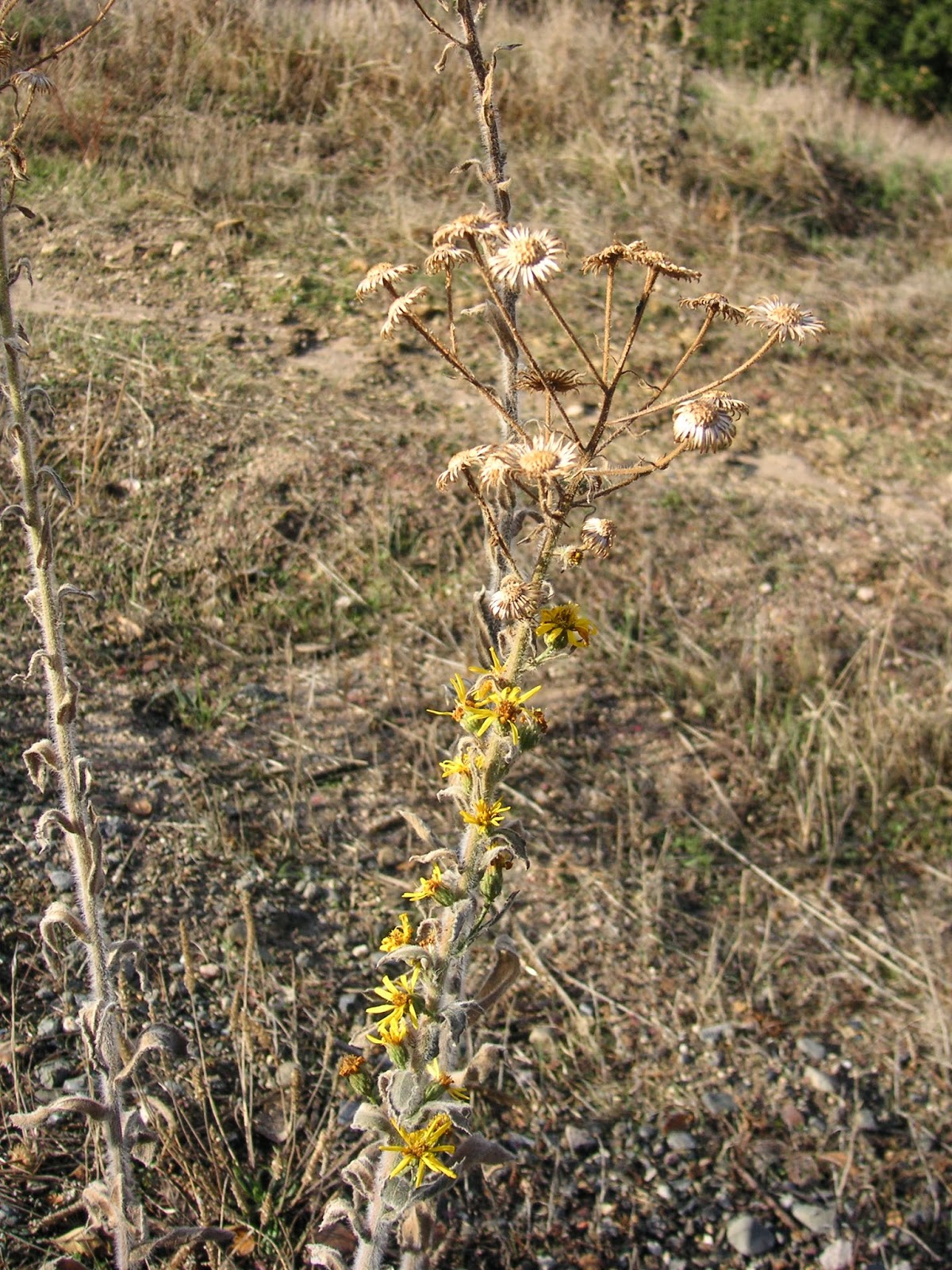
Asteraceae

It's because of the reported native host plant for C. speyeri, horseweed (Erigeron canadensis, aka Conyza canadensis), that I was able to track down the ID of this non-native < 4 ft. tall relative.  I checked the few flowers in bloom, and they definitely look like bonariensis, not canadensis, to me.  I'll try to take pictures of this plant in situ, as the one I have here was otherwise stripped of its leaves and didn't look like it normally would.  More to come...

Tuesday, August 26, 2014

yellow star-thistle ~ 08/26/14 ~ Wishing Well

Asteraceae

This cheery yellow flower is easily in my top 5 most despised plants in the state of CA, which gained a foothold here sometime before 1869 and hails from southern Europe and western Eurasia.  It's super pokey and stops me in my tracks while out hiking.  I realized recently that I may have been mistaking another star-thistle tocalote for this yellow star-thistle, so I made a point to find it on the road outside the west entrance to Pinnacles National Park to take a closer look and these pictures.  If only it weren't such a great reported butterfly nectar source...

Tuesday, August 19, 2014

shrubby butterweed ~ 08/19/14 ~ Pinnacles

Asteraceae

posted 09/16/14 - I first noticed a handful of these bright yellow shrubs blooming on August 5.  I paid particular attention, because I was looking for nectar sources, and it was the only plant blooming besides vinegar weed, isolated spots of CA buckwheat, extremely scattered patches of narow-leaf milkweed, and a tiny tarweed.  Hymenoptera seemed to love it with loud buzzy busyness.  However, the strangest thing is that in all of August, I never saw a single butterfly nectar on this plant.  Not one.  It's known to be a good butterfly nectar source, so what gives?  

August happened to be when I stopped seeing most butterflies altogether at Pinnacles, except for about 5 spp. (I haven't finished tallying all my notes... ugh!), in contrast to the many species reported on the Pinnacles butterfly list (zoom to 220% to see the light shading) for August from 1999-2011 and mainly observed from the east side.  It's unclear the reasons for the stark discrepancy.  Certainly, this year's extreme drought (in addition to 2 previous very dry years) comes to mind, but the differences could also be due to observation location (east vs. west) and individual recorder's methods (Paul's trained eye vs. mine, which isn't the best, btw).  As a note to me for later, some types of adult butterflies, specifically the coronis fritillary (but there may be others?), spend the extreme heat of the summer hiding in reproductive diapause (pers. comm. Shapiro and Hill), so they wouldn't be out nectaring.

The reason why I bothered to look this plant up today is because a fellow butterfly enthusiast Dave sent me pictures of an unknown plant from his camping trip at Pinnacles (read: east side) last week, on which he said numerous Mormon metalmarks were nectaring (interesting).  This post is for him, because I believe his plant photos match my shrubby butterweed from August. I'd like to point out that close-up shots of the flower heads shows much brighter green in color than lower down on the plant with the sagey-silvery colored leaves.

Tuesday, August 12, 2014

tocalote ~ 08/12/14 ~ Pinnacles

Asteraceae

This is the plant that while it was blooming, I had mistaken for yellow star-thistle.  There are large patches of tocalote inside the National Park and almost no yellow star-thistle (thanks to an aggressive targeted weed management program).  What made me realize I had been mistaking this ID is that while I was hiking past it, it dawned on me that it didn't hurt as much as I thought it should if it were yellow star-thistle.  No kidding.  I'm apparently not the only one who mistakes the two related plants, because Anna Bennett did a nice job comparing the two on CalPhotos: here, here, and here.

Friday, July 25, 2014

Mylitta crescent ~ 07/25/14 ~ Sierra Valley

female Mylitta crescent nectaring on Canada thistle
female Phyciodes mylitta mylitta nectaring on Cirsium arvense
Asteraceae

Note the stronger contrast of the female underside (ventral) markings compared to the male Mylitta crescent.  The same can be said above (dorsal), too - see below.

female (brighter, ~middle of pic), male (more solid in color and at the bottom of the pic)
Mylitta crescent

Thursday, July 17, 2014

CA dogface ~ 07/17/14 ~ Podere di Farfalla

male California dogface nectaring on bull thistle
male Zerene eurydice nectaring on Cirsium vulgare
Asteraceae

Despite the fact our official state insect seems to fly practically all year around here (Monterey Co. and Pinnacles), I've only ever spotted this yellow butterfly a couple times.  It's frequently reported that its only larval host plant is false indigo (Amorpha californica).  Either that's not entirely correct, or plant folks generally don't bother looking for this native shrub.  I say this because the plant checklists for Podere di Farfalla and San Benito County strikingly do not include false indigo, notwithstanding the reported 10-month flight period of the CA dogface in these same areas.

As a note to myself, I want to be sure to not mistake the CA dogface for the superficially similar orange sulphur (Colias eurytheme), another butterfly I don't often see and have yet to photograph.

Thursday, July 10, 2014

Mylitta crescent ~ 07/10/14 ~ Podere di Farfalla

male Mylitta crescent nectaring on tocalote
male Phyciodes mylitta mylitta nectaring on Centaurea melitensis
for more information, click here and here
Asteraceae

The first crescent butterfly I became familiar with was in Ohio, the pearl crescent (Phyciodes tharos).  It became my mental model of what a crescent should look like on the top, something I liken to a grandmother's lace doily (don't ask me why, it just worked for me).  It was such an immediate ID clue for me that I don't think I ever really bothered to look at the underside (ventral) of the wings.  It wasn't until I recently picked up Art Shapiro's Field Guide to Butterflies of the San Francisco Bay and Sacramento Valley Regions that it finally dawned on me why crescents are named such.  Just look at that white crescent shape, along the margin in the middle of the ventral hindwing!  Cool.  Note: not all crescents have such strongly marked crescents.  Also to note:  female Mylitta often have more strongly marked topside (dorsal) patterns.  Ah, I'm slowly getting the hang of local IDs...

acmon blue ~ 07/10/14 ~ Podere di Farfalla

acmon blue (blue male top, brown female below) nectaring on tocalote
Asteraceae

Sunday, February 16, 2014

western coltsfoot ~ 02/16/14 ~ Los Padres Dam

Asteraceae

Not much was in bloom, just a couple small patches of white flowers: milkmaids, miner's lettuce, and this.  On first glance I thought it was cowparsnip (Heracleum maximum), but the flowers didn't look quite right to me and there weren't any leaves. After I got home, I flipped through my Wildflowers of Garland Ranch by Michael Mitchell and Rod M. Yeager, my personal favorite local flower guide.  I double-checked online (see embedded links in the ID above).  Michael and Rod also do an impressive online MontereyWildflowers site that I tend to forget exists.  It looks like they've made a lot of improvements in the past few years.
Saturday, December 7, 2013

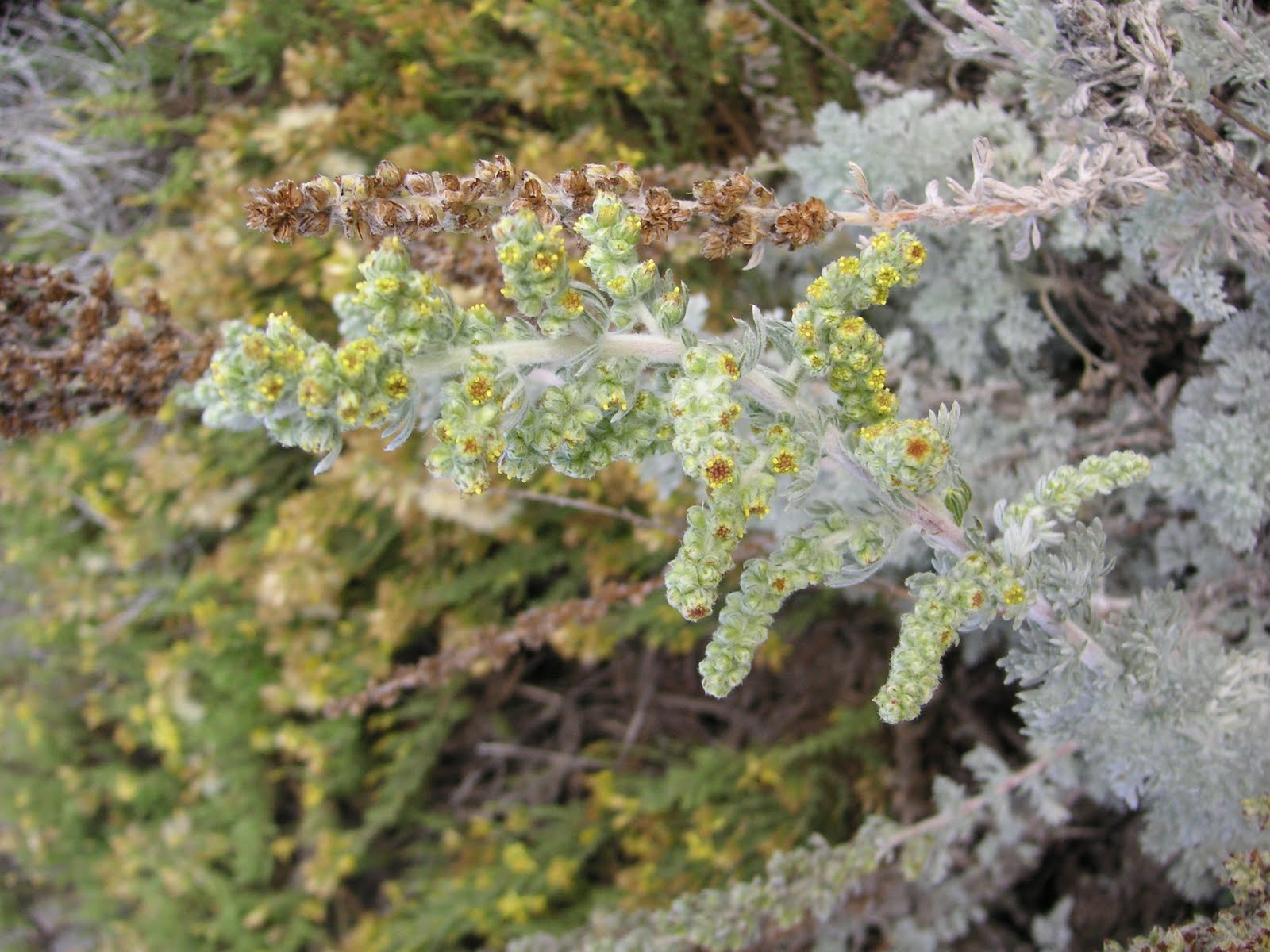
telegraph weed ~ 12/07/13 ~ Fort Ord


Wikipedia says this is a roadside weed.  No kidding.  In my tradition of trying to capture plants in various stages through the seasons, I came across this lovely, dried flower-looking thingie (yes, my terminology).  Thanks to an instructive set of photos by Zoya Akulova on CalPhotos, I now know those thingies are "receptacle and phyllaries after fruiting".  So, I'm wondering how to label this stage, because * fruits/seeds is not quite accurate.  Any suggestions?  While reading up, I found an excellent compilation of information at The Weed Society of Queensland, even though their descriptors like "infestation" and "unsightly" are not generally used here in its native CA.

Friday, May 3, 2013

blow-wives ~ 05/03/13 ~ Fort Ord

 Asteraceae

posted 05/22/13 - I've seen these before but simply had never bothered to look them up.  Look at what I've been missing.  What a peculiar common name!  I wonder what the story is, because it seems like it should be a good one.  Trying to google it returns some lewd results.  You'll notice I added the fruits/seeds label instead of the flower label. Apparently, the actual flower is a tiny yellow ray flower; it's a native version of the dandelion. I caught the flowering stage a little too late in the bottom center of the first photo. Still, cool beans.

I wanted to note this hike, because I met a local woman online and took her along with me.  She searched the internet for Yadon's piperia after seeing flags just like I did.  She found my images through flickr [I don't know what to make of their recent changes; it's flashier probably for high phone traffic.], which led to my Yadon's blog posts.  We exchanged a couple e-mails and set to meet up. Oddly enough, this is the second time I've actually had a face-to-face with someone I met online because of my Yadon's photos.  Has anyone else experienced that with a particular photo set?

ps - Here are links for later, comparing blow-wives with silverpuffs at Sierra Foothill Garden and the inaccurate picture on Wikipedia, which has unfortunately also populated iNaturalist.org and EOL.org. Editing Wikipedia is a bunch of mumbo jumbo to me, so I asked the iNat fellow to correct this in the interest of internet-kind.  Even, UCSC Natural Reserves has this incorrectly pictured.  Erg!

Sunday, May 13, 2012

coast dandelion ~ 05/13/12 ~ Fort Ord

Asteraceae

posted 06/09/12 - I don't have an absolutely positive ID on this dandelion, since it was not from one of my three May guided tours of Fort Ord (easy-peasy for IDs) but rather through Andy, my anywhere running cam (as one kind blog reader called him). There are 4 spp./var. of Agoseris listed for Fort Ord, which on the surface look quite similar. The tricky part is the wide, large, serrated, and deeply lobed leaves in the center of the second pic do not belong to the flowers. If you follow the stems down from the flowers, there are small clumps of thin, lobed leaves, hence how I went about this ID.

Friday, May 11, 2012

marsh scorzonella ~ 05/11/12 ~ Fort Ord


According to David Styer, we were about an hour and a half too late to see this rare flower in full bloom. He must be out here quite a bit to know that information. It looks very much like the typical weedy dandelion. While the common dandelion (Taraxacum officinale) is also found at Fort Ord, David said the marsh scorzonella is easily confused with cat's ears (Hypochaeris glabra and Hypochaeris radicata), which are also on his Checklist of Vascular Plants of Fort Ord, California. Geez, I never fully appreciated how many kinds of plants look like dandelions.

Saturday, December 10, 2011

CA goldenrod ~ 12/10/11 ~ Los Padres Dam


During this hike, I felt like I was in some kind of seasonal time warp. It is December after all. Here's another cheery flower that really should have finished blooming by now. Calflora shows there are 16 spp./ssp. of Solidago in CA. However, I'm fairly confident of this ID based on the leaf shape and the way the flowers are clustered on one side of the stem.

green lynx spider ~ 12/10/11 ~ Los Padres Dam

western variation female green lynx spider on cudweed
Peucetia viridans on Pseudognaphalium sp.
Asteraceae

That's quite a large egg sac she's protecting! She's about 1" or more in size but not very green, eh? While searching for an ID, I looked at other Oxyopidae, and none seemed to match as well as P. viridans. It helped to read that this spider can change color depending on the season or surroundings. As I was getting in close to take pictures, I got a whiff of the lovely scent from the cudweed. Green lynx spiders are not the only things that utilize cudweed blooms; Cindy at Dipper Ranch found American lady caterpillars tucked into her cudweed.

common yarrow ~ 12/10/11 ~ Los Padres Dam


posted 12/29/11 - When I started this blog 2 1/2 years ago, I focused on colorful, sunny flowers and animals that were already familiar to me. It's been a real joy learning more about my local natural world. My learning curve was a sharp incline at first and then it flattened out, partially due to blogging fatigue and partially due to my hesitancy to show off how much I don't know.

Without flowers, I'm often at a loss as to what a plant is. It's time for me to start looking at leaves. Once again, thanks to Flickr and Nature of a Man blogger randomtruth, I received help for the ID of this very common plant.

The white blooms in the last picture might be a type of naked buckwheat (Eriogonum nudum), but really I have no idea. I had several pictures of this buckwheat, but none of them turned out very well since my point-and-shoot couldn't find a focal point. Once again, I should have looked for the leaves to be able to make a better determination.

Monday, October 10, 2011

CA sagebrush ~ 10/10/11 ~ Point Lobos

California sagebrush / old man
Artemisia californica
Asteraceae

This was definitely the dominant plant that I noticed during our hike along the water at Point Lobos. I loved how someone from CalAcademy on CalPhotos called this plant "old man" so I had to include it in the common name above. In my second blurry photo above, I was trying to show how the flowers turn into berry-like seeds. Doesn't that seem unusual? In any case, I'm becoming more familiar with the great variety of ever-present Artemisia in our area.

coastal sagewort ~ 10/10/11 ~ Point Lobos


Sometimes it takes me really looking into something several times before I get it. It never ceases to amaze me how many different kinds of plants there are. I've already mentioned (eh-hem, I do repeat myself regularly) there are at least 41 sp./ssp. of Artemisia found in California. I like the feathery soft leaves of this particular sagewort, sagebrush, sage, wormwood... whatever you choose to call it. The flowers did surprise me.

Sunday, October 2, 2011

seaside daisy ~ 10/02/11 ~ Shoreline Park

seaside daisy
Erigeron glaucus
Asteraceae

It sure is nice to have an ID that I don't have to extensively search. I'm a little surprised this is my first post of this common coastal flower. Interesting to note, my Introduction to California Spring Wildflowers of the Foothills, Valleys, and Coast book states the seaside daisy "flowers from April to August." That's true. However, I also have a habitat post that shows it blooms as early as February, and here's evidence it blooms as late as October. That's a significant difference in timing of blooms.

As part of my Nature ID blog, I'm attempting to document when plants actually flower around here and not simply repeat others' claims, which may not be entirely accurate. This is the reason why I am so particular about posting to the date of my photos.

Saturday, September 17, 2011

Pacific aster ~ 09/17/11 ~ Wilder Ranch

best guess Pacific aster / common California aster
best guess Symphyotrichum chilense (formerly Aster chilensis)
Asteraceae

Maybe someday I'll know how to properly ID flowers. I've looked at hundreds of CalPhotos and even resorted to trying to decipher Jepson this morning - I simply cannot get my mind wrapped around terminology like "± oblanceolate", "cyme" and "phyllaries." It doesn't help that names and distribution records vary widely depending on the source. For the time being, I think I'll stick with S. chilense as one of the most common asters in this part of CA, which doesn't mean the above ID is correct. Regardless of the ID, I welcome seeing this autumn flower. Last year I made a virtual collection of fall aster love.