Showing posts with label * signs - interpretive. Show all posts

Monday, November 25, 2013

habitat ~ 11/25/13 ~ Asilomar State Beach & Conference Grounds

November 25, 2013

I feel like I should appreciate Asilomar more than I do.  It's just 2 miles across town on the ocean side of the Monterey Peninsula, and the weather is often more so than the bay side with more wind and fog.  I hardly ever get over there, unless I'm visiting a friend or taking the scenic route home from the grocery store.  To roam around, I have to be in the mood to deal with the super fine, squeaky Asilomar sand that gets lodged between my toes (I still haven't found great shoes for walking in sand).  However, it really is a gem of a place.  I love the architecture, which was designed by Julia Morgan who also did Hearst Castle.  The Conference Grounds are currently going through a multimillion-dollar accessibility renovation.  It's looking very spiffy.

Saturday, August 4, 2012

habitat ~ 08/04/12 ~ Henry Cowell Redwoods State Park


The only reason why we were up at Henry Cowell, about an hour away from home, was so Andy could volunteer for the relatively new Inside Trail Racing group. For his time, he'll get free admission to another race. I'm glad he didn't run this race, because invariably people get stung by yellowjackets anytime an organized trail run goes through redwoods. Sure enough there were a handful of people who had stings by the finish line. We believe the repeated disturbance by runners agitates nests in the soft ground. Andy once had to cut short a 50K to "only" 30K at nearby Big Basin Redwoods State Park since he was stung a couple dozen times within the first half hour of his run and was quite uncomfortable. Yet, given a choice of trail mischief, he would rather have stings over poison-oak. Um, no thanks to both.

The last time we were here was 7 years ago when we took our nieces to ride a train in the adjacent Roaring Camp Railroads. It was an enjoyable visit with a staged train robbery and a short jaunt through the Redwood Grove Loop Trail. This time I wanted to explore other parts of the park on my own. It's definitely a family friendly place with a carnival-like atmosphere at the railroad, shallow and wadeable San Lorenzo River, car camping up the hill, and a great nature center. Thanks to the nature center, I learned about stump sprouts, which explains why redwoods are often found growing in a circular pattern even if the stump is no longer present. It also had a nice presentation of the lime kiln and logging history of the area. Once I got away from the kiddie crowds and the race trails, I enjoyed my hike a little more. Near the observation deck at 800 ft, I was surprised to find the burned area of the Santa Cruz Sandhill Chaparral considering all the houses in the area. I'll be curious to see if their winter/spring fires will actually achieve their goal of preserving rare plants and animals. Overall, unless we have kids in tow, I doubt we'll return to Henry Cowell, because its habitat is so similar to several nearby parks with fewer visitors.

Thursday, July 19, 2012

fallow deer ~ 07/19/12 ~ Mt. Madonna


Hey, I thought these deer were separated to prevent breeding. The perimeter fencing is impossibly tall topped with electric wires to keep mountain lions out, but the gate separating the males from the females is not as tall and potentially jumpable. We only spotted one male's large horns in the distance, but in the past we've seen at least a couple young males. I wonder if the County Parks moves males around to keep the herd going for display. These two fawns were not twins and followed different mothers.

Wednesday, August 24, 2011

Santa Barbara sedge ~ 08/24/11 ~ Fort Ord

Santa Barbara sedge
Carex barbarae
Cyperaceae

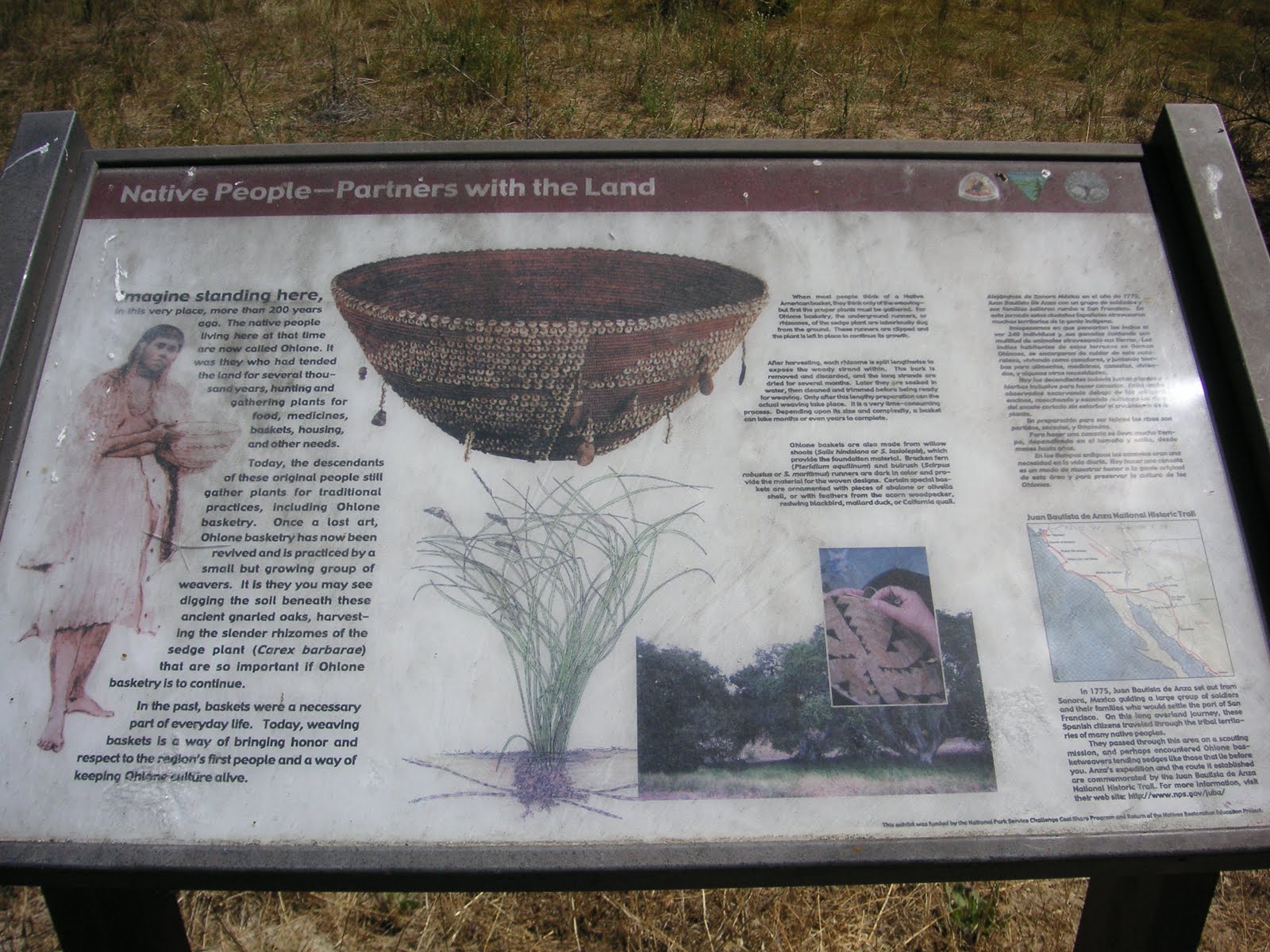
I normally stay away, far away, from sedge IDs. According to Calflora.org there are at least 292 members of the sedge family in CA alone, with 179 of those belonging to the genus Carex. Oh my! However, it helps to have a handy-dandy interpretive sign that identifies the Santa Barbara sedge I was seeing in the distance behind a fence. I was able to find more sedges to take close-up pictures without having to climb through fences or go off trail. Just to make sure, I checked the Monterey Bay Chapter CNPS Fort Ord plant list, which also names short-stemmed sedge (C. brevicaulis), round-fruited sedge (C. globosa), Monterey sedge (C. harfordii), sand dune sedge (C. pansa), clustered field sedge (C. praegracilis), and rusty sedge (C. subfusca). Luckily none of those look anything like Santa Barbara sedge, so I'm fairly sure of my C. barbarae ID. Since I have yet to figure out how to embed links to PDFs, here's an interesting google book view of California Riparian Systems with more information on indigenous sedge basketry. For additional references, check out a University of Michigan page I found. My main question from looking at sedges for the first time is: Are the brown things considered flowers or seeds?

Wednesday, August 4, 2010

habitat ~ 08/04/10 ~ Fort Ord - BLM InterGarrison

Fort Ord - Inter-Garrison entrance
August 4, 2010

posted 08/18/11 - I always like to save the last post for a day as a habitat post. It's a way for me to note that I've posted all I wanted for that hike and a way to headline a series of posts in the archives, say for all of August 4, 2010.


I'm wondering if I should start naming the different vernal pools at Fort Ord. There are so many and each seems to hold water differently through the seasons. The first picture above is of the same vernal pool from May 6, 2009. You can definitely see the difference in dryness from May to August, even though each year varies. Now I'm not positive, but I think the second picture above is the same vernal pool from May 8, 2010 and the second picture from March 20, 2011. Since it's likely the largest vernal pool at Fort Ord, it tends to stay greener longer than any of the others.


Again from May 8, 2010, I also posted a picture of mima mounds when the grass was considerably greener. Here you can see the mounds a little bit better, highlighted by the various dried grasses. The sticky monkeyflower has grown in between the coyote brush, a very typical late summer scene around these parts.

August is not my favorite time of year to hike, because it is so dry in so many places. I really don't like dried grasses, even though I know they're important, too. Incredibly, it's rarely blazing hot at Fort Ord, and it's a bit cooler at Inter-Garrison which is barely closer to the ocean than Creekside. The high marine layer is evident in the pictures above, casting a dark grey filter on everything. I am glad we went on the hike for the diversity we were able to see.

Wednesday, June 2, 2010

20 guesses!

Huckleberry Hill
June 2, 2010

I challenge anyone to provide the posted name for this odd contraption!
-
-
-
OK, I'll accept one guess. Here's the answer: Wildlife Guzzler. The name made me laugh; I pictured a group of deer kicking back with a case of beer and having a party. 550 gallons is a lot, isn't it?


Friday, June 26, 2009

cormorant, heron, egret ~ 06/26/09 ~ Heron Rookery Natural Preserve


I would imagine this is a North American birder's paradise. How could you not pass up the opportunity to see so many fantastic birds nesting? Other signs also indicated the snowy egret nested here, too. This rookery is within a 5 minute walk to the Morro Bay State Park Museum of Natural History. I am incredibly sad all these state parks are closing!!! Our friendly museum volunteer is in charge of some big birding shindig where people from around the world gather to observe the incredible bird diversity in Morro Bay. I signed up for her e-mail notice and will post here once I find out specifics for the event. She said they're having some difficulty figuring out alternatives to state park sites for their field trips.

double-crested cormorant
Phalacrocorax auritus

I find it fascinating these cormorants nest in trees versus the rocks of our Monterey area Brandt's cormorants. How do web feet cling onto tree branches?

great blue heron
Ardea herodias

Behind a church here in Monterey, there's a 3-year old nesting site for great blue herons. Whenever I visit my friend, I look out my sun roof to see if I can spot one of them in the nests. The nesting site is easy to spot because now most of the trees around the nests are dead.

great egret
Ardea alba

More often than not, signs do a much better job than I ever could at explaining things. Click on the photo above and you'll get a larger image for reading.