Considering this one greeted us with particular interest just a short ways down the path from the parking lot, I suspect it is accustomed to well-intentioned hikers offering tasty bits. I had never noticed before the cool blue stripes on Steller's jay foreheads. Usually, when I think of these jays, I recall how well they can mimic the sounds of other birds, like red-shouldered hawks. Once while we were camping down at Morro Bay, we were puzzled over the hawk sounds we heard repeatedly with no visual confirmation. Sure enough, the sound was coming from a Steller's jay hopping around a neighboring empty campground site. I wonder why they mimic?
Friday, March 4, 2011
common fiddleneck ~ 03/04/11 ~ Pinnacles
This is the first time I've taken an up close and personal look at fiddlenecks. Maybe it's the yellow or the spiny parts that makes me relatively adverse to this reasonably cute flower. Calflora lists 18 species and varieties of Amsinckia. Btw, what an awful genus name; sounds like "I'm sick of ya." For the record, I'm abandoning my usage of common names according to Jepson's that I started doing this year. Who the heck really calls this finger weed?
ps 04/05/14 - I updated the name from Amsinckia menziesii var. intermedia. There was a little bit of shuffling in the genus. I'm noting how skinny the whole plant is compared to what I consider A. menziesii. I really don't know how to tell them apart.
Annaphila depicta ~ 03/04/11 ~ Pinnacles
Annaphila depicta ssp. morula nectaring on Cardamine californica
Brassicaceae
When the first few Lepidoptera flew by me with their flashes of orange, I got excited believing I was seeing my first copper butterflies since returning to CA. Nope. It's a day flying moth! The official Pinnacles National Monument website is now including moths, instead of just butterflies. Great... except, as the PDF states, it's a work in progress. The only Annaphila they list is A. decia.
Here's a dirty little secret from my past life, I suck at identifying moths without a reference collection. So, I sent a picture to Chris Grinter of The Skeptical Moth this morning around 6:30am - gotta appreciate fellow bloggers who are up before the sun comes up. He promptly replied the following, "Love to see the moth photos. This is absolutely in the genus Annaphila (Noctuidae), and I'm comfortable calling it A. depicta. I could even take a stab at this being the subspecies 'morula' based on that pronounced brown bar on the forewing!" After comparing the very few photographs available online of Annaphila, I agree with his expert ID. Thank you, Chris!
I should mention these small moths were relatively abundant in what I affectionately term the "butterfly highway" at Pinnacles.
Plus, milkmaids were definitely the predominant blooming herbaceous perennials everywhere we hiked. Some looked more mustardy than milky. It looks like there are two varieties of C. californica (var. californica and var. cuneata) recorded from Pinnacles, but I wouldn't be able to tell you which is which or the difference.
ps - If you look closely at the second picture, there's a cute little beetle. Based on my other pictures of milkmaids, these beetles are quite abundant on this flower. However, I'm done with IDs for today.
pss 04/06/11 - Before I forget, Chris encouraged me to contact Paul Johnson of NPS. Paul and I had a couple of e-mail exchanges between March 6-9, 2011. He says he has 3 or 4 Annaphila on his Pinnacles moth list, but it's not updated and available to the public. Whether due to my e-mails or not, he did manage to catch a moth similar to the one shown above on March 7, 2011.
Here's a dirty little secret from my past life, I suck at identifying moths without a reference collection. So, I sent a picture to Chris Grinter of The Skeptical Moth this morning around 6:30am - gotta appreciate fellow bloggers who are up before the sun comes up. He promptly replied the following, "Love to see the moth photos. This is absolutely in the genus Annaphila (Noctuidae), and I'm comfortable calling it A. depicta. I could even take a stab at this being the subspecies 'morula' based on that pronounced brown bar on the forewing!" After comparing the very few photographs available online of Annaphila, I agree with his expert ID. Thank you, Chris!
I should mention these small moths were relatively abundant in what I affectionately term the "butterfly highway" at Pinnacles.
Plus, milkmaids were definitely the predominant blooming herbaceous perennials everywhere we hiked. Some looked more mustardy than milky. It looks like there are two varieties of C. californica (var. californica and var. cuneata) recorded from Pinnacles, but I wouldn't be able to tell you which is which or the difference.
ps - If you look closely at the second picture, there's a cute little beetle. Based on my other pictures of milkmaids, these beetles are quite abundant on this flower. However, I'm done with IDs for today.
pss 04/06/11 - Before I forget, Chris encouraged me to contact Paul Johnson of NPS. Paul and I had a couple of e-mail exchanges between March 6-9, 2011. He says he has 3 or 4 Annaphila on his Pinnacles moth list, but it's not updated and available to the public. Whether due to my e-mails or not, he did manage to catch a moth similar to the one shown above on March 7, 2011.
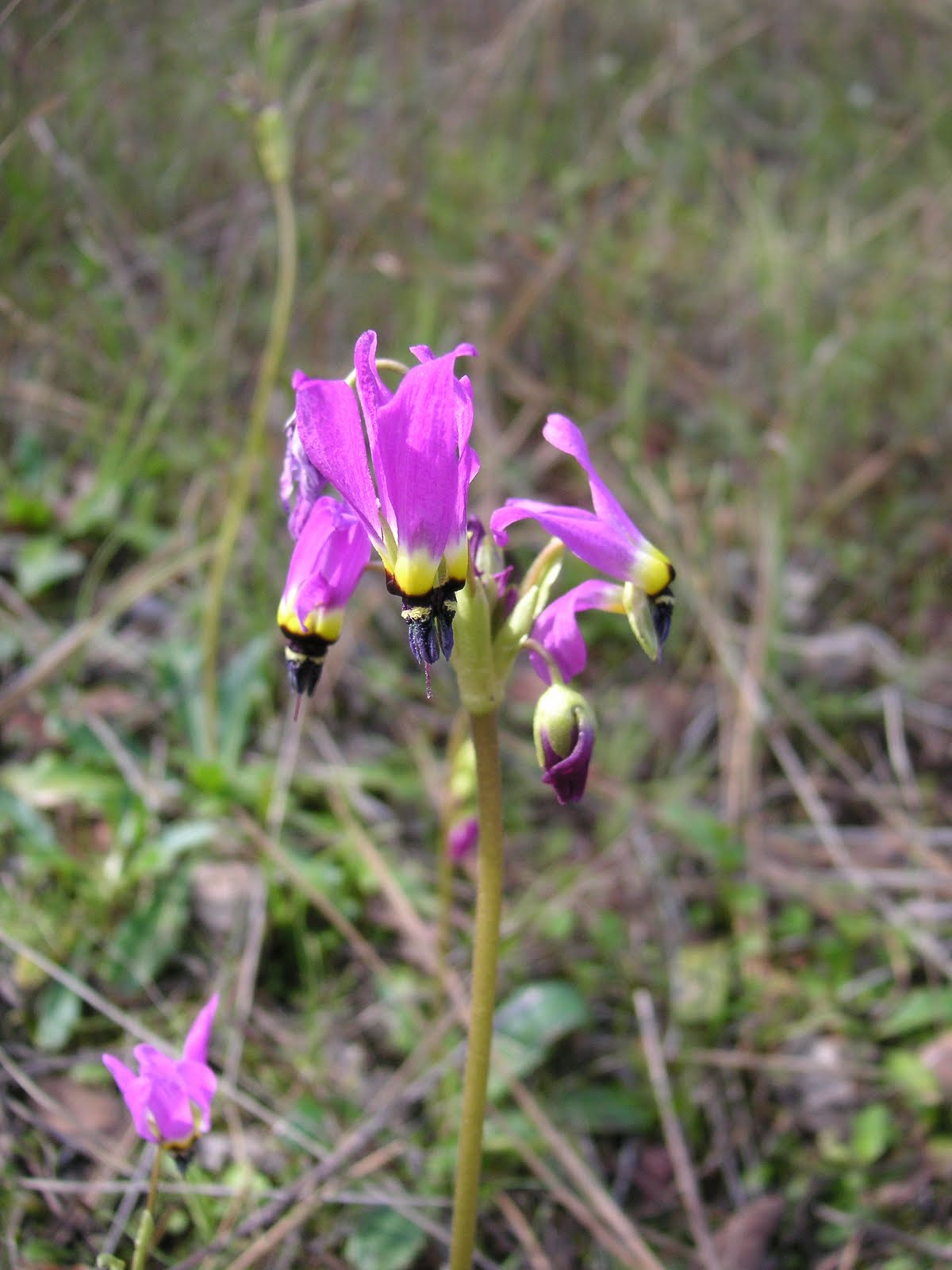
shootingstar ~ 03/04/11 ~ Pinnacles
I've spent an enjoyable evening looking up padre's shootingstars, which has four subspecies. I should mention that I'm starting to rely on location-based published plant lists for any particular flower ID, because I figure the folks who did the studies know a heck of a lot more than I do. Botanical descriptions and subspecies aside, these simply looked bolder and more intense than other shootingstars I've seen previously closer to home in Monterey County. Recently I read about a local seasoned botanist who distinguished species of wildflowers based on every smile. There's something to be said for familiarity and recognition, even with flowers, that is beyond words and fancy descriptors.