Thursday, January 19, 2012

sunrise ~ 01/19/12 ~ at home

sunrise from home
January 19, 2012

We had a lovely amount of rain off and on since Thursday ~4:15pm, the same day this sunrise picture was taken. By Friday night with help from the wind, our salty, ocean-mist covered windows finally had some cleaning. I really should park my car outside the garage so I can take advantage of nature's free car wash.

News, personal, and online stuff have been a bit... erm, different in the past week. I'd like to think I'm not the only one experiencing this. I've been wanting to update my indices and correct past blog posts, but blogger has been temperamental. Then, I'm still trying to find the right balance of what personal notes to share on Nature ID. Am I sharing enough to make a post interesting, or am I sharing too much (better known as TMI)? And, I won't even get started with the news.

Like the sunrise of a new day and like the declarations for a new year, it's comforting to believe starting fresh and new can actually happen. Here's a great time-lapse video of Yosemite to remind me and perhaps you, too, how the daily conditions of humans are truly insignificant compared to the larger picture: http://io9.com/5878091/this-time+lapse-video-of-yosemite-is-staggeringly-beautiful.

Monday, January 16, 2012

habitat ~ 01/16/12 ~ Garland Ranch - Garzas Creek

Garland Ranch Regional Park - Garzas Creek
January 16, 2012

posted 01/19/12 - I never thought I'd say this, but I need lots of rain to help pull me out of this year's winter doldrums. Sure, just about everyone else in the Northern Hemisphere would think this sunny warm weather we've had here on the CA coast is a blessing, but I'm feeling parched. Hopefully, we'll get some rain by this afternoon.

This was the biggest hill I've hiked in quite a while, and I'm still feeling some soreness in my thigh muscles. I'm fascinated that the slippery downhill was somehow more difficult than going uphill. I don't have many specific pictures to post, because the hike was its own reward for a change. I wanted to see Veeder Pond, which truthfully is actually a vernal pool. Compare how dry it is now to only 3 1/2 months ago on October 1, 2011. There's a fire tower on the highest hill in the first picture, and there's the Carmel Valley Village airstrip in the second picture, which was utilized as temporary housing for firefighters during the 2008 month-long Basin Complex Fire. In 2008 there were hundreds of fires across CA. I really hope we're not looking at another intense fire year for 2012. Most notable from our hike was an owl we saw fly right by us near the vernal pool. I also noticed dropped leaves on the ground from silver bush lupine, which I believe may be due to the lack of rain, and yellow blooms on CA bay.

Saturday, January 14, 2012

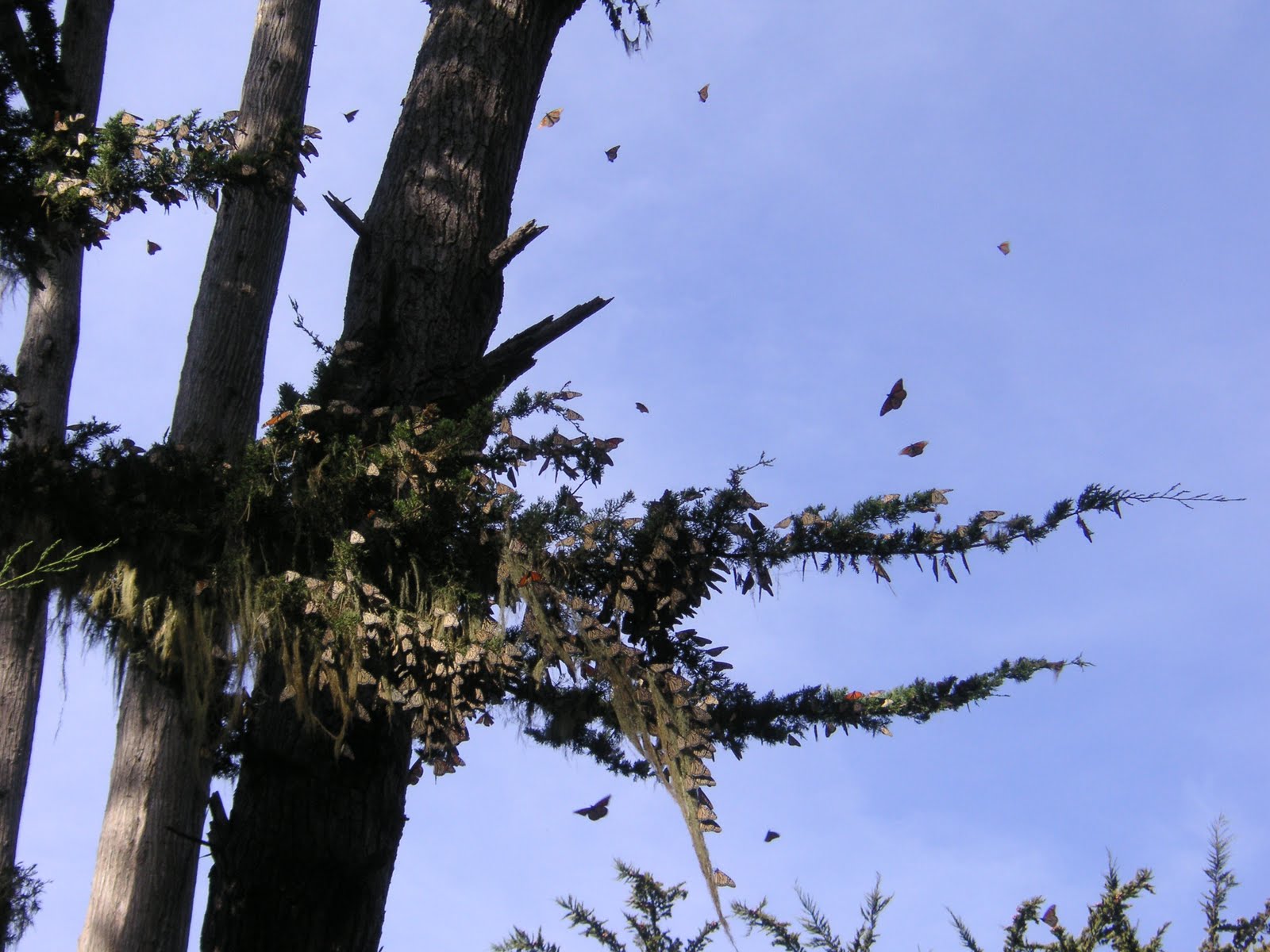
monarchs ~ 01/14/12 ~ Monarch Grove

monarch butterfly
Danaus plexippus

I don't like to repeat myself on Nature ID too often, but I felt these photos deserved the story they tell. On our way home from the movies (the new Sherlock Holmes film - I've been agog for all things Sherlock lately and have been thoroughly enjoying reading ACD's stories, too), we figured it was such a warm and sunny day that it might be a good time to check out the monarchs in our town's monarch park. We were quite surprised to see so many cars packed outside of the PG Adult School that we drove around to the lesser known access trail. Maybe it was the holiday weekend and the pleasant weather that brought out the visitors in droves?

Come to find out the monarchs are not clustering in the non-native eucalyptus trees in the sanctuary like they often do. Instead, they were primarily located in the neighboring motel yard. This is the first time I've seen monarchs clustered on native trees here in CA, like the Monterey cypress shown in the pictures above. This winter has been filled with a variety of local news and controversy about our overwintering monarchs. Last month, hundreds were found dead on the ground without abdomens and without any satisfactory explanation as to why. Then, there's been the continuing conflict of over-pruning the eucalyptus by the City to avoid another million dollar lawsuit, donors purchasing spendy eucalyptus trees to supplement the pruned trees, volunteers obtaining winter flowering plants, researchers pulling out plants placed by the volunteers, and tubs and tubs of plants purchased that now are left neglected and dying. Sheesh! The petty politics of this town sometimes gets me down. At the very least, it was great to see so many tourists simply enjoying the wonder of a wintering cluster of monarch butterflies.

blossom ~ 01/14/12 ~ Monarch Grove

blossom
Prunus sp.
Rosaceae

Blossoms in January!?! Since I started Nature ID in 2009, I have been attempting to be mindful that what I observe has its limitations, most likely based on my poor understanding of what is what, or based on when I am actually outside to observe whatever it is that strikes me as unusual, or based on my poor memory. When I first saw these blossoms, I kinda figured this year's mild winter weather must have something to do with it. Is it global warming? Maybe not. I remembered seeing a recent post by Marie at 66 Square Feet about cherry blossoms that are typical in New York City in December, a place that often gets decent snow in the winter (I've been there for work and have had flights cancelled due to too much snow, so I remember the weather well from first-hand experience). I have also commented on John at Sinbad and I on the Loose blog stating that I believe I'm noticing local flowers more this January simply because the weather is warm and I'm actually outside to see the beauty. So then, when I started writing this post and looked through my labels, I found I already have a couple posts of other ornamental blossoms in January. Hmph! Truth be told, blossoms could be about 10 days early this year, but I can't really say or proffer the cause. I now am aware that different species bloom months later like our neighbor's unidentified April blossoms, whereas our native cherry species blooms in June. It's been helpful to have the actual dated records on Nature ID to remind me of the seasonal changes, rather than relying on my fickle memory.

ps 02/11/12 - I originally posted this as cherry blossoms, but I looked at a post from last year by Katie of PhyteClub of Prunus cerasifera, commonly called a cherry plum. Ya! Now I'm confused. How can one tell the difference between cherries and plums when they're blossoming? A quick search online showed me that many other people are confused, too, even in Japan where spring blossoms are regularly celebrated. Some say look for a notch in the petals (notch = cherry, no notch = plum), the shape of the petals (oval = cherry, round = plum, or vice versa), the length of the blossom stem (long = cherry, short or none = plum), the timing of the blooms (late = cherry, early = plum), and all of these have exceptions because there are so many cultivated varieties and crosses. Erg. Two sites I found informative are Quirky Japan Blog and Japan-Guide.com.