Showing posts with label x: Monarch Grove Sanctuary. Show all posts

Saturday, January 14, 2012

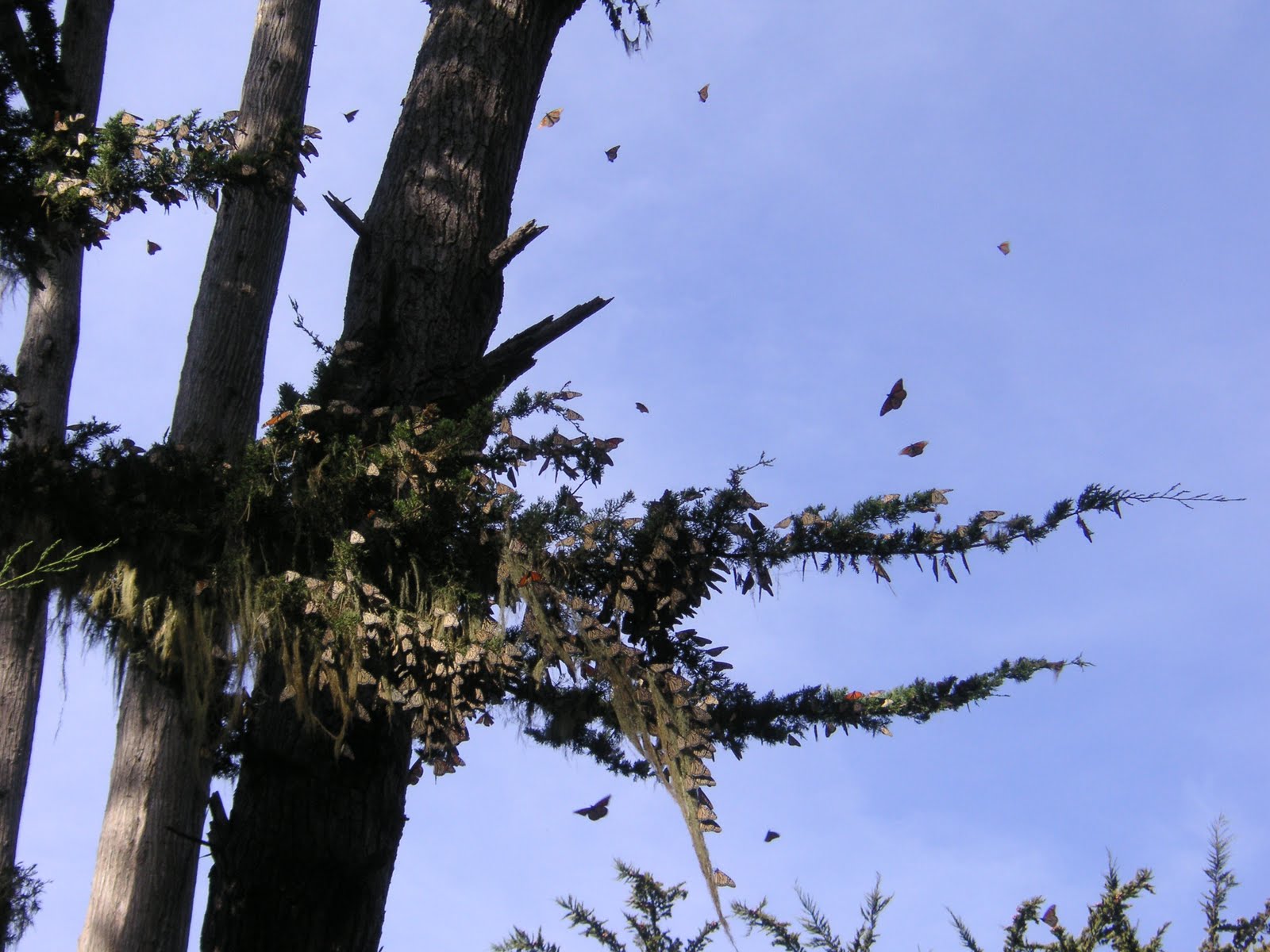
monarchs ~ 01/14/12 ~ Monarch Grove

monarch butterfly
Danaus plexippus

I don't like to repeat myself on Nature ID too often, but I felt these photos deserved the story they tell. On our way home from the movies (the new Sherlock Holmes film - I've been agog for all things Sherlock lately and have been thoroughly enjoying reading ACD's stories, too), we figured it was such a warm and sunny day that it might be a good time to check out the monarchs in our town's monarch park. We were quite surprised to see so many cars packed outside of the PG Adult School that we drove around to the lesser known access trail. Maybe it was the holiday weekend and the pleasant weather that brought out the visitors in droves?

Come to find out the monarchs are not clustering in the non-native eucalyptus trees in the sanctuary like they often do. Instead, they were primarily located in the neighboring motel yard. This is the first time I've seen monarchs clustered on native trees here in CA, like the Monterey cypress shown in the pictures above. This winter has been filled with a variety of local news and controversy about our overwintering monarchs. Last month, hundreds were found dead on the ground without abdomens and without any satisfactory explanation as to why. Then, there's been the continuing conflict of over-pruning the eucalyptus by the City to avoid another million dollar lawsuit, donors purchasing spendy eucalyptus trees to supplement the pruned trees, volunteers obtaining winter flowering plants, researchers pulling out plants placed by the volunteers, and tubs and tubs of plants purchased that now are left neglected and dying. Sheesh! The petty politics of this town sometimes gets me down. At the very least, it was great to see so many tourists simply enjoying the wonder of a wintering cluster of monarch butterflies.

blossom ~ 01/14/12 ~ Monarch Grove

blossom
Prunus sp.
Rosaceae

Blossoms in January!?! Since I started Nature ID in 2009, I have been attempting to be mindful that what I observe has its limitations, most likely based on my poor understanding of what is what, or based on when I am actually outside to observe whatever it is that strikes me as unusual, or based on my poor memory. When I first saw these blossoms, I kinda figured this year's mild winter weather must have something to do with it. Is it global warming? Maybe not. I remembered seeing a recent post by Marie at 66 Square Feet about cherry blossoms that are typical in New York City in December, a place that often gets decent snow in the winter (I've been there for work and have had flights cancelled due to too much snow, so I remember the weather well from first-hand experience). I have also commented on John at Sinbad and I on the Loose blog stating that I believe I'm noticing local flowers more this January simply because the weather is warm and I'm actually outside to see the beauty. So then, when I started writing this post and looked through my labels, I found I already have a couple posts of other ornamental blossoms in January. Hmph! Truth be told, blossoms could be about 10 days early this year, but I can't really say or proffer the cause. I now am aware that different species bloom months later like our neighbor's unidentified April blossoms, whereas our native cherry species blooms in June. It's been helpful to have the actual dated records on Nature ID to remind me of the seasonal changes, rather than relying on my fickle memory.

ps 02/11/12 - I originally posted this as cherry blossoms, but I looked at a post from last year by Katie of PhyteClub of Prunus cerasifera, commonly called a cherry plum. Ya! Now I'm confused. How can one tell the difference between cherries and plums when they're blossoming? A quick search online showed me that many other people are confused, too, even in Japan where spring blossoms are regularly celebrated. Some say look for a notch in the petals (notch = cherry, no notch = plum), the shape of the petals (oval = cherry, round = plum, or vice versa), the length of the blossom stem (long = cherry, short or none = plum), the timing of the blooms (late = cherry, early = plum), and all of these have exceptions because there are so many cultivated varieties and crosses. Erg. Two sites I found informative are Quirky Japan Blog and Japan-Guide.com.

Sunday, October 2, 2011

habitat ~ 10/02/11 ~ Monarch Grove Sanctuary


I don't have any pictures of monarchs here. We saw maybe 5, mostly clustered on one lone pride of Madeira bloom. We were told by the ever-active volunteer Tama O. that the majority of monarchs don't actually arrive until mid-November. Many tourists are a bit disappointed to see so few monarchs now, even though most everything about the Sanctuary states the butterflies start arriving by October. A lot has changed in the park since we last visited.

The pride and joy of Pacific Grove has been surrounded by death and controversy. Back in 2004, an elderly tourist was killed here by a tree that broke during a wind storm, hence the sign. My question is why would anyone go out looking for butterflies during a storm? The City settled a wrongful death lawsuit for $1 million. Since then, the City has done extensive tree removal and pruning, which raised the hackles of some monarch enthusiasts. Through private donations and some City funds, new trees were purchased and improvements made to this small 2.4 acre park. For more information about the Monarch Grove Sanctuary, check out the Pacific Grove Monarch Conservancy.

Thursday, December 17, 2009

in memoriam to Sonja

Danaus plexippus

Pacific Grove has two main sites where monarchs overwinter (out of an estimated 300 identified sites along California's Coast): the Monarch Grove Sanctuary and George Washington Park. The monarch count in the area is down again this year. I find it interesting that the Ventana Wildlife Society found the butterflies move between sites as much as 40 miles away throughout the winter.

By Valentine's Day (easy enough to remember), most of the monarchs will have mated and begin heading out of the area to lay eggs in the Central Valley. I like this map of monarch migrations in CA.

At some point, I'll have to post my Polaroid pics from 10 years ago when I raised almost 1000 monarch butterflies in my OH apartment. The trick was to prevent my 3 cats from playing with the adults. I hadn't meant to raise so many, but I didn't have the heart to throw away all the eggs... especially when many of the local nature centers had infection issues that killed off all their stock. I liked to call my bedroom the "butterfly love shack" - that was a fun summer!

ps 3/10/10 - I want to acknowledge my mentor Dr. Sonja Teraguchi. She shared with me the thrill of raising life, the importance of natural fluctuations, and the value of documenting my observations. Thanks to recent communications with Art and Renee, I've been reminded of her influence in my life and have especially missed her spirit and inspiration lately. Click on my lepidoptera label in memory of Sonja.